

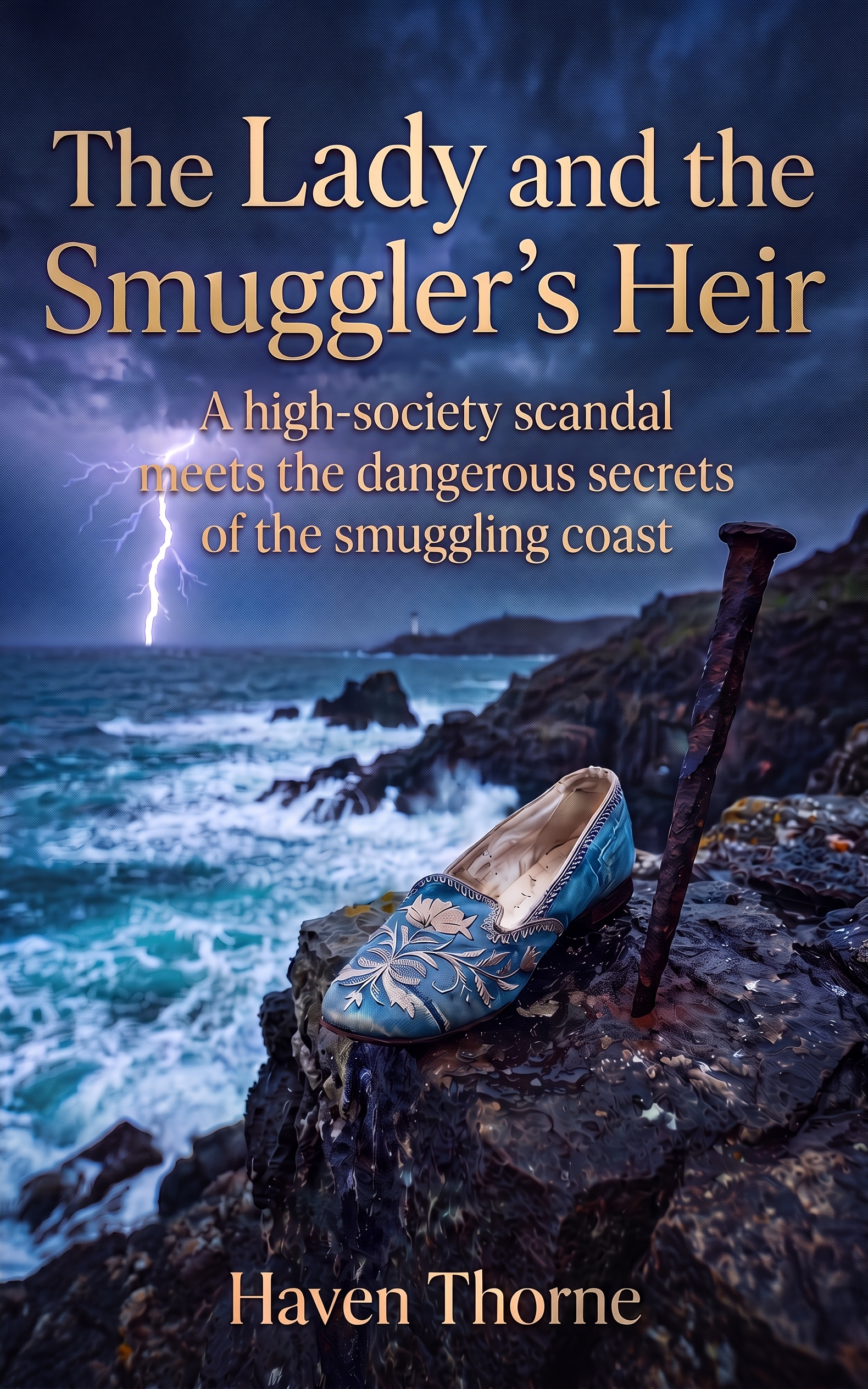
The Lady and the Smuggler's Heir
A high-society scandal meets the dangerous secrets of the smuggling coast
by H. Thorne
Lady Honoria Vale is no ordinary wallflower. While her peers hunt for husbands, she hunts for the funds to sustain a refuge for sailors' widows. But a midnight foray into a private library leads her to a far more dangerous discovery: Gabriel Rookesby, a man who enters through windows and carries the scent of salt air and secrets. Gabriel is the heir to a legacy of shadows, a man who knows the treacherous cliffs of the coast better than the ballrooms of London. When Honoria follows him into a web of treason and smuggled armaments, she finds herself trapped in an abandoned cottage during a fierce storm. In the heat of the night, the barriers of class and propriety vanish, replaced by a passion that threatens to consume them both. But Gabriel has been using Honoria as bait in a deadly game against a corrupt naval officer. As the truth emerges on the jagged cliffs, Honoria must decide if she can forgive the man who risked her life to save his honor. From the glittering lights of London to the wild, crashing waves of the sea, their love is a scandal waiting to break. In a world of rigid rules, sometimes the only way to find your harbor is to weather the storm.
- Romance
- Historical Fiction
- Historical Romance
- Regency
- Slow Burn Romance
A Gentleman at the Window
Music drifted through Killoran House in a series of elegant lies.
From the blue drawing room came a soprano’s clear, devotional rendering of an Italian air, all innocence and discipline, while beyond the open double doors footmen moved with trays of ratafia and negus, and women in pearl-grey and jonquil silk bent their heads together to exchange judgments under cover of applause. The chandeliers burned with so much wax and crystal that the room seemed to float in a pleasant golden haze. Every surface shone. Every voice softened itself to gentility. Every smile concealed an opinion sharp enough to draw blood.
Lady Honoria Vale smiled back at all of it with practiced ease.
“How very accomplished Miss Lascelles is,” she murmured to Mrs. Finch, though she had not attended to a note of the girl’s singing for the last five minutes.
Mrs. Finch, a widow with a nose for scandal and a purse forever opening and closing according to the attractiveness of a charitable cause, inclined her head. “Accomplished girls are everywhere this Season. Truly useful ones are not. You must remind me, Lady Honoria, of the date of your committee meeting.”
“I shall send a note in the morning.”
“You are goodness itself.”
Honoria gave the answer required of her. “Only busy, ma’am.”
Busy, and in danger of becoming desperate.
She let her expression remain serene while her thoughts returned, for perhaps the fiftieth time that evening, to ledgers, lists, and sums that refused to arrange themselves into possibility. Her scheme for a refuge and schoolroom for sailors’ widows in the East End had progressed too far to be abandoned and not nearly far enough to be secure. Rooms had been identified. Promises had been made. Two matrons had been sounded out. A physician had agreed to visit twice weekly at reduced cost. But promises, she had learned, were feathers unless tied to names and subscriptions.
Killoran House offered, tonight, an unusual concentration of both.
The Earl of Killoran’s sister had undertaken this musicale partly from taste and partly from policy; half the philanthropic and political world of London had been coaxed beneath her roof. There were ladies present who never subscribed under ten guineas if another lady was watching. There were gentlemen who gave with ostentation when a project could be made to sound practical, moral, and faintly patriotic. Somewhere in this great white-and-gold house there might be a list of past donations to maritime charities, and if Honoria could discover which names had given before, she could court them with precision rather than hope.
It was not, perhaps, entirely proper to go hunting through another hostess’s papers.
It was, however, considerably more proper than allowing twenty-four women and eleven children to continue in rooms where damp climbed the walls and a single fever could carry through the lot of them.
On the final trill of the song, the company applauded. Honoria applauded too, lowering her lashes in decorous admiration while she made her decision.
Now.
She waited through the first stir of movement that followed performance, when chairs scraped and gentlemen advanced to claim seats beside desirable women. Then she turned to Mrs. Finch with a look of apology so natural she scarcely felt she was acting.
“You must forgive me for two minutes. Lady Frances wished me to look at a volume of songs she has newly received from Vienna.”
“Do not let me keep you.”
Honoria inclined her head and glided away before any fresh claim might be laid upon her. She moved not quickly but with the measured pace of a woman who belonged wherever she chose to go. That was one of the first lessons drilled into girls of rank: hesitation invited inquiry. Certainty passed unnoticed.
The corridor outside the drawing room was cooler, less perfumed. The music softened behind her to a genteel murmur. Killoran House, for all its brilliance, had shadows enough beyond the entertaining rooms. Lamps burned in niches. Portraits looked down from dark paneling. A long runner muffled her steps.
She had been shown through the principal floor often enough to know the library lay toward the rear, past the morning room and a smaller saloon now empty of guests. If Lady Frances kept any account books in easy reach, they were likely there rather than in her brother’s study. The library served as the public heart of a house’s intelligence: books arranged to display taste, tables arranged to suggest rational leisure, and desks where hostesses kept those domestic papers that ought not stray far from the hand.
Honoria passed a pair of footmen speaking in low voices and received only a bow. Good. No one challenged her. No one ought.
At the library door she paused only long enough to listen. Silence. She slipped inside and gently closed it behind her.
The room smelled of leather bindings, banked coal, and beeswax. Two lamps had been left burning, one upon the mantel and one on a side table, so that the far reaches of the room retreated into amber gloom while the center remained warm with light. Glass-fronted bookcases climbed nearly to the ceiling. A globe stood near the windows. The great writing desk near the hearth held a tidy disorder of correspondence trays, a blotter, a sand shaker, and several neatly stacked memoranda.
Honoria released a breath.
She ought to be quick.
She crossed to the desk and put off her gloves finger by finger, laying them beside the blotter. Bare hands gave more certainty in dealing with papers. She opened the top tray first. Invitations. The second held callers’ cards and lists of seating arrangements. Useful to Lady Frances; useless to her. The third produced several folded circulars from charitable institutions, and her pulse quickened. She unfolded one. A subscription appeal for a seamen’s orphan school. Another for relief among fishing villages after a storm. Better. Better still.
She searched more carefully, sorting by candlelight with controlled fingers. A memorandum book tied in green ribbon. Several receipts. A half-sheet with names and amounts in a feminine hand. She bent nearer, reading.
Lady Beresford — twenty guineas. Mrs. Finch — five. Sir Thomas Blakely — ten. Admiral and Mrs. Vane — fifteen.
Exactly the sort of thing she needed.
She drew a small pencil from the reticule at her wrist and opened the little ivory tablets she carried for notes. If she copied quickly, no one need be the wiser.
Outside, somewhere in the depths of the house, a clock began to strike midnight.
She frowned faintly. Had it grown so late? The musicale had lengthened into supper and fresh performances more than she had realized. There would be a press of cloaks before long. She must be swift.
Twelve strokes, solemn and sonorous, rolled through the house. At the seventh, she had copied three names. At the tenth, she had reached for the next sheet. At the twelfth, a hard sound came from the far side of the room.
Not the door.
The window.
Honoria went still.
For one instant she told herself it was only the branch of a tree against the pane, though she knew very well no tree grew so near the library windows. Then came the unmistakable scrape of a sash lifted from below, followed by the soft but substantial thud of a man dropping inside.
Cold raced over her skin.
She turned.
A figure straightened from the darkness at the long window overlooking the rear terrace. He moved with the swift economy of someone accustomed to entering places where he was not expected. Moonlight silvered one shoulder before lamplight caught him fully: a tall man in evening clothes that had seen rougher handling than any ballroom approved, black coat close over a broad frame, linen no longer immaculate, dark hair wind-tossed, one gloved hand braced on the sill. His face was not that of a housebreaker from a penny broadside. It was worse. Intelligent. Hard. Arresting.
For the space of a heartbeat they stared at one another.
Then Honoria snatched up the nearest object to hand, which proved to be a heavy brass letter opener mounted on a stand, and held it before her with what dignity she could. “Do not move.”
The command emerged low and clear, not shrill. She was absurdly proud of that.
The stranger’s gaze dropped to the improvised weapon and returned to her face. His own expression altered by a degree so slight another woman might have missed it. Amusement, perhaps. Or surprise.
“I beg your pardon,” he said.
His voice was deep, perfectly controlled, and carried not the least tinge of alarm.
“You entered through a window after midnight,” Honoria said. “I do not think my pardon is the point at issue.”
“No.” His eyes, dark and keen beneath level brows, took her in with disconcerting thoroughness: the evening gown of pale lilac silk, the loosened tendril of hair at her temple, the note tablets in her open hand. “It appears we are both engaged in occupations requiring discretion.”
Heat sprang to her cheeks, infuriatingly. “Mine does not include breaking into other people’s houses.”
“Then you have the advantage of me.”
He left the window and took one step toward the desk.
Honoria lifted the letter opener higher. “I told you not to move.”
“And I heard you.”
“Then either your hearing or your manners are defective.”
At that, the corner of his mouth shifted. Not a smile, exactly. Something more dangerous, because it suggested he could smile if he chose and rarely did.
“My manners,” he said, “have often been accused.”
“Stay where you are, sir, or I shall ring.”
She cast a glance toward the bell pull beside the mantel. The movement was slight, but he saw it.
“If you ring,” he said quietly, “you will summon half the household and likely a number of guests still wakeful enough to enjoy a scandal.”
“That would be inconvenient for you.”
“For both of us.”
Her fingers tightened around the brass. “I have nothing to fear from scrutiny.”
He looked, just for a moment, at the papers spread before her and the pencil lying beside her reticule. “No?”
The insolence of him. Honoria drew herself up. “If I am called to account, I shall say I was seeking Lady Frances.”
“In the library. Alone. At midnight.”
“I doubt your concern for my reputation is sincere.”
“It need not be sincere to be accurate.”
The answer landed because it was true, and because he spoke it without mockery. Honoria’s pulse beat annoyingly fast. She hated that he had shifted the ground beneath her so neatly. She hated more that she had noticed the breadth of his shoulders when he moved, the startling grace with which so large a man crossed a room, and the worn line of a pale scar disappearing beneath his jaw into his collar.
He was not a gentleman in the drawing-room sense, whatever his coat and accent claimed. No drawing-room gentleman entered by climbing over a terrace wall. Yet no common intruder stood so carelessly before her either, as if danger were an element in which he naturally breathed.
“Who are you?” she asked.
He did not answer at once. “Who asks?”
“Lady Honoria Vale.”
Something changed in his face then. Recognition. Or calculation. “Ah.”
She disliked being met with ah. “And you?”
“Gabriel Rookesby.”
The name was not wholly unknown. She had heard it once or twice in company, spoken by men who lowered their voices afterward, as if the syllables carried interests not fit for general discussion. No title attached itself to him. No place. Merely Rookesby, with an odd little pause before and after, like the passing of a sealed note.
“I do not know you, Mr. Rookesby.”
“No.”
“Yet you seem astonishingly at ease in a nobleman’s library.”
“Appearances mislead.”
“Not in this case, I think.”
She shifted to put more of the desk between them. He noticed that too, and a flicker of something sharpened in his gaze.
“I am not going to harm you, Lady Honoria.”
“Most women are asked to accept that assurance on inferior evidence.”
He inclined his head, acknowledging the thrust as if she had scored a point in a fencing match. “Fairly said.”
A silence fell. In the drawing room, far away now, another song began, muffled by distance and walls. Here the fire whispered and the open window admitted a blade of night air. Honoria became acutely aware of every detail: her own breathing, the coolness on her bare hands, the faint scent of rain clinging to his coat, the relentless fact of being alone with a stranger.
And not merely alone. Seen.
Seen with her gloves off and another woman’s papers open before her.
He glanced again at the sheets she had been copying. “If those are the donor lists you were after, the names at the bottom matter less than the names at the top.”
The words escaped him so naturally she nearly answered before caution checked her. “You know what I was seeking?”
“You are not interested in music, and those are charitable subscriptions.”
“You seem very well informed for a burglar.”
He ignored that. “Mrs. Finch gives when publicly thanked. Admiral Vane gives if one can persuade him the enterprise assists naval families rather than merely the poor. Sir Thomas Blakely gives to anything with a committee because he likes committees. Lady Beresford gives if another woman of rank has given first, and not before.”
Honoria stared at him.
He met her stare evenly. “Would you like the rest?”
She should not have. She certainly should not have said, “How do you know any of that?”
But she did.
Instead of answering, he moved his attention to the memorandum book tied in green ribbon. “That one will have private pledges. The left page for names, the right for amounts. Lady Frances is methodical.”
He had not yet come nearer, and still she felt as if he had stepped too close. “You speak as though you have searched this desk before.”
“Not this desk.”
It was somehow the more alarming reply.
Honoria set the letter opener down only long enough to close the memorandum book and place her hand over it. “Whatever your purpose here, Mr. Rookesby, you shall not accomplish it by making me your accomplice.”
His eyes dropped to her hand. Strong fingers, unadorned save for one narrow ring. The lamp gilded the fine bones of her wrist. When his gaze returned to her face, his voice was lower.
“I had no wish to involve you.”
“Then your wishes and your actions are ill-matched.”
Again that almost-smile. “Frequently.”
The admission should have disarmed him. Instead it made him more interesting, which was intolerable.
A board creaked in the corridor outside.
Both of them turned toward the door.
Honoria’s heart climbed into her throat. If anyone entered now—
The handle moved.
Gabriel crossed the distance between one breath and the next. He did not seize her; he caught her wrist with a swift, firm hand and drew her sideways, placing himself between her and the window in the same motion. The contact burned through her skin. She ought to have cried out. She ought to have struck him. But the shock of his grip—warm, controlled, devastatingly sure—stole action from her for the briefest instant.
The door opened.
A man stood on the threshold, lantern light from the hall outlining a lean frame and a head of dark red hair. His gaze took in the room in one comprehensive sweep: Honoria flushed and barehanded beside the desk, Gabriel half-turned before her, papers scattered, window ajar.
For one charged moment no one spoke.
Then the newcomer shut the door behind him and said, very softly, “Christ, Gabriel. Could you not come by means of a door for once?”
Honoria looked from one man to the other. “You know him.”
The red-haired gentleman gave her a bow so smooth it would have suited a ballroom, though his eyes were alert with calculation. “Ewan MacRae, at your service, my lady. And yes. I know him entirely too well.”
Gabriel released her wrist at once.
The loss of contact felt as abrupt as the touch had. Honoria drew her hand back to her side and curled her fingers into her palm, angry with herself for noticing.
“Then perhaps,” she said to Mr. MacRae, “you will explain why your acquaintance is climbing through windows at Killoran House.”
MacRae’s mouth twitched. “A habit of his. A deplorable one.”
“MacRae,” Gabriel said.
“Yes, yes.” MacRae came farther into the room, his expression sobering as he addressed Honoria. “Mr. Rookesby is no threat to you, Lady Honoria. He is a trusted friend of the family.”
“By whose testimony?”
“Mine, for what little that is worth after such an entrance. And Killoran’s, if he were here to give it. Gabriel has business in this house tonight.”
“Business?” Honoria repeated. “At the desk?”
She saw MacRae weigh his answer and reject candor. “A private matter.”
“How convenient.”
“It is also true.”
Honoria turned her gaze on Gabriel. “You searched this desk for a private matter, and I am to accept that on trust?”
His expression did not change. “No. You are merely asked not to raise the house.”
The calm in him exasperated her. “You ask a great deal of women, Mr. Rookesby.”
“I know.”
The reply was so stripped of ornament that she felt it under her ribs. Not flippant. Not proud. Merely factual, and perhaps tired. It did not soften her. It made her more cautious.
MacRae stepped nearer the hearth, lowering his voice. “My lady, if this scene were discovered, the inconvenience would indeed not be confined to Gabriel. You deserve better than to be found in a locked room after midnight with two men and an open desk.”
Honoria went still. “The door was not locked.”
“No,” MacRae said. “But nuance rarely survives a gossip’s retelling.”
There it was at last, plain and ugly as a knife: the real risk. A lady’s explanation, however innocent, would be measured against appearances and found wanting. Men strayed, searched, climbed, gambled, lied, and survived. Women were merely seen and paid.
The fury that rose in her was cold. She looked at the desk, at her own little tablets half-filled with copied names, at the broad hand Gabriel had rested a moment before on the polished wood as if he had every right.
“What precisely,” she said, each word distinct, “were you seeking?”
Neither man answered.
MacRae’s silence was apologetic. Gabriel’s was implacable.
Honoria laughed once, without mirth. “Then your trusted friendship is of a singular kind. Enough to protect him, not enough to satisfy me.”
“Lady Honoria—” MacRae began.
“No. If I must preserve Mr. Rookesby from the consequences of his own conduct, I think I may at least be spared soothing falsehoods.”
Gabriel spoke then. “MacRae need not lie for me.”
“Yet you will not tell me the truth.”
“No.”
The bluntness of it struck sparks. She should have despised him wholly. It would have been easier if he had offered some polished absurdity about lost cufflinks or mistaken windows. Instead he gave her the discourtesy of honesty in one thing and concealment in all others.
She found, to her annoyance, that she respected it a little.
Only a little.
Beyond the walls of the library, laughter floated faintly from a distant corridor. The house had not gone to bed after all. Time pressed around them. If she delayed longer, absence would be remarked.
MacRae seemed to understand her thought. “If you permit it, my lady, I shall escort you back to the drawing room by the east passage. Fewer guests.”
“And leave Mr. Rookesby to his private business?”
Gabriel answered before MacRae could. “No. I am finished.”
The words carried an undercurrent she could not read. Finished because he had found what he wanted? Finished because she had interrupted him? Finished, perhaps, in some larger sense she had no business imagining.
Honoria looked at him fully for the first time since MacRae’s arrival. The lamp showed a face made more compelling by severity rather than less: strong nose, unsmiling mouth, eyes too watchful for ease. There was danger in him, yes, but not the theatrical danger of cads and rakes who cultivated notoriety for sport. This was something harder, forged rather than chosen. A man who had learned to move through shadows because daylight did not always welcome him.
And beneath that thought came another, absurd and wholly unwelcome: how those hands might feel if they touched a woman with deliberation rather than necessity.
Heat moved low through her body, so sudden she nearly despised herself. She had been in the room with him scarcely ten minutes. He was impertinent, secretive, and arrived like a thief. Yet her skin still held the memory of his grasp at her wrist with humiliating clarity.
She bent to retrieve her gloves, buying a moment. “How fortunate,” she said coolly, “that all parties may now resume respectability.”
MacRae coughed into his fist, perhaps to hide a smile. Gabriel did not smile at all.
Honoria drew on one glove, then the other, each finger settling like armor. She slipped the ivory tablets back into her reticule but left the copied page where it lay, then reconsidered and tucked it away after all. If she had compromised herself for these names, she would not go empty-handed.
Gabriel’s glance fell to the movement. “You missed two at the bottom.”
She looked up sharply.
His mouth remained set, but there was a glint in his eyes now, dark and elusive. “Mrs. Anstruther, three guineas. Lord Severn, twenty.”
MacRae stared at him. “Are you helping?”
“I dislike inaccuracies.”
Honoria held his gaze for a suspended second. “How conscientious of you.”
“Only occasionally.”
She ought not to have answered in kind. “Then I shall mark the date.”
Something passed between them then, slight as the brush of silk over skin and no less palpable. Wit on the surface. Something more dangerous beneath. He knew it; she knew it. MacRae, if his sidelong look signified anything, knew it too and wished fervently to be elsewhere.
Honoria broke the moment first. “Mr. MacRae, if you please.”
MacRae opened the door and offered his arm. She took it with composure restored, or so she hoped. At the threshold she paused and turned.
Gabriel had moved back toward the window, though he no longer seemed poised for escape. One hand rested on the sash. Night lay beyond him in a wash of silver over the terrace stones. He looked as if he belonged there more than in any chandeliered room in London.
“You have my silence for tonight, Mr. Rookesby,” she said. “Do not mistake it for confidence.”
“No,” he said. “I would not dare.”
The answer should have satisfied her. Instead it left a strange pull in her chest, as if the scene had not ended but merely changed shape.
She inclined her head with all the stately frost of Lady Honoria Vale and allowed MacRae to guide her into the corridor. The door closed behind them.
As they moved toward the distant glow and music of the assembled company, she kept her face serene for any servant they might pass. But inwardly she was in no serenity at all. She had gone in search of donor lists and found a man climbing through windows with shadows in his eyes and secrets in his hands. Worse, she had found herself looking back.
By the time the drawing room doors came into view and applause swelled once more to meet them, Honoria knew two things with unwelcome certainty: Gabriel Rookesby was dangerous, and she wanted very much to know what he had been doing at that desk.
Terms of Alliance
Lady Honoria Vale did not return to the drawing room in ignorance.She returned with her pulse still touched by alarm, her wrist still remembering the hard warmth of Gabriel Rookesby’s hand, and her mind sharpened by the certainty that whatever business had brought him through the library window would not bear daylight. That alone ought to have cure…