

THE SPRINTER LEADER
Sprint When Everything Disrupt
The market just flipped. Your team is looking at you. And you have thirty seconds to decide whether you freeze or move. Most leadership books assume you have time. The Sprinter Leader assumes you do not. This is an operating system for leaders who face rapid volatility, sudden crises, and personal depletion—and need a framework that works before the window closes. Built across eight core capacities called Sprints—Self Mastery, People Skills, Resilience, Influence, Need to Learn, Time Genius, Execution, and Ready for Challenge—the book gives you 72 cognitive frames and 72 practical tools to regulate pressure, communicate with clarity, and execute under disruption. Each chapter opens with a real-world case study of a leader who collapsed at exactly the wrong moment. Then it teaches you the architecture that would have caught them. From grounding yourself when panic sets in, to cannibalizing your own cash cows before the market does it for you, every page is built for decisive action. This is not theory. This is what you need when the heat is on. The Sprinter Leader: Because the people who move fastest are the ones who survive.
- Business & Entrepreneurship
- Self-Help
- Management & Leadership
- Corporate Leadership
- Business Strategy
- Personal Leadership
SELF MASTERY
P
R
I
N
T
E
R
SPRINT
01

Governing the instrument everything else is delivered through.
he last person who tried to warn Ali resigned eleven days later.
T
Her name was Alyaa. She had been his operations director for six years, she was the best hire he had ever made, and on a Tuesday afternoon in a room with four other people in it he told her that if she could not solve a problem this simple then he would find somebody who could.
He did not shout. He has never shouted. He said it quietly, and that was worse, and everybody in the room looked at the table.
He apologised the next morning. She accepted the apology. Eleven days later she gave him a letter, and when he asked her, honestly baffled, why she was leaving a company she had helped build, she said something he has repeated to me many times since.
It is not the Tuesday. It is that I never know which version of you is going to be in the room.
Here is what was happening to Ali that year, and notice how ordinary it is, because almost nothing in it is unusual.
He had spent fourteen years building a distribution business. Two hundred and forty people. It had worked, and then a client that represented a third of his revenue was acquired by a larger group, and the larger group had its own supplier, and in one phone call in March a third of Ali's business acquired an expiry date of December.
Nobody had done anything wrong. That was almost the hardest part. There was no villain and nothing to fight, only a number that would arrive at the end of the year whether or not he was ready for it.
And from March onward, Ali came apart in two specific ways.
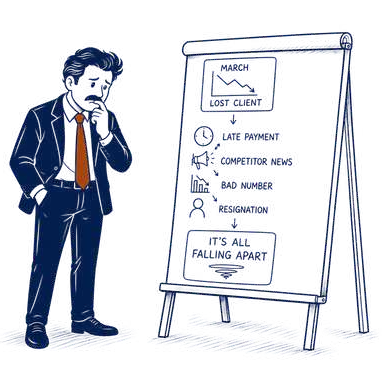
 The first was that every piece of news became evidence of the end. A late payment was not a late payment; it was the beginning of the collapse. A competitor's press release was not marketing; it was proof they knew something he did not. He was reading the world through one lens, and the lens said: it is over, and you are the man who let it happen.
 The second was that his days stopped having any shape. He had never needed structure before, because energy and instinct had always been enough. Now he arrived without a plan and left without one, answering whatever arrived, at eleven at night and at six in the morning, in no order and to no purpose. He was busier than he had ever been and could not have told you what he had done that week.
By August he was sleeping perhaps four hours. By September his wife had stopped asking how the day had gone, because the answer had become a mood rather than an answer. And in October his daughter, who was fifteen, said something to him in a car that he has never repeated to anybody except me, and that I will not print, and which he describes as the worst thing anybody has ever said to him and completely fair.
The client was going to leave in December no matter what Ali did. Everything else that happened that year, he did himself.
Ali did not lack intelligence, effort or commercial skill. He had built something real from nothing and he knew his market completely. What he lacked was any trained capacity to govern his own interior when the pressure came, and so the pressure came and governed it for him.
That is not a character flaw. It is a gap, and it is the gap almost none of us were trained to close.
Think about what we teach leaders.
Negotiation, finance, strategy, whatever software is current. We promote for technical brilliance and results, and we spend the entire development budget on the outer game, the part that fits on a curriculum vitae.
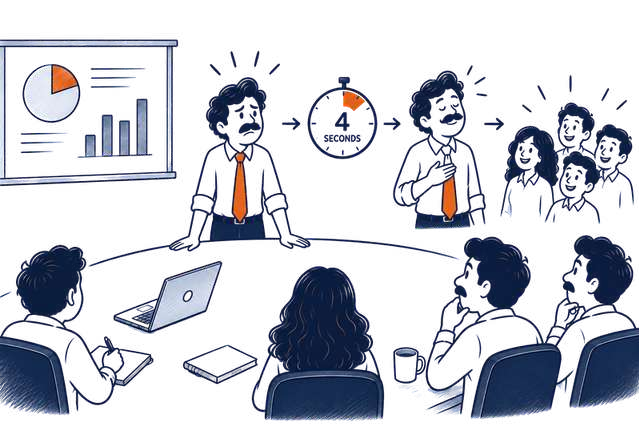
Nobody teaches a rising executive how to read a bad number without catastrophising it. Nobody teaches them to build a day that holds when they feel terrible. Nobody teaches them what to do in the four seconds before they say the sentence that costs them their best person.
The world can take back everything it trained you in. It cannot touch the part you neglected, which is why the part you neglected is now the only durable asset you own.
And under disruption this Sprint is not one capacity among eight. It is the multiplier on the other seven.
 The ground moving does not reach you directly. What reaches you is your reading of it, and everything you then do is executed through an instrument that is either steady or is not. A leader with poor Self Mastery under disruption does not have one problem. They have every problem, magnified, because each arrives through a distorted lens, is met by a person with no structures underneath them, and is answered in the four seconds when the alarm is holding the pen.
The costs have a shape you can recognise, and Ali is the demonstration.
Every later event gets read through the first one. He lost a client in March, and from March onward a late payment
was no longer a late payment. It was confirmation.
Once the lens tilts, disruption stops arriving as separate events and starts arriving as a single accumulating verdict, which nobody can act against.
The good-news version is acting the same way which surprises people..
The leader handed a market they are not yet ready for reads every early stumble as evidence they were the wrong choice. Same distorted lens, same three challenges, wearing a promotion.
Each Sprint runs on three Tracks, which are not three topics but three layers sitting inside one another.
Each Track carries three frames and three tools, paired.
Every frame has one tool attached, and the pairing is deliberate the frame is the diagnosis, the tool is the treatment. Each is numbered so you can find it again. [F1.2.3] is Sprint One, Track Two, third frame. The tool that answers it is [T1.2.3].
The three Tracks of this Sprint are exactly the three ways Ali came apart. How you think. What you repeat. How you steady yourself.
Everything visible about a steady leader was built somewhere nobody could see.
 Mindset Shift
The lens you read the disruption through
In the late 1930s a young mechanic in Hamamatsu made a set of piston rings and took them to Toyota. Toyota rejected them.
Read the facts and nothing else. A supplier submitted a part. The part did not meet the standard. That is the whole event.
Two meanings fit those facts exactly.
The first is a verdict about the man. I am not good enough for this industry, and people like me do not supply companies like that. That meaning produces a recognisable feeling, and the feeling produces a response, which is to stop and to call stopping realism.
The second is information about a gap. I do not understand metallurgy well enough yet. Soichiro Honda took that one. He went back to study, sat with people who knew what he did not, and came back later with rings that were accepted.Notice what did not change. The rejection was identical under both readings. Nobody at Toyota behaved differently depending on which meaning he chose. The entire distance between those two futures sat in a step that took a few seconds, that nobody asked him to say out loud, and that he could have skipped without ever knowing he had made it.
That is the gap. You are in it several times a week, and the reason it does not feel like a decision is that it never announces itself as one.
Two leaders lose the same client on the same day.
The first concludes that the market has turned, that the company is in decline, and that he has been found out.
The second concludes that a client with changing needs has gone elsewhere, that three competitors are probably facing the same shift, and that he now has a reason to build the thing he has been postponing for two years.
Same event. Same information. Two different companies twelve months later. Nothing separated them except what happened in the seconds between the phone call and the interpretation, and that is the most consequential real estate a leader owns.
Three frames, and each does a different job.
Three frames
Shows you where your power sits.
The Meaning Gap
Tells you what move to make there.
The Threat & Opportunity
Switch
Tells you how high you are operating across years. Where, what, how high.
The Three Altitudes
The Meaning Gap
Most people experience life as a straight line. Something happens, and they react. It feels instant and inevitable. Of course I panicked; the situation was frightening.
That line is an illusion, and the illusion is expensive.
Between what happens and what you do there is a gap, and inside it, faster than you can notice, your mind assigns a meaning. The meaning creates the emotion. The emotion drives the response. Four steps, not two, and only the first was outside your control.
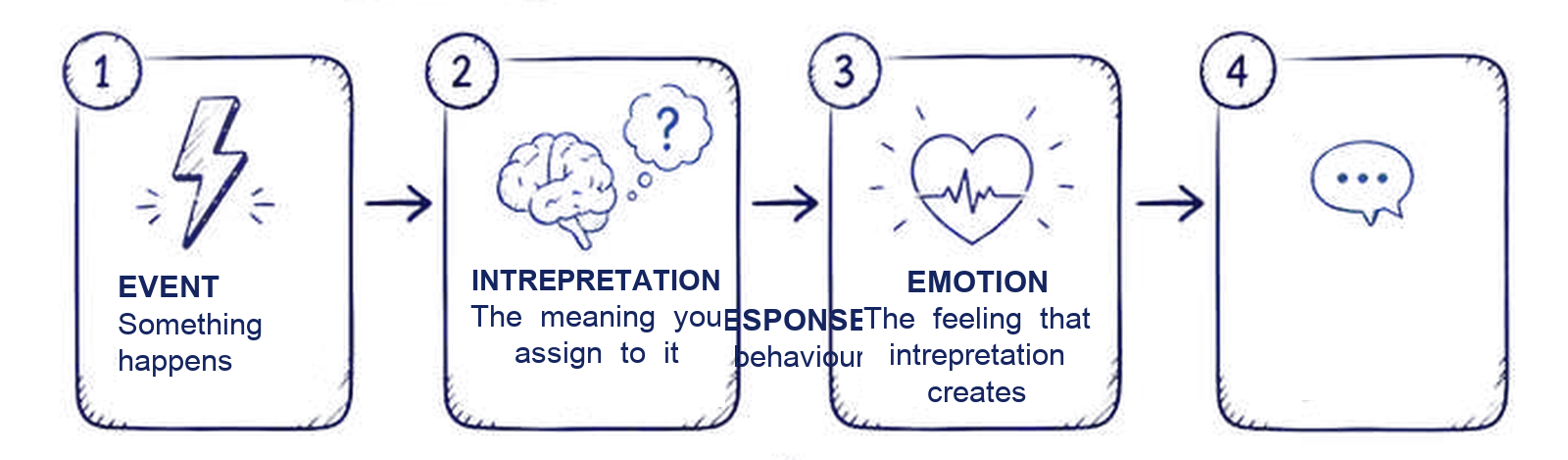
Between every event and your response sits a gap, and that gap is where your power lives.
Viktor Frankl, who survived the Nazi camps and built a school of psychology from what he learned there, located human freedom in that space. Everything else had been taken from the people around him. That could not be.
It is not only philosophy. Richard Lazarus spent decades showing that stress is not produced by events but by our appraisal of them is this a threat, and can I handle it. Change the appraisal and the entire stress response changes, with the event untouched. Albert Ellis built a therapy used worldwide on the same insight. We blame the event. The leverage was always in the belief sitting behind it.
Ali's gap was slammed shut from March. The client leaving was the event. You are the man who let it happen was the story. He spent seven months reacting to the second as though it were the first.
Notice what the frame has done..
It has not solved anything. It has shown you that there is a room you did not know you were standing in, and that the room has a door. The tool is how you open it.
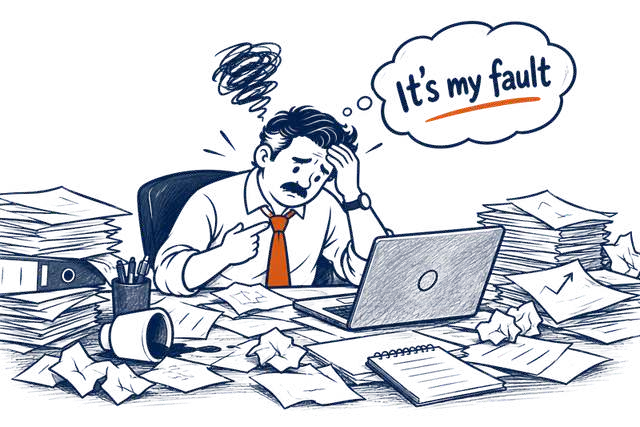
The Story Audit
R
TOOL
- THE EVENT JUST THE FACTS
Write what actually happened, stripped of all interpretation.
- THE AUTOMATIC STORY
Now write the meaning your mind assigned in the gap, honestly and in full: “This proves I’m losing my edge. We’re in decline.”
- THE EVIDENCE TEST
Cross-examine the story like a lawyer.
- THE TRUER STORY
Write an interpretation that is equally consistent with the facts but more useful: “A client reallocated spend.”
- THE UNLOCKED MOVE
Name one action the truer story makes possible that the automatic story did not.
Use it when You have been knocked off balance and you notice you are certain about what it means.
Takes Twenty minutes, on paper, within a day of the event.
You're done when You have named one action the truer story makes possible that the automatic story did not.
Five moves, on paper, within a day of being knocked off balance. Separate the facts from the story, cross-examine the story the way a hostile lawyer would, write a truer one, then name the action the truer story makes possible and the old one did not.
The Threat & Opportunity Switch
The Meaning Gap tells you where the power is. It does not tell you what to do once you are standing there.
Disruption always arrives wearing the mask of a threat. It has to, because your alarm system is older than the modern world and cannot distinguish a predator from a quarterly miss. Threat mode narrows your vision, shortens your horizon, and makes you defensive at exactly the moment you need to be inventive.The move is to reach past the mask.
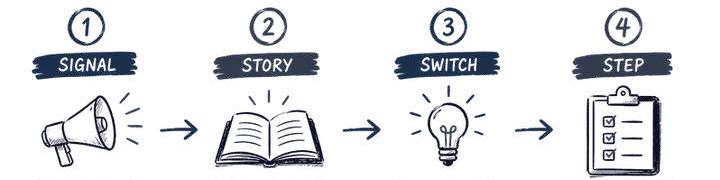
Catch the threat story, flip it, and act on what was behind it.
This is one of the best-evidenced ideas in psychology, under the name cognitive reappraisal. James Gross at Stanford has shown across decades that of the two ways people handle difficult emotions, suppression and reappraisal, reappraisal wins on nearly every measure. Suppressors perform worse, remember less, and do not feel better; they hide it while it burns. And you can watch reappraisal happen in a scanner amygdala activity falls, prefrontal activity rises. It is the thinking brain taking the wheel back from the alarm.
When Ali eventually ran this on the client loss, what came back was not comforting. His threat reading was that he had built a company on one relationship and was about to be exposed. His opportunity reading, from identical facts, was that he had built a company on one relationship and had just been given nine months' notice and a reason to fix it. Harder to sit with, and the only one with a next step in it.
Under pressure nobody performs this in their head, because the head is exactly what the surge has borrowed.
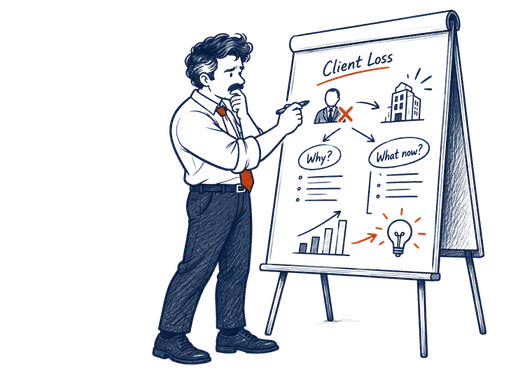 There is a second reason for paper, and it is the one leaders resist. Written down, the threat reading loses most of its authority.
Sentences that feel like observation while they are circling in your mind look noticeably thinner on a page, and several of them will not survive being read back. That deflation is the mechanism, and you cannot get it any other way.
The Reframe Matrix
Name the disruption factually. Write the threat reading in full and uncensored, because you cannot flip what you have not stated. Then run the switch questions and finish with one action you will take this week.
AM
TOOL
- NAME THE DISRUPTION
in a single, factual sentence.
- WRITE THE THREAT READING
The mask, in full, no censoring.
- RUN THE THREE SWITCH QUESTIONS
What is this disruption building or forcing that needed to change anyway?
What does it now make possible that wasn't possible before?
What would the most capable version of me see here that my frightened self cannot?
- WRITE THE OPPORTUNITY READING
The face behind the mask, equally true.
- COMMIT TO ONE STEP
The opportunity reading makes obvious.
Use it when A disruption has landed and everyone around you, including you, is reading it as a threat by default.
Takes Fifteen minutes,
once, on one page.
You're done when The threat reading and the opportunity reading sit side by side, and one step is dated inside this week.
Two warnings, because this tool is easy to do badly. If your opportunity reading feels comfortable, you have written a slogan rather than a reading. And if it produces no action, you have not finished. The test of a reframe is never how it feels. It is whether Monday looks different.
The Three Altitudes
The first two frames work in a moment. This one works across a decade, because a mindset is not only something you apply in a crisis. It is a height you habitually live at, and there are three.
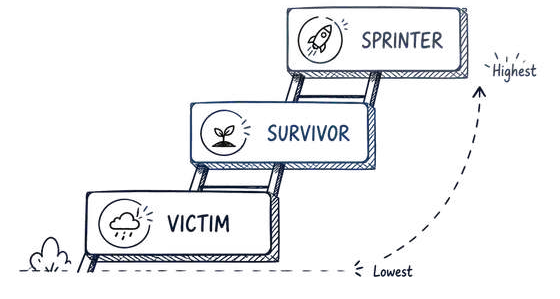
The same disruption, met from three different heights.
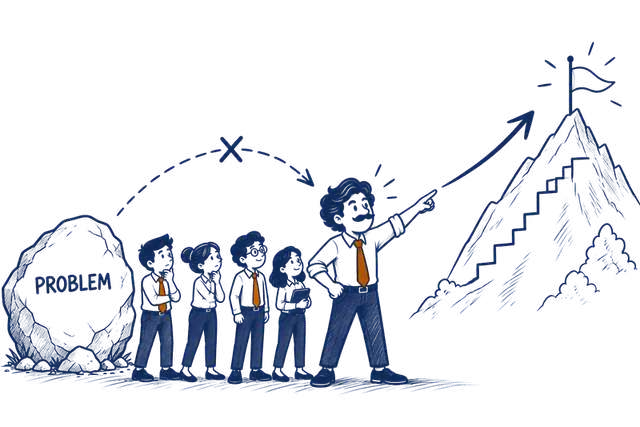
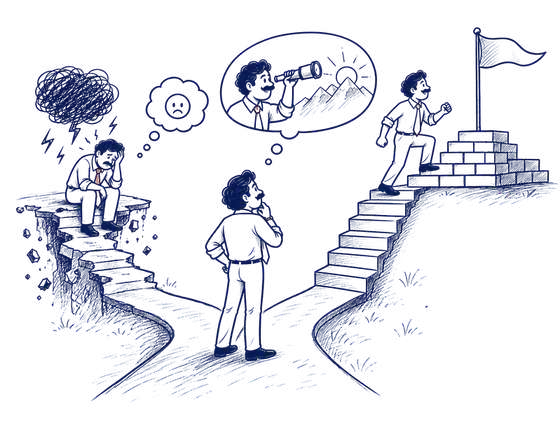
The Victim experiences the disruption as something done to them, and the language always gives it away there was nothing I could do, the market did this to us. Often they have genuinely been wronged, and the altitude is still fatal, because it locates all the power outside the self.
The Survivor takes responsibility and copes, which is a real step up, and has a ceiling built into it. The Survivor's goal is to get back to how things were. In a world that is not going back, the Survivor falls quietly and respectably behind.
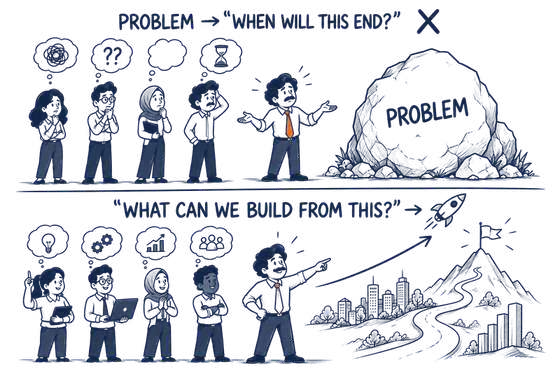
The Sprinter does not ask how do I get through this. They ask what can I build from this. Same difficulty, greater height.
That is Ibn Khaldun. He lost patrons, spent time in prison, and was pushed out of one court after another, and the Victim
reading was available to him every time, because most of it genuinely was done to him. In the 1370s he withdrew to a fortress in the western desert and stayed there for years. He did not spend them waiting for the politics to turn. He wrote the Muqaddimah, and six centuries later that exile is the only part of his career anybody remembers.
The altitude shows in what he did with the time, not in how he felt about the dismissals. He almost certainly felt what you would feel.
The research is unusually strong. Julian Rotter showed that an internal locus of control predicts higher achievement and resilience. Martin Seligman demonstrated that explanatory style can be measured, taught, and used to predict performance; in his work with a large insurer, optimists significantly outsold pessimists selling the identical product to the identical leads. And the literature on post-traumatic growth documents what the Victim altitude would call impossible that many people who endure serious adversity emerge not merely restored but enlarged.
Altitude is not a mood and you cannot decide your way up.
But you can hear it, in about thirty seconds, in the words a person uses about their own situation. Which means it can be measured, and anything that can be measured can be moved.
And altitude is contagious in both directions, which is the part that matters for a leader. A room takes its height from the most senior person in it, so a leader operating at Survivor altitude will find, within about two quarters, that their whole team has stopped asking what could be built from this and started asking when it will be over.
The Altitude Climb
Describe the challenge aloud and listen to your own language to locate your height. Then voice the lower stories deliberately, which drains them of their grip, and force the Sprinter version even if you do not yet believe it.
U
TOOL
- LOCATE YOURSELF
Describe the challenge out loud or on paper, and listen to your own language.
- VOICE THE LOWER STORIES ON PURPOSE
Write the full Victim version, then the full Survivor version.
- FORCE THE SPRINTER STORY COMPLETE THIS SENTENCE WITHOUT FLINCHING
“If this disruption were the best thing that could have happened to me if it were exactly the raw material I needed then it is forcing me to build _.”
- TAKE THE ALTITUDE’S FIRST STEP
Identify the one action available at Sprinter altitude that was invisible from below.
- RUN A WEEKLY ALTITUDE REVIEW
Once a week, scan your major challenges and mark the altitude you’re meeting each from. Over time, the simple act of measuring it raises it.
Use it when You are about to walk into a room carrying a challenge, or you hear victim language in your own account of it.
Takes Thirty seconds to locate your height. Five minutes to climb.
You're done when You have spoken the Sprinter version of the situation out loud, whether or not you believe it yet.
Run it weekly rather than in emergencies. Altitude is a habit of height, and habits are not built in crises.
ZONE | IF THIS IS YOU |
Frozen | A recent setback still feels like a verdict about you rather than information about a market, and you have not noticed you are reading it that way. |
Warm-Up | You separate the facts from the story eventually, usually days later, once the heat has gone out of it. |
Rising | You catch the story within a day, on paper, when somebody prompts you to look. |
Challenger | You catch it inside the hour, unprompted. It has become how you hear a phone call. |
Sprinting | You do it while the pressure is still on, and other people bring you their situations because you reliably see them accurately. |
How to move to next zone
MOVE | WHAT TO DO |
Frozen to Warm-Up | One Story Audit, written, on something that happened this month. Facts in one column, the story you attached in the other. |
Warm-Up to Rising | Run it the same day rather than the same week, four times. Speed is the whole difference between these two rungs. |
Rising to Challenger | Stop writing it. Run the four steps in your head during the call itself, and check afterwards on paper whether you got it right. |
Challenger to Sprinting | Do it out loud for somebody else, on their situation, while they are still upset. Teaching it under pressure is the last rung. |
Notice the asymmetry. The first rung costs one sheet of paper. The last costs the composure to do it for somebody else in the middle of their worst week.
Track One gives you the interpretation. You can separate an event from the story you attached to it, read a threat as an opportunity without lying to yourself, and meet a challenge from a height you chose rather than the one fear picked.
What it cannot do is hold. A lens is applied in a moment, and moments require you to be present, deliberate and undepleted — which is exactly what a hard quarter removes. Ibn Khaldun did not produce the Muqaddimah in a desert fortress because he interpreted his exile well that first week. He produced it because he was already a man who wrote, every day, before anything went wrong.
That is Track Two. Not what you see, but what runs whether or not you are seeing clearly.
 Identity Routines
What holds you up when the mindset is not enough
When Satya Nadella took over Microsoft in 2014, he inherited a company that was enormously profitable and quietly losing, and he did something that looked at the time like a category error. He did not start with products, or strategy, or the org chart.
He started with how the company thought about itself.
He drew explicitly on Carol Dweck's research, gave copies of her work to his leadership team, and reframed the entire culture around one distinction a company of know-it-alls against a company of learn-it-alls. Microsoft had been the first for two decades, and the internal culture that produced was famously brutal.
Here is why it belongs in this Track rather than the last one.
Nadella did not deliver a speech about mindset and hope it took. He changed what the company repeated. Performance reviews were rebuilt to remove the forced ranking that had made colleagues into competitors. Meetings were restructured. Executives were expected to demonstrate the new behaviour in front of each other, week after week, until it stopped being a policy and became what the place was like.
A mindset announced is a memo. A mindset repeated until it changes what people do is a culture, and the distance between those two things is measured in years of unremarkable repetition.
That is exactly the uncomfortable finding this Track exists to answer, and it applies to individuals as much as to companies.
Ali understood everything in the previous section by about the end of September. He could explain the Meaning Gap to you. He had run the Story Audit twice and found it useful.
And in the second week of October he had another Tuesday.
Insight is not durable. Every leader reading this has lived it. You read something that changes how you see, you feel genuinely different for about eleven days, and then a hard week arrives and you are exactly who you were before.
The reason is mechanical rather than moral..
On a good day you perform at the level of your intentions. On a bad day you perform at the level of your structures, and a bad day is precisely when it matters.
Three frames. The Identity Loop explains how a repetition becomes a person. The Performance Floor explains what to build so your worst day still clears a bar. The Compounding Curve explains why it is worth continuing when nothing appears to be happening. Mechanism, structure, patience how repetition becomes a person, what to build so the bad day still clears a bar, and why to continue when nothing appears to be happening.
The Identity Loop
We use a small word for this, habits, and it makes the idea sound like flossing. It is not. Habits are how identity is manufactured.
You do not become a disciplined leader by deciding to be one. You become one by performing small acts of discipline until disciplined leader is simply an accurate description of what you repeatedly do. Identity is not declared. It is accumulated, one vote at a time, and most people never notice they are voting.
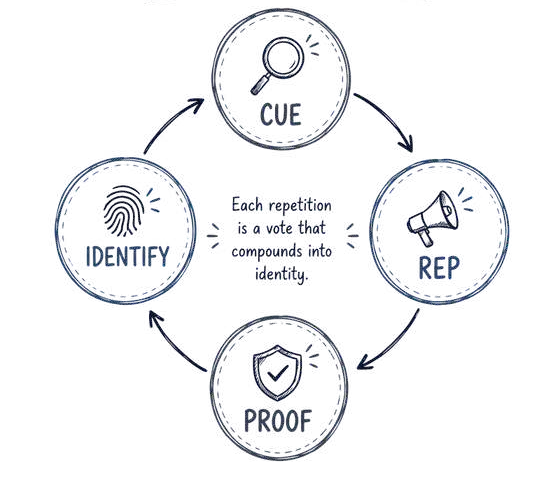
Each repetition is a vote, and the votes compound into a person.
Each repetition is a vote, and the votes compound into a person.
The science is well mapped. Researchers including Ann Graybiel at MIT located habit formation physically in the basal ganglia and found that the brain chunks a repeated sequence into a single automatic routine, executable with almost no conscious effort, which is why you can drive a familiar road while thinking about something else.
But the loop as usually taught, cue and routine and reward, is missing the part that matters to a leader. Each repetition is not only an action. It is evidence, filed in your own mind, about who you are. Thirty mornings of writing does not make you better at writing. It makes you a person who writes, and now the person defends the behaviour without needing your permission.
The frame explains why your last three attempts at change did not survive February.
You were installing behaviours and hoping a person would appear. It runs the other way round, so the tool starts where the frame ends, at the identity.
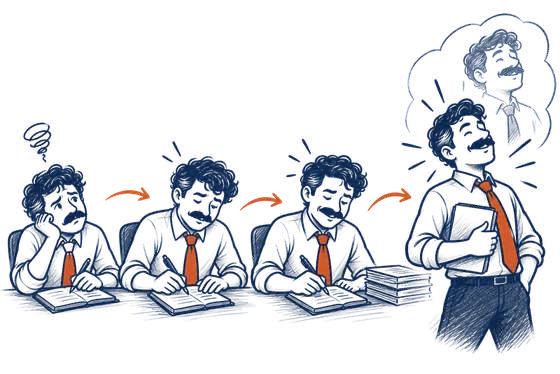
The Keystone Habit Designer
Declare who you are becoming. Choose the smallest repetition that counts as a vote for it, small enough that failing is almost impossible. Anchor it to something you already do without fail. Then bank the proof somewhere you can see it.
O
TOOL
- DECLARE THE IDENTITY
Finish the sentence: “I am the kind of leader who ” (e.g. who acts
before reacting, who learns something every day.) This is the destination.
- CHOOSE THE SMALLEST TRUE REP
What is the tiniest action that would count as a vote for that identity? Not the impressive version the unimpressive one. “Read one page,” not “read for an hour.” BJ Fogg’s research at Stanford is unambiguous here: shrink the behaviour until it is almost impossible to fail, and you will actually do it.
- ANCHOR IT TO A CUE
Attach the rep to something you already do without fail: “After I pour my morning coffee, I’ll _.” The existing routine becomes the
trigger. (Clear calls this habit stacking; the principle is to borrow the cue you already own.)
- BANK THE PROOF
ftark each rep somewhere visible. You are not tracking the task you are accumulating evidence for the new identity.
- LET THE IDENTITY RECRUIT MORE
Once the identity feels true, it begins pulling other supporting behaviours toward it instead of fighting them. That is the loop working for you instead of against you.
Use it when You keep intending a change and never installing it, or you are stepping into a role you have not yet become.
Takes Thirty minutes to design, then one repetition a day.
You're done when The identity is declared, the smallest vote for it is anchored to something you already do without fail, and the proof is visible.
The most common failure here is ambition. A managing director I worked with declared he was a leader who developed people and committed to a two-hour coaching session every Friday. He managed two Fridays. We rebuilt it as one question, asked to one person, once a day, taking ninety seconds.
Eleven months later four of his people had been promoted. Shrink it until it is embarrassing. Embarrassing is the size that survives a bad week.
The Performance Floor
Anybody performs well when they are rested and motivated. That is your ceiling and it is close to irrelevant, because disruption does not schedule itself around your good weeks.
The number that decides a career is the floor what you can guarantee on the day you are exhausted, frightened and out of enthusiasm.
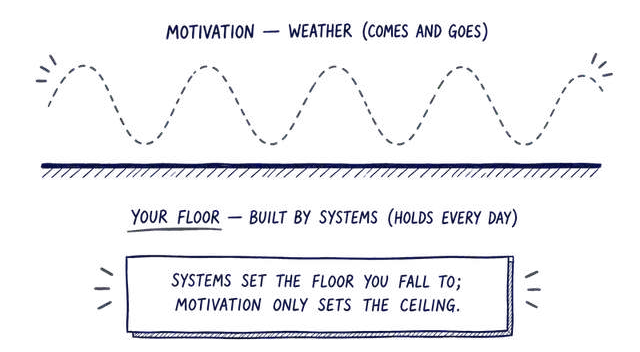
Wendy Wood's behavioural research found that roughly forty-three per cent of daily actions are performed habitually, in the same context, regardless of how the person feels, and that habits persist when motivation collapses. The leaders who hold up under pressure are not winning a daily contest with themselves. They arranged things so the contest is not held.
And there is relief buried in the research. You have been told a habit takes twenty-one days. That number appears to have escaped from a plastic surgeon's observations about patients adjusting to their appearance, and has been repeated ever since because it is convenient. Phillippa Lally's work at University College London put the real average nearer sixty-six days, with wide variation. That sounds worse and is actually liberating consistency beats intensity, and one missed day is not a failure.
Ali's whole year is a floor problem.
He had no morning, no close, no protected block. In March that looked like flexibility. By August it meant a man sleeping four hours a night was making every decision on whatever he happened to feel at the time.
And this is where the two arenas stop being separate. A man with no floor does not run out of capacity at six o'clock and then find more at home. He arrives at his own front door with whatever the day left, which by August was nothing. His daughter was not competing with his work. She was competing with its residue.
The reserves you fail to protect are not spent at the office. They are spent at the office and then missing at home, and only one of those places will tell you.
The Daily Architecture
Three protected zones that run whatever your mood..
A designed opening to the day. Pre-decided blocks of deep work. And a short fixed close that turns today's experience into tomorrow's instruction.
R
TOOL
- THE POWER HOUR
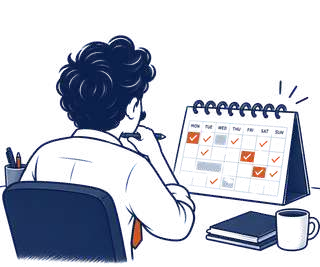
A designed opening to the day a short, fixed sequence of your highest-value personal routines (mindset practice, physical activation, reviewing your single most important priority). Because how you begin the day sets the flow for all of it, and beginning on autopilot means beginning low.
- THE SPRINT BLOCKS
Pre-decided periods of deep, protected work on what matters most, scheduled rather than left to “whenever you find time” which, on hard days, you never do.
- THE DEBRIEF RITUAL.
A brief, fixed close to the day: what worked, what I learned, the single most important action for tomorrow. This is the loop that turns each day’s raw experience into tomorrow’s improvement.
Use it when Your days run on whatever you happen to feel that morning, and the good ones no longer outnumber the bad.
Takes Ninety minutes to design. One week to bed in.
You're done when Three zones hold on a bad day a designed opening,
protected deep work, and a short fixed close.
One principle surrounds all three and does more than any of them. Design the environment so the right behaviour is the easy one. Wood's finding is emphatic that context beats intention. You are not strengthening your willpower; you are arranging your world so that less of it is required.
The Compounding Curve
People abandon routines because on any given day the routine is obviously pointless. One page. One ten-minute review. The difference between doing it and skipping it is invisible, so skipping it is rational.
It is rational and it is wrong, because these things do not add. They multiply.
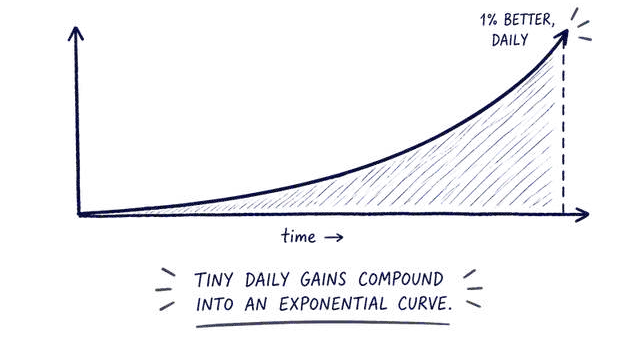
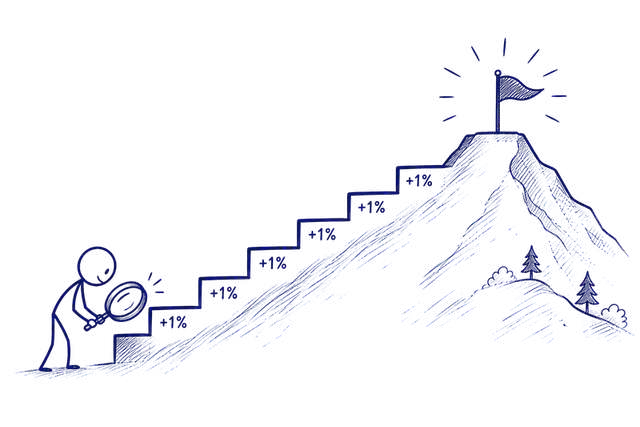
One per cent better every day for a year does not leave you three times better. It leaves you roughly thirty-seven times better, because each gain builds on the last. Run it the other way and a year of one per cent worse leaves almost nothing. The daily difference is imperceptible. The annual difference is the difference between mastery and decline.
Dave Brailsford proved it at British Cycling with what he called the aggregation of marginal gains a hundred things improved by one per cent each, down to the pillows the riders slept on and how they washed their hands to avoid illness.
Trivial individually. Compounded, they built the most dominant programme in the sport.
The frame is a promise about a curve you cannot see, which is the problem, because human beings do not persist at things that show no evidence of working. So the tool's only job is to make the invisible visible.
The Streak Ledger
Make the chain visible, aim at not breaking it rather than at brilliance, and obey one rule never miss twice. One miss is an accident. Two is a new habit.
A
TOOL
- TRACK THE REP DAILY, IN ONE PLACE
A simple mark for each day you complete your keystone
habit. The visible s
treak becomes its own reward the brain does not want to break an unbroken chain.
- MAKE THE GOAL “DON’T BREAK THE CHAIN,” NOT “BE BRILLIANT.”
tency, not intensity. A modest rep done daily beats a heroic one done rarely, every time, because only one of them compounds.
The target is consis
E ONE RULE THAT PROTECTS EVER MISS TWICE
4. REVIEW TH
them and make re
a new (worse) habi
ftissing one day is
THE CURVE: N
3. FOLLOW TH
an accident; missing two is the start of
t. Life will force occasional misses accept turning the next day non-negotiable.
E CURVE MONTHLY
Once a month, look back not at any single day but at the
streak’s length. Seein
accumulation — the
pages read, the reps banked, the g the compounding is what carries you
through the stretch where it isn’t yet obvious.
Use it when A habit is running and you can no longer feel it working, which is where most people quit.
Takes Two minutes a day,
ongoing.
You're done when The chain is visible, you are aiming at not breaking it rather than at brilliance, and you have never missed twice.
Never miss twice is worth more than any amount of motivation.
It concedes in advance that you will fail, which is realistic, and it puts a hard boundary on how far the failure travels. Most people do not lose a habit on the day they miss it. They lose it on the day after.
ZONE | IF THIS IS YOU |
Frozen | You have no fixed morning and no fixed close, and your performance tracks your mood closely enough that a bad fortnight looks like decline. |
Warm-Up | Routines exist and survive good weeks. The first genuinely hard week ends them. |
Rising | One routine holds reliably. The rest are intentions you still describe as things you do. |
Challenger | A morning, a close and protected blocks survive a bad month, because they are anchored to something rather than willed. |
Sprinting | Your worst week clears a bar most people's best week does not, and your household can feel the difference. |
How to move to next zone
MOVE | WHAT TO DO |
Frozen to Warm-Up | One keystone habit, shrunk until failing is almost impossible, anchored to something you already do without fail. |
Warm-Up to Rising | That same habit surviving one bad week. Not a new habit. The same one, through the week you did not want to. |
Rising to Challenger | Add the close. Five minutes at the end of the day what worked, what I learned, the single thing that matters tomorrow. |
Challenger to Sprinting | Protect the blocks against other people for a full quarter, which means disappointing somebody who wanted the time. |
Track Two gives you the floor. An identity you are voting for daily,
a day with a shape that does not depend on your mood, and a chain visible enough that you keep it. Your worst week now has a minimum.
What it cannot do is govern the four seconds. Routines run on the slow brain, and the moments that decide how people experience you are settled by the fast one, several times a day, before the floor has any say. Nadella rebuilt what Microsoft repeated. He still had to survive individual meetings.
That is Track Three, and it is the Track the room actually sees.
 Inner Steadiness
The four seconds that cost Ali his best person
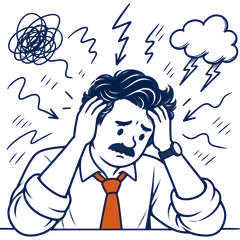
Everything on the first two Tracks exists to produce this one, and this is the Track the world actually sees. Alyaa did not resign because Ali's mindset was wrong or because his mornings had no shape. She resigned because of what came out of his mouth on a Tuesday, in front of four people, in the two seconds after she told him something he did not want to hear.
That is where leadership is actually won and lost. Not in the strategy, and not in the plan. In the small interval between a trigger and a response, several times a day, for your entire career.
Your team does not experience your intentions. They experience what you did in the four seconds after the bad news arrived.
Three frames. The biology of the interval, the method for using it, and what your regulated state does to everyone in range.
The Hijack Window
You are running two brains at different speeds, and under threat the fast one tries to act before the slow one has finished reading the situation.
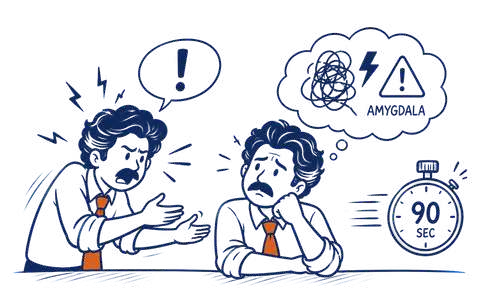
Joseph LeDoux mapped it. A trigger travels two roads. The low road reaches the amygdala, the threat alarm, in milliseconds, and fires a full stress response before you are consciously aware of anything. The high road reaches the prefrontal cortex, where deliberate thought happens, and it is slower. Which is why you can be flooded with anger a second or two before the thinking part of you has established whether anger is warranted. Daniel Goleman named the extreme version the amygdala hijack.
And the surge has a clock. Jill Bolte Taylor's ninety-second rule holds that the physiological flood runs its course and clears in roughly a minute and a half. The number is her formulation rather than a constant, and the principle underneath it is well supported the chemical surge is short, and much shorter than the emotion most of us sustain. If you are still furious ten minutes later, that is no longer chemistry. That is you, re-triggering it.
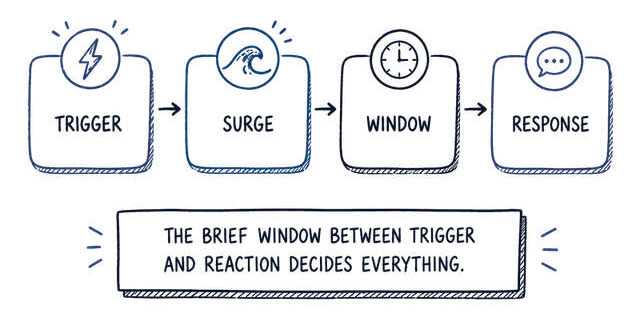
Act inside the surge and the alarm is driving with the thinking brain offline. Hold the window open and the chemistry clears, the prefrontal cortex returns, and you are yourself again.
The frame gives you a fact you can use the surge is short, and it is on a clock. Which reduces the entire problem to one question. Can you not act for ninety seconds? You cannot answer that with willpower. Deciding to be calm is the thinking brain arguing with chemistry, and chemistry wins. It has to be physiological.
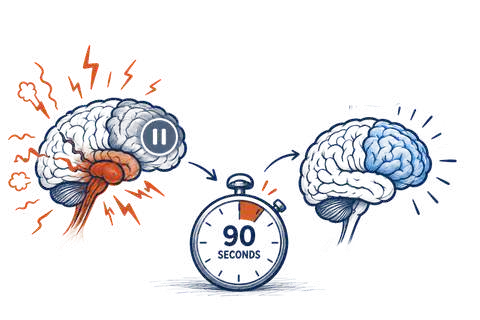
The 90-Second Reset
Label the surge so you know what it is. Refuse to act, decide or send while it is running. Lengthen the exhale, because the out-breath is the fastest brake your body owns. Then let the wave pass on its own timer and answer afterwards.
C
TOOL
T AS A SURGE, NOT A TRUTH
2. DO NOT AC
recognition alone res
racing — silently lab
1. RECOGNIZE I
The instant you feel
the flood — the tight chest, the heat, the el it: this is the P0-second wave. That tores a sliver of the window.
T, DECIDE, OR SEND
Nothing irreversible happens inside the surge.
The single rule is: the
No reply, no decision
, no words. surge does not get to hold the pen.
- LENGTHEN THE EXHALE
ical brake on a stress response is a long exhale ivates the calming parasympathetic branch of
your nervous system
— the breath out act
The fastest physiolog
. The most efficient version, studied by physiology labs, is the physiological sigh: two short inhales through
chemistry for four, ei
The goal is not to “br
three of those are en
the nose followed by
a long, slow exhale through the mouth. Two or ough to create a noticeable shift in the body. eathe deep”; it is to physically drain the ght, and more seconds.
- WAIT OUT THE NINETY SECONDS
will. It is on a timer.
Let the wave pass. It
Then respond — from the brain that just came back online.
Use it when The surge is running right now and you are about to send, decide or speak while it is still in your body.
Takes Ninety seconds. That is the whole tool.
You're done when The wave has passed on its own timer and you answered afterwards, not during.
Ali now has a rule with no exceptions in it nothing that cannot be unsent gets sent inside the surge. No message, no decision, no sentence in a room. He estimates it has cost him perhaps forty minutes a year in delay, and he can name three people who still work for him because of it.
The Two Roads
The reset buys the window. An open window with nothing in it is only a delay. This frame is what happens inside it, and it rests on the anatomy from the previous frame.
The alarm always wins the race. Always. It is not a question of character, and no amount of maturity changes the timing.
Composure is not a personality trait. It is what a person looks like who has learned to wait for the second road.
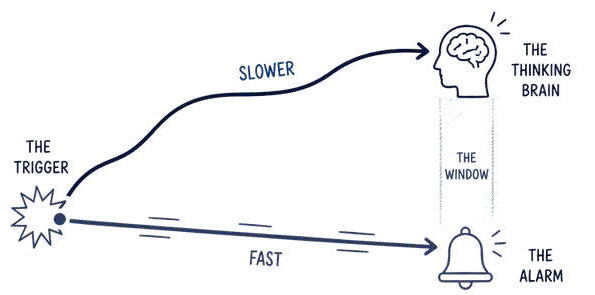
Once it arrives, a sequence turns a raw surge into a chosen response, in an order the brain will cooperate with.
The naming step has the strongest evidence behind it. Matthew Lieberman showed with brain imaging that putting a feeling into words lowers amygdala activity and raises prefrontal activity. Name it to tame it. An unnamed emotion runs you; a named one comes under management, because naming is the thinking brain reasserting itself.
Then the reframe, the Threat and Opportunity Switch turned inward. Then the choice, where your routines pay out, because under pressure you do not select a response, you produce a trained one.
Notice how the Tracks work together the naming is this one, the reframe is the first, and the choosing exists only because the second built something to choose from. That is what a core is, and it is why they had to be built in that order rather than in the order that would have felt most urgent.
Run in sequence it takes about six seconds, which is roughly the time it takes to fill a glass of water, and it is the difference between a Tuesday somebody resigns over and a Tuesday nobody remembers.
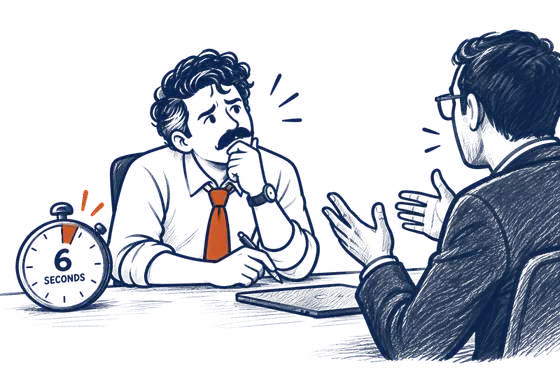
The Emotional Regulation Compass
The sequence made portable. Four moves, fast enough to run in the room while the other person is still speaking.
AL
TOOL
- PAUSE
Hold the window the breath from the previous tool. Six seconds is enough to let the prefrontal cortex re-engage.
- NAME
Silently and precisely label what you are feeling. Specificity is the point. “Frustrated” is weak. “I’m feeling disrespected and that’s making me defensive” is powerful because it is the thinking brain in action.
- REFRAME
Ask the question that changes the interpretation: “What is actually true here, and what would the leader I am becoming see in this?”
- CHOOSE
Select your response on purpose the words, the tone, the action aligned to your values rather than your surge.
Then, and only then, speak or act.
Use it when You need the sequence live, in the room, while the other person is still speaking.
Takes Four moves, run in under a minute.
You're done when You named it, relabelled it, aimed it at the task, and chose a trained response rather than produced an untrained one.
Run it once this week in a conversation that matters and you will meet a strange sensation watching your own emotion from half a step back.
Present in the room. No longer driven by it.
The Steady Field
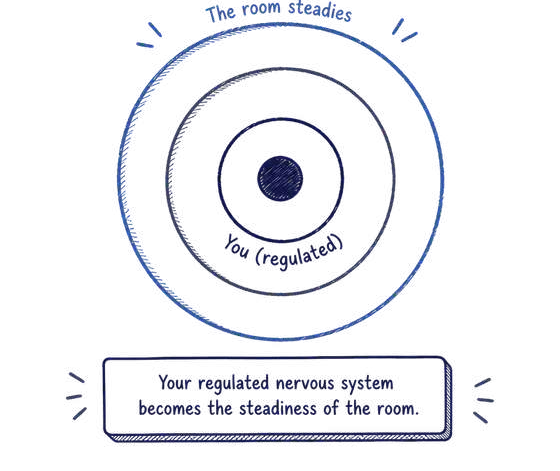
The first two frames regulate you. This one is about what your regulated state does to everybody else, and it turns a private discipline into a leadership multiplier.
Emotions are contagious, and a leader's most of all. Researchers including Elaine Hatfield and John Cacioppo have shown that people catch each other's states automatically, syncing physiology and mood within seconds and below awareness. Our nervous systems are open loops. We regulate one another whether we intend to or not. And attention flows toward power, which means your state is broadcast on the widest channel in the room.
This is the foundation of what Amy Edmondson calls psychological safety, and Google measured it in a multi-year study of its own teams, expecting the answer to be talent. It was not. The strongest predictor of team effectiveness was psychological safety whether people felt able to speak up without being punished.
Which is what Ali had destroyed.
Alyaa's resignation letter did not say his mindset was poor. It said she never knew which version of him would be in the room, and a person who does not know that stops bringing you problems. He had not merely upset one director. He had taught two hundred and forty people to manage him rather than inform him.
In a crisis your people will not read your plan. They will borrow your nervous system, and whatever is in it is what they will have to work with.
The Steady-Field Protocol
Regulate before you enter, not after. Slow your pace and your body, because the room will track you. Name the emotion in the room out loud. And then respond to the first piece of bad news with visible calm, because everybody present is watching that single moment to decide whether it is safe here.
IE
TOOL
TE YOURSELF FIRST.
Reset before y
your real stat
You cannot pr
1. REGULA
oject a calm you do not have. The field carries e, not your performed one. Run the P0-second ou enter, not after.
- SLOW EVERYTHING DOWN.
Lower your vocal pace and soften your posture and your hands. Leave deliberate pauses. The group’s nervous system will track yours slow yourself and you slow the room.
- NAME THE ROOM’S EMOTION.
After a full day or with a group, the room is a stressful container, and there’s understandable and we are going to think our way through it clearly. Naming the collective emotion defuses it and signals that it is safe to feel it.
- MAKE IT SAFE TO SPEAK.
Explicitly invite the hard truths and the dissent and, above all, respond to the first piece of real resistance with visible calm. The room is watching that single moment to decide whether your field is safe.
Use it when You are walking into a room that will read your state before it reads your words, and bad news
is likely.
Takes Two minutes before you enter, then held throughout.
You're done when You regulated before entering rather than after, named the emotion in the room out loud, and met the first bad news with visible calm.
One steady response to bad news will build more safety than a year of speeches about openness. Alyaa did not leave because of a policy but because of a Tuesday.
ZONE | IF THIS IS YOU |
Frozen | The surge holds the pen several times a month, and each occasion feels justified at the time. |
Warm-Up | You regret it afterwards and apologise. The apology is sincere and changes nothing. |
Rising | You catch it in formal settings and lose it at home, where it costs more and is noticed less. |
Challenger | Nothing irreversible leaves the building inside the surge. Ever. Not a message, not a decision, not a single sentence in a room. |
Sprinting | People bring you bad news early and unprompted, because they have stopped calculating which version of you is in the room. |
How to move to the next zone
MOVE | WHAT TO DO |
Frozen to Warm-Up | One rule with no exceptions in it nothing that cannot be unsent gets sent inside the surge. |
Warm-Up to Rising | Learn the physiological brake. Long exhale, twice, before you reply. Practise it when you are calm so it is available when you are not. |
Rising to Challenger | Apply the rule at home first, where it is hardest and where the surge arrives with no professional obligation to be reasonable. |
Challenger to Sprinting | Two years of that rule holding, which is roughly how long it takes people to stop managing you. |
Ali says he learned this at home rather than at work, and almost every leader I work with says the same. A board meeting is a controlled environment compared with a fifteen-year-old who knows precisely which sentence will find the gap in your armour.
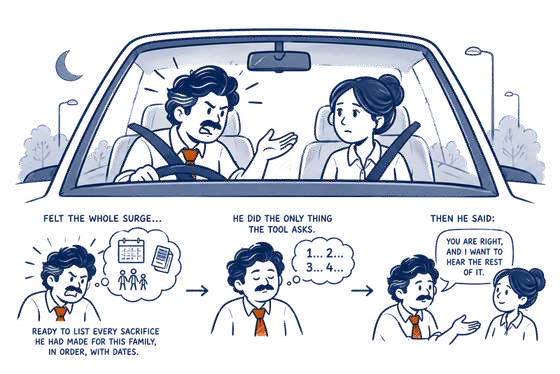
The evening after the conversation in the car, he felt the whole surge, the heat and the immediate readiness to list every sacrifice he had made for this family, in order, with dates. And he did the only thing the tool asks. He said nothing for a slow count of four, and then he said you are right, and I want to hear the rest of it.
He describes that as the hardest single thing in this book, and as the beginning of the relationship he has with her now.
When I Was Frozen
It is only your dream
She said no.
Not defensively. Not to win the argument. She said it the way you tell somebody the time, and it took me three years and a great many good people to arrive at that evening.
We were three years old as a company and doing better than we had any right to do. The results were bigger than our capability. We were winning work in markets we had no business winning in, against competitors with more of everything. From the outside it looked like a company that was flying.
From the inside there was a man who could not stop being angry.
Not loudly. Angry the way a founder is angry, which is a very respectable kind of anger, because it arrives dressed as standards. A detail missed in a proposal. A follow-up a day late. Somebody asking for leave in a week I considered important. Each one landed like a small betrayal, and the sentence underneath it was always the same.
Is this not their dream too?
That was the story, and it sat so deep that I never examined it, because it did not feel like a story. It felt like a fact about the world. I worked because this company was my dream. They worked here. Therefore it was their dream. And if it was their dream, how could anybody forget a detail, or want a holiday? I did not take one when I was ill.
It was wrong. Not slightly wrong. Wrong in a way that was costing me the best people I had.
Because I lost them. Not in a dramatic exit and not with a row. One at a time, quietly, the way good people always leave, which is that they simply stop arguing with you and a few months later they are gone. These were the ones who had built the launch, who had opened markets for us with nothing but a phone and their own nerve. And the story I told myself about their leaving was also wrong they were not committed enough. It was not their dream after all.
I was right about the last part. I had drawn exactly the wrong conclusion from it.
It ended on an ordinary evening, late, in the office, the way the important conversations always are.
I was in a difficult discussion with my operations director, and I asked her the question I had been asking silently for three years and had finally said out loud, because I thought it would end the argument.
Isn't this your dream too? To make this place bigger? And she said no.
Then she said the rest, and I have carried the shape of it ever since. It is not our dream. It is yours, and we are part of it. Your big dream for this company is a small part of our own big dreams. What your dream does is feed ours, through the salary, the bonus, the meaning we get from good work. But it is not us.
I had no answer. There was not one. Everything reorganised in about four seconds, and it hurt, because what she had just done, without either of us having a name for it, was separate the event from the story I had wrapped around it. The event was that a talented person wanted a holiday. The story was that a talented person did not love my dream enough. The first was a fact. The second I had manufactured, then reacted to, then lost people over.
That is the Meaning Gap, and I lived on the wrong side of it for three years. My operations director ran the Story Audit on me in the middle of an argument, without knowing such a thing existed. She handed me the facts, unwrapped, and the anger that had felt like a permanent feature of my character had nothing left to stand on.
Here is what I want you to take from it, because it is not a lesson about patience.
I had been running my company on a design error. I assumed the fuel that moved me was the fuel that moved everybody. My fuel was the dream itself, and it burned hot enough that I needed no conditions, no appreciation and very little rest.
But that is founder's fuel. It belongs to the person whose name is on the thing. And I had been quietly, constantly disappointed in an entire team for not running on a fuel that was never theirs to have.
Their fuel is different and it is not lesser. Conditions. Being appreciated out loud. A system that works rather than one they survive. Progress they can see. Rest that is rest. Give people that and they will pour more into your dream than your passion ever extracted from them.
So I stopped trying to make them feel what I felt, and started building what they ran on.
I took one of my team to a business conference in Portugal, because I had spent three years being annoyed at people and almost no time celebrating them. I rebuilt the calendar so every department got a long weekend once a month, so that rest was something the system gave rather than something they justified to me. Small, structural things that said your fuel matters here. And my standards did not drop, which is the part people get wrong when I tell this story. I hold a very high bar. I simply hold the highest one against myself. The dream is mine, so the weight is mine, and I get to expect more of me than of anybody who works for me. That is not a burden. It is what ownership means.
I lost extraordinary people to a sentence I never examined, and I have not lost anybody to it since.
Bringing It Together
The Inner Core
We began with a man who lost his best director on a Tuesday and could not understand why. We end with the same man running a larger business through four managers whose decisions he never sees, and on speaking terms with a daughter who once said something to him in a car that he still will not repeat.
The client left in December, exactly as scheduled. Everything else that year, he did himself, which is the bad news and also the entire hope of this Sprint.
Track One, Mindset Shift.
Between every event and your response sits a gap. Disruption arrives wearing the mask of a threat. And you can climb, across a career, from the leader things happen to toward the leader who builds from whatever happens.
Track Two, Identity Routines.
Insight is not durable and motivation is weather. On your worst day you fall to your structures, so build structures worth falling to, and trust a curve you cannot feel forming.
Track Three, Inner Steadiness.
There is a brief window between trigger and reaction. Inside it you can pause, name, reframe and choose. And your regulated state becomes a field other people borrow from.
Notice the dependency, because it is the whole design. Steadiness is not willpower; it is what a corrected lens and a built structure produce between them. Change the centre and the rings reorganise. Neglect the centre and no technique survives contact with a bad week.
And hold on to the second half, because it is the half most leadership books drop. The lens that stops you reading a lost client as a verdict on your worth is the same lens that stops you reading your daughter's honesty as an attack. The structure that guarantees your worst professional day still clears a bar is what guarantees your family gets a version of you on the bad weeks. The steadiness your team borrows is the steadiness your children are learning from, whether or not you meant to teach it.
You are not building a work self and a home self. You are building one instrument, and it will be played in both rooms.
Here is the freeze-or-sprint version of this Sprint. Freezing on Self Mastery does not look like paralysis. It looks like Ali between March and September a man working harder than he ever has, reading every event as a verdict, running a day with no shape, losing his best people one Tuesday at a time. Everybody around him could see it. He could not, because the instrument that would have told him was the instrument that was broken.
Sprinting on Self Mastery looks unremarkable from outside. A lens that separates the event from the story within a day. A morning that runs whether or not you feel like it. Four seconds that belong to you rather than to the surge. None of that is impressive in a meeting. All of it is the difference between a leader the disruption builds and one it quietly dismantles while everybody admires their work ethic.
- Your power lives in the gap. You do not respond to events. You respond to the meaning you gave them.
- Where, what, how high. The Meaning Gap locates your power, the Switch tells you the move, the Altitudes tell you the height.
- Insight is not durable. On the bad day you fall to your systems, so build systems worth falling to.
- Identity is accumulated, not declared. Every repetition is a vote. Never miss twice.
- Your team does not experience your intentions. They experience the four seconds after the bad news.
- Nothing that cannot be unsent gets sent inside the surge.
- The inside comes first, and it pays out in both arenas.
Sprinting Questions
What have I decided a recent event means, and is that the only reading the facts allow?
Which single daily repetition, held for a year, would most change the leader I become?
When the pressure last spiked, did I hold the window, or did the surge hold the pen?
If somebody on my team had bad news for me this afternoon, would they bring it?
Choose the Track costing you most right now: the lens that keeps reading every shift as catastrophe, the day with no shape, or the four seconds you keep losing. Run one tool this week on something real.
Depth in one Track pulls the other two upward. That is how a core grows.
Three Tracks, and they only work in this order.
The lens decides what the event means. The routines make the lens available on a day you have nothing left. The interval is where both of them either show up or do not, in front of other people, in about four seconds.
Run in reverse it fails, and this is the most common way Self Mastery is attempted. Composure without interpretation is suppression, and it holds until it does not. Interpretation without routine is a good week followed by a bad month.
Everything in the seven Sprints ahead is carried by somebody. This is the Sprint that decides what kind of somebody that is.
PEOPLE SKILLS
SPRINTERSPRINT02People SkillsWhether your meaning arrives, and whether anybody movesFour people knew, and not one of them told him. That is the sentence Alaa cannot get past, and he has had two years to try.He runs a specialist engineering firm of about three hundred people, and he is very good at what he does. The year this happened, his industry …