

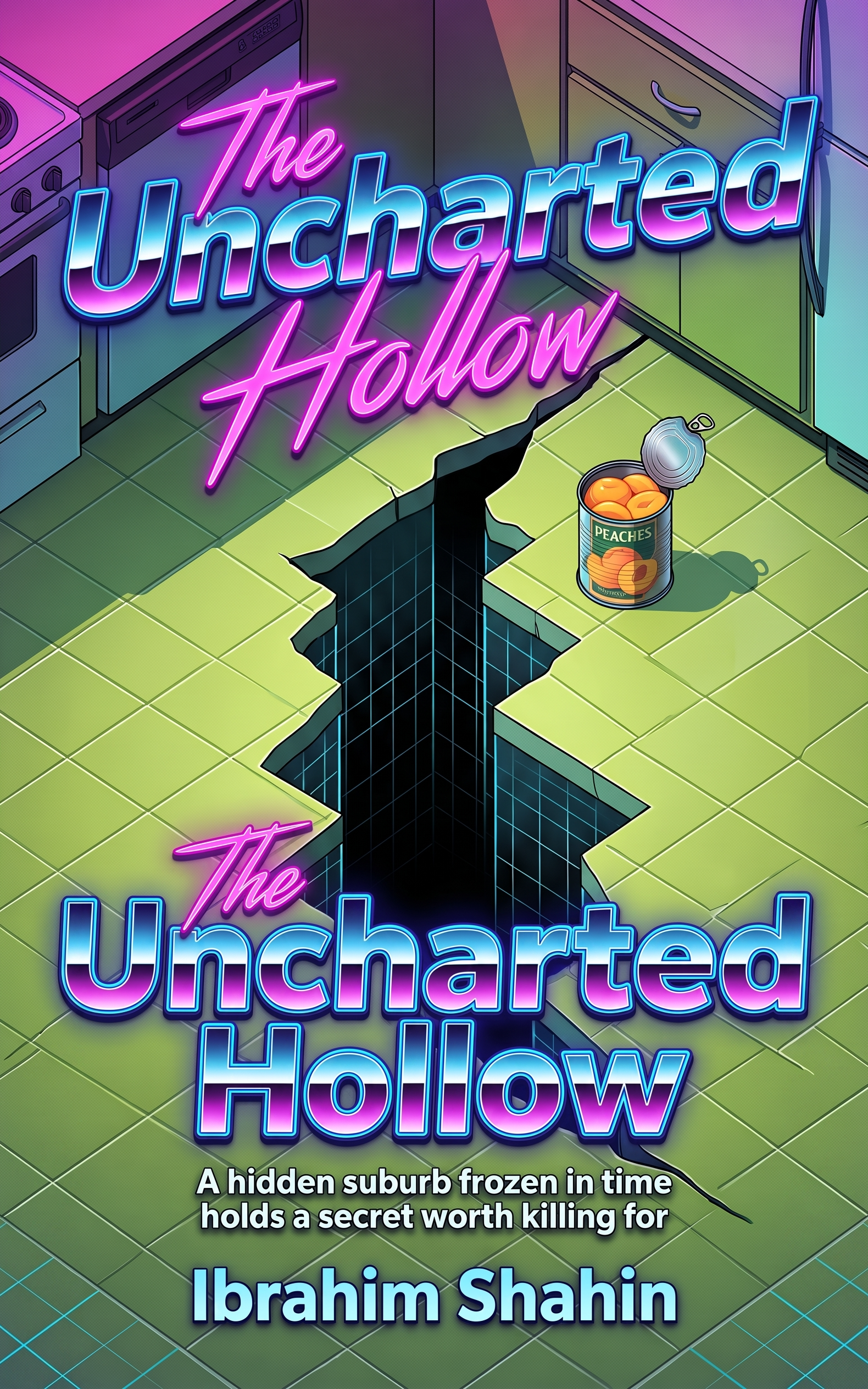
The Uncharted Hollow
A hidden suburb frozen in time holds a secret worth killing for
by Ibrahim Shahin
Deep in the dense timberland of the Pacific Northwest, aerial surveyor Martin Cross spots something impossible on his drone feed: a pristine cul-de-sac of 1970s prefabricated homes hidden at the bottom of an unmapped canyon. When Martin hikes into the gorge to investigate, he enters a neighborhood frozen in time. The lawns are manicured, the pantries are stocked with long-defunct brands, and a massive generator hums silently beneath the community center with no visible fuel source. But not a single resident is in sight. Before he can map a way out, an elite black-budget defense team locks down the perimeter with orders to erase the site—and anyone who finds it. Trapped inside a localized temporal anomaly alongside an eccentric technician stranded since 1974, Martin realizes the canyon isn't just hidden; it's slipping out of reality entirely. To survive, Martin must use his surveyor instruments to navigate shifting terrain, outsmart ruthless mercenaries, and stabilize a fracture in spacetime before fifty years of conspiracy swallow the Pacific Northwest whole. From Ibrahim Shahin comes a pulse-pounding sci-fi thriller where every coordinate leads closer to catastrophe.
- Mystery
- Science Fiction
- Thriller
- Amateur Sleuth
- Parallel Worlds
- Conspiracy Thriller
The Phantom Ridge
The lidar point cloud on Martin Cross’s secondary display showed an impossible fracture in the earth. According to the United States Geological Survey layers cached on his ruggedized laptop, the terrain three miles north of his field camper was supposed to be a contiguous timber ridge, sloping gently down toward the Blackwood River basin. The elevation profile should have varied by no more than forty feet across two square miles of Douglas fir and western hemlock.
Instead, the laser pulses bouncing back to the drone’s optical sensor painted a sudden, sheer void. The ground dropped three hundred feet straight down into a narrow, knife-cut canyon that had no right to be there.
Martin adjusted his faded baseball cap, leaning over the folding table set up inside the back of his camper. The monitor hummed, bathing his scruffy jaw in pale green wireframe lines. Outside, the midday wind off the Cascade Range rattled the camper’s aluminum siding, smelling of cold spruce and wet pine needle mulch.
"Sensor calibration error," Martin muttered into his lapel microphone, triggering the voice recorder on his utility vest. "Lidar unit Alpha-Four registering a three-hundred-foot negative elevation spike at coordinate grid four-six-point-eight-two-one, negative one-two-one-point-five-four-nine. Checking telemetry."
He tapped the mechanical keys of his controller, sending a command packet up to the survey drone hovering at eight hundred feet. The drone tilted its nose and descended toward the coordinate anomaly. The live optical feed flickered on the primary screen. The dense canopy of hemlock and fir parted on the monitor, revealing a jagged rock fissure split wide open like a cracked ribcage.
Martin leaned closer. "Optical feed confirms a structural rift. No surface logging roads visible on the rim. The gorge is approximately four hundred yards wide at the shoulder."
He nudged the throttle stick forward. The drone dropped past the lip of the canyon, slipping below the granite crest. As soon as the aircraft cleared the shadow of the cliff face, the digital telemetry began to skew. The altitude readout jumped erratically from one hundred feet to negative twenty, then snapped to zero.
Then the video signal cleared, and Martin stopped breathing.
The canyon floor was not a bed of jagged scree or a wild riverbed. It was a paved two-lane asphalt street. Along the road stood a neat row of mid-century prefabricated ranch houses, complete with manicured curbs, painted fire hydrants, and tall metal streetlights. At the far end of the road, the asphalt rounded into a wide, quiet cul-de-sac. Trim lawns of pale, unblemished grass lined every driveway. The rooftops were covered in cedar shake shingles that looked pristine, devoid of moss or fallen branches.
"Telemetry confirms... residential infrastructure," Martin whispered, his dry voice catching on the words. "A planned community at the bottom of the fissure. No service access roads entering or exiting the perimeter. No visible overhead power lines."
A burst of harsh static ripped across the speaker. The drone’s internal compass icon on the screen began spinning in wild clockwise rotations. The GPS lock failed instantly, dropping from twelve satellites to zero in a single frame. The video feed tore into jagged horizontal lines of white noise, shuddered once, and cut to black.
The screen flashed: SIGNAL LOSS — NO CARRIER.
Martin pushed his chair back from the table. He stood in the quiet of his camper, listening to the soft tick of the cooling engine block outside. He took off his cap, ran a hand through his dark hair, and set it back on his head. He pulled his canvas field pack from the storage bench, checking the contents with routine precision: two spare lithium-polymer batteries, a hand-held radio transceiver, a high-lumen tactical flashlight, a mechanical compass, and his digital field notebook.
Within ten minutes, he had his mud-caked boots on the forest trail, following the bearing on his handheld navigation unit before the tree canopy grew too thick for satellite coverage.
The hike through the timberland took forty minutes. The woods were heavy with the usual wet loam and decaying cedar logs, but as Martin approached the coordinates, the forest grew unnervingly quiet. No jays called from the branches. No chipmunks rustled in the sword ferns. The ambient noise of the woods simply faded out, replaced by a low, almost imperceptible pressure in his ears.
He reached the edge of the fissure and stopped. The earth ended in a sheer, vertical cliff of dark basalt, looking as though a massive wedge of mountain had been sheared away by a clean surgical cut. Down below, nestled in the shadow of the stone walls, lay the quiet suburb.
Martin found a natural weakness in the rock face, a diagonal chimney of broken stone and exposed roots. He secured his pack, gripped the cold stone, and began his descent. His boots found narrow ledges of crumbly basalt, kicking loose small showers of gravel that fell silently into the depths. Halfway down, the air changed abruptly. The rich, rotting smell of the forest floor vanished, replaced by an aroma that was strangely sterile, crisp, and heavy with the sharp tang of ozone.
He dropped the final six feet, his boots landing with a hard, hollow thud directly on black asphalt.
Martin straightened up and looked around. The road was immaculate. There were no oil stains, no weeds pushing through the expansion joints, and no fallen needles from the trees hundreds of feet above. The towering rock walls encircled the entire hollow like a stone fortress, completely blocking out the wind and sealing the basin in absolute stillness.
He pulled his smartphone from his pocket. The screen read: Searching for service. The digital compass on the display was locked in a useless drift. He pulled his brass magnetic pocket compass from his vest pocket; its needle spun lazily without pointing north.
Martin tapped the voice recorder on his collar. "Physical entry achieved at twelve-forty-six. Canyon floor is paved with standard asphalt. Atmospheric odor resembles an electrical substation after rain. No ambient wind."
He walked down the center of the street toward the nearest house, a low-slung single-story ranch painted in pale yellow siding with white trim. A concrete walkway led to a small porch. A metal mailbox stood on a wooden post, devoid of any house numbers or names.
Martin stepped onto the porch. The floorboards did not creak. He reached out and grasped the brass doorknob. The metal was cool to the touch. He turned it. With a quiet click, the latch disengaged, and the front door swung inward without resistance.
"Hello?" Martin called out, stepping across the threshold into the entryway. "Is anyone here?"
No answer came. The house smelled faintly of dry paper and lemon oil. To his left, the living room was furnished with a low-profile sofa upholstered in burnt-orange fabric, a walnut coffee table, and a boxy wood-cabinet television set sitting on short peg legs. Everything was completely clean. There was not a speck of dust on the tabletop.
Martin reached to the wall beside the front door and pushed the light switch upward. The ceiling fixture clicked on instantly, filling the room with the warm, steady glow of incandescent light.
He paused, staring up at the bulb. There were no power lines outside the house, and no utility poles lined the street. He walked down the short hallway into the kitchen. The linoleum floor was patterned in pale green diamonds. On the wall above a chrome-trimmed laminate counter, a rotary telephone hung silent on its cradle.
Martin heard a steady, low vibration. He tracked the sound to a boxy, mustard-yellow refrigerator against the far wall. It hummed smoothly, vibrating with active mechanical life.
He pulled the refrigerator door open. Cold air spilled out across his knuckles, carrying the sharp scent of refrigerated dairy. The shelves inside were fully stocked. Glass bottles and paper cartons filled the door racks. Martin picked up a cardboard half-gallon carton of whole milk. The brand name printed across the side in bold, blocky red letters was Golden Valley Creamery, an agricultural cooperative that had gone bankrupt and dissolved in the late nineteen-seventies.
Martin opened a pantry cabinet next to the stove. The shelves were packed with rows of canned green beans, condensed tomato soups, and jars of instant coffee. The packaging featured vintage logos, pull-tab lids, and expiration codes stamped with years that had passed half a century ago, yet the metal was shiny and uncorroded.
He took a step back, the refrigerator door still hanging open, the small interior bulb casting his long shadow across the pristine green floor.
Outside the kitchen window, the basalt walls of the canyon loomed high and dark against the narrow strip of sky, shutting out the rest of the world.
The Silent Turbine
Martin closed the refrigerator door. The latch clicked shut with a sharp, heavy snap that broke the silence of the kitchen. He stepped out the front door, letting it swing shut behind him, and walked down the driveway to inspect the rest of the street. The second house was painted an olive green. The front door was unlocked, just like the first. I…