
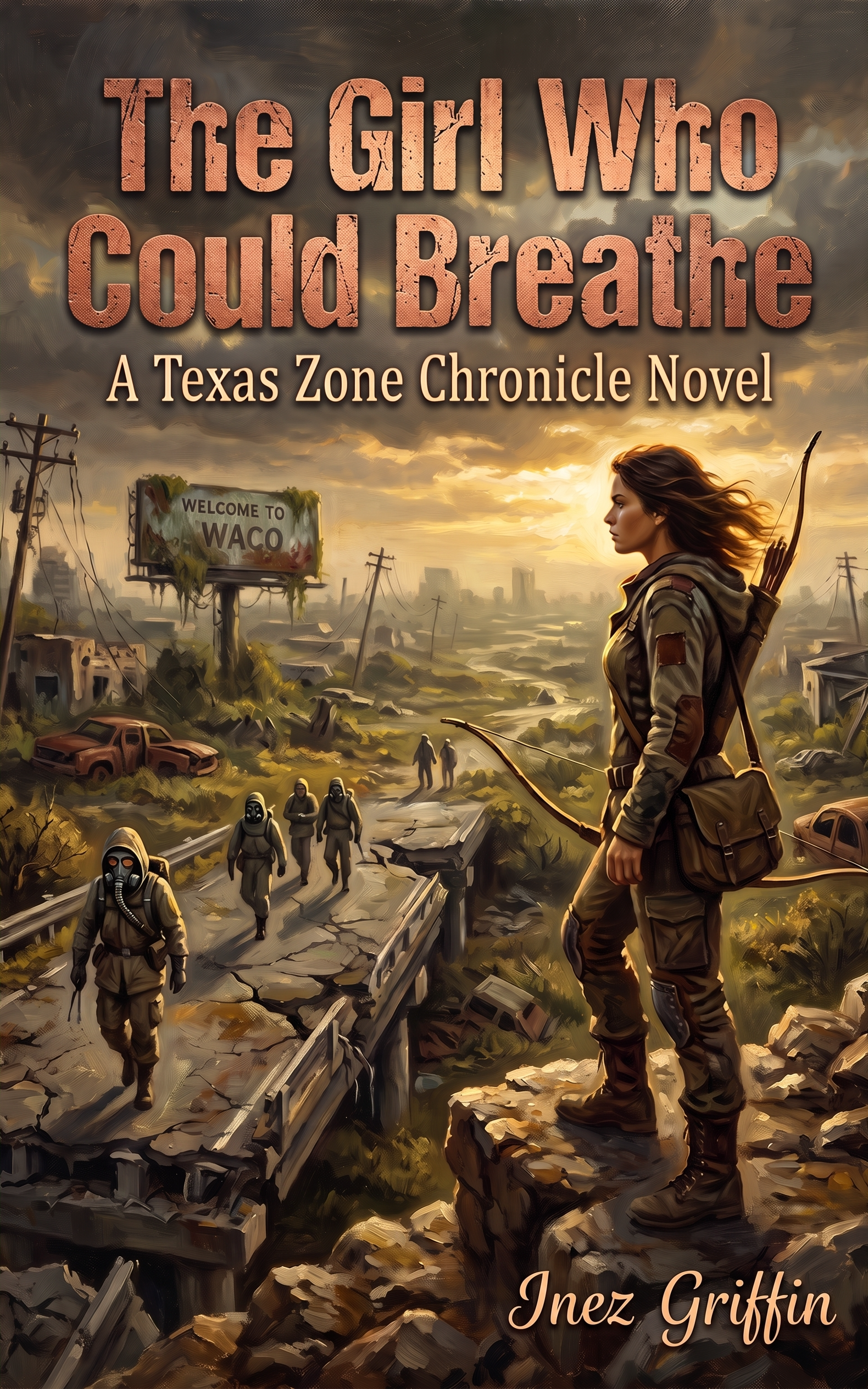
The Girl Who Could Breathe
A Texas Zone Chronicle Novel
by Inez Griffin
The air in the Zone doesn't just kill—it mutates everything it touches. To survive the toxic wilderness, you need a mask, a filter, and a prayer. Unless you’re Nico. Nico is the only person who can breathe the poisoned air. When the ruthless dictator Falcon razes her home and murders her father, her secret immunity becomes a deadly tool for vengeance. Escaping into the wasteland with her childhood friend Dan, Nico sheds her identity and assumes the mantle of a fallen soldier to join a desperate rebel cell in the ruins of Old Waco. To the rebels, she is Jack, a fearless second-in-command. To the enemy, she is a ghost—a maskless shadow haunting the supply lines of a tyrant. But as her nanite-enhanced blood begins to reveal its true power, Nico realizes she isn't just a survivor; she is a catalyst for the world’s rebirth. As Falcon’s massive military machine closes in for a final confrontation at the crumbling highway interchanges, Nico must decide how much of her humanity she is willing to sacrifice to breathe life back into a dying world. The war for the future has begun, and the first breath belongs to her.
- Science Fiction
- Adventure
- Fantasy
- Young Adult
- Post-Apocalyptic
- Dystopian
Chapter One
The whip-tongue buck stood twenty yards below her, its head lowered to graze on a patch of blue-veined grass that pulsed faintly with its own sick light. Nico held her breath behind the mask, counting the rise and fall of the creature’s ribs beneath a hide mottled gray and green, the barbed tongue curling out to strip leaves the way a snake tests the air. She had tracked it since first light, moving through undergrowth thick with chemical rot, letting the Zone swallow the sound of her footsteps the way it swallowed everything eventually.
Her mask filtered the worst of it, the acrid tang of sulfur and burnt copper hanging over this stretch of forest like a fog that never lifted. Even through the rubber seals she could taste it at the back of her throat, a chemical sourness that never fully washed out. She had grown so used to it that clean air, when she found it, tasted wrong. Empty. Like a held note dropped too soon.
She drew the bowstring back to her cheek, feeling the familiar strain settle into her shoulder, and sighted along the arrow to the soft place behind the buck’s foreleg. The whip-tongue lashed out again, tasting a low branch, and in that half second of distraction she loosed the arrow.
It took the buck clean, a solid hit that dropped it where it stood, no thrashing, no cry. Tar-black blood welled from the wound and ran down into the grass, thick as oil, threading between the blades before the ground swallowed it. Nico watched from her perch a moment longer, waiting to be sure, the way her father had taught her to wait. Then she slung the bow over her shoulder and began her climb down the oak, boots finding the notches she had memorized on the way up.
She landed soft in the leaf litter and crouched beside the animal, running a gloved hand along its flank. Even dead, the whip-tongue looked wrong to her, the proportions all slightly off, the legs a touch too long, the skull too narrow, evidence of whatever the Collapse had done to the world's blood fifty years back. She had grown up around wrongness like this. It no longer startled her. It simply was, the way the sky was, the way the wind moved through poisoned leaves.
She reached up and adjusted her mask where the strap had begun to dig into her cheekbone, the rubber warm from her own breath. It was a small motion, one she performed a hundred times a day without thinking, and yet for a moment her fingers lingered there, tracing the seal at her jaw the way she might touch a scar.
She had been six years old the first time the mask failed her, out past the north fence with her father's old hunting party, when a branch had snagged the strap and torn it loose. The men's faces twisted in panic as she was hauled behind a boulder, someone shouting for the spare filter, while she breathed—actually breathed—the raw air of the Zone with no barrier between her lungs and the poison everyone said would kill a person in minutes. She had waited to die. She had waited and waited, crouched in the dirt with her father's hand clamped so hard over her mouth that it left bruises, and nothing had happened. No burning. No blood at the eyes. Nothing at all except the strange, sweet relief of air that did not taste like rubber.
Her father had never explained it to her, not properly, not then. He had only gripped her by both shoulders once they were home, his eyes wet in a way she had never seen before, and told her that she must never let another living soul see her without the mask again. Not Dan. Not the guards. Not her own reflection, if she could help it. It was a secret sealed the way a wound gets sealed, quick and rough, before it has time to fester into something worse. She had kept it for years now. She wore the mask even when it choked her, even when the filter clogged with grit and made her head swim, because a girl who could breathe the Zone's poison air unmasked was not a girl anyone in Ward would understand. She would be a curiosity. A weapon. A thing to be studied rather than a daughter to be loved.
She pushed the memory down, the way she always did, and set to work on the buck.
The whip-tongue barb came first, the long, segmented protrusion at the base of the animal's throat that traders in Ward prized above almost anything else. It yielded a crude cure against Zone rot and fetched a high price from buyers who never asked where it came from.
Next she took the hide, peeling it back in one long, practiced motion, the muscle beneath still warm and steaming faintly in the cool morning air. She worked quickly and without waste, taking the choice cuts of meat for the community stores and leaving the rest, the organs, the bones, the ruined portions of hide, spread out for whatever scavenged this stretch of forest after dark. Nothing here went to rot for long. The Zone recycled its dead the way it recycled everything else, greedily, without sentiment.
She was folding the last of the meat into her pack, the cloth already dark with blood, when her knee pressed down into the soft earth beside the carcass and she felt something give beneath her.
She went still.
Beneath a scatter of leaves, half-sunk into the mud, was the print of a boot. Not her own boot, not the soft-soled leather the hunters of Ward wore, but something with a deep honeycomb tread, the kind stamped by pre-Collapse military issue, the kind she had only ever seen in her grandfather's old sketches. She brushed the leaves away with two fingers and found a second print beside the first, and then a third, a trail of them heading north along the tree line, deep enough to have been made recently, the mud around the edges still dark and unweathered by rain.
Her pulse picked up. She followed the line of prints another few yards on her hands and knees, careful not to disturb them further, until her fingers brushed something that was not mud at all. A scrap of fabric, snagged on a low bramble, stiff with dried blood. She worked it free and turned it over in her palm. Gray-green, tightly woven, the stitching along the hem too fine and too even to have come from anything made in Ward. She had seen fabric like this only once before, on a Capital courier who had passed through the guardhouse the previous winter under an escort of six armed men. Standard-issue garrison cloth. And blood on it, dark and old but unmistakably blood, soaked deep into the weave.
She crouched there for a long moment, listening. The Zone around her had gone quiet in the way it sometimes did, the rhythmic clicking of the blue-veined grass stilled, the rustle of unseen things in the underbrush paused as if listening back. She folded the scrap into her jacket and rose to her feet.
Whoever had left these prints did not belong out here. Capital men did not walk the deep Zone on foot, not without heavy escort, not without reason. And judging by the blood on the cloth, whatever reason had brought them here had not gone smoothly.
She spent a few careful minutes scattering leaves and brush back over the clearest of the prints, covering her own tracks alongside them, an old habit of caution that felt sharper now, more urgent. Then she shouldered her pack, heavy with meat and the whip-tongue barb, and set off at a jog toward the perimeter wall, the taste of chemical rot and old blood mixing sour at the back of her throat behind the mask.
The wall came into view an hour later, a gray concrete scar rising out of the green like something the Zone had grown around rather than something built to keep it out. Ward's perimeter had been reinforced twice in her lifetime, each time the concrete poured a little thicker, the razor wire strung a little higher, as if the settlement's fear could be measured in layers.
The guardhouse stood at the checkpoint gate, a squat structure of scavenged brick and rusted sheet metal, and Merrick was already leaning out of the window when she approached, his mask pushed up onto his forehead the way he always wore it this close to the wall, where the filtration towers kept the worst of the Zone's poison from drifting in.
"Ward's little ghost," he said, the same greeting he gave her every time, though there was real warmth beneath the teasing. He was a heavyset man with a graying beard and hands scarred from years of gate work, and he had known her since she was small enough to ride his shoulders through the market. "What'd the Zone give up today?"
She unslung her pack and set it on the guardhouse counter, unwrapping the oiled cloth to reveal the whip-tongue barb, its segmented casing catching the pale morning light. Merrick's eyebrows rose.
"Well, would you look at that," he said, letting out a low whistle. "Been a month since anyone brought one of these through my gate. You're spoiling us, girl."
"Eighteen tokens," Nico said. "That's the going rate. Don't tell me it's dropped."
Merrick chuckled, already reaching for the lockbox beneath the counter. "No, no, still eighteen. Just surprised is all. Most hunters won't go near a whip-tongue's home ground. Nasty tempers, those bucks." He counted out the wooden tokens one by one into her palm, each stamped with Ward's crude sigil, a coiled river snake burned into the grain. "You get anything else out there worth mentioning?"
She hesitated only a fraction of a second, the scrap of bloody Capital cloth heavy in her jacket pocket like a stone she had swallowed. "Nothing worth mentioning," she said. "Quiet morning, otherwise."
Merrick nodded, satisfied, and waved her through the gate with the easy familiarity of a man who trusted her judgment more than his own two eyes. The gate groaned open on its chain pulley, and she stepped through into Ward proper, the concrete wall closing behind her with a heavy clang that always made something in her chest loosen, just slightly, the way it never quite did out in the Zone.
The market hit her first, before she even reached the square, a wall of smell so different from the chemical rot of the Zone that it always took her a moment to adjust. Woodsmoke curled up from a dozen cook fires. Someone nearby fried river fish in rendered fat, the oil popping and hissing. Beneath that ran the earthy smell of turned soil from the community gardens, the yeasty warmth of bread baking in the communal ovens, and the animal musk of penned goats bleating past the tanner's stall. It was a crowded, human smell—sweat, smoke, and cooking fat layered over packed dirt streets. After hours of sulfur and rot, it filled her lungs like something she had been starving for.
She kept her mask on regardless. Ward's air was cleaner than the Zone's, filtered by the towers along the wall, but it was not clean enough to breathe bare, not according to anyone but her, and she had learned long ago not to test that truth where eyes might be watching.
She was halfway across the square, weaving between stalls of dried herbs and traded scrap, when a familiar voice called her name.
"Nico! Hey, wait up."
Dan Radcliff came jogging toward her, lanky and a little too fast for the crowd, nearly upending a stall of dyed cloth before he caught himself. His mask, custom-fitted with the tactical goggles his father had scavenged from a Capital surplus crate years back, sat slightly crooked on his face, and he pushed it straight with the back of his wrist as he reached her.
"You look like you slept in a ditch," she said.
"I did sleep in a ditch. Well, not a ditch, the filtration shed, but it might as well have been. Compressor's been acting up again and my dad wanted it fixed before the council meeting tonight." He fell into step beside her, glancing back over his shoulder toward the trade road the way he always did when something was on his mind, a nervous habit she had given up trying to break him of. "Listen, you should know. There's been talk."
"There's always talk."
"Not this kind." He lowered his voice, leaning in close enough that she caught the grease smell still clinging to his sleeves. "Capital men came through the east road yesterday. Three of them, official escort and everything, said they were doing a routine tithe inspection, but that's not what they were asking about at the tavern."
Nico slowed her pace. "What were they asking?"
"Maskless people." Dan's eyes flicked to hers, wide behind the goggles. "That's the word going around, anyway. My mother heard it from the innkeeper, who heard it from one of the escort himself, half drunk and running his mouth. They wanted to know if anyone in Ward had ever heard stories about survivors out in the Zone who could breathe the air without a mask. Old wives' tales, ghost stories, that sort of thing. Except they weren't asking like it was a joke. They were writing it down."
Something cold settled low in Nico's stomach, a feeling she recognized from childhood, from the moment her father's hand had clamped over her mouth in the dirt. She kept her voice even. "That's a strange thing for a tithe inspector to care about."
"That's what I thought too." Dan glanced around the square again, an old habit worn smooth from years of caution. "I don't know what it means. Probably nothing. Capital's always looking for some new excuse to squeeze more tithe out of us, some new threat to justify the garrisons. But I thought you'd want to know. Given, you know." He didn't finish the sentence. He never had to, not with her.
She thought of the boot prints sunk deep in Zone mud, of the bloody Capital cloth folded in her jacket pocket, and felt the pieces settle into a shape she did not like.
"Thanks for telling me," she said. "I need to get this meat to Ruth before it turns. I'll find you later."
Dan nodded, already distracted by the sight of a stall selling scavenged filter cartridges, and she left him haggling over prices as she cut through the square toward the community center.
The community center occupied what had once been, according to the oldest residents, some kind of pre-Collapse civic building, its bones still visible beneath decades of patchwork repair, brick walls reinforced with scavenged sheet metal, windows boarded over except for narrow slats that let in thin bars of daylight. Inside, the air was warm and close, thick with the smell of curing meat and root vegetables stored in barrels along the back wall.
Ruth stood behind the long counter that served as Ward's rationing desk, her graying hair pinned back beneath a kerchief, a ledger open in front of her with columns of names and weights marked in careful, cramped handwriting. She looked up as Nico approached and set her quill down with the briskness of a woman who did not enjoy having her rhythm interrupted.
"Whip-tongue," Nico said, setting the wrapped bundle of meat on the counter. "Fifteen pounds, dressed. Already sold the barb to Merrick at the gate."
Ruth unwrapped the cloth with practiced hands, weighing the cuts on the iron scale bolted to the counter, murmuring numbers to herself as she went. "Good color," she said, more to herself than to Nico. "Not gone gray at the edges like the last batch. You dressed this clean."
"Field dressed it within the hour."
Ruth made a note in her ledger, then glanced up, her sharp eyes narrowing slightly the way they did whenever she sensed Nico's mind wandering somewhere else. "You look distracted, girl."
"Long walk back," Nico said. "That's all."
Ruth studied her another moment, then seemed to decide it wasn't worth the argument, and turned back to her ledger, tallying the weight against the day's total. "Fifteen pounds, noted. Tell your father the western quota's still short for the month. Council's been asking after every hunter in town."
"I'll tell him."
She left the community center with the wooden tokens from Merrick still weighing her pocket, the bloody scrap of Capital cloth weighing heavier still, and made her way through the narrowing streets toward Ward Manor, the largest structure in the settlement, built up from the old pre-Collapse ruins her father had claimed as the seat of his authority when he first wrested control of these lands from the warlords who ruled here before him.
The manor's front hall smelled of beeswax polish and old paper, the scent of order imposed on a world that had none, and she crossed it quickly, nodding to the two guards posted at the base of the stairs, before making her way up to her father's study.
The door stood ajar. Inside, she could hear her father's low voice and, beneath it, the clipped, formal tones of Mr. Radcliff, Captain of the Guard, Dan's father, a man whose posture always seemed carved from something harder than flesh. She paused at the threshold only a moment before pushing the door open the rest of the way.
Both men looked up. Her father sat behind his desk, a broad man with dark hair cropped close and a heaviness in his brow that had only deepened in the years since her mother's death, maps and ledgers spread across the desk in front of him. Mr. Radcliff stood at his shoulder, one hand resting on the hilt of the short blade he wore even indoors, his expression unreadable.
"Nico," her father said, setting down whatever he had been reading. "You're back early."
"I need to show you something." She crossed the room and set the bloody scrap of Capital cloth on the desk between them, unfolding it so the fine, even stitching was visible along the hem. "I found this in the deep Zone, north of the whip-tongue's territory. There were boot prints alongside it. Military tread, honeycomb pattern, the kind Grandfather sketched once. Deep enough in the mud to be recent."
Her father's face changed, something tightening around his eyes as he reached for the cloth and turned it over in his fingers. Mr. Radcliff leaned in beside him, studying the stitching with the same narrow focus he brought to inspecting the guard rotation.
"Garrison issue," Mr. Radcliff said quietly. "No question."
"How many prints," her father asked, not looking up from the cloth.
"At least three sets. All heading north, away from the river, deeper into the Zone. The cloth was snagged on a bramble near the last set of tracks. There was blood soaked into it, dried, maybe a day old."
Her father set the cloth down slowly, and when he looked at her, the weight in his gaze was heavier than she had expected. "You covered the tracks?"
"Yes. Scattered the prints, buried what I could."
"Good." He exhaled through his nose, glancing at Mr. Radcliff, some silent communication passing between the two men that Nico could not fully read. "This is council business now, Nico. You've done well to bring it to me. But that's the end of your part in it."
"The end of it?" She kept her voice level, though something in her chest had already begun to protest. "Three Capital soldiers on foot, deep in the Zone, one of them bleeding. That's not nothing. If they're scouting—"
"I know what it might mean." Her father's voice sharpened, the way it did when he had already made up his mind and did not intend to revisit it. "Which is precisely why it isn't yours to chase. You are not tracking Capital soldiers through the deep Zone, Nico. Not alone, not with a hunting party, not under any circumstance I will approve."
"I found the tracks by accident. I wasn't chasing anything, I was hunting whip-tongue on the north ridge same as always. If there are Capital men moving through there, don't you want to know why?"
"I want the council to know why, through proper channels, with armed escort and men trained for exactly this kind of reconnaissance. Not a seventeen-year-old girl with a bow and a mask two seasons past its filter life." He caught himself at the sharpness of his own tone, softened it slightly, though the iron beneath remained. "You brought me useful information. That's your part done. Let the guard handle what comes next."
Mr. Radcliff cleared his throat, the closest thing to sympathy the man's stiff bearing ever allowed. "I'll take my leave," he said, folding the bloody cloth carefully and tucking it into his coat. "I'll have men review the northern approach at first light, Tyler. Quietly."
Her father nodded, and Mr. Radcliff inclined his head to Nico on his way out, the door clicking shut behind him with a finality that seemed to settle the matter for good in her father's mind, if not in hers.
"Father—"
"This conversation is finished, Nico." He was already turning back to the maps and ledgers spread across his desk, a clear dismissal, the kind he had given her a hundred times before when the subject strayed too close to danger. "Go home. Get some rest. You've done your work for the day."
She wanted to argue further, wanted to remind him that she had walked that ridge line more times than any guard he might send, that she knew its false paths and its sinkholes and the places where the ground turned to poison mud without warning. But she had learned long ago which battles were worth fighting with her father and which only hardened him further, and this one, she could tell from the set of his jaw, was already lost.
She left the study without another word, descending the stairs past the guards at the base, out through the polished front hall and up the narrower back stairs to her own room on the manor's second floor.
Her room was small and plain, a cot against one wall, a chest of drawers scarred with age, a narrow window that looked out over the rooftops of Ward toward the dark line of trees marking the edge of the Zone. She shut the door behind her and stood for a moment in the quiet, listening to the manor settle around her, the distant murmur of voices from the study below fading into silence.
She crossed to the chest of drawers and drew her hunting knife from its sheath, sitting on the edge of her cot with the whetstone she kept wrapped in oiled cloth at the bottom of her pack. The rhythm of the blade against stone was familiar, steadying, a sound she had grown up falling asleep to some nights when sleep did not come easily otherwise. She worked the edge with slow, even strokes, watching the dull gray steel catch the last of the afternoon light through her window.
When the blade was sharp enough to satisfy her, she set the whetstone aside and reached beneath the loose floorboard near the head of her cot, drawing out a folded square of paper worn soft at the creases from years of handling. She unfolded it carefully on her knee, smoothing the wrinkles with the flat of her palm.
It was a map, hand-drawn in faded ink, sketched decades ago by her grandfather before he vanished into the deep Zone to live his solitary, scavenging life. It showed the northern ridge line in careful detail, elevation lines and old road markers, a scattering of symbols in the margins she had never fully learned to read, notes in a cramped, precise hand about water sources and shelter and places the Zone's poison ran thinner than anywhere else for reasons no one had ever explained to her.
She traced her finger along the ridge where the Capital boot prints had led, north and further north, past the edge of what her grandfather's map even bothered to chart, into blank paper where nothing was marked at all.
Her father had told her to leave it to the council. She had agreed with her silence, the way she always did when arguing further would cost her more than it gained. But sitting there with the map spread across her knee, the knife freshly sharpened at her side, she found she could not stop turning the boot prints over in her mind, the honeycomb tread sunk deep in poisoned mud, the blood soaked dark into garrison cloth.
Whatever had happened out there, whatever had driven Capital soldiers on foot into the deep Zone bleeding and alone, it was not finished. She could feel it the way she felt weather changing before the first drop of rain, a pressure at the back of her skull that would not let her rest.
She folded the map along its old creases and slid it back beneath the floorboard, but she left the knife out on the cot beside her, within easy reach, and did not light the lamp as the room slid slowly into dusk.
Chapter Two
The Great Hall of Ward Manor had once been a bank lobby, or so her father claimed, back before the Collapse scoured the meaning out of words like teller and vault. Now it served as council chambers, its high windows boarded halfway up and its marble floor scuffed pale by decades of boots. The long table at its center was pre-Collapse oak, salvaged …