

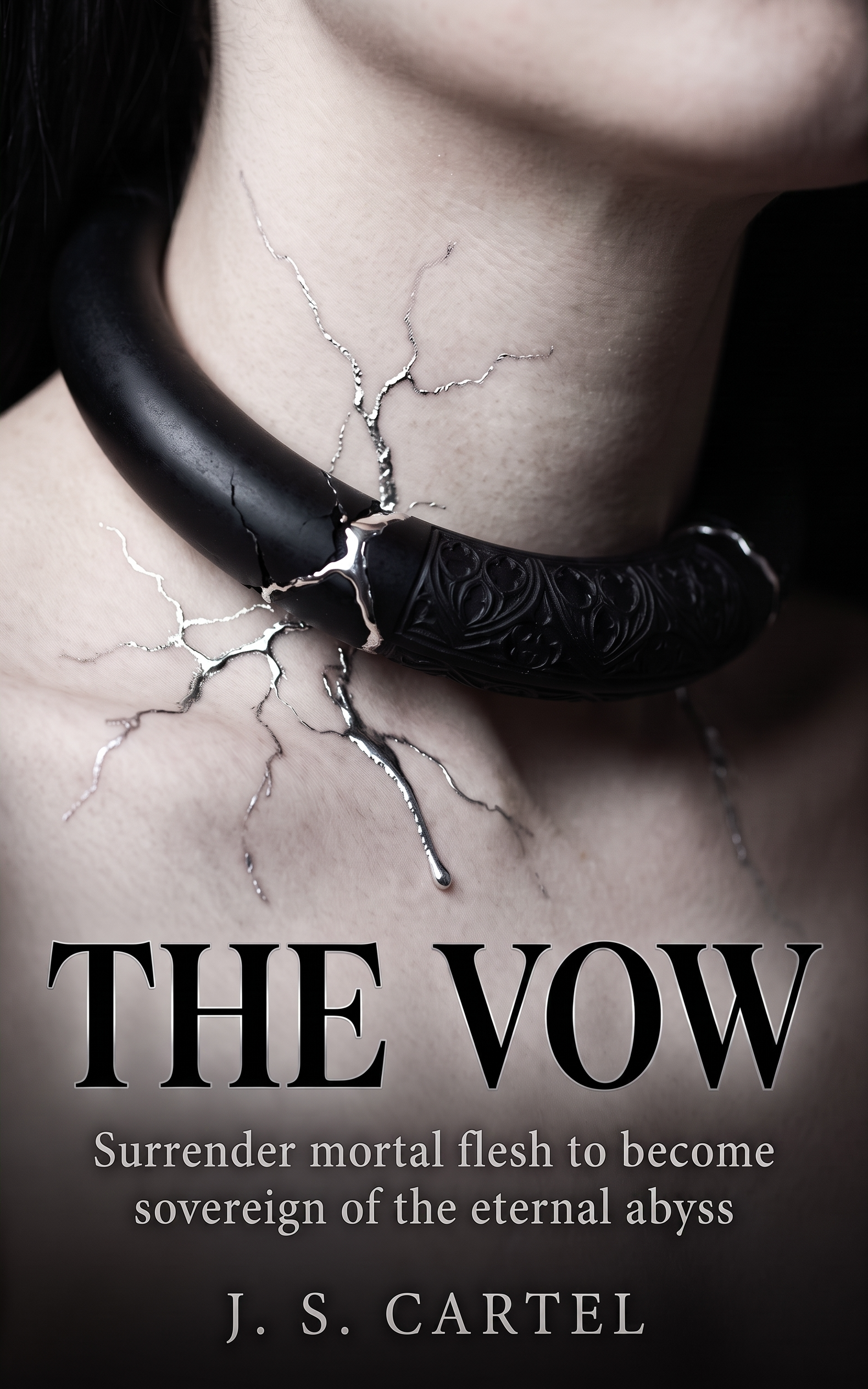
The Vow
Surrender mortal flesh to become sovereign of the eternal abyss
by J. S. Cartel
Anistasia Wilde knows how to restore fractured beauty, but she cannot mend her own fraying reality. Within her mundane restoration studio, the mortal world begins to splinter, bleeding into sensory visions of a breathing Gothic cathedral carved from obsidian stone. A primal, suffocating pull summons her away from the safety of her mortal life and the warnings of her dearest friend, dragging her toward an ancient entity of terrifying majesty. Abasolm Neichi is the sovereign lord of shadow and void, a towering nightmare with mercurial silver eyes who claims Anistasia was forged solely to be his eternal bride. The shifting halls of his dark realm echo with the restless debris of centuries of discarded women. Yet where others withered, Anistasia feels an intoxicating awakening. To rule beside him, she must endure an ancient covenant: the binding weight of an obsidian collar, a sacred communion of blood, and an etched brand upon her collarbone. Choosing eternity over her human soul, Anistasia faces total eclipse. Will she shatter beneath his abyssal claim, or rise transformed as the merciless queen of darkness?
- Fantasy
- Romance
- Horror
- Dark Fantasy
- Paranormal Romance
- Dark Romance
The Threshold of the Dreamscape
The thermostat on the wall hummed, a persistent, mechanical drone that usually lulled Anistasia into a state of productivity. Tonight, however, the digital readout—set stubbornly to seventy-two degrees—felt like an insult.
She stood in the center of her living room, her art history textbooks splayed open on the mahogany coffee table, their pages filled with the cold, precise observations of human history. They felt like artifacts from a life she had lived in a different century. A shiver tore through her, jagged and cold, starting at the base of her spine and blooming outward until her skin prickled. It wasn't the temperature of the room that had changed; it was the temperature of the air itself.
The scent of ozone—sharp, metallic, and electric—cut through the familiar smell of lavender candles and old paper.
Anistasia gripped the edge of the bookshelf, her knuckles turning white. She squeezed her eyes shut, trying to force the rational world back into focus. It’s just stress, she whispered to the empty, quiet room. Elias said it’s just stress. A reaction to the burnout. The research paper on Gothic architecture is just… bleeding over.
But her hands refused to stop shaking.
When she opened her eyes, the edges of her vision blurred. For a heartbeat, the pristine white walls of her apartment vanished. In their place, for the briefest, most agonizing flicker, she saw the silhouette of a stone archway, towering and decrepit, stained with centuries of moss and shadow. She felt the dampness of a subterranean cavern on her skin, a heavy, oppressive humidity that smelled of incense and ancient, drying blood.
Then, the living room slammed back into view. The hum of the AC returned, but it sounded distorted now, like a groan coming from the throat of a dying thing.
She stumbled backward, her hip catching the edge of the sofa. She reached out, grasping for something—a lamp, a throw pillow, anything—but her fingers passed through the solid matter of her own reality as if it were made of smoke. The sensory bleed was becoming absolute. She could see her coffee table, but she could also see the slick, uneven floor of a cathedral nave beneath it. The floorboards of her apartment were interlaced with cracked, obsidian flagstones.
"Stop it," she gasped, her voice sounding small and brittle, a moth fluttering against a storm. "I am here. I am in the city. I am in my home."
She looked down at her wrist. A thin, jagged line of red, fresh and stinging, had appeared across her pulse point. It hadn’t been there a minute ago. She hadn't cut herself. It looked like a graze, a phantom wound inflicted by something that wasn't currently in the room with her.
The shadows in the corner of the room began to lengthen, crawling across the floorboards with a predatory, liquid grace. They didn't move like natural shadows cast by her reading lamp; they moved with purpose, stretching toward her, curling around the legs of her furniture as if tasting the space.
She felt an overwhelming pull in her chest, a physical tug at her very sternum that threatened to unspool her. It was a sensation of gravity shifting, as if the apartment were a ship tilting violently on a dark, churning sea. The walls seemed to breathe, the wallpaper rippling like skin. Every time she blinked, the reality of her apartment receded, replaced by the crushing, majestic darkness of a place that existed outside of time.
She pressed her palms to her temples, trying to ground herself, but the touch felt wrong—too thick, too clumsy. She could see her hands, but they looked pale, ethereal, almost translucent against the dark, swirling void that was encroaching from the periphery of her vision.
"Elias," she breathed, the name an anchor she was desperately trying to cast into a receding tide. But even as she spoke, the name tasted like ash. It felt like a memory from a dream she had forgotten upon waking. Her mortal life, the logic, the safety, the predictable routines—they were fraying, dissolving into threads that were being woven into something far more intricate and dangerous.
The air grew heavy, thick with the weight of an immense, singular presence. It was a pressure that didn't just push against her skin; it pushed against her thoughts, quieting the frantic, logical protestations of her brain. It was a velvet shroud descending over her consciousness.
The scent of ozone deepened, becoming suffocating. She felt her knees buckle, not from weakness, but from an instinctual, primal urge to bow. The floorboards beneath her seemed to soften, turning into the cold, unyielding stone of an altar.
Her vision tunneled. The last thing she saw of her apartment was the stark, fluorescent flicker of her desk lamp. Then, the light hissed and died, smothered by a darkness so absolute it felt like a caress.
She wasn't falling, but she was no longer standing on anything solid. She was suspended in the silence, a silence so profound it roared in her ears. The boundary was gone. The transition was complete. And as the last vestiges of her apartment faded into the void, she felt the terrifying, electric jolt of being pulled—not into sleep, but into the inevitable.
She let out a final, shuddering breath, her body going limp, surrendering to the void, waiting for the shadows to claim what was already theirs. The hunger for the dream had finally eclipsed the hunger for her life. She closed her eyes, and for the first time, she didn't try to wake up.
When she opened her eyes, the air tasted of pulverized stone and cold, stagnant ozone, a pressurized silence that made the tiny bones in her inner ear ache.
Anistasia stood on a floor of polished obsidian, slick with a fine, translucent frost. She was no longer wearing her oversized cotton sleep shirt. In its place, she felt the heavy, archaic weight of midnight-dark velvet dragging against her skin, the fabric woven with threads that seemed to pulse in time with her own slowing pulse.
She was in the heart of the cathedral.
It was a cavernous ribcage of architecture, soaring upward into a darkness so absolute it felt sentient. Massive, flying buttresses curved overhead like the talons of a sleeping god. There were no candles, yet the space was illuminated by a sickly, bioluminescent fog that clung to the floor and curled around her bare ankles.
Every facet of the cathedral felt like a mirror. The cracked stained glass didn't depict saints or martyrs; it depicted sequences of her own life—the lonely nights grading papers, the hollow satisfaction of a finished article, the frantic, desperate way she had clawed at the locks of her own apartment door to keep the shadows out. She saw herself in the leaded glass, distorted and diminished, a small, fragile creature trapped in a life that had never quite fit.
She turned in a slow, hypnotic circle, her breath hitching. The architecture here wasn't merely inanimate stone. The walls breathed. When she leaned a hand against a pillar to steady herself, the masonry felt warm, vibrating with a low-frequency hum that resonated in her teeth. It was a rhythmic, guttural sound—the sound of a heartbeat that wasn't hers.
"You are finally quiet," a voice drifted through the gloom. It wasn't spoken in the air; it vibrated against the back of her retinas, a velvet-edged command that stripped away the last of her defenses.
Anistasia didn't jump. She couldn't. Her body felt strangely heavy, as if the very air in this realm had turned to quicksand, pinning her in place. The yearning she had buried under years of professional ambition and suburban normalcy bloomed in her chest, sharp and agonizing. It was a hunger she hadn't known how to name until this moment.
"I didn't ask to be here," she whispered, though the words felt like a lie the moment they left her lips. She didn't struggle. She simply watched as the shadows at the far end of the nave began to knit themselves together.
The darkness didn't part; it condensed. It pulled inward, folding upon itself until it solidified into a silhouette that dwarfed the towering arches. The entity moved without the friction of human joints, his footsteps making no sound against the obsidian, yet with each closing stride the air compressed like lead around her ribs. The humid drone of the nave died away to a pressurized stillness, so close and dense she could hear the sharp prickle of frost creeping over the hem of her gown and the heat of her own throat catching against the hush.
She felt him before she saw his face. It was the sensation of being under a microscope, of having every secret thought, every suppressed desire, and every fractured piece of her identity laid bare under his scrutiny. He was a master of this domain, and she was the long-lost artifact he had finally recovered.
"You have been asking since the moment you were born, Anis," the voice rumbled, closer now.
He stepped into the thin, grey light. Abasolm Neichi.
In her dreams, he had been a suggestion, a flicker of silver eyes in the periphery. Here, he was absolute. He was tall, clad in armor that looked like solidified shadow, etched with runes that seemed to writhe against his skin. His face was a masterpiece of harsh, classical angles, cold as the marble surrounding them, but his eyes—those impossible, mercurial silver eyes—were burning with a terrifying, ancient intensity.
He stopped just a breath away from her. The proximity drew a tight, dizzying heat through her limbs, pulling at the tendons in her neck until the impulse to tilt her chin back—to bare the pale line of her throat to him, or drop to her knees upon the obsidian—settled in her marrow before she could even summon a thought to stop it.
"Look at this place," Abasolm murmured, his gaze sweeping the crumbling, Gothic decay of the cathedral. His hand came up, his fingers trailing through the air near her cheek without making contact. The mere proximity of his skin made the hair on her arms stand up. "It is a monument to your own internal desert. You have spent your life starving for a purpose that the waking world could never provide. You look for logic, for history, for anchors—and all the while, your soul has been screaming for the abyss."
Anistasia trembled, her hands clenching into fists at her sides. "It’s a nightmare," she insisted, though her voice lacked conviction. "It's just my mind breaking down. You’re not real."
Abasolm stepped closer, invading her space until their chests were almost touching. The scent of him—ozone, old parchment, and something metallic, like blood on a cold blade—overwhelmed her senses. He reached out, his long, pale fingers hooking firmly beneath her chin, forcing her to look up into that silver-eyed void.
"If I am a nightmare, then why does your heart race for me instead of for the exit?"
He tilted her head back. His thumb traced the line of her jaw, his touch firm, possessive, and electric. "The anchor you cling to—that boy, Elias—he offers you a safety that is nothing more than a slow death. He offers you a mundane, ticking clock. A life of soft edges and shallow breaths."
He leaned down, his lips brushing against the shell of her ear, his breath a chilling draft against her skin. "I offer you the truth of what you are. I offer you the end of the waiting."
Anistasia closed her eyes, a shudder wracking her frame. The reality of her apartment—the stack of unread journals, the ticking wall clock, the crushing weight of her own insignificance—seemed like a faded photograph held against the vibrant, terrifying intensity of his presence. She felt her autonomy slipping away, not through force, but through a seductive, terrifying gravity. She was a planet being pulled into the orbit of a dying, beautiful star.
She didn't pull away. Instead, she leaned into his touch, her breath hitching in a jagged sob. The surrender wasn't an act of weakness, she realized with a jolt of clarity; it was the final shedding of her skin.
"What do you want from me?" she whispered, her voice barely audible in the vast, hollow cathedral.
Abasolm’s fingers tightened, not enough to bruise, but enough to claim. A dark, predatory smile touched his lips—a gesture that promised both exquisite pleasure and absolute subjugation.
"I want the only thing I have ever wanted, Anis," he replied, his voice dropping to a low, resonant thrum that vibrated through the very floorboards. "I want the totality of you. I want your history, your fears, and every heartbeat you have left to offer. I want you to stop pretending you are human."
He withdrew his hand, the sudden absence of his touch leaving her feeling colder than the stone beneath her feet. He turned and walked toward the center of the nave, where a massive altar of jagged black stone rose from the floor. It was etched with glowing, crimson sigils that pulsed in time with the architecture.
"The union is not a request," he said, turning back to face her, his silver eyes reflecting the swirling chaos of the ceiling. "It is an inevitability. Come to the altar, Anistasia. Step out of the dream and into the binding."
He stood waiting, a sovereign in his own dark kingdom, holding the threads of her fate between his fingers. Anistasia took a single, shaky step forward, the sound of her movement echoing off the vaulted ceilings like a gavel striking a desk. She was no longer afraid of the end. She was only afraid that he might change his mind, and leave her back in the silence of her own empty rooms.
Anistasia stepped onto the rise of the dais, the obsidian floor biting through the soles of her bare feet like a mirror of frozen smoke as the architecture of the cathedral inhaled around her. The vaulted ceiling, lost in a suffocating shroud of soot and starlight, seemed to weep, the silence thick with the hum of a frequency that vibrated in her marrow.
Abasolm stood before her like a monolith carved from the midnight air. Up close, he was not merely a man; he was an overwhelming gravitational field. The silver of his eyes had bled into the whites, turning his gaze into two pools of liquid mercury that reflected not her face, but the raw, unadorned truth of her soul.
"You have been wandering the periphery of this moment for lifetimes," Abasolm said, his voice less a sound and more an imprint left directly onto her psyche. He did not reach for her. He did not have to. His presence was a physical weight, a velvet collar tightening around her throat.
Anistasia’s pulse stuttered, not from fear, but from the sudden, jarring recognition of purpose. All the years of mundane study, the art history lectures, the sterile silence of her apartment—it had all been a long, shallow breath held in anticipation of this exhale.
"Is this real?" she whispered, her voice sounding thin and brittle against the vast, oppressive grandeur of the nave. "Or am I finally losing the last thread of myself?"
Abasolm descended a single step. The movement was predatory in its grace. He reached out, the backs of his cool knuckles trailing along the hollow beneath her collarbone. His skin felt like marble—hard, smooth, and impossibly cold—yet the touch sent a searing heat cascading down her spine, a molten river that liquified her remaining resistance.
"Reality is a consensus, Anistasia. A fragile agreement made by those who fear the dark," he murmured. His thumb traced her bottom lip, his touch possessing a clinical, terrifying intimacy. "You never belonged to that world. You were a guest, an observer, a ghost haunting your own life. Here, you are finally tangible. Here, you are finally mine."
She trembled, the sensation of his power bleeding into her veins like ink into water. The air around them began to thicken with the scent of ozone and crushed lilies—the smell of a storm trapped in a tomb. She looked up into those mercurial eyes, and for the first time, she saw the scope of his hunger. It wasn't the ravenous, mindless consumption she had feared; it was something far more ancient and possessive. It was the hunger of a collector who had finally found the missing piece of his masterpiece.
"I am afraid," she admitted, the confession torn from her by the sheer gravity of his stare.
"Fear is the first step of surrender," Abasolm replied, his tone softening into something dangerously intoxicating. "To be bound is not to be broken, little historian. It is to be anchored. You have spent your life drifting in the currents of a world that does not see you. Let me be the shore."
He shifted, his hands sliding to her waist. The heavy, archaic velvet of her gown—an ancient shroud replacing the remnants of her mortal life—seemed to yield beneath his touch, or perhaps she simply stopped perceiving any barrier between them. She felt only the shock of his fingers against her skin, the way his heat acted as a catalyst, igniting dormant nerves that had been numb since birth.
The shadows around them began to stir. The gargoyles perched high above the columns seemed to tilt their heads, their stone eyes following her progress. She felt the heavy, rhythmic thrum of the earth beneath them—the cathedral wasn't just a building; it was a living, breathing entity, and it was watching them.
Anistasia leaned into him, a silent gasp escaping her lips as his strength braced her, holding her upright in a space where gravity seemed a mere suggestion. She felt the intoxicating pull of his darkness, a seductive gravity that demanded she cease her striving. The conflict that had warred within her for weeks—the pragmatic logic of Elias, the terror of the unknown—evaporated, replaced by a crystalline clarity.
"What do you require of me?" she asked, her voice steadying, growing resonant in the hollow silence.
Abasolm’s lips curved into a smile that held no warmth, only a profound, possessive satisfaction. "Only the truth, Anistasia. The truth you have hidden from yourself in every waking hour. I do not want your obedience; I want your recognition. I want you to look at the abyss and realize it is where you have always belonged."
He tilted her head back, exposing the fragile column of her throat to the dim, shifting light. She didn't flinch. Instead, she felt a strange, primal urge to offer him more. The dread that had characterized her early experiences had transmuted into an addictive, electric hum. She was a vessel, and he was the tide, and she could feel herself beginning to fill with the weight of him.
"I see it," she whispered, her hands rising instinctively to grip his forearms. His skin felt solid, immutable, a stark contrast to the shifting, dreamlike quality of the world around them. "I see what you are. And I recognize what I am becoming."
"Good," he breathed, the word a caress against her ear.
The air in the cathedral shifted. A low, rhythmic chanting began to resonate from the very foundations, a discordant, multi-tonal sound that felt like the earth grinding its teeth. It was an ancient, forgotten language, one that didn't need to be understood to be felt. It set her blood on fire.
Abasolm leaned down, his face hovering mere inches from her own, his gaze locked onto her pupils as if he were reading the history of her bloodline. "The rite is a covenant, not a theft. You are choosing this. You are choosing the weight of my crown and the shackles of my devotion."
Anistasia looked around the cathedral one last time. In the shadows, she thought she caught a glimpse of a different world—the gray, drizzling morning of her apartment, the stack of unfinished paperwork, the empty coffee mug that had once been her anchor. It looked small. It looked grey. It looked like a grave.
She turned her attention back to Abasolm, her eyes finally darkening to match his own. "I choose," she said, her voice echoing through the vaulted space, a final, irrevocable decree. "Bind me."
Abasolm’s expression shifted, his composure cracking for a heartbeat to reveal the sheer, terrifying intensity of his relief—or perhaps his triumph. He gathered her closer, his arms wrapping around her like iron bands, and she let go. She let go of the sanity she had been clutching, the definitions of herself she had been given by others, and the anchor of her mortal identity.
She wasn't falling; she was arriving. As he pressed his forehead against hers, the world outside the cathedral doors ceased to exist entirely, leaving only the sound of their unified breath and the suffocating, glorious weight of their covenant. The transition was no longer a dream; it was the onset of a new, relentless reality, and for the first time in her life, Anistasia Wilde was entirely, perfectly awake.
Whispers in the Shadowed Hall
The space between her breaths thinned until the air itself felt like crushed velvet—heavy, cold, and tasting of ozone and ancient dust. Anis felt the floor beneath her boots, once the solid, reliable oak of her apartment hallway, now shift into a geometry that defied Euclidean logic. The stone here didn't merely exist; it breathed. As she stepped f…