

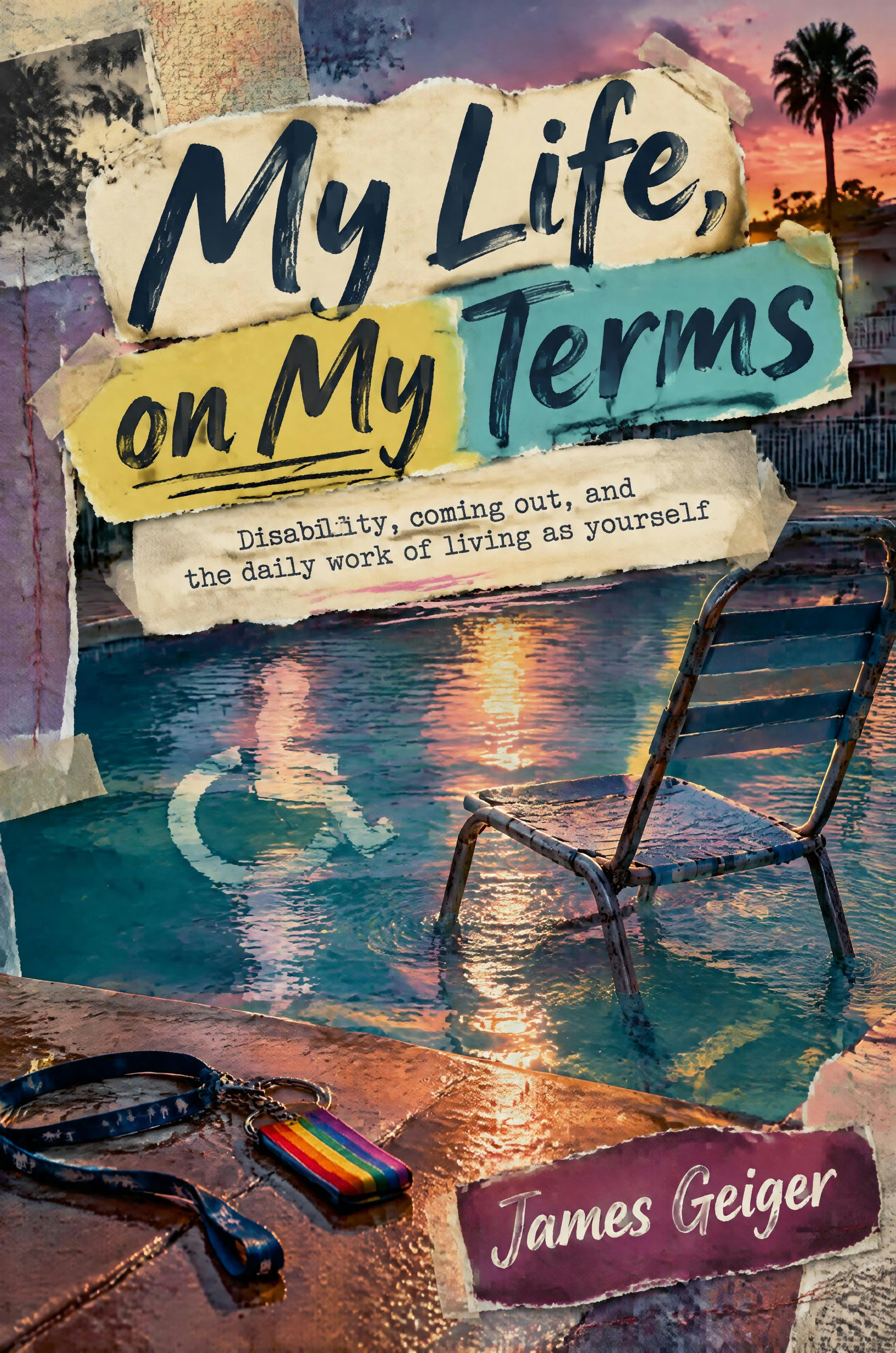
My Life, on My Terms
Disability, coming out, and the daily work of living as yourself
by James Geiger
James Geiger’s life has never been a straight line from struggle to triumph. It has been both at once. My Life, on My Terms follows him through childhood in an inaccessible world, a family move to Florida in 1996, youth leadership that cracked open his sense of possibility, and the double weight of homophobia and ableism as he came of age. Coming out to family, friends, and peers is not a single scene; it is a long, unfinished conversation with himself. College brings autonomy, advocacy, and real academic success—proof that the same person who fought for ramps and belonging can also build a life on his own terms. Yet self-acceptance remains daily work, not a trophy on the shelf. This memoir is also a guide: each chapter pairs vivid story with reflection questions, exercises, and takeaways for LGBTQ+ readers, disabled people, educators, and allies. If you have ever been told you could only be one thing at a time, this book is an honest map of how to stay whole anyway.
- Biography
- Coming of Age Memoir
- Family Memoir
- Overcoming Adversity
- LGBTQ+ Memoir
Nine Weeks Early: Arrival and Adoption
I arrived into the world nine weeks ahead of schedule. When you are born that early, your body has not finished building the equipment it needs to survive outside the womb. My lungs were incomplete, my nervous system was raw, and my weight was dangerously low. Before I had taken a breath on my own, doctors and nurses were rushing around me with monitors, plastic tubes, and warming lights. I was placed straight into an incubator in the neonatal intensive care unit (NICU). In those first minutes, the primary goal was keeping me alive.
During that rush of medical emergencies, bleeding surged through my brain. That lack of oxygen and the resulting damage to my motor control centers brought an early diagnosis: Cerebral Palsy. My brain could not send clean, steady electrical signals down to my limbs. My muscles would tighten on their own, clenching against my will. My legs pulled inward, my balance was fragile, and my motor coordination was knocked out of sync before I possessed conscious awareness of my limbs. Along with that physical diagnosis came another sudden reality. My biological parents could not keep me. I was placed into the adoption system as a medically fragile infant with an uncertain prognosis. I had no say in where I landed or who would care for me.
When you enter the world through an incubator and a social services file, you do not start with a blank slate. You start with a chart. Doctors had their notes on my muscle tone, reflexes, and developmental benchmarks. Caseworkers had their folders detailing legal status and foster placements. I was an infant who needed specialized physical therapy, round-the-clock monitoring, and someone willing to take on a lifetime of orthopedic appointments. Many prospective parents look for easy, predictable babies. I was neither of those things. I was a tiny boy with stiff muscles, high medical needs, and a nervous system that reacted to every sound like a direct alarm.
The Divide of Early Memory
I grew up knowing I was adopted. My mother never hid it from me, and that honesty was one of the greatest gifts she gave me. But understanding adoption in your head is very different from processing it in your gut when you are five or six years old. When you combine adoption with a physical disability, childhood feels split in two. There is the world that other children live in, running across grass without thinking about their ankles, and then there is the world you inhabit, where your body feels like an unfamiliar machine.
I remember sitting on the edge of the sandbox at our neighborhood playground. The other boys chased each other around the swing sets, kicking up clouds of dust. Their sneakers hit the dirt in clean, rhythmic beats. When I tried to run after them, my heels stayed off the ground. My calf muscles were so tight that I walked on my toes, my knees knocking together with each step. After twenty feet, my shins burned, my balance tipped, and I ended up in the dirt. The other kids did not mean to be cruel, but they did not wait around either. They kept running toward the monkey bars while I sat on the pavement, dusting gravel off my scraped palms.
In those quiet moments, questions crept in. I wondered whose eyes I had. I wondered whose blood ran through my veins, and whether the people who created me also had trouble keeping their balance. Did my biological father have stiff legs? Did my biological mother get tired after walking a block? Or were they out there somewhere, perfectly healthy, running easily while I struggled to stay upright? When you do not have biological mirrors in your living room, you start searching for clues everywhere. You look in shop windows, at teachers, at strangers in the grocery store checkout line, wondering if an ear shape or a jawline looks familiar.
That feeling of alienation is heavy for a small child. It makes you feel like an accidental visitor rather than a permanent resident in your own life. I felt different from the kids at school because my legs did not work the way theirs did. I felt different from everyone else because my genetic roots were buried under court papers and sealed records. That combination created a deep, persistent ache. I wanted to know where I belonged. I wanted to know why my body felt like an uphill climb while everyone else seemed to be rolling downhill with the wind at their backs.
The Anchor of Unconditional Advocacy
What saved me from sinking into that isolation was my adoptive mother. She did not look at me and see an impossible medical chart. She looked at me and saw her son. From the day she brought me home, she made it clear that we were family not because of biology, but because she chose me. That choice was not a quiet, passive thought. It was an active, stubborn, daily commitment that shaped every single year of my childhood.
My mother had to deal with doctors who looked at my Cerebral Palsy and spoke in limitations. In the late 1980s and early 1990s, medical specialists were quick to outline what a disabled child would never do. They told her I might never walk independently. They told her I would lag behind my peers in school. They warned her about chronic pain, social isolation, and academic delay. My mother sat in those small, fluorescent examination rooms, listened to their predictions, and refused to let their low expectations define my future.
"He will do what he can do," she told one doctor, her voice level and firm. "We aren't putting a ceiling on him before he even gets a chance to stand up."
She brought that same energy home every day. Physical therapy was not just an appointment we drove to once a week; it was built into our daily routine. My legs needed stretching to prevent contractures—a condition where muscles shorten permanently and pull joints out of alignment. Those stretches hurt. Every night, my mother had me lie on the carpet while she gently took my feet in her hands and pulled my toes back toward my shins. My calf muscles fought against the movement, burning and shaking.
I cried sometimes. I asked her why she was hurting me. That broke her heart, but she never stopped the stretch. She looked me right in the eye, wiped my tears, and spoke with calm warmth. "I know it hurts, James," she would tell me. "I know you hate it right now. But we have to stretch these legs so you can walk tomorrow. I am doing this because I love you, and we are not giving up on your legs."
She taught me that real love is not just hugs and soft words. Real love shows up when things are painful and stays until the hard work is finished. She drove me to therapy, fought with health insurance representatives over coverage for leg braces, and showed up at school meetings with a notebook full of questions. When teachers tried to place me in separate rooms or leave me out of activities, my mother intervened. She made sure I had the accommodations I needed without letting administrators treat me like an invalid.
Through her, I learned an essential truth that has carried me through adulthood: family is forged through presence, not genetics. A biological link gives you DNA, but presence gives you identity. She was there when I had night terrors from sensory overload. She was there when my feet were rubbed raw by stiff plastic orthotics. She celebrated the smallest wins—a clean step without stumbling, a successful trip up the stairs, a book read cover to cover. She anchored my worth to something solid. Before I ever knew how to advocate for myself, I watched her advocate for me.
Survival and the Spark of Curiosity
Surviving the first years of my life was a physical victory. The doctors had worried about my lungs, my heart, and my brain development. Step by step, my body stabilized. My lungs grew strong enough that the threat of respiratory failure faded into memory. My weight climbed into normal percentiles. With consistent stretching, custom leg braces, and sheer stubbornness, I learned to walk. My gait was uneven, my heels still drifted off the floor, and I tripped over uneven pavement, but I was upright. I was moving under my own power.
Once my survival was no longer in question, a new energy took over: curiosity. Being physically limited meant I spent a lot of time sitting while other kids were running around outside. Because I could not always participate in rough games, I became an observer. I watched how people talked. I watched how objects fit together. I tore into books, puzzles, and drawing pads. I wanted to understand how things worked.
My bedroom became a small laboratory of imagination. I spent hours building structures out of plastic blocks, testing how high I could stack them before the base gave out. When the blocks fell, I did not get frustrated. I just rebuilt them with a wider base. Looking back, that was my earliest lesson in engineering and design. If a system is unstable, you do not abandon the project. You strengthen the foundation. You adjust the balance. You work with the physical laws in front of you until the structure stands firm.
That curiosity gave me an outlet. My disability often felt like a cage that locked down my movement, but my mind was completely free. I loved stories. I loved history. I loved finding out why things were the way they were. When you are a child who feels out of place, learning gives you control. I might not have been able to outrun the boys down the street, but I could explain how an airplane wing worked, or tell a story that made an entire room of adults stop and listen.
My mother nurtured that curiosity at every turn. If I asked a question she could not answer, we went to the public library. She would pull heavy reference books off the shelves, lay them out on low wooden tables, and let me flip through pages filled with maps, anatomy diagrams, and historical timelines. She made sure that my intellectual world expanded whenever my physical world felt constricted. She showed me that my brain was a powerful asset, one that Cerebral Palsy could never take away from me.
Managing the Noise: Sensory Grounding in Childhood
Living with Cerebral Palsy involves more than tight muscles and poor balance. It changes how your central nervous system processes everyday information. Because my brain sustained injury at birth, my sensory filters did not always work properly. Sounds that were normal to other people sounded twice as loud to me. Sudden noises—a dropped cafeteria tray, a school bell ringing without warning, a car backfiring—would trigger a full-body startle reflex. My back would arch, my legs would lock rigid, and my heart rate would spike.
Sensory overload was a constant hazard in early childhood. Crowded spaces, bright fluorescent lights, and chaotic classrooms drained my energy fast. By mid-afternoon, my muscles were tied in tight knots from bracing against the noise around me. When my body became overwhelmed, walking became twice as difficult. I stumbled more. I dropped pencils. My frustration boiled over into deep exhaustion.
To cope with this, my mother and I developed clear routines and sensory grounding habits. We had to find practical ways to dial down the nervous system before it tipped into total fatigue. We did not call it therapy; we called it getting our bearings. Those childhood routines became my first survival tools for navigating a chaotic world.
| Sensory Challenge | Physical Impact | Childhood Grounding Tool | Long-Term Benefit |
|---|---|---|---|
| Sudden loud noises | Full-body startle reflex and muscle locking | Three slow breaths with hands flat on thighs | Regains motor control after unexpected disruptions |
| Crowded, chaotic spaces | Balance loss and rapid sensory fatigue | Finding a wall to brace against and steadying gaze | Prevents falls and centers spatial awareness |
| Muscle stiffness from stress | Toe-walking and severe joint pain | Floor stretches and weighted blankets at night | Maintains physical mobility and resets nervous system |
| Classroom overstimulation | Loss of focus and dropped objects | Five-minute quiet breaks in low-light spaces | Restores focus and emotional stability |
The habit of pressing my palms down onto a solid surface was one of the best things I learned. Whenever my body felt unsteady or the room felt too loud, I found a wooden desk, a kitchen counter, or a smooth wall. I planted my hands flat against it, closed my eyes, and focused entirely on the cool, firm surface beneath my skin. That physical contact sent a clear signal to my brain: you are here. You are supported. The floor is solid under you. You are not falling.
We also kept our daily schedule predictable. Chaos in the environment produced chaos in my body. Knowing what was coming next—when we would do stretches, when we would eat, when we would read, and when I could rest—gave my nervous system space to settle. Structure was not restrictive; it was protective. It created a reliable rhythm that allowed a boy with high muscle tone and unpredictable limbs to feel safe in his own home.
Actionable Steps: Building Your Foundation
My early life taught me lessons that reach far beyond childhood, adoption, or physical disability. The challenges I faced before my tenth birthday established principles that any person can use when dealing with vulnerability, self-doubt, or isolation. When you start from behind, you have to build your foundation deliberately.
1. Establish Clear Daily Support Networks
Nobody builds a resilient life alone. If you try to carry medical stress, personal trauma, or social difference in total isolation, the weight will wear you down. You must identify and nurture people who show up for you consistently.
- Choose reliable presence over casual company: Look for friends, family members, or mentors who remain steady when life becomes inconvenient or messy. Pay attention to who shows up when you are struggling, not just when things are easy.
- Set realistic communication rhythms: Keep your core circle informed about what you need without feeling guilty. A quick text or phone call to check in keeps your support system functional before an emergency arrives.
- Establish clear boundaries with unsupportive people: If certain individuals consistently minimize your challenges, offer unsolicited advice, or drain your emotional energy, limit their access to your personal life.
2. Communicate Essential Medical Realities Openly
Shame often makes people hide their physical limits, chronic conditions, or emotional injuries. Pretending everything is fine when your body is in pain or your mind is exhausted only leads to burnout and injury. Clear communication protects your health.
- State facts without apology: Speak about your physical limits or needs clearly and without shame. Saying "I need to sit down for ten minutes because my legs are cramping" is practical communication, not weakness.
- Educate chosen family early: Teach your inner circle what your physical or emotional limits look like in real time. Explain how fatigue affects you, what signs indicate you are overwhelmed, and how they can best help when you hit a wall.
- Document personal health patterns: Keep track of what triggers your physical pain or sensory overload. Having clear data helps you advocate for yourself with doctors, employers, and family members.
3. Separate Innate Dignity from Physical Vulnerability
The world often equates human value with speed, strength, and flawless productivity. When your body works differently, it is easy to internalize the false idea that physical limitations mean personal inferiority. You have to dismantle that lie every single day.
- Recognize that a body is a vehicle, not your measure: Stiff muscles, scars, and chronic conditions are physical realities. They describe how your body functions; they do not determine your human worth.
- Define success on your own metrics: Avoid measuring your progress against people who do not carry your specific burdens. Compare your performance today to your starting line, not someone else's highlight reel.
- Claim your space without hesitation: Enter rooms, classrooms, and workplaces knowing you have every right to be there, exactly as you are. Never apologize for needing accommodations or tools that allow you to participate fully.
Reframing the Beginning
For a long time, I viewed my arrival into the world as a series of strikes against me. Premature birth. Cerebral Palsy. Adoption. It was easy to look at that list and feel like I started life in a deficit. I spent childhood days wishing for different legs, a different origin story, and a body that didn't require daily stretching or clinical appointments.
Time and perspective change how you view those early years. Being born nine weeks early meant I was fighting for my breath before I had language. Dealing with Cerebral Palsy forced me to develop patience, grit, and physical endurance while my classmates took their bodies for granted. Being adopted placed me directly in the hands of a mother who taught me what fierce, unconditional love looks like in practice. She showed me that commitment matters more than blood.
None of those early hardships were easy, and I would never romanticize the pain they caused. But they forged the person I grew up to be. They taught me to pay attention to small details, to build stable foundations, and to advocate for myself when systems failed to make room for me. I learned that you do not need an easy start to live an authentic, meaningful life. You just need the willingness to face the reality of where you are, surround yourself with people who believe in your dignity, and refuse to let outside voices set the limits of what you can accomplish.