

The Trans Man's Surgical Guide
A Comprehensive, Clinical Guide to Navigating Gender-Affirming Surgeries and Medical Autonomy
by Jamie Frank
Navigating gender-affirming surgery requires clear facts, objective science, and grounded clarity—not online rumors or idealized promises. The Trans Man's Surgical Guide cuts through the noise of social media forums to deliver an authoritative, clinical roadmap for transmasculine gender affirmation. Grounded in informed consent principles and peer-reviewed research, this indispensable manual walks you step-by-step through every surgical milestone. Explore detailed breakdowns of chest reconstruction techniques, internal reproductive procedures, and the complexities of lower surgeries, including metoidioplasty and phalloplasty. Understand anatomical trade-offs, donor site options, microsurgical mechanics, and implant technologies alongside frank discussions of risks, recovery timelines, and revision surgeries. Beyond the operating room, you will find vital guidance on insurance coverage, ERISA regulations, appeal processes, and financial planning. Whether you are contemplating your first consultation or planning multi-stage procedures, Jamie Frank provides an objective, empowering companion designed to help you advocate for your body with absolute confidence.
- Wellness & Fitness
- Educational & Academic
- Men's Health
- Reference Materials
Building Decisions on Evidence
People tend to talk about gender-affirming surgery in extremes. One version says that surgery is a smooth series of steps that brings quick relief and total satisfaction. The other version focuses almost entirely on regret. It highlights the worst complications to talk people out of getting care.
Neither version is true.
Real surgery involves a careful look at three things: what your anatomy allows, what the operation can and cannot do, and how your body heals. Getting ready means letting go of the ideal picture and learning what actually happens.
This chapter sets up how to judge medical information. It moves your attention away from social media stories and toward clinical research. Good decisions come from solid data and clear personal goals, not from the rare stories at either extreme.
How Informed Consent Works
For a long time, doctors treated gender-affirming care as something patients had to earn. Therapists and surgeons acted as gatekeepers. They asked patients to prove their gender identity through long evaluations before allowing surgery. The idea behind this was that patients could not be trusted to know their own needs.
Today the conversation sometimes swings too far the other way. Surgery gets treated like a purchase, as if you should pick operations off a menu without a serious medical discussion.
Both approaches fail you. The better path is the informed consent model.
Informed consent is a working partnership between you and your surgeon, built on evidence. It puts you at the center of the decision while keeping medical and ethical standards in place. You have the right to make your own choices about your body. But that right only means something when you fully understand the risks, the benefits, and the limits of what surgery can do.
Informed consent is the legal and ethical foundation of modern medicine. It requires your providers to tell you everything you need in order to choose well. In gender-affirming surgery this matters even more, because many of these operations cannot be undone.
The four principles behind it
Informed consent rests on four ethical principles. Doctors use Latin-derived names for them, and it helps to know what each one means:
Autonomy — your right to decide what happens to your body.
Beneficence — your provider must act in your best interest.
Non-maleficence — your provider must do no harm. The benefits have to outweigh the risks.
Justice — medical care should be available fairly, not just to those who can afford it.
Autonomy is the one that shapes your daily experience most. It means you get the plain, unfiltered data. Personal stories alone will not give you an accurate picture. Outcome numbers and complication rates have to guide the choice. You cannot make a free decision without accurate information.
Here is what that looks like in practice. Say you agree to a phalloplasty because you assume healing will go perfectly. You do not know how often urethral fistulas happen. A fistula is an unwanted opening that lets urine leak through the skin. Without knowing that risk, your consent does not really count as consent.
Agreeing is not the same as consenting
There is a real difference between agreeing to something and consenting to it.
You are agreeing when you say yes without grasping what will happen to your body. Real consent requires that you understand it. If a surgeon uses technical language and never translates it, you may nod along, but you have not given informed consent.
For example, you might agree to a vaginectomy, the surgical closing of the vaginal canal, without understanding how it changes your anatomy or what it risks in nearby structures. That is agreement, not consent.
Doctors have a duty to close that gap. They need to explain hard concepts in clear language without softening the risks.
Your rights in this model
You have specific rights during this process:
You can ask for detailed explanations of the procedure using exact medical terms.
You can ask to see photos that show average results, including visible scarring and uneven outcomes, rather than only the best cases.
You can ask a surgeon for their own complication rates.
You can explore other options, including non-surgical ones or choosing no surgery at all.
These rights let you walk into a consultation with real standing. Judging a surgical team means asking about their methods. Ask which technique they use, such as whether a mastectomy would be done with a double incision or a periareolar approach. Ask why they recommend that technique for your anatomy and your skin. A good surgeon will explain these factors openly, including the reasons some of your goals may not be possible.
What you are responsible for
The same model asks a lot of you. Autonomy is not the same as sitting back.
You are responsible for building your own health literacy. That means looking up published outcomes and learning to tell the difference between hard evidence and a single success story. Results vary with anatomy, genetics, and how your body heals.
Weighing risk against reward takes a calm, methodical approach. Every operation, from an oophorectomy (removal of the ovaries) to a multi-stage metoidioplasty, injures the body on purpose. Every operation carries risks: reactions to anesthesia, infection, and tissue loss. You need to build these possibilities into your plan. Complications are common, and many of them are a normal part of healing. Knowing that ahead of time prepares you for what recovery actually feels like.
Risk numbers can be misleading. A five percent complication rate sounds small. But it means five out of every hundred patients will have that complication. Picture what those weeks would look like in your own life and the number stops being abstract. Ask what a specific complication would mean for you in extra surgeries, hospital days, and time off.
Your responsibility continues before and after the operation. Following medical instructions has a direct effect on your results. Nicotine is the clearest example. It narrows blood vessels, cuts circulation to healing tissue, and raises the chance that a graft will fail, so surgeons require you to quit. Afterward you have to respect activity limits and follow wound care instructions exactly. In this model you are an active participant in your own recovery.
Consent covers money and logistics too
A full consent process includes an honest look at what recovery will require from your life.
These surgeries often mean significant time off. You need to think through whether you can take leave from work, who will care for you, and how you will handle physical limits. Financial consent means understanding the cost of the surgery and the possible cost of treating complications. Revisions and specialist care often bring expenses no one planned for.
Consent also covers the psychological side. Surgery changes your anatomy. It does not fix unrelated mental health conditions or the stress of a hard living situation. Surgery often improves quality of life, but it is not a cure for everything. Recovery frequently brings a stretch of low mood, sometimes called postoperative depression. Expecting that is part of consenting well.
There is no single correct path. A procedure that one person needs may be pointless for someone else. Choosing one surgery and turning down another is a legitimate choice. The informed consent model protects that. It requires professionals to fit their recommendations to your specific goals.
In the end, this model turns you into an informed advocate for yourself. It uses exact terms so nothing stays vague. It replaces extreme expectations with a realistic picture of healing. When you demand transparency and take on the work of learning, you build a foundation for safe care. Decisions made this way hold up, because they rest on evidence rather than belief.
Evidence and Personal Stories
You have more access to surgical stories than any generation before you. Online platforms hold huge archives of photos and personal accounts. Medical institutions hold peer-reviewed research on techniques and long-term results.
Most patients move back and forth between these two worlds. One offers the emotional power of a single person's experience. The other offers the harder truth of combined data. You need both, used correctly.
Why social media distorts the picture
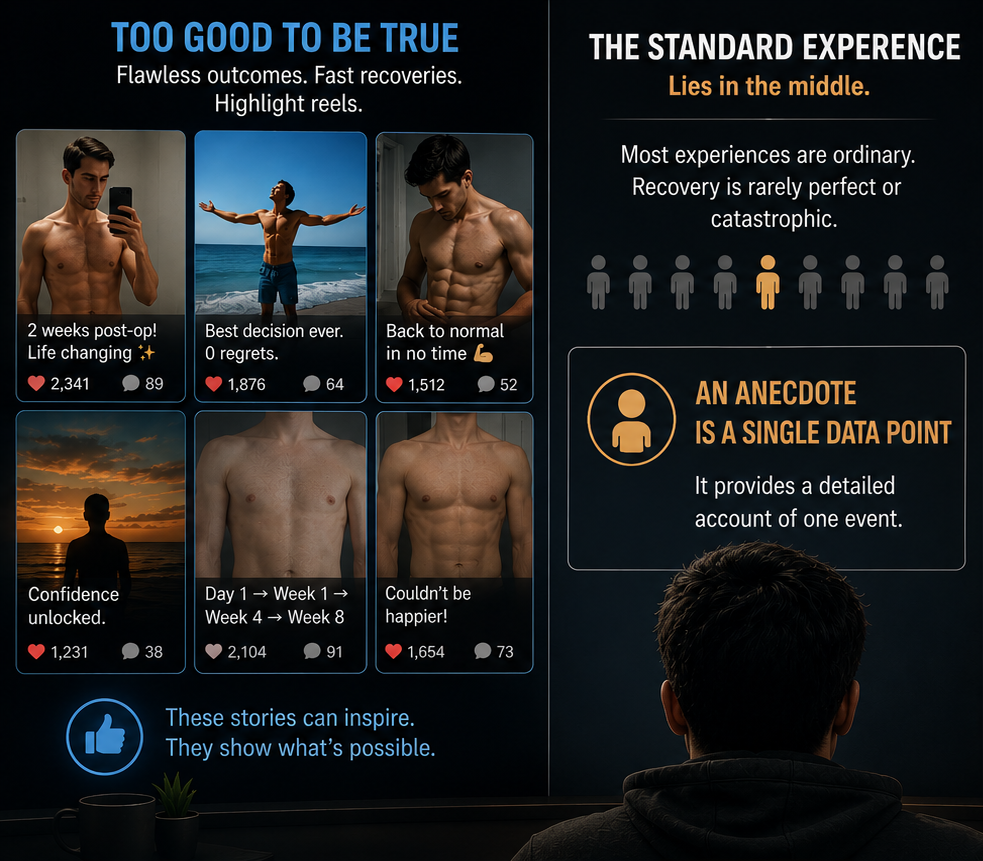
Online, surgery usually shows up in extremes. Some communities showcase flawless results and fast recoveries. Others focus on serious complications and deep regret. Neither reflects the typical experience.
These platforms run on anecdotes. An anecdote is a single data point, a detailed account of one event. These stories can teach you a lot about the practical side of recovery, such as how to manage surgical drains or line up help at home. What they cannot do is predict your medical outcome.
Social media algorithms make this worse by design. Platforms push the extremes. People with exceptional results post often, so ideal healing looks more common than it is. People with severe complications post to find support, so failure also looks more common than it is. The large middle group, patients with ordinary results and minor complications, rarely gets the same attention.

Think about someone researching chest surgery who finds a post about a failed nipple graft. The post probably leaves out the medical context. It rarely mentions the patient's health conditions, body mass index, or nicotine use. It may not say which surgical technique was used. Reading that story without the context can create fear far out of proportion to the actual risk. The story is completely true for that one person. It is not a probability for you.
How clinical evidence works
Moving from stories to research is necessary if you want real informed consent. Clinical evidence relies on large numbers of patients and controlled comparisons. Researchers try to separate the effect of a technique from the effect of individual differences, which gives you a picture of probability.
Not all evidence carries the same weight.
It helps to know the hierarchy:
Case studies describe one patient or a small group. They are useful for spotting new patterns, but they cannot tell you what is normal.
Retrospective cohort studies review the records of large groups of patients. These let researchers calculate complication rates and satisfaction levels.
Systematic reviews and meta-analyses sit at the top. They combine data from many separate studies to produce reliable guidelines.
Human bodies vary, and research accounts for that in ways anecdotes cannot. A story rarely mentions skin elasticity or healing speed. A technique that works well for one patient gives a different result in someone with different anatomy. A phalloplasty study will sort its results by body mass index and blood vessel anatomy. That level of detail lets you find your own profile inside the data. The question shifts from "what happened to this one person online" to "what is likely for a body like mine."
Two biases worth knowing
Survivorship bias. Patients who are happy tend to leave online support groups. They move on and stop posting. So forums fill up with people in the raw early phase of recovery and people dealing with long-term problems. The result is an echo chamber that sounds far worse than reality.
Marketing dressed as experience. Surgeons often post galleries of only their best results. That is advertising, not data. Those galleries hide the normal reality of scarring and tissue settling over time.
Good research counters both problems by following patients over years. Solid studies check in at six months, one year, and five years. This shows how healing actually behaves. Something that looks like a disaster at three weeks can settle into an acceptable result by two years with proper care. Long-term data gives you a realistic timeline and keeps you from mistaking the early healing phase for your final result.
Reading research yourself
Medical databases are open to you. A few habits make them useful:
Search with precise terms. "Free nipple graft survival rates" returns far more useful data than the name of the procedure alone.
Read past the abstract. The abstract summarizes the findings, but the methods section tells you who was in the study. If researchers excluded patients with certain health conditions, the results only apply to people without those conditions.
Go straight to the complications section. Good research lists every adverse event. Learn to separate minor complications, like a surface infection treated with antibiotics, from major ones that require another operation. Knowing how often each type happens lets you prepare for the likely annoyances while judging the odds of something serious.
Check the conflict of interest disclosure. Research funded by doctors who hold patents on the instruments being studied deserves skepticism. Independent studies run at multiple hospitals give you the most trustworthy picture.
Using both sources well
Evidence and personal stories are not enemies. They do different jobs.
Evidence sets the boundaries of reality. It tells you the probabilities and the anatomical limits. That is the foundation of consent. Once you understand the data, personal stories fill in the practical details. A study can tell you there is a ten percent risk of slow healing. Another patient can tell you how to manage that healing day to day, which dressings helped, and how to stay steady emotionally through weeks of rest.
An informed patient reads personal stories through the filter of data. A spectacular result registers as an outlier. A severe complication registers as a known risk with a known frequency, not a reason to panic. Anchoring your expectations to clinical reality is what health literacy actually means, and it protects your ability to choose freely.
Defining Success on Your Own Terms
Transitioning used to follow a fixed path. Clinical guidelines and community expectations both presented it as a checklist: testosterone first, then chest surgery, then removal of internal organs, then genital surgery. Anyone who stepped off that sequence faced questions.
Modern guidelines have dropped the checklist, but its influence lingers. Sorting through your options means letting go of that one-size-fits-all idea and replacing it with your own definition of success.
Dysphoria is specific, not general.
Dysphoria shows up differently in every person. It tends to be focused rather than total. Some people feel intense distress about their chest and none about their genitals. Others want genital surgery and have no interest in chest surgery.
The assumption that everyone needs every available operation does not match reality. A successful transition has nothing to do with how many procedures you have. It has to do with relieving the specific things that cause you distress.
Anatomy sets the limits
Success also means shifting from an ideal image to what will actually work.
Patients often arrive at a consultation with a precise visual goal taken from photos. Those goals often ignore biological limits. Your anatomy determines what surgery can do, and those constraints always win. So a realistic definition of success starts with an honest inventory of your own starting point.
Tissue volume, skin elasticity, and body mass index set the boundaries. Someone with a lot of chest tissue and low skin elasticity cannot get the same result as someone with little tissue and high elasticity. The first person will most likely need a double-incision mastectomy, which leaves visible scars. The second may qualify for a periareolar approach with far less scarring.
If the first person defines success as a chest with no scars, they have guaranteed their own disappointment. Success has to be defined inside the limits of what is possible. A masculine chest contour that lets you feel comfortable in your clothes is a successful medical outcome, scars included.
Every choice is a tradeoff
There is no surgery without some cost, either to function or to appearance. You get to decide which costs you can live with. That decision is what separates an informed patient from someone shopping for an ideal.
Chest surgery offers a clear example: sensation versus contour. Keeping sensation means keeping the nipple attached to its nerve supply. That limits how much tissue the surgeon can remove and how precisely they can place the nipple. Using free nipple grafts gives the surgeon much more control over the final appearance, but it requires cutting the nerve supply, which raises the chance of permanent numbness. You have to decide which one your version of success depends on.
This kind of thinking sometimes leads to unconventional choices that work beautifully. Imagine someone with real anxiety about graft failure and slow healing. After looking at the data, they decide the stress of managing a possible graft problem is more than they want to carry. They choose a mastectomy with no nipple grafts at all. That removes the risk of graft death entirely and shortens recovery. It departs from the standard look, and it is still a successful outcome for that person. They chose peace of mind over meeting a norm.

Tradeoffs in genital surgery
The choices get harder here. Deciding between metoidioplasty and phalloplasty requires real honesty about your priorities, because the two offer different results and different complication profiles.
Metoidioplasty tends to suit people who prioritize spontaneous erections, fewer surgical stages, and preserved sensation, since it uses tissue that is already there. The tradeoff is limited length and a lower chance of being able to urinate while standing.
Phalloplasty tends to suit people who prioritize size and the ability to have penetrative sex. It requires tissue taken from elsewhere on your body and multiple stages over several years. The tradeoff is a visible scar at the donor site and a higher rate of urinary complications.
You cannot have the size of a phalloplasty with the minimal scarring of a metoidioplasty. Not defining your priorities is what puts people at risk of regret. Someone who gets a phalloplasty only to be able to stand to urinate, and then feels real distress about the donor scar, may end up worse off than before. Success means matching your functional goals to the procedure that can actually deliver them, and accepting what that procedure costs.
Your life is part of the equation
Transition happens inside an actual life, so lifestyle and money belong in the decision.
A procedure that looks ideal on paper can go badly if it demands more than you can give it. Complex operations require long rehabilitation. Phalloplasty recovery involves restricted movement and urinary catheters. You need to look honestly at your job security and whether someone can care for you. Choosing to delay surgery until your situation is more stable is a responsible use of your autonomy, not a failure of nerve. Healing safely and keeping your job are part of a successful outcome.
Think about how much medical environment you can tolerate, too. Surgery brings consultations, blood draws, and hospital stays. If you have significant medical anxiety, that belongs in your planning. For some people, a less complex procedure with less follow-up is a better outcome than a multi-stage reconstruction, even if the reconstruction would produce a more dramatic result.
Let the outcome serve you
Defining success finally requires ignoring outside approval. The result has to work for you, not satisfy anyone else's expectations. An outcome that eases your dysphoria and makes your daily life more comfortable is a win.
Before you sign a consent form, write out your priorities in three lists:
1. What you require
2. What you would like
3. What you will not accept
Anchoring your expectations in data and acknowledging your body's limits removes the guesswork. It keeps surgery what it should be: a deliberate step you chose, designed to improve the life you actually live.
Chest Surgery
Chest surgery is the most common gender-affirming operation for trans men and transmasculine people. Most people call it "top surgery." The clinical name is bilateral mastectomy with male chest contouring. That longer name matters, because it separates this operation from a cancer mastectomy. A cancer mastectomy has one goal: remove every trace of …