

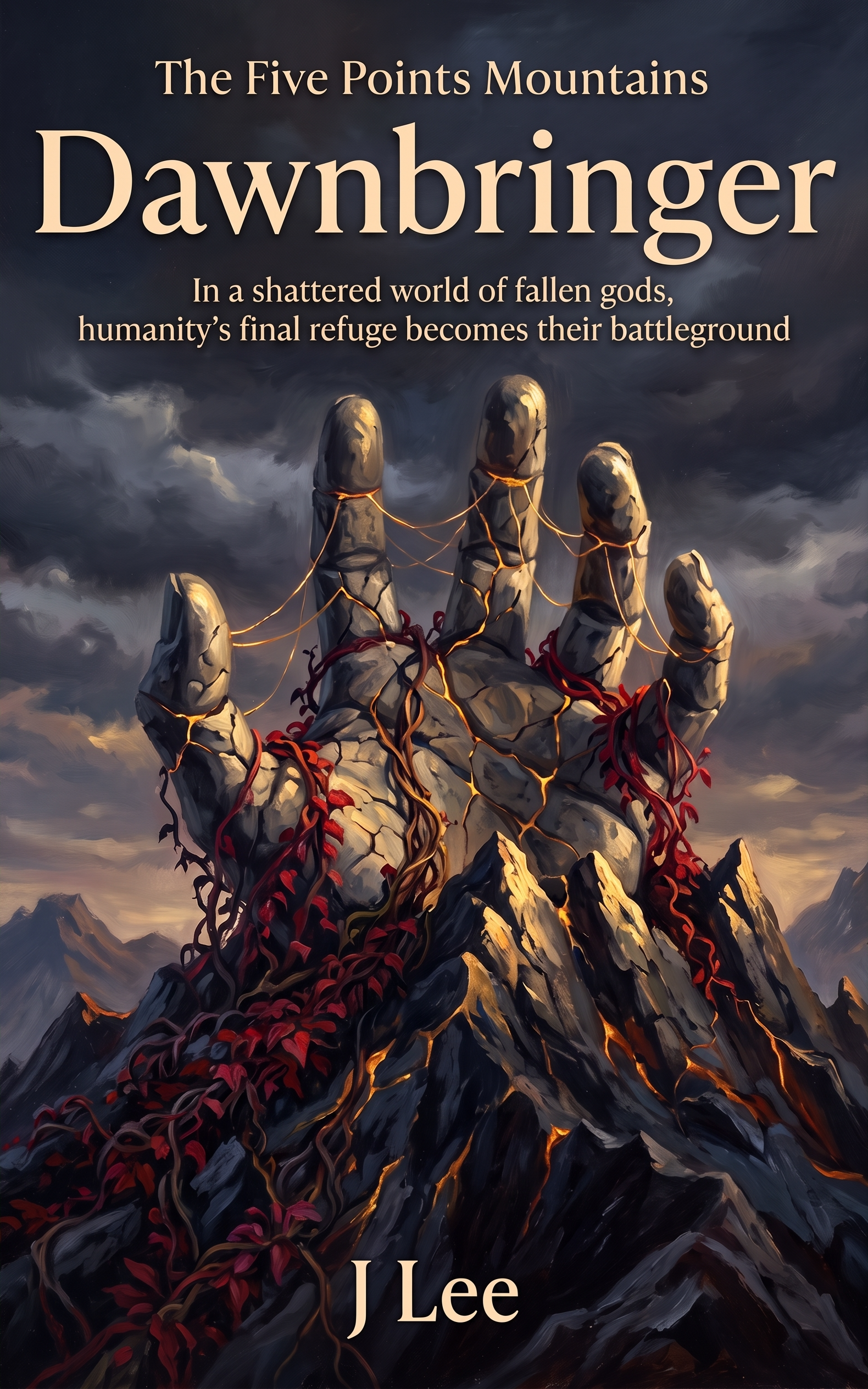
Dawnbringer
In a shattered world of fallen gods, humanity's final refuge becomes their battleground
by Jared Marchand
Two thousand years ago, the five gods fell, and the light of Pithaka went out. Once masters of a thriving world, humanity has been hunted to the brink of extinction. Enslaved and slaughtered by dark elf vampires and their savage were-beast thralls, the remnants of mankind have retreated to their final sanctuary: the treacherous Five Points Mountains, named in honor of the dead deities. Here, amid jagged peaks where no creature of darkness dares tread, a desperate stand begins. As the predatory shadow under Kreag Mountain spreads ever wider, humanity's last stronghold must either rise with steel and ancient sorcery or be snuffed out forever. In a world where gods are dead and monsters rule the plains, survival demands more than endurance—it demands blood. From author J Lee comes an epic dark fantasy saga of ruined empires, ancient blasphemies, and the unbreakable spirit of mankind.
- Fantasy
- Sword & Sorcery
- Witches & Wizards
- Fae & Elves
- Dark Fantasy
- Epic Fantasy
The Twilight of the Five
The gods did not die in a single hour, though every priest who lived to see the aftermath swore they had. That was the cruelty of it, the priests would say later, in the cold years when there was time enough to say anything at all. The end came so gently that no one marked its beginning, and by the time anyone noticed the silence, the silence was already fifty years old.
It began, though none could have named it a beginning, in the smallest of ways. A blessing that used to make a wound close in a single night instead took two. A harvest rite that had never failed in living memory produced a field of grain thin and pale, as if the sun itself had grown stingy. A child born under the sign of Aleth, goddess of healers, did not glow faintly silver at the crown as every child of that bloodline had glowed for a thousand years before her. Her mother wept, certain some fault of her own had caused it, and no priest could tell her otherwise, because no priest yet understood there was anything to tell.
The decline crept forward the way rot creeps through the heartwood of an old tree, invisible from the bark, felt only when the whole trunk groans and finds it has less to stand on than it believed. Fifty years is a long time to a mortal life and no time at all to a god, and it was this mismatch of scale that let the poisoning finish its work unseen. The five gods of humankind were dying by degrees, their divine essence bled from them drop by drop by some agency none of their worshippers could name, and because gods do not scream, because gods do not fall to their knees clutching a wound, the only witnesses to their long murder were the small failing miracles left behind, easy enough to explain away as bad luck, or a priest grown careless, or the will of the Five simply testing their children's faith a little harder than before.
By the time the High Priest of the Five knelt at his altar and felt the warmth gone entirely out of the stone, the true death had already happened, quietly, far off, in whatever place gods go to expire. What he felt that night was not a killing. It was only the world catching up to a grief fifty years overdue.
What the priests of that generation could never explain, though they tried, in scroll after desperate scroll, was why the silence did not simply remain silence. A dead god should leave an emptiness, a hole in the shape of what it once was, and holes, by their nature, do not act. But the void the Five left behind was not empty for long, and it was not passive, and within a generation of that final flicker in the altar stone, it had become something closer to a wound that would not close, through which two forces older than the Five themselves came pressing into the world.
They had always been there, the priests would come to understand, in the frantic theology of the century that followed, though "always" was a poor word for beings who existed before the word itself had meaning. One was called, in the oldest fragments that survived the burning of the great library at Ashvane, the Voice of Balance, a presence without hunger and without mercy, that measured the scales of the world the way a stonemason measures a wall, indifferent to whether the wall was raised to shelter a saint or a slaughterhouse. The other had no name the priests dared write twice in the same document, as if the ink itself feared to summon her by repetition. She was called, when she was called anything at all, the God-Queen of the Dark, and where the Voice of Balance merely watched the dying of the Five with the patience of an accountant closing a ledger, she rejoiced.
It was never recorded, in any surviving text, precisely how she came to be the one who filled the vacuum first. Perhaps it was simply that darkness requires no invitation to fall, only an absence of light to fall into, and the Five had left behind an absence larger than any the world had known since its shaping. What the priests did know, what they wrote and copied and smuggled forward through three centuries of retreat until the words themselves grew brittle with handling, was this: within a single generation of the gods' true death, the corruption that had been creeping beneath Kreag Mountain for uncounted ages found the surface world undefended for the first time since its birth, and it did not hesitate.
The Great Forest of Eldara felt it first among the light-blessed peoples, though the Light Elves would not understand what they felt until it was already killing them. The silver luminescence they called the Breath of Vessa, the glow that had lit their spires every night since before their oldest songs, began to dim at its edges, a slow graying that started at the forest's western border and crept inward a mile every decade, so gradual that a Light Elf who lived a hundred years might never notice the forest had grown darker at all, only that his grandchildren seemed to squint more than he remembered squinting, and that certain groves his own grandmother had sung to sleep now refused to wake come spring.
The elven healers called it the Long Dusk, and treated it first as a blight of soil, then a blight of water, then, when neither cure worked, a blight of something they had no word for because their language had never needed one. Trees that had stood since before the gods of men were carved from clay began to hollow from the inside, their bark still green and living to the eye while the wood beneath crumbled to a fine gray dust that smelled, elven scholars noted with growing dread, faintly of cold iron. It was the same smell, though none of them yet knew to connect it, that clung to the black stone halls beneath Kreag, five hundred miles to the north.
The Dwarves of Terrun's Anvil watched their own decline in the language they understood best, which was stone and light and the patient arithmetic of the forge. The crystal veins that had drunk in centuries of divine radiance and given it back a thousandfold began, over the span of two centuries, to burn duller, the way a coal bed burns duller as the fire beneath it starves. A vein that had lit an entire hall bright as midday sun now lit it bright as dusk, and the dusk deepened with every generation of dwarven kings who inherited the throne and the problem in the same breath.
It became a ritual of that royal line, passed down like a birthright nobody wanted, that within a season of a new king's coronation, a human priest would arrive at the gates of Terrun's Anvil, robes travel-stained, eyes hollow with the same warning his father had carried before him and his father's father before that. The first of these priests to make the journey, an old man named Corwin who had inherited the office of High Priest from a mentor who died still believing the gods merely slept, stood before a young dwarven king in a hall lit bright as any hall in the world had ever been lit, and told him the light would fail.
The king had laughed, not cruelly, but with the easy confidence of a ruler whose halls had never known a shadow they could not banish with more fire, more crystal, more of the endless dwarven ingenuity that had never once failed them. "Your gods may be tired, priest," he said, "but stone does not tire. Stone remembers nothing and forgets nothing. It simply is." He sent Corwin home with good steel and better wine and forgot the warning by midwinter.
Eighty years later, Corwin's successor, a woman named Ysolt who had never met her predecessor and knew his warning only from a scroll copied so many times the letters had begun to soften into each other, stood before that king's grandson in a hall grown noticeably darker, and delivered the same warning in words nearly identical to the ones her mentor's mentor had used. This king did not laugh. He listened, and ordered his engineers to seal the deepest veins against whatever creeping cold was drawing the light from them, and for a time it seemed to work, the way sealing a wound with cloth seems to work, right up until the cloth soaks through.
By the third such visit, a hundred and sixty years after Corwin first made the climb to Terrun's Anvil, the High Priest who carried the warning was received not in a hall of blazing crystal but in a council chamber lit by ordinary torches, because the deep veins nearest the throne room had gone dark entirely, and the dwarven king who received him did not laugh, and did not seal anything, because there was nothing left in his engineers' arsenal that had not already been tried and had not already failed. He only nodded, and thanked the priest for his family's long service in carrying bad news across five hundred miles for four generations running, and asked, in a voice gone quiet with something that was not quite despair but stood close enough to touch it, whether the priest's order had any warning left to give that was not simply the same warning worn smoother by repetition.
The priest did not have one. No one did. That was the particular cruelty of a war fought not in a single battle but across three centuries of slow erosion: there was no enemy to name in the early decades, only a series of small failures that no single generation lived long enough to see stitched together into a pattern. Each king inherited a kingdom slightly dimmer than the one his father had ruled, and each believed, because it was easier and because hope dies harder than light, that the dimming would find its floor within his own lifetime, that his son would inherit something that had finally stopped falling. None of them did. The Ogres in their high valleys between the dwarven holds and the failing forest fared no better, their great shaggy herds sickening on grasses grown thin and gray at the root, their solitude, once granted freely by a world content to leave them be, becoming instead the loneliness of a people no one thought to warn and no one thought to save.
While stone and forest bled slow and quiet in the north, the Ivory Plains bled loud and often, and it was there that the God-Queen's patience, and the patience of the pale court that served her from beneath Kreag Mountain, showed itself in its truest and most horrifying form.
The vampire nobility of Kreag did not descend upon the Ivory Plains all at once in the years after the gods' death, though every instinct of a mortal heart would expect exactly that kind of hunger to strike fast and strike hard. Xylia Vane-Nightsong, who had sat the Obsidian Throne since before the Five drew their last breath and who would go on sitting it for centuries more, understood something her impatient kin did not: a harvest rushed is a harvest wasted, and the Ivory Plains, with its proud, quick-eyed Lesteir hunters, was worth more as a slow cultivation than a single night's slaughter.
So her court sent envoys instead of armies, at first. Pale traders wrapped against the sun who arrived at Lesteir camps bearing gifts of black iron and strange, sweet wine that left the drinker's dreams edged in a violet light no Lesteir elder could explain. They came speaking of alliance against the wolves that had begun, in isolated incidents easy to dismiss as beast trouble rather than war, to test the edges of the plains. They came patient, courteous, endlessly willing to wait through a season of Lesteir suspicion, and willing again to wait through the next season after that.
It took three generations, by the reckoning later pieced together from fragments of Lesteir oral history that survived the collapse, for the first true converts to rise among the hunt-clans, young Lesteir who had grown up hearing their grandparents speak with something close to fondness of the pale traders who had never once raised a hand against them, who offered black iron blades that never dulled and potions that healed wounds no plains medicine could touch. These converts did not think of themselves as traitors. They thought of themselves, the surviving fragments suggest, as the clear-eyed among the credulous, the ones willing to see that the gods of men were dead and gone and that the coming age belonged to whoever was wise enough to bargain with its new masters rather than pretend the old order might yet return.
By the fourth generation, entire hunt-clans carried the mark of that bargain beneath their painted chests, hidden beneath the sigil of Korvus they still wore for appearances, still hunted beside kin who did not know, still sat at council fires and voted on matters of war and peace with a hollow already carved beneath their loyalty that no elder's eye could detect. It was the perfect corruption, patient past any mortal span of patience, and when at last it bore its fruit, it bore it all in a single terrible season that the surviving Lesteir would call, in the few songs that outlived the slaughter, the Night the Grass Remembered Nothing.
The betrayal did not come as an uprising. It came as an opening of doors that had never before stood open. Sentries who should have raised the horn at the first wrongness in the wind instead stood silent at their posts, already sworn, already hollow, while the werewolf packs of Kreag came pouring across the dry grass in numbers the plains had never seen gathered in one place before. Camps that had survived a hundred seasons of ordinary raids found their outer wards already broken from within before the first fang ever tore canvas, found their swiftest runners, the ones meant to carry warning between clans, simply gone, vanished days before the slaughter on errands that made perfect sense at the time and made no sense at all in the horror that followed.
What the corrupted Lesteir gained for their long patience was not the alliance they had been promised. It was a collar. Those among the converts who survived that first terrible season learned, in the months that followed, that the pale court had never intended partnership, only a longer, gentler leash than the one thrown over the raw and unwitting clans slaughtered in their tents. They were made hounds all the same, only hounds who had chosen their own chain, and it was this particular shame, the priests of the surviving human settlements later wrote, that made the corrupted Lesteir the most effective and most merciless trackers the God-Queen's armies ever fielded, for a creature ashamed of its own choosing will run down anything to avoid remembering what it once was.
The Ivory Plains did not fall in a single season, whatever the songs later simplified it to. It fell across decades, a war of attrition fought not between armies that faced each other but between a hunted people and a patient tide that never needed to win every battle, only to keep coming. Seasonal raids became a rhythm as regular and as dreaded as harvest itself. Every autumn, when the grass turned the color of old bone and the nights grew long enough to hide movement, the packs came, and every spring the plains dwellers who survived counted their dead and rebuilt what they could and told themselves, as every generation had told itself before them, that this year had been the worst of it, that surely no year could be worse.
Every year was worse. By the fiftieth year after the Night the Grass Remembered Nothing, the great camps of the Lesteir had scattered into smaller and smaller bands, each one easier prey than the last, until what remained of that proud, cat-eyed people who had once measured wealth in the grace of a hunt were themselves the hunted, driven ahead of the packs like game flushed from cover, running not toward safety, for there was none left to run toward, but simply away, generation after generation, until running was the only inheritance left to pass down.
It was during this long bleeding of the plains that the first serious waves of human refugees began the climb toward the mountains that would, in time, bear the names of their dead gods. The Five Points had never been a kingdom before that century. They had been, in the oldest human maps, simply a barrier, a wall of black stone too steep and too broken for farming, useful only as a boundary beyond which a sensible person did not travel. It was a measure of how thoroughly the plains and river valleys had failed the people who lived there that a barrier came, within three generations, to look like a sanctuary.
The exodus was not a single march. No banner led it, no king called it into being with a single decree that sent an entire nation moving at once. It happened the way water finds a lower place to pool, in small trickles first, individual families abandoning farmsteads too close to the plains' bleeding edge, then whole villages, then, as the corruption crept further and the raids grew bolder and the trade roads between settlements grew too dangerous to travel without an armed escort that few villages could any longer afford to spare, entire river valleys emptied out within a single generation, their people strung out along mountain trails never meant to carry the weight of so many desperate feet.
The climb itself killed almost as many as the packs did. Old women who had walked those trails as girls, visiting kin in the foothills, found at eighty that the same paths had grown steeper, or perhaps it was only that their legs had grown weaker, and either way the mountain did not care which. Children born on the road never knew a home that was not a moving camp, a fire built and abandoned by morning, a mother's back the only country they ever belonged to. Priests who carried what relics they could save from the crumbling temples of the plains buried more of those relics along the trailside than they ever carried to safety, wrapped in whatever cloth could be spared for a grave marker, because a broken axle or a fever or a night too cold for an old man's heart to survive did not wait for a convenient season, and the mountain offered no gentler death than the plains had, only a slower and lonelier one, without the mercy of teeth to end the waiting quickly.
Those who reached the high valleys and the first defensible passes did not find welcome so much as they found room, empty stone shelves where a people could dig in and hold, and holding, by that point in the long war, had become the only ambition anyone still living could afford to hold onto. They built where the Ogres had once tended their sickening herds, on ground the great shaggy people had themselves been forced to abandon as their valleys failed beneath the same slow blight that had dimmed the dwarven crystal and hollowed the elven wood. There was no war fought over that abandoned ground, no conquest to record in any surviving chronicle. There was only one exhausted people arriving to find the shelter another exhausted people had already been forced to leave behind, and taking what was left because there was nowhere else remaining to take.
Five peaks rose highest among that broken range, and it was there, across the last hard decades of the retreat, that the surviving human settlements finally stopped retreating and began, instead, to dig. Each peak took the name of one of the Five, not as an act of faith so much as an act of grief, a way of carrying the dead into the only fortress the living had left to build. The priests who still kept the old rites, thinned now to a handful of exhausted keepers of a faith whose gods no longer answered any prayer at all, blessed the naming of each peak with whatever ceremony they could still remember whole, and if their god no longer heard the words, the mountain, at least, did not object to bearing the name.
It took the better part of the third century since the gods' death for that retreat to become a fortress in truth rather than merely in hope. Walls rose where trails had once been the only road. Terraces were cut into slopes too steep for any sensible farmer to have attempted a generation before the plains fell, because a hungry people learns quickly that steep ground worked is better than fertile ground lost. The dwarves of Terrun's Anvil, themselves driven deeper into their own failing stone by that same century of blight, found in the human refugees at their southern doorstep not a burden but, unexpectedly, a partner, for a people who had nothing left to trade but desperate hands and desperate need for steel discovered they had exactly what a people running short on surface grain and surface cloth required in return. It was a trade born of two declines meeting in the middle, and it would outlast every king who signed its first uncertain terms.
Below the mountains, on the plains and beneath the darkening canopy of a forest that had, by then, gone gray and silent for a hundred miles in every direction from Kreag, the God-Queen's court did not pursue the retreat into the high stone with anything like the urgency that had driven her packs across the open grass. There was no need. The plains were hers. The forest's edges withered further with each passing decade, and though the Light Elves fought a long and bitter defense of what remained of Eldara's living heart, the corruption crept inward regardless, patient as it had always been patient, content to let three centuries do the work that no single battle could accomplish. Xylia Vane-Nightsong, who had watched the fall of Corwin's warnings and Ysolt's warnings and every warning that came after from a throne that never once needed to rise and march, understood better than any general of flesh and blood ever could that a war fought across centuries did not require haste. It required only that the other side eventually run out of century.
By the close of that long, grinding age, the humans had run out of plains, run out of forest, run out of every fertile mile their ancestors had once claimed from the great forest's eastern edge to the western sea. What remained to them was stone, and height, and the five dead names carved into the peaks that sheltered what was left of a race that had once covered half a continent beneath five gods who had not known, in their long and careless age, that they could ever die at all. And in the ruins below, where cities of timber and stone had stood for a thousand years before the silence took the altars, the Dark Elves of Kreag walked at last into the empty halls their patience had finally emptied for them, and found, waiting in the dust and the gray grass and the hollow trees, nothing left to conquer but the memory of what a free people had once been.
Echoes in the Obsidian
Darkness does not sleep, and it does not dream, but in the long centuries since the Five had gone silent, Xylia Vane-Nightsong had learned something close to both. She spent most of her existence unbound from flesh, spread thin across the black spaces between stars where no candle had ever burned and no god had ever thought to look, and in that sta…