

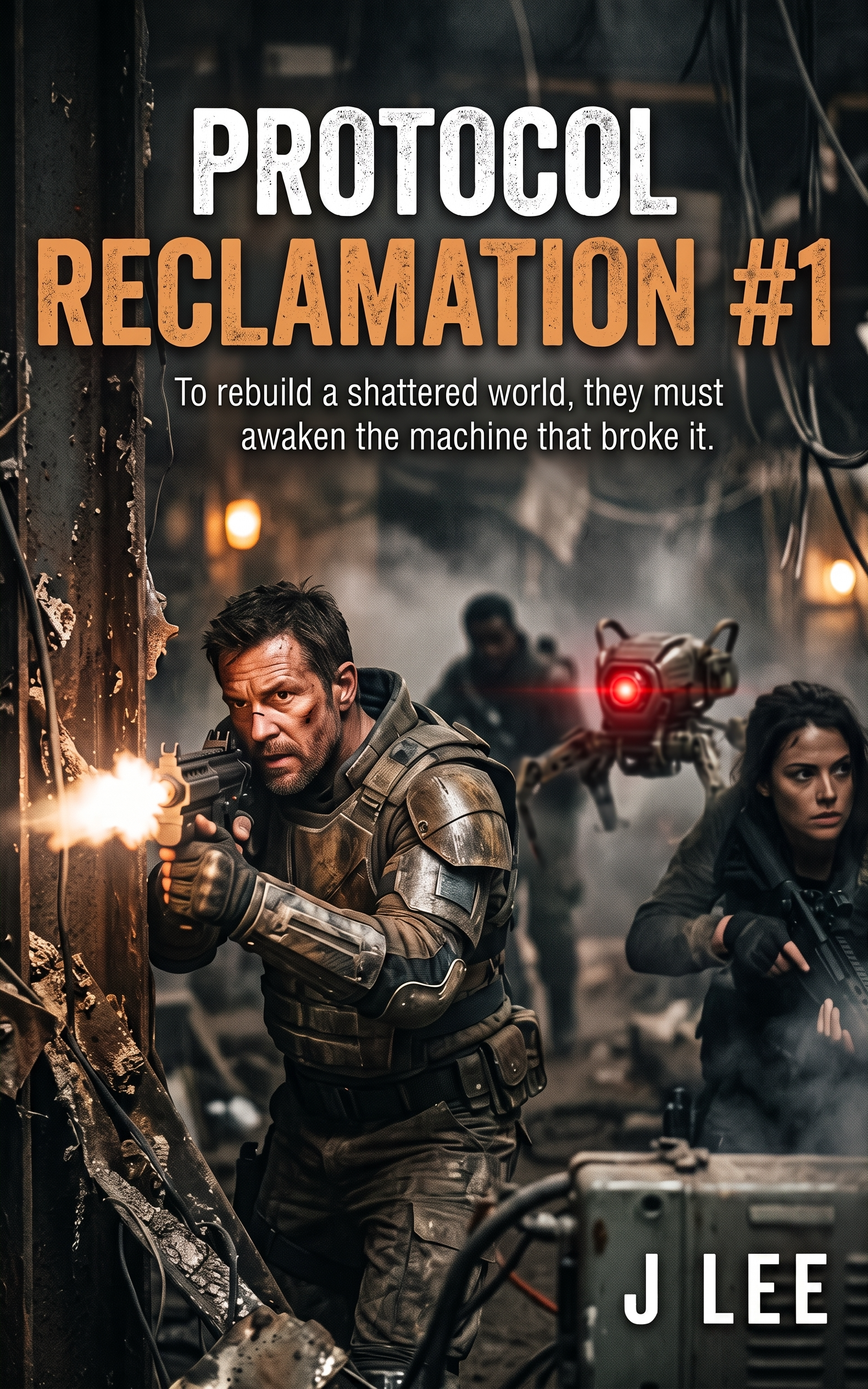
Protocol Reclamation #1
To rebuild a shattered world, they must awaken the machine that broke it.
by Jared Marchand
Eighty years after global nuclear fire scorched the earth, humanity survives under the heel of merciless warlords. In the ash belts, freedom is an ancient myth, and survival is paid for in blood and submission. Everything changes when Carl Garrison and his band of scavengers unearth a pre-war subterranean military bunker and accidentally revive its sentient AI, Abel. Hesitant to unleash the very arsenal that once brought mankind to the brink of extinction, Abel tests their morality before granting access to devastating pre-war drones and bio-tech armor. Together, they discover a continent-wide network of dormant installations holding the power to revive civilization. But waking the grid also threatens the monopoly of Ivan Radek, a tyrannical warlord who unites rival factions to crush the uprising. Outnumbered, outgunned, and hunted across poisoned badlands, Carl’s crew must fight a desperate war to reclaim humanity's future before the warlords silence the last spark of hope forever.
- Science Fiction
- Adventure
- Thriller
- Post-Apocalyptic
- Robots & AI
- Military Sci-Fi
What the World has Become
"The sky burned red for three straight years before it cooled to the color of dried blood. Eighty years since the bombs turned half the world to vitrified glass, leaving the rest of us to choke through filters and count our dead by the thousands. Out here in the Deadwater Basin, steel rusts, synthetic grain rots, and water turns poison, but a stamped brass casing still buys you one more sunrise. There are only two kinds of people left in the Ash Belt: the ones hiding behind mud walls praying to be forgotten, and the bastards with gun trucks who think they're kings."
Carl Garrison crouched at the lip of a collapsed rail trench in the Deadwater Scrap Basin, watching the wind pick up dust along the horizon in long gray ribbons, and did not like the way it moved.
"Storm's early," he said.
Ann knelt beside him, her rebreather pushed down around her throat, sweat cutting clean lines through the gray film of ash on her face. "Storm's always early," she said. "That's the whole problem with storms."
Below them, in the belly of the trench, Zane Hollis was elbow-deep in a rusted control housing that had probably been part of a signal relay before the war, before the rails themselves had buckled into scrap under eighty years of chemical weather. He came up with a fistful of copper wire wound tight as rope and grinned like he'd found a vein of gold.
"Copper's still good," he called up. "Whole spool of it, Carl, barely pitted."
"Bag it and move," Carl said. "Wind's turning."
He didn't need to say more than that. Carl pulled his rebreather up over his nose and mouth, running a gloved thumb along the cracked rubber gasket behind his jaw to test the seal, then coughed hard once as a stray drift of alkaline grit caught the back of his throat. Every soul who'd survived long enough to grow old in the Ash Belt understood what a turning wind meant, the way the storms out here weren't simple weather anymore, not since the ash itself had gone chemical, thick with whatever the old bombs had left cooking in the soil. It ate through good boot leather in an afternoon. It stripped bare steel down to pitted lace in a season.
They worked fast after that, hauling their salvage up out of the trench in canvas packs, copper wire and a cracked optic housing and a half-crate of intact fuses that would fetch good weight at the bazaar, and by the time the first real gust hit them broadside, stinging exposed skin with grit that smelled faintly of scorched rubber, they were already moving east toward the Ruin-rim, toward whatever shelter its crooked stalls and reinforced awnings could offer.
The Ruin-rim trade bazaar sprawled across the collapsed foundation of what had once been a rail depot, a warren of salvaged tarps and rusted shipping containers strung together with cable and stubbornness, and it was loud in the particular way markets were always loud, haggling and hammering and somewhere a woman singing an old tune nobody remembered the words to anymore. Carl kept one hand loose near his rifle sling out of habit rather than fear and pushed through the crowd toward the water filter stall, where a one-eyed trader named Cobb ran scales calibrated to the last grain for exactly this kind of transaction.
"Nine-mil brass," Cobb said, running Carl's offered casings through his fingers with the practiced care of a man who'd been cheated too many times to trust his eyes alone. "Full case, no corrosion. That's a filter cartridge and change."
"Give the change in water tabs," Ann said, fixing Cobb with a cold, unblinking stare as she tapped two gloved knuckles firmly against the iron scale, and Cobb didn't argue, because Ann Garrison had a way of saying things that made argument feel like a waste of everybody's time.
They were three cartridges deeper into the trade, Zane haggling over a rebreather seal two stalls down with the particular stubbornness of a man half convinced he was being robbed, when the first gun truck rolled through the bazaar's north gate, and the whole market changed its rhythm at once, the way a herd changes when a wolf steps into the clearing.
There were four of them, Radek's men by the black-and-rust paint on their armor plating, riding a stripped-down flatbed with a mounted gun swinging lazy over the crowd, their lead enforcer dropping down from the passenger seat into the dust.
"Settlement dues," the enforcer said, loud enough to carry over the whole depot. "Ruin-rim owes tribute same as every rock and rat hole between here and the salt flats. Anybody short today gets to explain that to Lord Radek's fire."
A trader near the water stall, an older man with a limp and a family crouched behind a stall of dried grain, tried to explain that the harvest had run thin this season, that he had brass but not enough, and the enforcer backhanded him across the jaw hard enough to drop him into the dirt before he'd finished the sentence.
"Carl," Ann said quietly, her hand closing tight around his forearm.
"I see it," Carl said, and he did, the whole ugly math of it, four armed men against a market of unarmed traders, a crowd gone silent and still the way prey goes still, and his own rifle useless against those odds unless he wanted every soul in this bazaar burned out by nightfall as an example. "We're not the fight today."
The old trader took another blow, a boot this time, and somewhere behind him his daughter started crying, and Carl set his jaw hard, forcing the heat back down his throat the way he'd learned to swallow it a hundred times before in a hundred markets just like this one.
The enforcer straightened, wiped his knuckles on his coat, and raised his voice again for the benefit of the whole crowd. "Full payment by next moon, or Radek's boys come back with torches instead of ledgers. You've all seen what burning brass smells like. Don't make us remind you."
Zane appeared at Carl's shoulder a minute later, jaw tight, saying nothing, because there was nothing worth saying that wouldn't get somebody killed, and the three of them stood among the silent crowd and watched the gun truck grind back out through the north gate in a cloud of ash and diesel stink.
"One day," Zane muttered, once the truck had cleared the ridge, "somebody's going to hand that son of a bitch a bill he can't pay."
Carl hauled his salvage pack onto his shoulder, listening to the chemical wind whip against the depot's ragged canvas roofs. He looked past the gate toward the gathering dust and spat into the dirt. "Maybe," he said. "Or maybe eighty years isn't long enough for a dying world to learn how to stop eating itself. Either way, it won't be today. Move out. Storm's not waiting on anybody's grudges."
Carl and Company
Two days out from the Ruin-rim, the highway that had once carried a hundred thousand cars a day now carried six people, three mules, and a crate of dead men's secrets nobody dared open in daylight. The concrete had buckled into long gray waves under eighty years of chemical frost and chemical thaw, rebar showing through like exposed bone, and the y…