

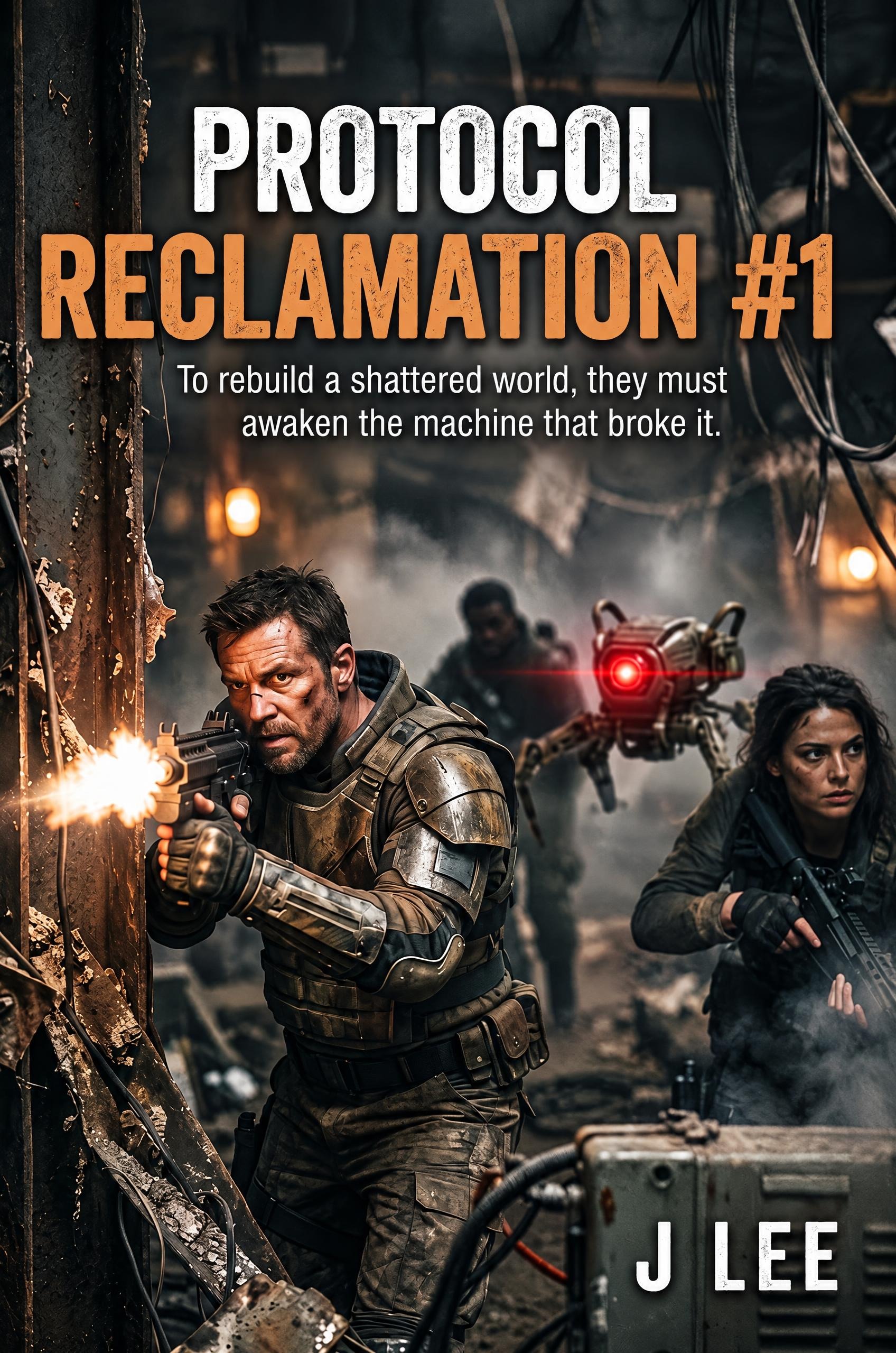
Protocol Reclamation #1
A scavenger crew awakens a buried war AI and reclaims a dead continent
Eighty years after nuclear fire turned the world into ash and vitrified glass, scavenger Carl Garrison and his crew live by what they can haul from the Deadwater Basin. In Hollow Bend they buy a set of coordinates to Site Charlie, a sealed pre-war installation under the Smoky Mountains. Warlord Ivan Radek hears the same rumor, burns the settlement, and sends mechanized hunters after them. Inside the slag they wake Abel, a military artificial intelligence still bound by continuity directives. Abel arms civilians it was never meant to serve: drone grids, Mastodon haulers, mag-lev lines, and assault frames that have slept since the last war. Across sieges, seed vaults, and a frozen escarpment, Carl, Diana, and Wes race Radek to Command Redoubt Omega. If they fail, the last archives of life stay dark. If they win, fourteen continental vaults come back online, and every remaining warlord learns the monopoly on survival is over. Protocol Reclamation #1 is post-apocalyptic military science fiction about found family, buried machines, and the cost of lighting the world again.
- Science Fiction
- Adventure
- Post-Apocalyptic
- Military Sci-Fi
- Dystopian
- Robots & AI
Brass and Turning Wind
Cobb counted out the water tabs from a tin box with the slow precision of a man who had learned a long time ago that fast hands got you robbed. Ann watched his fingers, not his face, and nodded when the count came out right.
"Good trading," Cobb said, and his one eye flicked past her shoulder toward the open ground between the stalls. Whatever he saw there made him close the tin box faster than he needed to.
Carl heard the engine before he saw the truck. It came in low and loud over the broken concrete, a stripped frame riding on bald tires with a mounted gun welded crooked to the bed, and every head in the bazaar turned toward the sound at once the way a herd turns from a sound it already knows. Conversations died in patches, stall by stall, until the only noise left was the truck's engine and the wind pushing grit against the tarps.
"Enforcer," Zane muttered beside him, shifting the weight of his pack higher on his shoulder like that might make him smaller.
"I know," Carl said.
The gun truck rolled to a stop in the center aisle, close enough that Carl could see the rust bleeding through the black paint on the door panel, and the man who climbed out of it moved like he already owned every square foot of ground he touched. He wore plating scavenged from three different uniforms and none of it matched, but the rifle slung across his chest was clean and well-oiled, and that told Carl more about the man than his face did.
"Ruin-rim owes tribute same as every rock and rat hole between here and the salt flats," the enforcer said, loud enough to carry to the back row of stalls. "Anybody short today gets to explain that to Lord Radek's fire."
Nobody answered him. Stall owners found reasons to look at their own hands, their own scales, the dirt at their feet. Carl kept his own hand loose near his rifle sling, not reaching, just close, and watched the enforcer walk the aisle like a man inspecting livestock.
He stopped at a stall of dried grain where an old trader stood with a visible limp and a face already pale with the kind of fear that came from knowing exactly what was coming.
"Harvest ran thin this season," the old trader said. His voice shook on every other word. "I've got half what I owed last tribute, I swear it on my own grave, the fields along the basin went to salt before the frost ever—"
The enforcer didn't let him finish. The first blow caught him across the jaw and dropped him into his own stall, scattering a burlap sack of grain across the packed dirt, and the second blow came before the old man had finished falling. Behind the stall, a girl who couldn't have been older than ten pressed herself into the gap between two crates and started to cry, the high thin sound of a child who had seen this before and knew better than to scream.
Zane's hand had drifted toward his own rifle. Carl caught his wrist without looking at him.
"Boss," Zane said under his breath, "he's gonna kill that old man."
"Maybe," Carl said. "Count the gun on that truck, Zane. Now count how many of us got weapons drawn right now."
Zane's jaw worked, but he didn't pull his hand free. Across the aisle, Ann had gone very still, the kind of stillness Carl had learned to read as her own war between what she wanted to do and what she knew she could survive doing. Her eyes stayed on the girl behind the crates, not on the beating.
"We're not the fight today," Carl said, quiet enough that it was only for the two of them. "Not here. Not against a mounted gun with forty strangers standing between us and cover."
"So we just watch," Zane said.
"We just watch," Carl said, and hated the taste the words left in his mouth.
The old trader took three more blows before the enforcer straightened up, breathing hard, and stepped back like a man satisfied with a job finished. He spat on the ground near the trader's head.
"Half tribute today," he said, loud again, playing to the crowd now that the point had been made. "Full tribute next time, old man, or Lord Radek sends someone who doesn't bother asking first."
He climbed back into the truck without looking at anyone else, and the engine roared to life, and the whole bazaar held its breath until the sound of it faded out past the broken rail depot toward the open ground beyond. Only then did people start moving again, slow at first, then faster, the way water finds its level after something disturbs it.
The trader's daughter crept out from behind the crates and knelt beside her father, pressing her small hands against the side of his face where blood had already started to crust in the cracks of his skin. He groaned and tried to sit up, and she helped him, her whole body shaking with the effort of not crying loud enough to draw attention back to them.
Carl watched them for a moment longer than he needed to, long enough that Ann noticed.
"We can't fix all of it," she said. It wasn't a question.
"I know," Carl said.
"Doesn't mean it sits easy."
"No," he said. "It doesn't."
Zane had gone quiet, his earlier anger folded down into something flatter and harder, the look of a young man learning a lesson he hadn't asked to learn. He glanced at the girl one more time before he shouldered his pack and turned east, toward the edge of the bazaar where the tarps thinned out into open ground.
"Cobb's got nothing to do with it," Ann said, mostly to herself, tucking the water tabs into the satchel at her hip. "He'll trade with whoever's still standing after. That's the whole math of this place."
"That's the whole math of everywhere," Carl said.
They walked in silence past the stalls that had already started pretending nothing had happened, past a woman resetting a table of scavenged tools that had been knocked over in the scramble, past a boy sweeping grain back into a torn sack with his bare hands. Nobody looked at the trader and his daughter directly. Nobody looked away from them completely, either. That was the particular cruelty of a place like Ruin-rim, the way people learned to hold both at once.
At the eastern edge of the bazaar, where the collapsed depot gave way to open scrubland and the wind had picked up again in long gray ribbons just like it had out at the trench, Carl stopped and looked back once.
The gun truck was gone. The dust it had kicked up was already settling. The old trader was on his feet now, leaning on his daughter's shoulder, limping toward whatever shelter he had back behind his stall.
"Storm's going to hit before we make the ridge line," Ann said, pulling her rebreather back up over her mouth.
"Then we'd better move," Carl said.
Zane fell into step beside them without a word, his copper and his fuses and his cracked optic housing still slung across his back, worth something in brass and nothing at all against the sound of a man being beaten in the open while forty people watched and did the math on their own survival. Carl had done that math a thousand times over the years, in a hundred places just like this one, and it never got easier to carry. It only got more familiar, which was its own kind of poison.
They walked east into the rising wind, toward the camp they'd left before dawn, with water in Ann's satchel and the taste of Ruin-rim still sitting sour at the back of Carl's throat.
Filter Seals and Old Grudges
The overpass had collapsed in a long diagonal slab, concrete and rebar leaning against its own ruin like a drunk against a wall, and it left enough of a gap underneath for three bodies and a small fire that nobody outside fifty yards would ever see. Carl had chosen it an hour before dusk, back when the wind was still behaving itself. Now it threw g…