

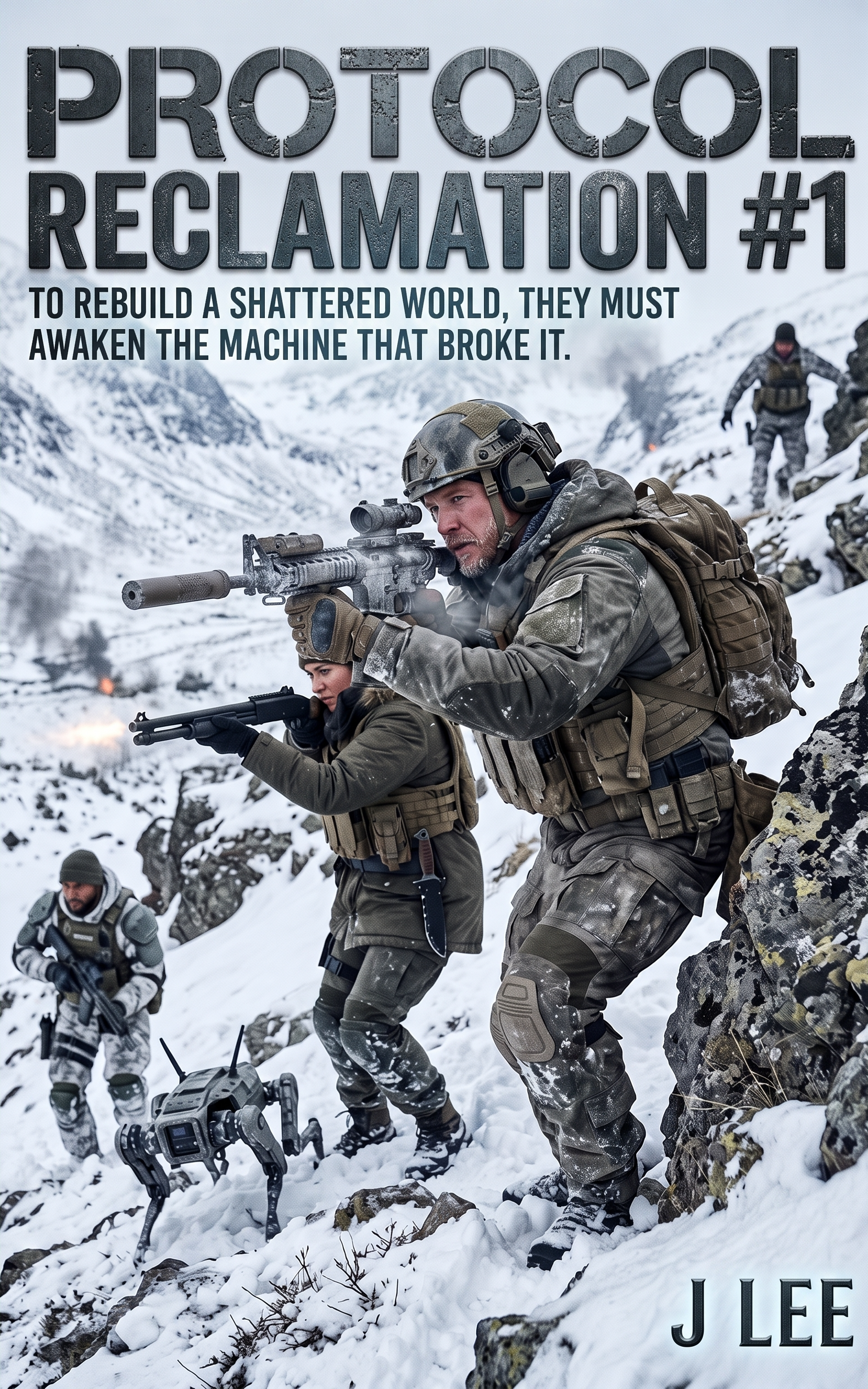
Protocol Reclamation: Blood and Ash
To rebuild a shattered world, they must awaken the machine that broke it.
by Jared Marchand
Eighty years after global nuclear fire scorched the earth, humanity survives under the heel of merciless warlords. In the ash belts, freedom is an ancient myth, and survival is paid for in blood and submission. Everything changes when Carl Garrison and his band of scavengers unearth a pre-war subterranean military bunker and accidentally revive its sentient AI, Abel. Hesitant to unleash the very arsenal that once brought mankind to the brink of extinction, Abel tests their morality before granting access to devastating pre-war drones and bio-tech armor. Together, they discover a continent-wide network of dormant installations holding the power to revive civilization. But waking the grid also threatens the monopoly of Ivan Radek, a tyrannical warlord who unites rival factions to crush the uprising. Outnumbered, outgunned, and hunted across poisoned badlands, Carl’s crew must fight a desperate war to reclaim humanity's future before the warlords silence the last spark of hope forever.
- Science Fiction
- Thriller
- Post-Apocalyptic
- Military Sci-Fi
- Robots & AI
- Survival Thriller
The Broken Spine
The year is 2101, though no calendar out here counts the days the way they used to. Thirty years have passed since the firestorms rolled across the old world in a single scorching week, and thirty years since the skies opened up afterward and drowned what the fire hadn't already taken. Nobody alive remembers exactly why the missiles flew, not anymore. The reasons died with the men who pushed the buttons, buried under strata of ash and glass and the slow, patient work of a planet trying to forget its own history. What's left is the aftermath, spread out across a continent that used to have a name and now has only directions: north, south, the ridge, the flats, the dead cities nobody goes near anymore.
The Great Salt Expanse stretches for two hundred miles in every direction a person cares to walk, a white and cracked wound where an inland sea used to sit before the flooding came and went and left its mineral ghost behind. The old maps, the ones that survive in waterlogged fragments inside collapsed libraries and looted government vaults, called this place fertile farmland once, checkerboarded with irrigation canals and grain silos that fed half a hemisphere. Now it is a bleached table of hardpan salt crust, broken here and there by black ridges of exposed bedrock that jut up out of the flats like the spines of something long dead and only half buried. The wind moves across it constantly, carrying fine alkali dust that gets into everything, lungs and gear and the seams of a man's boots, and there is a smell to the place that never fully leaves, sulfur and old brine.
Beneath the crust, in places where the salt has thinned or cracked away entirely, the old superhighways still run in long straight lines toward horizons nobody travels to anymore. Whole sections of interstate lie swallowed under drifts of white mineral silt, guardrails poking up like broken teeth, the skeletal remains of vehicles fused to the asphalt where their owners abandoned them during the last panicked exodus out of the cities. Scavengers who work the flats have learned to read those buried roads the way sailors once read currents, because the old grades hold firmer ground than the open salt pan, less likely to swallow a boot to the ankle in a pocket of soft brine mud hiding under a deceptive crust.
Fallout still lingers in patches across the expanse, invisible and patient, clinging to certain low basins where the old floodwaters pooled and never fully drained before evaporating into salt. Most of it has decayed down to background levels that a careful person can walk through without consequence, provided they know which basins to avoid and which to cross quickly. The unlucky or the ignorant do not get a second warning. There are stories, the kind traded around cookfires late at night, of entire scavenger crews who wandered into a hot zone marked by nothing more than a slightly different shade of white on the horizon, and who did not understand what they'd found until the sickness set in weeks later, hair coming out in patches, blood in places blood should never come from. The wasteland does not announce its dangers. It simply waits for a person to make the mistake, and then it lets the consequence speak for itself.
What civilization remains scattered across this ruined ground has organized itself the only way desperate people ever have, around whoever holds enough guns to make the arrangement stick. In the decades since the collapse, a handful of warlords carved the surviving territories into fiefdoms bought and held with blood, each one ruling over some patchwork of fortified settlements, forced-labor enclaves, and roaming raider battalions that live off plunder and terror in equal measure. The syndicates fight among themselves when it suits them and unite against outsiders when it doesn't, and somewhere beneath their competing banners the ordinary people of the wastes do what ordinary people have always done under tyranny: they keep their heads down, they learn which roads are watched and which are not, and they pray to whatever they still believe in that today is not the day a convoy of raiders decides their settlement looks worth the trouble of burning.
Scavenger crews move through the gaps between those territories, small independent bands who answer to no warlord and pay no tribute, surviving instead on what they can pull from the bones of the old world before somebody with more guns decides to take it from them. It is a hard way to live and a shorter way to die, but it is the only kind of freedom left on this continent, and there are those who would rather starve free on the salt flats than eat well in a labor pen behind a warlord's wire. These crews know the northern foothills better than any surveyor ever did, know which switchbacks hold ambush cover and which gullies flood without warning when a distant storm dumps its water into a dry wash forty miles upstream. They have learned to read the ground the way old-world sailors once read the stars, because out here the ground is the only thing that has never lied to them.
At the northern edge of the Great Salt Expanse, where the flats finally give way to broken limestone foothills that climb toward the jagged spine of the old mountain range, the land bears a fresh scar that was not there a season ago. A recent slide, the kind the bedrock has been threatening for years as old fault lines settle and shift beneath the weight of three decades without proper rainfall to hold the soil together, tore loose a wide section of cliff face and sent it crashing down into a gully below. Where the rock came down, it opened a wound in the earth that had not seen daylight since before the missiles flew, and buried within that wound sits the rusted spine of something that does not belong to the wasteland at all.
It is a convoy, or what remains of one, thirty-some vehicles of pre-war military hardware that some retreating unit tried to save on the last chaotic night of the old world, driving it up into these mountains ahead of the firestorms only to lose it beneath a collapsing hillside when the ground itself turned against them. Troop transports lie crushed and folded among the debris, their titanium alloy frames scarred but largely intact, a testament to engineering standards no living metalworker on the continent could hope to replicate anymore. Fuel tankers sit crumpled like discarded cans, their contents long since evaporated or leaked away into ground poisoned decades before their arrival. And near the heart of the wreckage, wedged beneath a slab of limestone the size of a modest building, an armored command vehicle has somehow kept its shape through thirty years of settling earth and grinding tectonic patience, its rear doors buckled but not quite sealed, holding whatever secrets it carried the night the mountain came down on top of it.
The trench itself is a strange wound to look at, a slice of raw earth exposed after decades of undisturbed dark, its walls striped with the geological record of everything that happened to this land since the old world ended. Layers of ash from the firestorms sit compressed beneath thick bands of mineral sediment left by the great floods that followed, and above all of it, the crust of salt and alkali that has become the signature of everything this continent has turned into. Anyone with the patience to read those layers could trace the entire collapse in cross-section, fire giving way to flood giving way to drought giving way to this, the long gray silence that has settled over everything since. Nobody out here has that kind of patience. Survival does not leave much room for geology.
Metal glints in the raw scar of the gully where the sun catches it right, a hard, unnatural gleam against all that bleached white and gray, the kind of shine that draws the eye of anyone crossing the flats with a scavenger's trained instinct for finding what does not belong. No drag marks mar the wreckage. No scoring cuts through the rust. Whatever brought that cliff face down did it recently, and in all the years since the convoy first went under, nobody has walked this ground and found it. That kind of untouched find does not last long in a land this hungry. Word travels on the wind out here just as fast as dust does, faster sometimes, carried by the desperate and the greedy alike, and there is no such thing as a secret that stays buried once the ground gives it back up to the sky.
Above the trench, the foothills rise in broken tiers of pale limestone toward higher ground where the old mountain range still holds patches of stubborn scrub growth clinging to whatever soil the decades of acid rain didn't strip away. Somewhere deeper into those mountains, buried far below layers of rock that even the great floods never touched, older secrets than this convoy still wait in the dark, sealed behind blast doors that have not opened since the final days of the old world. The people crossing this expanse do not know that yet. They know only the flats beneath their boots, the ridge ahead of them, and the hard mathematics of water and food and daylight that governs every mile they walk.
It is into this world that Carl Garrison leads his crew, day after day, across salt flats that swallowed an ocean and now threaten to swallow anyone careless enough to trust them. It is a world stripped down to its essentials, where the old highways lead nowhere anyone wants to go and the sky carries poison as often as rain, where warlords rule by fear and scavengers survive by cunning, and where the wreckage of the old order lies scattered across the ground like bones nobody has bothered to bury. Somewhere out on that white expanse this morning, a small column of travelers moves toward the northern ridge, drawn by instinct and necessity toward a scar in the earth that the mountain only recently decided to give back.
They do not know yet what waits for them in that trench, wedged beneath a slab of fallen limestone, still holding the last shape of a dead man who never made it out of his seat. They do not know that the ground ahead of them is about to hand them something the wasteland has not offered in thirty years of taking: a piece of the old world that never quite finished dying, still humming faintly in the dark, still waiting for someone to come along and wake it up.
The wind moves on across the salt, indifferent to all of it, scouring the flats the way it has every day since the water pulled back and left this behind. Somewhere beneath the crust, the old highways keep their silent lines toward the horizon. Somewhere in the foothills, the newly opened trench sits exposed to a sky it has not seen in three decades, patient in the way that only the dead and the buried can afford to be. And somewhere between the two, the future of everyone left alive on this broken continent is about to come walking up out of the salt haze, boots crunching over ground that has never once forgiven anyone for what was done to it.
The Sinking Threshold
The limestone escarpment climbed in broken tiers above the gully, and Carl Garrison set the pace hard, harder than he liked to push people carrying packs, but the dust columns behind them weren't slowing down to accommodate anybody's tired legs. Loose scree slid under his boots with every third step, a hiss of gray shale sluicing downslope behind h…