

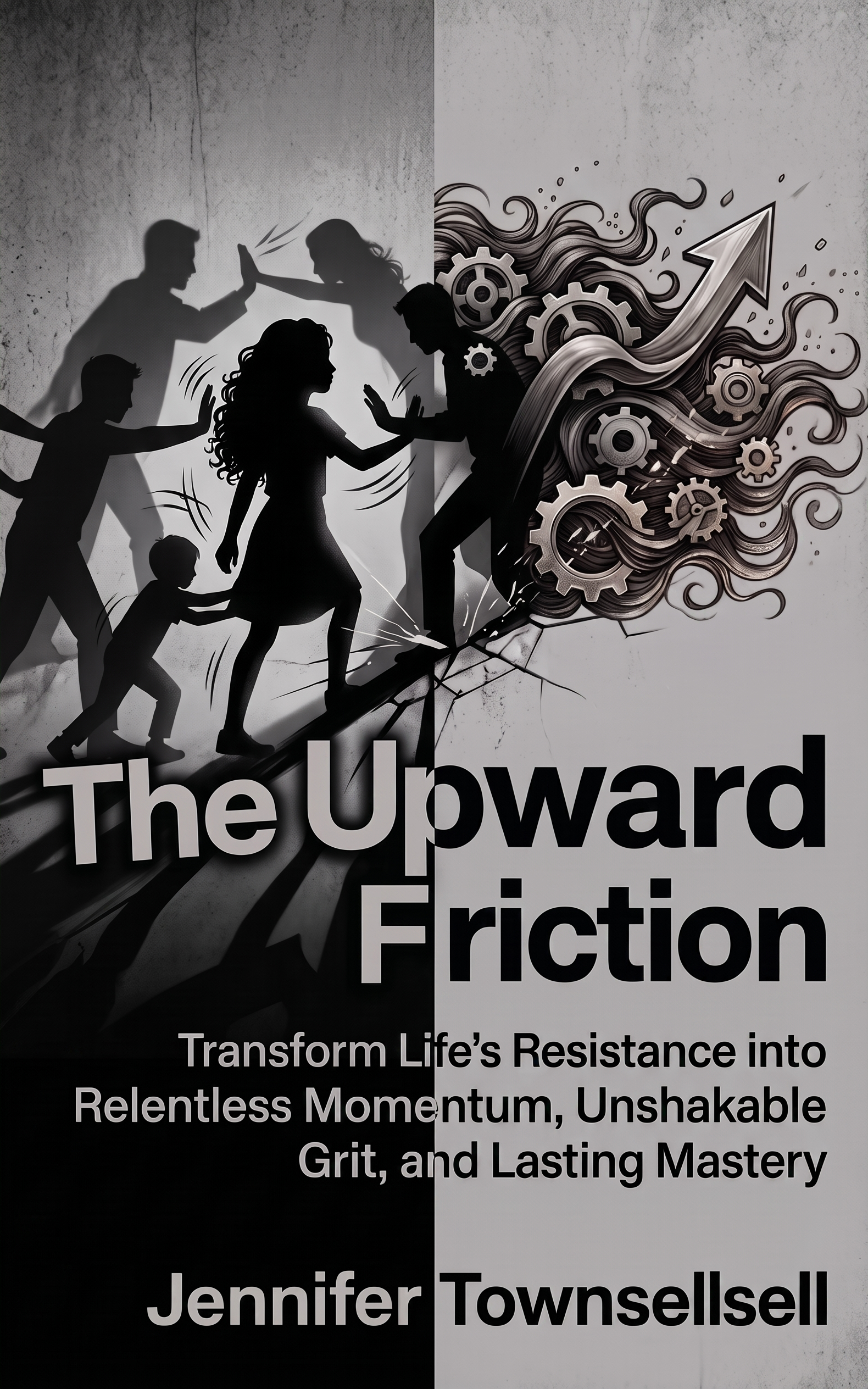
The Upward Friction
Transform Life's Resistance into Relentless Momentum, Unshakable Grit, and Lasting Mastery
by Jennifer Townsell
What if the resistance holding you back is actually the force you need to move forward? When setbacks strike, decision regret sets in, and initial excitement fades, most people freeze. We wait for a spark of motivation that never arrives, paralyzed by fear of making the wrong move. In The Upward Friction, Jennifer Townsell delivers an honest, practical blueprint for turning everyday resistance into unstoppable momentum. Moving far beyond temporary hype and empty platitudes, this book provides actionable frameworks to conquer self-doubt, overcome burnout, and construct durable daily systems that withstand real-world pressure. Through clear, evidence-based phases, you will discover how to reframe unavoidable failures as strategic milestones, build psychological grit when discipline wavers, and transform stumbling blocks into stepping stones. Stop running from the friction in your life. Embrace the resistance, master your habits, and forge the strength needed to navigate your boldest ambitions.
- Self-Help
- Mindset & Motivation
- Resilience & Grit
- Personal Growth & Habits
Embracing the Pushback: Why Friction Is Your Compass
You sit down on a Sunday evening with a clean notebook, a fresh cup of coffee, and a sudden wave of clarity. You decide that tomorrow morning everything changes. You are going to wake up at six, run four miles, spend an hour studying a technical skill that will double your market value, cook every meal from scratch, and stop checking your phone during work hours. The plan feels clean and sharp in your head. It carries an undeniable sense of purpose. As you sketch out the weekly schedule, your pulse picks up. You feel ready, capable, and fundamentally aligned with a better version of yourself.
Then Monday morning arrives at 5:58 AM. The alarm rings. The room is cold. Your throat feels dry, your shoulders are stiff, and the enthusiasm that filled your chest fourteen hours ago has vanished. In its place is a thick, heavy resistance. You do not want to put on running shoes. You do not want to review complex notes before work. The moment your feet hit the floor, your mind offers a rapid series of reasonable excuses: you did not sleep well, you have a heavy project due by noon, and starting on a Tuesday makes much more practical sense anyway. You tap the snooze button, pull the blanket up, and tell yourself that something felt off.
That subtle feeling of something being off is where most personal growth quietly dies. We operate under an unspoken, deeply flawed premise: if a goal is right for us, pursuing it should feel natural, energizing, and relatively smooth. We mistake early enthusiasm for genuine capability, and when the initial high wears off, we treat the resulting discomfort as a warning sign. We tell ourselves that because the action feels clunky, irritating, or embarrassing, we must be on the wrong path. We pull back, wait for another burst of inspiration, and restart the cycle three weeks later with a different routine.
This pattern is the friction point. It is the exact threshold where an imagined plan collides with the physical, messy mechanics of reality. Friction is not a defect in your personality. It is not evidence of a weak character, nor is it a signal from the universe that you ought to turn around. Friction is the universal tax that reality levies on any attempt to change your state. Until you understand what this pushback actually represents, you will remain trapped in a frustrating loop of starting, stalling, and retreating the moment the work demands real effort.
The Illusion of Effortless Alignment
Young adults in particular face an overwhelming cultural narrative that champions effortless alignment. We scroll through social media and observe creators, entrepreneurs, and athletes operating at peak capacity. We watch short video clips of people writing code effortlessly, giving confident presentations, or finishing intense gym sessions with a grin. Because the editing cuts out the three hours of boredom, the repeated failed drafts, and the morning dread, our brains register the performance as fluid and continuous. We conclude that successful people do what they do because they discovered their true passion, and that this passion generates an endless supply of ease.
This creates a dangerous cognitive trap. When we decide to learn public speaking, launch a freelance side project, or change our financial habits, we expect the work to mirror the tidy narratives we consume. When we sit down to write an article and stare at an empty document for forty-five minutes with a knot in our stomach, we panic. We assume that a talented writer would already have three paragraphs on the page. When we try to network and our voice cracks while introducing ourselves to a manager, we feel a sudden rush of shame. We tell ourselves: If I had real talent for this, I would not feel so ridiculous right now.
Notice the jump in logic. You experience an uncomfortable physical sensation, and you immediately assign it a catastrophic emotional meaning. You equate emotional ease with correctness, and awkwardness with incompetence. This belief is backwards. Ease is rarely an indicator of progress. In almost every domain of life, ease simply means you are repeating actions you already know how to perform within an environment you can already control. Ease means you are operating well inside your current boundaries.
When you attempt something beyond your current skill level, your nervous system experiences a genuine threat response. Your brain prefers predictability because predictability conserves energy and avoids social danger. When you step outside established routines, your brain tries to pull you back to safety by generating dread, doubt, and physical lethargy. That internal pushback is not a rational evaluation of your potential. It is an automated survival mechanism designed to keep you stationary. When you mistake that survival reflex for an objective assessment of your talent, you abandon valuable pursuits before you even build the first layer of competence.
The Growth Resistance Model
To break this loop, you need a functional framework that strips away the emotional drama from everyday discomfort. Consider the physical world. If you drop an apple, it falls to the earth at a predictable rate because gravity exerts a constant downward pull. You do not get angry at gravity. You do not accuse gravity of having a personal vendetta against the apple, nor do you assume the apple is defective because it cannot float on command. You accept gravity as an unavoidable law of physics and build ladders, airplanes, and bridges accordingly.
Human development operates under an identical principle called the Growth Resistance Model. Under this model, any attempt to lift your baseline performance creates an equal and opposite force of psychological pushback. This pushback is simply ambition meeting resistance. It takes three distinct forms:
- Cognitive Drag: The mental fog and fatigue that occurs when your brain has to build new neural pathways instead of running automated habits. This is why reading thirty pages of dense technical material feels exhausting, while scrolling through social feeds for two hours feels effortless.
- Affective Pushback: The emotional discomfort that accompanies unfamiliarity. It manifests as embarrassment, self-consciousness, performance anxiety, and the persistent fear of looking foolish in front of peers.
- Behavioral Friction: The logistical resistance built into your physical environment. This includes cluttered workspaces, disorganized tools, chaotic schedules, and competing domestic demands that pull you away from your intended focus.
When you encounter these three forces simultaneously, your immediate reaction is to interpret the combined weight as personal failure. You think: I am just not cut out for this. The Growth Resistance Model asks you to make a cold, mechanical shift in your perspective. You must view resistance as confirmation of contact with reality. If you push against a solid wall and feel nothing, your hands are not touching the wall. If you push against the wall and your muscles strain while your palms burn, you have made firm contact. Discomfort is the direct sensory proof that you are demanding more from your current capacity than it is accustomed to providing.
When you accept that friction is a structural requirement of adaptation, the emotional sting disappears. You stop treating a difficult morning as a crisis of identity. You stop waiting for a mood shift before you sit down to work. You realize that feeling unmotivated, awkward, and slow is the normal baseline for anyone attempting to learn a difficult skill. The goal is not to find a magical path where resistance does not exist; the goal is to stop running away from the resistance you encounter.
Case in Action: Dakota's Career Transition
Consider the experience of Dakota Musick, a twenty-six-year-old administrative specialist working at a regional logistics firm. Dakota spent four years managing scheduling, processing supplier invoices, and organizing internal files. She was efficient, reliable, and comfortable. Her daily tasks were so predictable that she could complete most of them on autopilot by early afternoon. However, the work offered zero upward mobility and left her feeling stagnant. She decided she wanted to transition into data analytics, an area with higher pay and better long-term potential.
Dakota spent six months studying independently after work. She learned SQL, practiced building dashboard visualizations, and completed several portfolio projects. She felt capable while working alone in her apartment. Her code ran cleanly, her datasets were organized, and she felt a strong surge of pride every time she solved a complex query. Based on this solitary progress, she believed she was ready for the job market.
Her confidence cracked during her very first technical interview with a software company. The interviewer asked her to share her screen and talk through her thought process while cleaning an unfamiliar dataset in real time. Dakota froze. Her hands shook on the keyboard. Under the gaze of a senior engineer, the commands that seemed obvious the night before slipped from her memory. She stumbled over basic terminology, misidentified a table relationship, and spent ten agonizing minutes trying to fix a syntax error while the interviewer watched in silence. The rejection email arrived the next morning.
Two weeks later, she secured a second interview at a healthcare analytics firm. This time, the hiring manager asked behavioral questions about how she handled project disagreements and cross-functional communication. Once again, Dakota felt overwhelmed. She gave rambling, disorganized answers. She felt like an imposter masquerading as a professional analyst. She walked out of the room with a burning face and a sinking feeling in her stomach.
That evening, Dakota closed her laptop and decided to stop applying. She told herself that despite her independent study, she simply lacked the natural presence and quick-thinking capability required for corporate analytical roles. She assumed that real analysts did not freeze on screen, nor did they struggle to explain their logic aloud. She interpreted her intense anxiety and awkward performance as clear proof that her career pivot was a mistake.
She remained stuck in that defeatist mindset for nearly two months until she spoke with a veteran data architect at a local meetup. Dakota confessed how disastrous her interviews had been and admitted she was thinking about staying in administration permanently. The architect laughed, not out of malice, but out of immediate recognition. He explained that writing code alone in a quiet room uses an entirely different set of mental muscles than explaining code live under scrutiny. Her failure in the interviews did not mean she was unqualified; it meant she had only trained the solitary half of the skill set. The awkwardness she felt on screen was simply the friction of learning how to communicate under pressure.
That conversation changed Dakota's perspective. She realized that she had been demanding emotional comfort during a process that is inherently uncomfortable. The interview awkwardness was not a sign of incompetence; it was the exact point where her skill gap existed. If she wanted to become a professional analyst, she had to treat live communication as a technical skill that required deliberate calibration through repetition.
Dakota changed her approach entirely. She stopped waiting to feel confident before applying. Instead, she set up mock technical interviews with peers twice a week. During these sessions, she deliberately forced herself to speak out loud, make mistakes in front of others, and continue working through code while being watched. The first five sessions were excruciating. She stumbled, misstated concepts, and felt the same physical urge to quit. But because she now viewed the discomfort as necessary calibration rather than proof of inadequacy, she stayed in the seat.
By her twelfth mock session, the physiological panic subsided. Her explanations became concise, her hands stopped shaking, and she learned how to pause calmly when she encountered an unexpected error. Four months later, Dakota completed three rounds of interviews at a logistics software firm and secured a junior analyst position with a thirty percent pay increase. The job requirements had not changed, nor had her innate personality altered. What changed was her willingness to endure the friction of real-time communication until the awkwardness transformed into capability.
Diagnostic: The Three Types of Daily Friction
To navigate resistance effectively, you must diagnose the specific type of pushback you are facing. When you treat all resistance as a vague emotional cloud, you cannot apply a targeted solution. The table below breaks down the primary forms of friction, how they present in daily life, and the direct corrective action required.
| Friction Type | Internal Sensation | Common False Conclusion | Correct Action |
|---|---|---|---|
| Judgment Friction | Social anxiety, dread of criticism, acute self-consciousness | "I do not belong in this room; people are judging my incompetence." | Expose your work early in low-stakes settings; desensitize your fear of visibility. |
| Competence Friction | Mental fog, slow execution, frequent technical errors | "I lack natural talent for this subject; it should not be this hard." | Shrink the scope of work; break the task down into smaller mechanical steps. |
| Structural Friction | Lethargy, distraction, physical reluctance to start | "I lack motivation and discipline; I will try again tomorrow." | Alter your physical environment; remove barriers between you and the starting line. |
When you find yourself hesitating before a task, pause and identify which row of this table matches your current state. If you are avoiding sending an email to a client, you are likely dealing with Judgment Friction. The solution is not to wait until you feel brave; the solution is to hit send while your stomach is churning. If you are staring at a textbook and cannot retain a single sentence, you are facing Competence Friction. The solution is to drop your expectations of rapid mastery and focus on understanding a single paragraph. Pinpointing the exact nature of the resistance strips away the mystery and leaves you with an objective mechanical problem to solve.
The Action Protocol: Calibrating Under Resistance
You do not build tolerance for friction through passive contemplation. You build it through deliberate, structured exposure to uncomfortable tasks. Use the following three-step protocol whenever you find yourself stalling on an important objective.
Step 1: Isolate Three Stalled Objectives
Take out a sheet of paper and write down three specific tasks or projects that you have delayed over the past fourteen days. Be precise. Do not write vague aspirations like "get in shape" or "work on career." Write concrete outputs that have been sitting unfinished on your to-do list. Examples include:
- Drafting the introductory email to a prospective business partner.
- Reviewing the financial statements from the past three months to build an accurate budget.
- Practicing the first five minutes of an upcoming presentation out loud without notes.
Step 2: Label the Friction Category
Next to each item, write down the dominant category of friction preventing your progress: Judgment, Competence, or Structural. Be completely honest about the underlying cause. If you have not opened your financial spreadsheets, is it because you do not know how to use the software (Competence), because you have messy files scattered across three hard drives (Structural), or because you are terrified of seeing your actual bank balance (Judgment)? Naming the specific resistance disables the vague dread that keeps you paralyzed.
Step 3: Execute a Non-Negotiable Two-Minute Action
Select one of the three items right now. Strip away all demands for emotional readiness. You do not need to feel positive, inspired, or confident. You only need to perform two minutes of physical movement toward the task. If the task is drafting an email, open a blank message, type the recipient's address, and write the first two sentences. If the task is cleaning your budget, open the spreadsheet and enter the balance from one account.
The rule is simple: during these two minutes, you are entirely forbidden from evaluating your performance. You are not allowed to judge whether the work is good, whether you feel like continuing, or whether you are doing it correctly. Your only assignment is to make physical contact with the resistance. Once the two minutes expire, you may stop if you choose. In most cases, making contact breaks the static friction holding you in place, and continuing becomes significantly easier than stopping.
Pitfalls That Sabotage Your Progress
While learning to tolerate pushback is critical, you must avoid two common errors that derail people when applying this framework.
Pitfall 1: Confusing Destructive Environments with Productive Friction
There is a massive, fundamental difference between the productive resistance of learning a difficult skill and the destructive friction of a toxic environment. Productive friction occurs within your own nervous system as you stretch your abilities. It leads to increased competence, resilience, and clarity over time. Destructive friction comes from exploitative relationships, abusive work cultures, or severe chronic sleep deprivation that destroys your physical health.
Do not use the Growth Resistance Model to justify staying in an abusive workplace or tolerating personal disrespect. If a situation constantly drains your mental and physical health without providing any baseline of safety or skill acquisition, that is not growth resistance; it is an environment that requires immediate exit. Learn to distinguish between the healthy ache of lifting heavy weights and the sharp pain of a torn ligament.
Pitfall 2: Demanding Emotional Comfort Before Starting
The second pitfall is the persistent belief that you must eliminate negative emotions before you begin an important task. Many people spend years reading productivity literature, experimenting with complex morning routines, and listening to motivational audio in an attempt to reach a state where work feels effortless. This is a subtle, sophisticated form of procrastination.
You do not need to feel like doing something in order to do it well. Action and emotion can operate completely independently of one another. Professional surgeons do not wait to feel enthusiastic before operating on a patient. Commercial pilots do not wait for a burst of inspiration before landing an aircraft in heavy crosswinds. They follow their training, execute the proper mechanical inputs, and let their emotions catch up later. Treat your personal goals with the exact same professional detachment. Carry the awkwardness with you into the work instead of waiting for it to leave.
Friction as Your Compass
When you change how you interpret pushback, your relationship with difficulty changes entirely. You stop looking for shortcuts that promise effortless results. You realize that any path offering zero resistance is a path that leads directly to stagnation. A workout that does not challenge your muscular capacity builds no strength. A project that demands no new thinking teaches no new skills. A conversation that avoids all tension resolves no underlying conflicts.
Friction is not your enemy; it is your compass. In almost every situation, the specific task you are actively avoiding because it feels uncomfortable, tedious, or socially intimidating is the exact task that holds the highest leverage for your personal growth. When you feel that familiar knot of resistance tighten in your chest, do not take a step back. Recognize the resistance for what it is: concrete evidence that you have arrived at the outer boundary of your current capacity.
Your task for today is simple and direct. Identify one task you have delayed purely because it feels awkward or inconvenient. Do not wait for tomorrow morning. Do not wait until you have cleared your entire schedule. Take the first concrete step on that task within the next three hours. Step directly into the pushback, execute the movement without demanding emotional comfort, and let the friction do its work.
The Sunk Cost Cure: Reclaiming Power from Bad Choices
Walk into almost any household storage closet, and you will find an expensive piece of exercise equipment holding winter coats. Look into the garages across your neighborhood, and you will see half-finished woodworking benches, unused sets of golf clubs, and boxes of technical textbooks for degrees that were never completed. Most people keep these …