

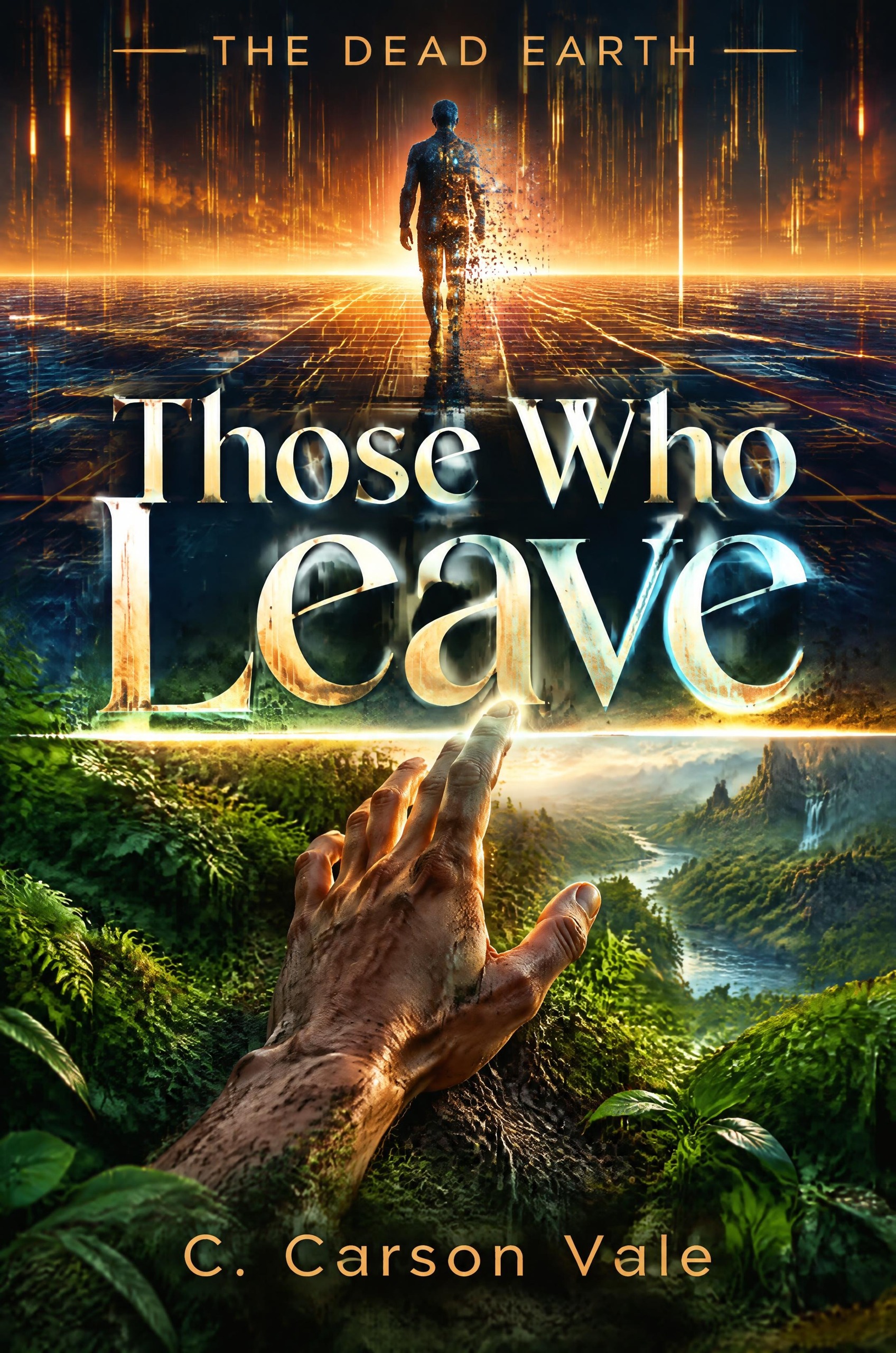
Those Who Leave
The Dead Earth - Book One
For millennia, humanity has survived in three worlds without realizing it. The Zone holds billions of digital minds in manufactured paradise. The 'Claves shelter the physical few who maintain the machines. And the surface of the Earth - the Dead Earth - is believed to be poison, lifeless, unsurvivable. Jonah Tender has spent his life questioning that certainty. When the woman he loves is declared Forever Chaste by a mysterious authority called Progenics, forbidding her from ever building a life with him, Jonah makes an unthinkable choice. He volunteers for Leaving: permanent exile into the toxic wasteland above. He expects to die within hours. Instead, the Dead Earth changes everything. Beyond the barren scar surrounding the 'Claves, the planet is vibrantly, dangerously alive. Forests swallow ancient ruins. Wildlife dominates the landscape. And physical humanity did not perish—it scattered, survived, and built new societies across a recovered world. Under the mentorship of an exiled heretic who was cast out fifteen years before him, Jonah discovers that the system he fled was never what it claimed to be. Meanwhile, inside the Zone, Miriam Oracle finds herself the target of Maximillian, an ancient virtual architect whose fascination with her has curdled into something possessive and dark. His manipulation of Progenics destroyed her future with Jonah. Now he offers her a different eternity—one that would cost her everything she is. To find each other again, Jonah and Miriam must each confront the lies their worlds were built upon. The Dead Earth was never dead. Now they must decide whether the systems created to save humanity are still preserving it—or preventing its scattered descendants from becoming human again.
- Science Fiction
- Erotica
- Post-Apocalyptic
- Virtual Reality
Heresy
Jonah-of-Micah was ten years old when he learned that the Dead Earth had a door.
He had always known about the Dead Earth, of course. Every child did. The world beyond the ’Clave was poison, lifeless, a wasteland of ash and silence where nothing grew and nothing breathed. Generations of Shepherds had maintained the Behemoth and the Zone while the surface remained sealed away behind barriers that no one Jonah knew had ever crossed. The Dead Earth belonged to history, to lessons recited in the education commons and warnings so old that nobody seemed to remember who had first spoken them. It was not somewhere Jonah imagined people going. It was the vast, ruined nothing that existed beyond the limits of everything that mattered. The Dead Earth wasn’t a place. It was an ending. That had always been enough of an explanation for most children, because most children seemed perfectly willing to accept that there were some places they would never see and therefore had little reason to wonder about. Jonah had questions. He always had questions.
The assembly horn sounded at midday, three long blasts that echoed through the ’Clave’s primary corridors and summoned every resident who wasn’t currently tending a critical system. Jonah felt the first vibration through the floor before he properly heard it, a deep thrumming that traveled up through the soles of his shoes and settled somewhere in his chest. By the second blast, the adults nearest him had already begun putting aside whatever they were doing, and by the third, conversations throughout the corridor had dwindled into the peculiar silence that accompanied anything important enough to disrupt the normal rhythms of the ’Clave.
Jonah hurried back to the family quarters and found his father already pulling on his formal tunic. Micah Tender’s broad hands moved with the practiced efficiency of a man who had dressed for assembly countless times before, but there was a little more speed in his movements than usual. One fastening caught incorrectly, forcing him to undo it and start again, and the small mistake caught Jonah’s attention immediately. His father worked on the Heart. Micah did not often need to do things twice.
“What’s happening?” Jonah asked as he stepped farther into the room.
“An assembly,” Micah answered, although he didn’t look up from the troublesome fastening.
Jonah waited for him to say more. When his father didn’t, he frowned and asked, “I know it’s an assembly. Is it a Cleaving?”
“No,” Micah said, finally getting the fastening where he wanted it.
“A Calling?”
“No, Jonah,” Hannah said from behind him, and something in his mother’s voice stopped the next question before it reached his mouth.
Jonah turned toward her. Hannah Cultivator had already changed out of the practical clothing she wore in the cultivation halls and into something darker and more formal. She’d washed before coming home, but a faint crescent of soil remained trapped beneath one thumbnail. On any ordinary day, Jonah might have found some amusement in pointing out that his mother had missed a spot, particularly given how frequently she inspected his own hands before meals. Today, the thought came and went without becoming a joke.
Hannah looked worried. Not frightened exactly, and certainly not panicked. Jonah had never seen his mother panic over anything. Hannah dealt with failing crops, damaged irrigation systems, sick plants, and all the other unpredictable complications of keeping living things alive with a stubborn practicality that bordered on defiance. What he saw now was quieter than fear, held somewhere around the set of her mouth and the slight tension across her shoulders.
“What is it, then?” Jonah asked.
Hannah glanced toward Micah before answering. “Something you’re going to listen to without interrupting.”
That wasn’t an answer, and Jonah suspected his mother knew perfectly well that he knew it wasn’t an answer. “Am I allowed to know what it’s about?”
Micah finally stopped fussing with his tunic and looked at him. There were times when Jonah suspected his parents possessed some private language that had nothing to do with words. Hannah looked at Micah, his father returned the look, and in the silence between them some entire discussion seemed to take place without including him. Jonah watched closely, as he always did, but whatever signals passed between husband and wife remained maddeningly beyond his ability to decipher.
Hannah finally drew a slow breath. “You’re allowed to know there’s an assembly. You’re allowed to come with us. And you’re allowed to listen.”
Jonah considered her careful phrasing. “What am I not allowed to do?”
The corner of Micah’s mouth twitched, although the expression never developed into a proper smile. “What do you think?”
“Ask questions.”
“During the proceeding,” Micah clarified as he finally finished fastening his tunic. He smoothed the fabric across his chest, then looked directly at Jonah. “Whatever you hear, you stay beside us and keep your questions to yourself. Afterward, we’ll talk.”
That concession was enough to keep Jonah from arguing, although not enough to satisfy him. “All right.”
Hannah crossed the short distance between them and straightened the collar of Jonah’s tunic, despite the fact that there was nothing visibly wrong with it. Her fingers lingered against the fabric for a moment before she flattened it needlessly against his shoulder. “I mean it, Jonah. Whatever happens in there, you stay close to us. You don’t interrupt, and you don’t let that mind of yours convince your mouth that every question has to be asked the moment you think of it.”
Jonah almost smiled because the complaint was familiar enough to sound reassuring. The way Hannah’s hand remained on his shoulder kept the smile from quite arriving. “I won’t,” he promised.
Micah studied his son for a moment, then nodded. “I know.”
Jonah caught the hesitation behind the answer. “Then why are you looking at me like that?”
This time Micah managed a faint smile, although whatever troubled him remained visible around his eyes. “Because you remember everything.”
They left the family quarters and joined the steady flow of people moving through the residential corridors toward the assembly hall. Assemblies were hardly unheard of, but Jonah had never seen one gather with so little conversation. Neighbors acknowledged one another with nods or brief greetings, yet almost no one lingered. Twice he saw adults start speaking only to lower their voices when another family approached, and once an older man Jonah recognized from the maintenance levels stopped talking altogether when he noticed Micah. Jonah looked up at his father, but Micah kept walking. The first question Jonah wanted to ask joined the others he’d been ordered to keep to himself.
The assembly hall was the largest open space in the ’Clave, a cavern carved from living rock and reinforced with ancient alloys whose composition no living Tender fully understood. Huge structural braces disappeared upward into darkness, supporting a ceiling so high that the normal lighting arrays could only suggest its existence. Jonah had always liked that about the chamber. Almost everywhere else in the ’Clave had boundaries a person could see. Walls met ceilings, corridors turned corners, doors separated one space from another. Here, if he tilted his head far enough back, there was only darkness above him.
Benches descended in concentric rings around a broad central floor and the raised platform at its center. Jonah had sat on those benches for celebrations, memorial observances, Callings, and announcements important enough to require the whole community’s attention. He associated the chamber with noise, hundreds of familiar voices reverberating through stone until conversation became a continuous murmur that seemed larger than any individual person. Today even that murmur felt restrained.
Micah led them toward a bench in one of the middle rings, neither conspicuously close to the central platform nor far enough away to suggest they were avoiding it. Jonah settled between his parents and immediately began searching the crowd.
Hannah caught him doing it. “Looking for Miriam?”
Jonah nodded, and his mother leaned slightly across him before pointing toward the opposite side of the hall. “She’s over there with Esther.”
He found Miriam-of-Esther a moment later. At nine, she was still small enough to nearly disappear among the adults surrounding her, although Jonah could recognize her almost anywhere. She sat beside Esther Oracle, leaning subtly to one side so she could see around the taller person seated in front of her. The movement was so characteristically Miriam that Jonah felt a brief flash of relief simply from seeing it.
As though she sensed him staring, Miriam turned and found him across the hall. Jonah raised his eyebrows and tilted his head slightly toward the platform, silently asking the question his parents wouldn’t answer. Miriam considered him for a second and gave the smallest possible shake of her head. She didn’t know either. For reasons Jonah couldn’t quite explain, that bothered him more than anything else had. Miriam usually knew things.
Before he could try another silent question, the horn sounded again. The deeper blast rolled through the cavern, swallowing the remaining conversations until hundreds of people fell almost simultaneously quiet. A side entrance opened near the floor of the hall, and the Wardens entered first.
Eight of them came through the doorway in formal gray tunics and moved down the central aisle in pairs. Jonah recognized one of the women near the front, a broad-shouldered Warden with close-cropped hair who had visited the education commons the previous year to explain her Calling. She had possessed the peculiar ability to bring an entire room of restless children to silence simply by becoming still herself and waiting for them to notice. Jonah had liked her.
His attention shifted to the man walking between the Wardens, and the faint pleasure of recognition vanished. The man was large, broad through the chest and shoulders, with dark hair and heavy features that Jonah vaguely recognized even before he could attach a name to them. He wore ordinary clothing rather than the gray of the Wardens, but it was his hands that captured Jonah’s attention. Someone had bound them together in front of him with a simple length of cord.
Jonah leaned slightly toward his father. “Who’s that?” he whispered.
Micah’s jaw tightened. For several seconds, Jonah thought his father might invoke the no-questions rule. Instead, Micah kept his eyes fixed on the procession and answered so quietly that Jonah barely heard him. “That’s Enoch Checker.”
The name meant something. Jonah searched his memory until the connection formed. A Checker monitored the integrity and continuity of Zoner data, watching for corruption, degradation, incomplete replication, or anything else that might threaten the countless human consciousnesses entrusted to the Zone. Jonah understood only the simplest version of the work, but even children knew how important it was. A damaged mechanism could be repaired. A malfunctioning system could be taken out of service and restored. The Zoners were people. If something happened to the information that made one of them who they were, a Checker might be the person who noticed before whatever had been lost became permanent.
Jonah looked again at the cord around Enoch’s wrists. “Why is he tied?” he whispered before caution could quite catch up with curiosity.
This time Micah turned his head. He didn’t glare, and he didn’t need to. “Jonah.”
His father spoke only his name, but the warning inside it was unmistakable. Jonah pressed his lips together and looked back toward the central floor.
Enoch walked between the Wardens without resistance. He was large enough that Jonah found himself wondering whether the bindings were meant to restrain him or merely to show everyone watching that he had been restrained. There was no struggle in him. No bowed head, no dragging feet, none of the shame Jonah might have expected from a man being marched before the entire ’Clave with his hands tied. Instead, Enoch looked at the people. His eyes moved slowly across the crowded benches as he passed, lingering here and there on faces Jonah could not identify. There was none of the wildness Jonah associated with guilt discovered or punishment approaching. If anything, Enoch seemed unnervingly composed.
Jonah had expected a prisoner to look ashamed. Enoch didn’t. He looked like a man trying very hard to remember everyone, and the realization sent an unexpected chill across Jonah’s skin.
The Wardens stopped at the base of the central platform. Two remained immediately beside Enoch while the others moved outward with practiced precision, creating a perimeter around a man who had shown no indication that he intended to run anywhere. After several seconds, one of the Elders rose from the first ring and began climbing the shallow steps to the platform.
Jonah knew the man by sight but couldn’t remember his name. He was old enough that white had nearly conquered the remaining gray in his hair, and he moved with the deliberate care of someone whose authority no longer depended upon speed or physical strength. Jonah had always been vaguely suspicious of adults like that. Everyone became quiet when they spoke, which meant either that they possessed unusual wisdom or that everyone else had simply grown tired of disagreeing with them.
The Elder took his place, looked toward Enoch, then turned to face the assembled Shepherds. “Enoch-of-Abner, Called as Checker,” he began, his voice carrying easily through the cavern, “you have been brought before the assembled ’Clave to receive judgment upon the charge laid against you.”
Beside Jonah, Hannah shifted. Her hand came down over his where it rested against the bench. She didn’t squeeze it, not quite, but her fingers closed enough that Jonah became acutely aware of their presence.
The Elder let the silence settle before continuing. “You stand judged guilty of Heresy.”
Jonah felt his mother’s fingers tighten. He knew the word. Every child in the ’Clave knew it. Until that moment, Jonah had always thought that meant he understood it. Watching Enoch Checker raise his head and meet the Elder’s gaze without looking away, Jonah suddenly wasn’t so sure.
The Elder allowed the judgment to settle over the hall before he continued. “The charge concerns claims you made in the course of your work as Checker. Claims regarding the integrity of the Zone and the safety of those entrusted to it. You were instructed to reconsider your conclusions in light of established understanding. You were given an opportunity to acknowledge error and accept correction. You refused.”
Enoch’s expression barely changed, although Jonah saw his jaw tighten before he answered. “I asked that what I found be examined.”
“It was examined,” the Elder replied.
Enoch shook his head slowly, the movement small enough that it might have been missed by anyone farther from the platform. “No. It was dismissed.”
A murmur traveled through the benches, beginning somewhere close to the central floor and spreading outward until hundreds of whispered fragments blended into a single uneasy sound. Hannah’s fingers tightened around Jonah’s hand as he instinctively leaned forward, trying to catch whatever might follow. The Elder waited without raising his voice or calling for silence. Eventually the murmur subsided on its own.
When he spoke again, the Elder’s attention remained fixed on Enoch. “You were counseled by those whose Calling required them to consider your conclusions. You rejected that counsel and continued repeating claims judged dangerous to the stability of this community. Even now, standing before the assembled ’Clave, you refuse to acknowledge the possibility that you were mistaken.”
Something about the wording bothered Jonah. He turned it over in his mind, trying to identify exactly what was wrong with it. The Elder had spoken at length about Enoch’s conclusions, about counsel and correction and the danger of repeating whatever Enoch believed, but he still hadn’t said what Enoch had actually claimed.
Apparently Enoch noticed the omission too. “I’ve acknowledged that possibility from the beginning,” he said, and for the first time some of the composure slipped from his face. Not much, but enough for Jonah to see frustration in the deeper crease beside his mouth. “That’s why I asked for an investigation. If I’m wrong, demonstrate where my analysis failed. Show me what I missed, and I’ll accept it.”
The Elder’s eyebrows drew together. “Your analysis was reviewed.”
“Then let me see the review.”
A sharper murmur moved through the chamber. One of the Wardens standing behind Enoch shifted his weight, and Hannah’s thumb pressed hard against the back of Jonah’s hand. Jonah expected the Elder to answer immediately, but the old man remained silent for several seconds, studying Enoch with an expression Jonah couldn’t decipher.
Finally, the Elder said, “This proceeding isn’t an examination of your work. That opportunity has passed.”
Enoch released a quiet breath through his nose that might almost have been a laugh, although there was nothing amused in it. “There was no opportunity.”
The Elder’s face hardened. “You were given the opportunity to recant.”
“To recant?” Enoch repeated, turning the word over with obvious disbelief. “I was given the opportunity to say I was wrong. I wasn’t given the opportunity to prove I might be right.”
The reaction this time was impossible to contain completely. Someone several rows below Jonah whispered something too softly for him to hear, followed by a terse response from another voice. Jonah saw heads turn before people remembered where they were and faced forward again. Across the hall, Miriam was leaning so far toward the aisle that Esther rested a hand on her shoulder and gently drew her back. Miriam looked toward her mother, received some whispered instruction, then returned her attention to the platform.
Jonah understood exactly how she felt. The proceeding was supposed to be answering questions, but every answer seemed to produce another question while carefully avoiding the one that mattered most. He still didn’t know what Enoch had supposedly done.
The Elder drew himself straighter. “You persist in placing your own judgment above that of the institutions charged with protecting this ’Clave.”
Enoch’s shoulders rose with a slow breath. When he answered, the anger Jonah expected never came. If anything, the Checker sounded tired. “No. I placed evidence before the people whose responsibility it was to examine it. What happened after that wasn’t my choice.”
For the first time, Jonah wondered what Enoch had expected to happen when he reported whatever he’d found. Surely not this. A man didn’t spend his life earning a Calling as important as Checker while secretly planning to throw it away. Somewhere before the bound hands and the Wardens and the silent assembly hall, Enoch must have believed that someone would listen to him. The thought disturbed Jonah because it transformed the scene below from something inevitable into something that had gone terribly wrong.
“You’ve been judged,” the Elder said, and whatever room there had been for argument disappeared from his voice. “The charge is Heresy. The judgment stands.”
Enoch stared at him for a long moment. His bound hands shifted slightly in front of him, the cord creaking against the tension in his wrists, but his voice was steady when he answered. “Then there was never any reason to bring me here except to make everyone watch.”
A breath seemed to pass through the hall. Jonah felt Hannah move beside him, and when he looked up he saw that her attention was no longer on Enoch. She was watching the Elder.
The old man’s expression gave nothing away. “The Shepherds have always witnessed judgment in matters that concern the safety of the whole.”
“And do they get to know what I supposedly did?”
The question struck Jonah with enough force that he stopped breathing for a moment. That was it. That was precisely what had been bothering him all along.
The Elder didn’t answer Enoch’s question. Instead, he turned slightly so that his voice carried across the full breadth of the chamber. “Enoch-of-Abner, Called as Checker, having refused correction and persisted in Heresy against the sacred trust between Shepherd and Zoner, you are sentenced to Leaving. You will pass beyond the protection of this ’Clave with those provisions required by law. Once you cross the outer threshold, you will not return. Your place among the Shepherds ends when that door closes behind you.”
Jonah felt Hannah’s hand close completely around his. Her palm was warm, but her fingers had become strangely cold at their tips.
Leaving. The word had appeared in lessons, usually attached to old warnings and rare judgments from generations Jonah barely understood. Until now it had possessed the unreal quality of ancient catastrophes and distant history, something that had happened to people whose names were recorded because everyone who had known them was already dead. Enoch Checker was standing directly in front of him.
The Elder regarded Enoch for several seconds before asking, “Do you have anything to say before the judgment is carried out?”
Enoch initially said nothing. His gaze dropped toward his bound hands, not in shame, Jonah thought, but with the concentration of someone deciding how much could still be accomplished with very little time. When he finally raised his head, he didn’t look at the Elder. He turned instead toward the surrounding benches and regarded the people of the ’Clave who had gathered to watch him disappear.
“I was Called as Checker,” Enoch said. His voice wasn’t particularly loud, but the stillness of the hall carried it farther than shouting might have. “I accepted that Calling willingly. I did the work entrusted to me, and when that work showed me something I couldn’t explain, I reported it to the people I was taught to trust.” His eyes moved slowly across the chamber before he continued. “I asked them to look. I asked them to show me where I was wrong. That’s all.”
The Elder shifted behind him, but Enoch continued before the old man could interrupt. Something changed in Enoch’s face then, not fear and not quite anger, but a hard resignation that made him suddenly look older.
“If asking for an answer is Heresy, then remember that when your own questions come.”
No one responded. The Elder merely gave the Wardens a curt nod and instructed them to take him away.
They moved immediately, one taking position on either side of Enoch. Neither seized him nor dragged him toward the aisle. Enoch turned and walked between them under his own power, the remaining Wardens falling into formation around him as they left the platform. Jonah watched him go, expecting Enoch to look back, perhaps to search the crowd for a wife, a child, a friend, anyone who might offer some final acknowledgment that the life being taken from him had existed. Instead, Enoch kept his head raised and walked steadily toward the archway through which he had entered. The crowd seemed to shrink from him as he passed, although no one was close enough to touch him.
Only when the gray uniforms had disappeared through the far archway did Jonah realize how hard he was gripping his mother’s hand. He loosened his fingers and leaned closer to his father. “Where are they taking him?”
Micah remained facing the empty aisle for a moment before answering. “To the departure chamber.”
Jonah swallowed, understanding the words individually while still struggling with what they meant together. “And then he Leaves?”
Micah finally looked at him. The hardness Jonah had seen earlier was gone, replaced by something heavier that made his father look suddenly tired. “Yes.”
“Into the Dead Earth?”
“Yes.”
Jonah glanced toward the archway where Enoch had disappeared. All his life he had been taught what existed beyond the protection of the ’Clave. Poisoned air. Ruined land. Nothing living. Nothing capable of sustaining a human being for more than the briefest span. He knew all of that with the same certainty that he knew the Heart kept the lights burning and the Behemoth kept the Zone alive. “He’ll die,” Jonah whispered.
Micah’s gaze lingered on him, and for a moment Jonah thought his father might offer some explanation that softened the conclusion. Instead, Micah reached across him and rested one broad hand on the back of Jonah’s neck.
“That’s what Leaving means,” Micah said quietly, his hand remaining there for another moment before he withdrew it.
The warmth of his palm lingered after it was gone, but Jonah found little comfort in the gesture. His father had always been able to explain things. Even when his explanations sailed beyond Jonah’s understanding, as they sometimes did when Micah forgot himself and began talking about the Heart as though his ten-year-old son were another Tender, there had always been an answer somewhere beneath the unfamiliar words. This time there was only a judgment and the certainty of what would follow it.
Around them, the assembly had begun to dissolve. People rose from the benches in orderly rows, speaking in subdued voices as they moved toward the exits, but Jonah remained seated between his parents and watched the archway through which Enoch had disappeared. “Can we go?” he finally asked, turning the question toward Micah because his father had been the one willing to answer him so far.
Micah frowned. “Go where?”
“To the departure chamber.” Jonah saw Hannah stiffen on his other side and hurried to explain before she could refuse. “I’ve never seen it. If he’s going to Leave, I want to see what that means.”
“No,” Hannah said immediately. She rose and smoothed the front of her tunic with both hands, a gesture Jonah recognized as something she did when she wanted movement to settle thoughts she had no intention of sharing. “You’ve seen enough.”
“But you said I should listen.”
“I said you should listen during the proceeding. The proceeding is over.”
Jonah pushed himself to his feet beside her. He knew better than to confuse his mother’s patience with weakness, but he also knew that an immediate refusal wasn’t always the same thing as an irrevocable one. “I don’t understand why everyone had to watch him be judged if nobody’s supposed to watch what the judgment actually means.”
Hannah closed her eyes briefly, while Micah made a sound suspiciously close to a sigh. Jonah waited as his mother looked at his father and yet another of those irritatingly complete conversations seemed to pass silently between them. Hannah’s expression said no clearly enough that even Jonah could interpret it. Micah glanced toward the archway, then back at his son.
“He’s seen the judgment,” Micah said. “Maybe he should understand the consequence.”
“He’s ten, Micah.”
“I’m sitting right here,” Jonah pointed out.
Hannah turned a look on him that made him reconsider the value of contributing further. “And you were told not every thought needs to become words.”
Jonah pressed his lips together. Micah’s mouth twitched despite the gravity of the moment, and he looked away before Hannah could catch him almost smiling. Jonah saw it and felt an answering flicker of satisfaction. His parents might currently be united against his questions, but not quite enough to eliminate the familiar contours of family life.
Hannah noticed anyway. She usually did. Her attention moved from husband to son, and whatever argument she might have made seemed to collapse under the knowledge that both of them were waiting for it. She exhaled slowly, then pointed one finger at Jonah. “You’ll stay between us. You won’t approach the Wardens, you won’t speak to Enoch, and you won’t ask anyone questions while we’re there. If I tell you we’re leaving, we leave. Immediately.”
Jonah nodded quickly. “I understand.”
“I sincerely doubt that,” Hannah muttered, but she reached for his shoulder and steered him toward the aisle.
The departure chamber lay farther from the inhabited heart of the ’Clave than Jonah had ever traveled. They passed beyond the residential tunnels and the cultivation halls, then through sections of the Behemoth’s support infrastructure that most children had little reason to visit. Jonah knew enough about his father’s work to recognize when they passed near the Heart, not because he could see the fusion systems themselves, which were buried behind layers of shielding and restricted access, but because the character of the place changed. The familiar stone corridors gave way to older construction, with broad sections of metal exposed between later repairs. Some walls carried conduits thicker than Jonah’s leg, while others disappeared behind access panels marked with symbols so old that their original meanings had been reduced to occupational knowledge handed down from one generation of Tenders to another.
The farther they walked, the less human the ’Clave felt. Warm amber lighting gradually yielded to harsher white strips recessed into the walls, and the air became noticeably cooler. Jonah caught the faint metallic taste of it against the back of his tongue and wondered whether he was imagining the difference simply because he knew they were approaching the outer boundary. He considered asking Micah whether the ventilation system changed here, then remembered his promise and kept the question inside his head. It joined several dozen others already waiting there.
They passed through the first pressure door under the watch of two Wardens. Jonah had seen pressure doors elsewhere in the ’Clave, particularly around critical systems, but these were larger and older. The first opened reluctantly enough that he could hear machinery laboring somewhere inside the wall. The second was thicker, and its locking mechanism produced a succession of heavy metallic impacts that Jonah felt through the floor. By the time they reached the third, he had begun to understand that the barriers protecting the ’Clave from the Dead Earth were not merely doors. They were layers, each one designed to preserve the community even if something happened to the one beyond it.
A small group had gathered in the corridor outside the departure chamber. Most were Wardens, although Jonah recognized several Elders from the assembly. Esther Oracle stood slightly apart from them with Miriam beside her, the deep blue of Esther’s formal robes almost unnaturally vivid beneath the cold lighting. Miriam spotted Jonah before Esther did and started to raise a hand. Her mother noticed the movement and rested two fingers lightly against Miriam’s wrist, lowering it without reprimand. Miriam frowned up at her, then settled for meeting Jonah’s eyes across the corridor. The look lasted only a few seconds, but Jonah read enough in it to know that she had accumulated questions of her own.
Micah guided Jonah toward the wall and positioned himself between his son and the Wardens while Hannah remained close at Jonah’s other side. Nobody ordered them away. That surprised Jonah until he remembered what Micah had said in the assembly hall. The punishment had been delivered publicly because the Shepherds were meant to witness judgment. Apparently they were permitted to witness its consequence as well.
Enoch stood near the far end of the chamber. The cord had been removed from his wrists, and someone had given him a small pack. Jonah stared at it longer than he intended, wondering what anyone packed for a journey into a world where nothing lived. The bag didn’t look large enough to hold much. Water, perhaps. Food for however long the law required. Clothing. Jonah wondered whether giving provisions to someone expected to die was intended as mercy or whether it merely allowed everyone inside the ’Clave to pretend Leaving was something other than an execution.
A Warden approached Enoch and stopped a few paces away. She was the same broad-shouldered woman Jonah remembered from the education commons, although there was none of the approachable patience in her face now. Her posture had become rigidly formal, her hands folded behind her back as she regarded the condemned man.
“Enoch-of-Abner,” she said, her voice carrying through the chamber, “the judgment of Leaving has been entered and witnessed. You are being provided with the provisions required by law. Once you cross the outer threshold, the protection of the ’Clave ends, and you may never return. Do you understand the judgment?”
Enoch looked at the Warden for a moment before answering. “I understand.”
Something in the response made Jonah glance at his parents. Hannah was watching Enoch with her jaw set, while Micah’s attention remained fixed on the massive structure occupying the far wall. Neither looked reassured by Enoch’s calm acceptance.
The Warden stepped to the control station beside the outer door. The panel itself looked ancient even compared with the machinery they had passed on the way there, its surface worn smooth around those controls generations of hands had touched most often. She placed her palm against one section, waited until a dim indicator changed color, then entered a sequence Jonah couldn’t follow from where he stood.
A low hum rose through the chamber, deepening until Jonah could feel it in his teeth. The sound seemed to come from the walls themselves, followed by a sequence of mechanical impacts spaced several seconds apart. Locks, Jonah realized. He counted four before losing track as another vibration passed beneath his feet. The enormous circular structure in the far wall rotated several degrees, shedding fine dust from seams that had been invisible a moment earlier, then began withdrawing with ponderous slowness.
Jonah had expected a door. What opened before him looked more like a piece of the mountain moving out of the way.
The barrier was several meters thick, built from layered metal and material Jonah didn’t recognize. As it withdrew, daylight appeared around its edge, pale and diffuse at first, then widening into a gray illumination unlike anything produced by the ’Clave’s lamps. Jonah narrowed his eyes instinctively. He had seen representations of sunlight in lessons, but the actual thing looked wrong to him. There was no fixture producing it, no obvious direction from which it came, only a dull brightness spilling through the widening opening and painting strange colors across surfaces he had known only beneath artificial light.
Then the outside air reached him.
It was cold enough that Jonah felt it across his face before he thought to fear it. Beside him, Hannah’s hand found his shoulder so quickly that he knew she had felt the same instinctive alarm. Jonah inhaled before he could stop himself and tasted dryness, metal, dust, and something faintly bitter. For one irrational second he waited for pain, for his throat to close or his lungs to burn or for whatever poison made the Dead Earth dead to announce itself.
Nothing happened.
Of course nothing happened, he reminded himself. The departure chamber would have its own protections. The Wardens wouldn’t open the exterior if doing so poisoned everyone standing inside. Still, the air had come from the Dead Earth, and Jonah found himself breathing it again.
Through the open threshold, the world beyond stretched beneath a gray sky. Rock and dust dominated everything he could see, broken here and there by shapes whose origins he couldn’t identify. Some might once have been structures. Others could have been nothing more than stone worn into unfamiliar forms by weather no Claver had experienced in generations. There was no green. Nothing moved. No bird crossed the sky, no insect crawled across the threshold, and no sound reached them except the low mechanical rumble of the door and a thin whisper of wind.
For the first time in his life, Jonah understood that the Dead Earth wasn’t simply a lesson recited by adults. It existed. It had a sky and wind and cold air and a landscape that continued farther than he could see. Most unsettling of all, it had been sitting there the entire time, separated from everything Jonah had ever known by machinery people still knew how to operate.
Enoch lifted his pack and settled it over one shoulder. He approached the threshold without anyone touching him, but when he reached it, he stopped. The gray light sharpened the lines of his face and revealed small details Jonah hadn’t noticed in the assembly hall, including the shadow of exhaustion beneath his eyes and the faint abrasion around one wrist where the cord had rubbed his skin.
For a long moment Enoch simply studied the world outside, and Jonah wondered whether he was afraid. If he was, nothing in his posture admitted it. He stood with both feet planted and his shoulders squared, studying the wasteland with the concentration Jonah had seen Tenders give an unfamiliar piece of machinery. He seemed less like a condemned man staring at his death than a Checker confronted with one final problem he intended to understand.
After several seconds, Enoch turned back toward the people gathered behind him. His gaze moved across the Wardens and Elders first, then Esther and Miriam, then the handful of witnesses who had followed from the assembly hall. When his eyes reached Jonah’s family, they seemed to pause.
Jonah couldn’t be certain Enoch was looking at him, but he felt certain anyway.
“When the questions come,” Enoch said, his voice quieter than it had been in the assembly hall but perfectly audible in the waiting chamber, “ask them.”
The Warden at the control station stiffened. “Enoch.”
He looked toward her, and the hard edge that had briefly surfaced during the judgment softened into something almost weary. “I’m going.”
Enoch Checker stepped across the threshold and walked into the Dead Earth.
The Wardens allowed him to put several paces between himself and the threshold before the woman at the control station began the sealing sequence. Jonah expected someone to call after him, perhaps to repeat the prohibition against returning, but no one did. The only sound came from the ancient machinery awakening around them. Somewhere inside the walls, mechanisms engaged with a succession of heavy impacts, and the enormous circular barrier began moving back toward its housing. Jonah shifted sideways, trying to keep Enoch in sight through the narrowing opening, earning a firm pressure from Hannah’s hand that reminded him not to move any farther from her.
Outside, Enoch never looked back. He walked carefully across the broken ground, testing each step before committing his weight to it, and Jonah found himself fascinated by the simplicity of the act. A man was walking beneath the open sky. Jonah had seen old images depicting such things, but photographs and educational renderings had never conveyed how strange it looked without a ceiling above him. Enoch seemed impossibly exposed, a solitary figure crossing a landscape with no walls to define where one place ended and another began. The farther he went, the smaller he became, until details disappeared and Jonah could distinguish little more than the dark shape of his body against the gray terrain.
The barrier continued closing. For several seconds Jonah could see Enoch through a narrowing crescent of daylight, then only part of him, then nothing at all. Stone-colored metal slid into place and cut the outside world away so completely that Jonah experienced the absurd urge to step forward and make certain it had actually been there. Locks engaged one after another with deep concussions, sealing the Dead Earth behind several meters of machinery. By the time the warning indicators on the control panel returned to their former steady glow, the chamber looked almost exactly as it had before the door opened.
From a seemingly impossible distance, certainly beyond the door, a muffled, deep noise could be heard. At Jonah's questioning glance, Micah merely shrugged, then whispered, "It is done."
Jonah could still taste the outside air.
He drew another breath through his nose, searching for whatever trace might remain. The metallic bitterness was fading beneath the sterile circulation of the ’Clave’s ventilation, but he thought he could still detect dust, dryness, something foreign that hadn’t passed through filters and ducts before touching his lungs. He wondered how long the departure chamber would take to scrub it away. Somewhere above them, vents were already pulling the alien air inward and replacing it with the familiar atmosphere he had breathed every day of his life.
Hannah felt him inhale and looked down. “What are you doing?”
“Nothing,” Jonah replied, but his mother’s narrowed eyes made it clear that she knew him too well to believe that.
Micah glanced toward the sealed door before resting a hand on Jonah’s shoulder. “Come on. There’s nothing else to see.”
Jonah resisted the first impulse to argue because Micah was right in the most literal sense. The door was closed. Enoch was gone. The Wardens were already abandoning their ceremonial positions, and the witnesses had begun turning toward the interior passage. Whatever had just happened appeared to be over for everyone except Jonah, whose thoughts had multiplied so rapidly that he hardly knew which question deserved to be asked first. He allowed his father to turn him toward the corridor, but after two steps he twisted enough to look back at the massive circular door.
“How long will his provisions last?” Jonah asked.
Hannah’s hand settled between his shoulder blades and gently but insistently urged him forward. “Not here.”
“But they said he gets provisions. If he’s going to die anyway, why give him provisions?”
“Jonah,” Micah warned, although the word carried more exhaustion than reprimand.
Jonah glanced between his parents and lowered his voice. “I’m not trying to be difficult. I don’t understand.”
“I know,” Hannah said. She kept walking beside him, but her expression softened slightly as they entered the first connecting corridor. “And I know not understanding something feels unbearable to you. Right now, you’re going to have to bear it until we get home.”
That answer irritated him because it was reasonable enough that he couldn’t find a useful argument against it. Jonah shoved his hands into the sides of his tunic and followed his parents through the first pressure door. Ahead of them, other witnesses moved quietly toward the inhabited portions of the ’Clave. Esther and Miriam were among them, perhaps twenty paces ahead, and Jonah watched Miriam glance backward twice before Esther said something that drew her attention forward again. He wanted to know what Esther had told her. He wanted to know whether Oracles knew more about Heresy than everyone else, whether Miriam had understood the proceeding differently, and whether she had noticed that no one had ever explained exactly what Enoch had found.
There was also the matter of the air. Jonah looked back once more as the pressure door closed behind them. He had expected the Dead Earth to announce itself somehow, perhaps with the acrid sting of poison or some other unmistakable quality that separated death from the carefully sustained atmosphere of the ’Clave. Instead, he had breathed outside air and survived it. He understood perfectly well that nothing about that contradicted what he had been taught. People exposed to poisons didn’t necessarily collapse after a single breath, and the departure chamber almost certainly incorporated environmental protections he knew nothing about. Yet some small part of him had expected the Dead Earth to feel more immediately deadly than it had.
The observation joined the growing collection of details he didn’t know what to do with.
They were halfway back through the outer maintenance corridors when Jonah finally caught sight of Miriam waiting beside Esther near an access junction. He initially assumed they had stopped for some Oracle-related reason, but Miriam’s eyes immediately found his, and the explanation became obvious. Esther had stopped because her daughter had asked her to.
As Jonah and his parents approached, Esther exchanged a quiet greeting with Micah and Hannah. The formal severity Jonah remembered from the assembly had softened, although her expression remained unusually subdued. Up close, Jonah could see fatigue around her eyes that the distance of the assembly hall had concealed.
“Miriam wanted to wait for Jonah,” Esther explained. Her hand rested lightly on her daughter’s shoulder, neither restraining nor directing her. “I suspect they both have questions.”
Hannah gave a humorless little laugh. “One of them certainly does.”
“One?” Miriam protested, and the indignation in her voice was so familiar that some of the tension in Jonah’s chest finally eased.
Esther looked down at her daughter with raised eyebrows. “Apparently I stand corrected.”
Miriam stepped closer to Jonah, then hesitated as though suddenly remembering that whatever had happened was too serious for their usual conspiratorial enthusiasm. “Did you see him go?” she asked.
Jonah nodded. “You didn’t?”
“Mother said the judgment was what I needed to witness, not the Leaving itself.”
Jonah looked toward Esther. The Oracle met his gaze without irritation, but there was something guarded in her expression that discouraged him from asking why. He wondered whether she had stayed outside the departure chamber because Miriam was too young to watch, because Esther herself hadn’t wanted to see it, or because an Oracle witnessing a condemned man walk into the Dead Earth carried some meaning Jonah didn’t yet understand.
Miriam lowered her voice, drawing his attention back to her. “What did it look like?”
That question opened a path through the confusion in Jonah’s head because, unlike most of the things he wanted to understand, it had an answer. “Gray,” he told her. “Everything was gray. There were rocks and dust and things that might’ve been old buildings, but I couldn’t tell. The sky was gray too.” He paused, remembering the strange brightness spilling into the chamber. “The light was different.”
“Different how?” Miriam asked.
“I don’t know.” Jonah frowned, annoyed by his inability to describe something so simple. “It didn’t come from anywhere.”
Miriam considered that with the seriousness she normally reserved for difficult lessons. “Sunlight comes from the sun.”
“I know that.”
“Then it came from somewhere.”
Jonah gave her an irritated look. “That’s not what I meant.”
“I know.” The faintest smile appeared at the corner of Miriam’s mouth, gone almost as quickly as it arrived. “I wanted to see if you did.”
Jonah would normally have responded to the provocation, but another question had already displaced it. “Do you know what Enoch actually did?”
Miriam’s amusement vanished. She glanced toward Esther before answering, and Jonah noticed the movement even though she seemed to think she had hidden it. “He committed Heresy.”
“That’s what they called it. What did he do?”
“I don’t know.”
Jonah studied her face, looking for the tiny changes that usually betrayed when she was holding something back. Miriam disliked being caught without an answer almost as much as he did, and the annoyance gathering between her eyebrows convinced him she genuinely didn’t have one.
“He kept saying he found something,” Jonah said. “The Elder kept saying his work had been reviewed, but nobody said what he found. Didn’t you notice?”
“Of course I noticed.”
“Then why didn’t they say?”
Miriam’s eyes flicked toward their parents again. Esther was speaking quietly with Hannah, while Micah stood close enough to hear the children if he chose but appeared willing to pretend otherwise. Miriam edged nearer to Jonah and lowered her voice another degree. “Mother says some things can be true and still be dangerous if people understand them badly.”
Jonah frowned. “What does that mean?”
“It means exactly what I said.”
“That doesn’t mean anything.”
“Yes, it does.” Miriam folded her arms, adopting an expression that Jonah recognized from countless arguments in the education commons. “You just don’t like it.”
Jonah almost laughed because that, at least, felt normal. “If something’s true, how can understanding it be dangerous?”
“I didn’t say understanding it was dangerous. I said understanding it badly could be.” Miriam glanced toward Esther again before continuing. “Mother says being given part of an answer can make people more wrong than knowing they don’t have an answer at all. That’s why Oracles have to learn before they Commune. You have to know enough to understand what you’re being shown.”
Jonah considered the distinction, reluctantly admitting that it wasn’t entirely stupid. That made it more irritating rather than less. “Fine. But Enoch was a Checker. He wasn’t some child who found something he didn’t understand. That was his Calling.”
Miriam’s expression changed slightly at that, her folded arms loosening as she looked past him toward the sealed corridors they had left behind. “Maybe he misunderstood anyway.”
“Maybe,” Jonah conceded. He let the possibility sit between them for a moment because Enoch himself had admitted it. He had asked them to show him where he was wrong. That detail seemed important in a way Jonah couldn’t yet articulate. “But if he did, why wouldn’t they show him?”
Miriam didn’t answer immediately. She looked down at the floor, rubbing one thumb absently across the side of her index finger, a gesture Jonah recognized as one she made when working through a problem she couldn’t solve quickly. Eventually she looked back at him.
“I don’t know.”
There was something unsettling about hearing Miriam admit it. Their friendship had always been built partly upon the assumption that anything one of them didn’t know merely gave the other an opportunity to be annoyingly pleased about knowing it first. This felt different. Neither had an answer, and for once the absence itself seemed more important than whatever answer might eventually fill it.
Jonah looked back along the corridor, although the curvature of the passage had long since hidden the doors leading toward the departure chamber. “When he was outside, Enoch told me to ask questions when they came.”
Miriam stared at him. “He spoke to you?”
“I don’t know if he was talking to me.” Jonah remembered Enoch’s gaze passing over the witnesses and the peculiar certainty he had felt when it stopped in his direction. “It felt like he was.”
Miriam absorbed that without the teasing response he might have expected. Her attention remained on Jonah for several seconds before she reached out and caught his hand, squeezing it once. “Then be careful which questions you ask out loud.”
Jonah looked down at their joined hands, then back at her. Miriam’s expression was earnest rather than frightened, which somehow made the warning more serious. “I can be careful,” he assured her.
Miriam’s eyebrows rose. “You can?”
He tried not to smile. “When I want to.”
“That isn’t what I asked.”
This time Jonah did smile, and Miriam answered with one of her own. The moment didn’t erase what they had witnessed, but it reduced it to something they could stand beside together rather than something enormous separating them from everything familiar. Their parents began moving again, and Miriam released his hand before they followed.
Jonah walked beside her toward the inhabited heart of the ’Clave, carrying more questions than he had possessed when the assembly horn first sounded. For once, he didn’t feel any urgency to voice them all. Enoch’s accusation had been hidden behind a word everyone understood well enough to fear but apparently not well enough to explain, and Jonah had learned something about the Dead Earth that no lesson had ever made quite real.
The Dead Earth had a door, and people in the ’Clave knew how to open it.
Questions
Jonah-of-Micah carried the memory of the departure chamber for months before he understood what it had done to him. The image of Enoch Checker walking into gray daylight did not fade the way ordinary memories faded, losing their edges until they became stories a person told rather than things a person had witnessed. Every few days some small detail…