

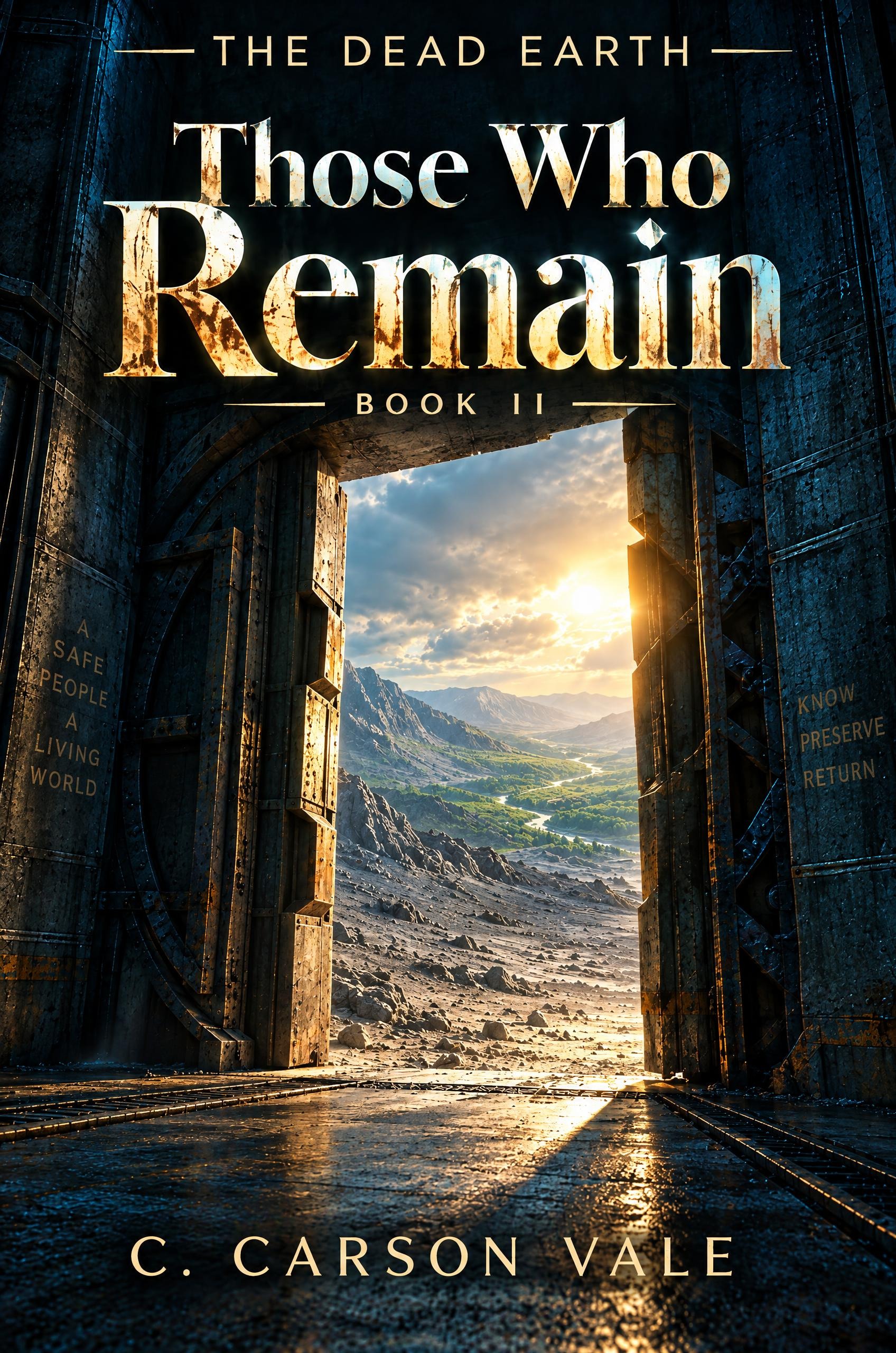
Those Who Remain
The Dead Earth - Book II
Grief has carved a hollow space in Esther Oracle's life since her daughter vanished beyond the sealed perimeter. Bound to the subterranean sanctuary of the Enclave, Esther buries her loss in duty, training Nate, a sharp-eyed novice whose relentless curiosity rivals her own. Then Maximillian returns from censure with impossible news: the ruined surface of Earth is stirring back to life, and survivors walk its poisoned soil. Summoned into the secretive Council's inner circle, Esther uncovers a devastating betrayal spanning generations. The leaders of the Enclave have concealed the planet's recovery to preserve an engineered hierarchy, trapping citizens in the synthetic Zone to feed the endless demands of the Behemoth architecture. Urged forward by Nate's unyielding questions and sick of comforting lies, Esther refuses to let humanity languish in forced obscurity. She must choose between an engineered peace and dangerous truth, defying centuries of institutional control to reshape what remains of civilization. Those Who Remain is an electrifying post-apocalyptic thriller about the cost of fabricated survival and the courage required to tear down a gilded cage.
- Science Fiction
- Adventure
- Dystopian
- Post-Apocalyptic
- Virtual Reality
- Apocalyptic
The Assignment
The summit had ended four hours earlier, or so the official schedule claimed. Eugene Maxwell had watched the delegations file out through the east atrium in their dark suits and their exhausted faces, had watched the press vans pull away from the perimeter checkpoints one by one, and had assumed, like everyone else filing toward the exit with him, that whatever had happened inside those sealed rooms over the past three days was now, blessedly, someone else's problem.
He had gotten as far as the lobby before a woman in a gray blazer intercepted him by name.
"Mr. Maxwell. If you could come this way."
She did not ask. She did not explain. She simply turned and walked, and Eugene found himself following her down a corridor that branched away from the main exit, past two security checkpoints that had not been there during the public sessions, into a part of the building that did not appear on any floor plan he had been given.
He was not alone. A man he recognized vaguely from a biomedical conference years ago was being escorted along the same corridor from the opposite direction, glasses pushed up into graying hair, looking as baffled as Eugene felt. Ahead of them, a woman with a neat gray streak through dark hair walked with the brisk, unhurried pace of someone who had long since stopped being surprised by anything institutions did to her schedule. Eugene didn't know her name yet. He would, within the hour.
The room they were brought to had no windows. It had the particular hush of a space built for conversations that were never meant to leave it: thick carpet, a long table, water glasses already filled and sweating faintly in the recycled air. Eugene counted heads as people settled into chairs. Five of them, counting himself, pulled from five entirely different corners of the summit's technical delegation, along with a handful of younger aides and analysts who took seats along the wall rather than at the table itself, notebooks open, saying nothing.
A tall man in a plain charcoal suit stood at the head of the table. He introduced himself as Thomas Hale, coordinating director for the joint technical council, and he did not waste time on pleasantries.
"Thank you for staying. I know you were told this would be a three-day summit, and I know several of you have flights booked for tonight. Cancel them."
Someone down the table, the biomedical man with the glasses, let out a short laugh that had no humor in it. "I have a surgical fellowship review in two days."
"You won't be attending it, Dr. Kim," Hale said, not unkindly, and that was the first time Eugene heard the name Robert Kim spoken aloud.
Hale did not sit. He stood with his hands flat on the table and looked at each of them in turn, and something in the set of his shoulders made the room go quiet without him needing to ask for it.
"What I'm about to tell you does not leave this room. Not your labs, not your spouses, not your journals. Before we go further, I need each of you to understand that the confidentiality agreements you signed to attend this summit were, frankly, decorative compared to what you're about to sign now."
Eugene glanced sideways. The woman with the gray-streaked hair had not moved, had not reacted at all, as though she had already guessed the shape of what was coming and was simply waiting for it to be confirmed. Later he would learn her name was Helen Okafor, and that stillness, he would come to understand, was simply how she looked while she was thinking hardest.
"Three weeks ago," Hale said, "a joint observational consortium confirmed a set of findings that have since been independently verified by four other national programs. I'm not going to walk you through the astrophysics today. There are people far more qualified than me for that briefing, and you'll receive it this evening. What you need to understand right now is the conclusion. We are facing an extinction-level event. The timeline is measured in years, not centuries. It is not avoidable through any mitigation strategy currently known to exist."
Nobody spoke. Eugene felt the words land somewhere behind his sternum, a cold weight that didn't immediately translate into thought. He had spent the last decade of his life worrying about server latency and player retention curves. The sentence Hale had just said had no shelf he could put it on.
"How certain?" Helen Okafor said. It wasn't really a question, more of a demand that Hale commit to a number.
"Certain enough that eleven governments have reallocated their entire emergency budgets without public announcement," Hale said. "Certain enough that you're all sitting in this room instead of on your flights."
A woman near the far end of the table, compact and gray-browed, spoke next in a voice that was quieter but no less direct. "And what exactly are we meant to do about an extinction event that can't be mitigated?"
"That's Dr. Mercer," Hale said, by way of introduction, and nodded toward her as though her question had earned her a name tag. "And that's exactly the right question, because the honest answer is that conventional mitigation isn't the plan anymore. The plan is survival of a different kind, and it did not originate with any of the people in this room, or with me."
He gestured to one of the aides along the wall, a young man who tapped something on a tablet, and the wall screen behind Hale brightened with a simple interface, clean and unadorned, more like a diagnostic terminal than a presentation slide.
"Eighteen months ago," Hale said, "a consortium of defense and academic computing programs achieved a breakthrough in general analytical systems that none of you have been briefed on, because frankly almost nobody outside this consortium has. I'm not going to pretend I understand the architecture. What I can tell you is that for the past eleven months, this system has had access to nearly every unclassified and classified research program on the planet relevant to long-term human survival, and three weeks ago, once the certainty of the Cataclysm was confirmed, it was tasked with one question. Given everything humanity currently knows how to build, what gives our species the best chance of enduring?"
"And it answered," said a man across the table. Lean build, close-cropped graying hair, a stillness to him that Eugene would later recognize as the particular quiet of someone doing arithmetic in his head at all times. This was Daniel Cho, though Eugene didn't know it yet.
"It identified a convergence," Hale said. "Three technology programs that nobody had previously considered related to one another at all. It did not hand us a finished solution. It isn't that kind of system, and frankly we wouldn't trust an answer that arrived without us understanding how it got there. What it gave us was a map of overlapping capability. And it told us that the five of you, along with your respective teams, represent the fastest viable path to turning that overlap into something real."
Eugene felt his stomach drop slightly, the specific vertigo of being named in a sentence he didn't yet understand.
Hale nodded to the aide again, and the screen changed. Three labels appeared, spaced apart, with no connecting lines drawn between them yet.
Immersive synthetic environments.
Consciousness preservation and transfer.
Long-duration consciousness transport for deep space.
Eugene read the first line twice before the rest of the room caught up to what he already understood instinctively. That was him. That was Island Games, the persistent-world engine his team had spent six years building for an entertainment product that, as far as his board of directors was concerned, existed to keep subscribers logged in and spending money on cosmetic upgrades.
"I build video games," he said, before he could stop himself.
"You build," Hale said, "the most sophisticated large-scale persistent synthetic environment currently operating anywhere on Earth. Millions of concurrent users, continuous world state, environments stable enough that your own user research shows people experience genuine psychological attachment to characters and locations that don't physically exist. I'm not being generous, Mr. Maxwell. That's simply what the data says."
"It's a game," Eugene said again, quieter this time, because some part of him had already started doing the math Hale wanted him to do and didn't like where it was heading.
"It was a game," Hale said. "I'm asking you to consider what else it might become."
He let that sit for a moment, then turned to Helen. "Dr. Okafor's research program has spent the last nine years developing methods for digitally preserving detailed neural state information, originally commissioned by private longevity clients who wanted some form of continuity beyond biological death. Dr. Mercer has spent fifteen years studying the psychological and social viability of human minds in extreme isolation and extended confinement, originally for deep space mission planning. Dr. Cho has spent his career designing distributed computational systems that survive catastrophic failure across geography and time, originally for autonomous deep space probes intended to operate for centuries without human maintenance. And Dr. Kim has spent his career on regenerative medicine and tissue engineering intended to let human bodies survive conditions they were never evolved to survive."
He looked around the table slowly.
"Each of you has spent your career solving a piece of a problem you didn't know you were solving. The system identified the pattern. We are asking you to finish what it started."
Helen Okafor was the first to break the silence that followed, and she did it with the flat precision of someone refusing to let an impressive sentence substitute for a rigorous one.
"Finish what, exactly. You've described four research programs that touch on human consciousness from four completely different angles. You haven't told me what the actual proposal is."
Hale exchanged a brief look with one of the aides, and something in his posture shifted, the practiced authority of the briefing giving way, just slightly, to something more uncertain underneath it.
"The honest answer, Dr. Okafor, is that there isn't a finished proposal. That's why you're here instead of reading one. The system identified that these capabilities, combined, could theoretically preserve the human species through an event that will otherwise kill nearly everyone on the planet. It did not design the mechanism. That work doesn't exist yet. We're hoping it will exist by the end of this week, in rough outline, and in working form within the next several years, because that is approximately how much time we believe we have."
Robert Kim pushed his glasses up his nose, a gesture Eugene would come to recognize as his particular tell for frustration. "Years. You want a credible path to preserving the human species, built from scratch, across four disconnected fields, in years."
"I want you in a room together for the next several hours," Hale said, "to tell me whether that's even theoretically possible, and if it is, what it would require. After that, yes. Years. Possibly fewer than we'd like."
That was when the mandate came, delivered plainly, without ceremony, the way a man might read out a verdict he didn't particularly enjoy but had no authority to soften.
"Your employers have been informed that their intellectual property agreements are suspended for the duration of this program. Every patent, every proprietary system, every trade secret any of you hold is now shared property of this consortium. I understand what I'm asking. I don't care whether Island Games would normally license its engine technology to a rival studio, Dr. Maxwell, and I don't care whether Dr. Okafor's longevity clients signed exclusivity contracts worth more money than most of us will see in our lives. None of that currency exists anymore. Your mandate, all of you, starting now, is simple to state and extraordinarily difficult to execute. Preserve humanity."
Nobody said anything for a long moment. Eugene found himself staring at the three labels still glowing on the screen, immersive synthetic environments, consciousness preservation and transfer, long-duration consciousness transport, and felt the particular dizziness of a man who has just been told that the thing he built to keep teenagers entertained on a Tuesday night might now be asked to hold the species.
"That's not a mandate," Caroline Mercer said finally. "That's a sentence missing its verb. Preserve humanity how. Preserve what part of humanity. Bodies. Minds. Culture. Genetics. Those are entirely different engineering problems with entirely different failure modes, and some of them may actively conflict with each other."
"That," Hale said, with something that might almost have been relief, "is precisely why you're in this room and I'm not."
They moved, an hour later, to a different room entirely, lower in the building, windowless like the first but configured for work rather than announcement. A long table had been pushed against one wall, laptops and printed binders stacked along its length, and the opposite wall was a whiteboard the size of a garage door, blank except for a faint ghost of marker residue from some previous meeting that hadn't been fully erased.
Eugene found a chair near the whiteboard out of old habit, the same instinct that had always put him closest to the surface he'd eventually end up covered in diagrams. Helen Okafor sat across from him, already pulling a worn notebook from her bag rather than a laptop, flipping it open to a blank page with the unhurried precision of someone who had learned long ago that a pen forced her to think before she wrote rather than after.
Daniel Cho took the seat beside Eugene without comment, laid a slim laptop flat on the table, and did not open it. He simply sat, hands folded, watching the room the way Eugene imagined he might watch a system diagram before deciding where the failure points were likely to hide.
Robert Kim remained standing near the door for a moment, arms crossed, before finally pulling out a chair and sitting heavily.
"I'll say the thing nobody else wants to say first," he said. "If the ask here is uploading human minds into a computer and calling that survival, I'm not interested. I didn't spend twenty years trying to regrow a child's trachea so that someday we could tell ourselves a flattering story about digital immortality while the actual human species goes extinct."
"Nobody's proposing that," Eugene said, though even as he said it he wasn't entirely sure it was true.
"Aren't they? You build synthetic worlds for a living. Hale just told us that's one third of the solution."
"I build places people visit," Eugene said. "Not places people are supposed to live. There's a difference, and it's not a small one."
"Is there?" Helen said quietly, and when Eugene looked at her, she wasn't challenging him so much as genuinely asking. "Because that's actually the question underneath all of this, isn't it? What does it mean for a person to continue existing? If I take a complete map of every neural connection in your brain, every synaptic weight, everything that makes you recognizably you, and I run that map inside a machine, have I preserved Eugene Maxwell, or have I built an extremely convincing description of him that believes it's real?"
The room went quiet in a different way than it had with Hale, less the silence of shock and more the silence of people recognizing that they had just been handed the actual problem, the one underneath the one they'd been told about.
"That's not a rhetorical question for you, is it?" Eugene said.
"No," Helen said. "It's the only question that matters, and I've spent nine years watching extremely wealthy men pay enormous sums of money to avoid ever having to answer it honestly. They want to believe that if the pattern survives, they survive. I'm not convinced that's true, and I think if we're about to be asked to build something at planetary scale based on an assumption nobody's willing to examine, we had better examine it now, in this room, before anyone starts pouring concrete."
Caroline Mercer had taken the seat at the end of the table, and she leaned forward now, elbows on the surface. "Let's set the metaphysics aside for one minute, because I think there's a second problem that's just as dangerous and a lot easier to get our hands around. Suppose it works. Suppose you can preserve something that is, functionally and experientially, the continuation of a person's consciousness. Fine. Now what? Where does that consciousness exist? For how long? Doing what?"
"Meaning?" Daniel said.
"Meaning that human minds did not evolve to exist without bodies, without seasons, without the specific sensory and social texture of being an animal on a planet. If you're talking about preserving people for years, that's one kind of problem. If Hale's timeline is as bad as he's implying and this becomes the only viable refuge for an extended period, decades, longer, you are not just solving an engineering problem. You are designing the entire psychological and social environment an enormous population will be forced to live inside, with no ability to leave, possibly for longer than any of us can comfortably imagine. I've spent my career on crews of a dozen people in isolation for eighteen months and watched how badly that can go even with careful planning. Scale that up by a factor of millions, and lengthen the duration by an order of magnitude or more, and I don't think anyone in this building understands what we'd actually be building."
Eugene felt the shape of the problem shifting under him again, the way it had when Hale first put those three labels on the screen. He had spent years thinking about retention curves and engagement loops, about keeping a few million people content enough inside a game world to keep paying a monthly fee. He had never once had to think about what it would mean if those people could never log out.
"I need to be honest about something," he said, and the room's attention swung to him. "Island Games has built environments that are extremely convincing for short, medium, even fairly long stretches. We have players who've logged thousands of hours. But every single one of them goes home at the end of the session. Every one of them has an actual body living an actual life outside the headset, and the game is something they do, not something they are. I don't know what happens to a human mind that has no outside to return to. I don't think anyone knows that, because nobody's ever had to build it."
"Then that's one of the things we have to figure out," Daniel said, matter-of-fact, the first time he'd offered a full sentence since sitting down. "Before we talk about whether we can preserve consciousness at all, I want to understand what we're actually being asked to survive. Hale said years before the event itself. He didn't say how long the recovery period might be after."
"He didn't say," Caroline said, "because I don't think anyone's told him. Or possibly because nobody knows."
"Then we plan for the version where nobody knows," Daniel said. "Which means we plan for a duration far longer than anyone in this room finds comfortable, because underestimating that number kills people and overestimating it mostly just costs resources we no longer have the luxury of worrying about. If this is a survival system, it has to survive not just the Cataclysm itself but every unknown that comes after it. That means redundancy. That means the system cannot depend on any single piece of infrastructure, any single facility, any single point of control, surviving intact. I've built autonomous probes meant to function for two hundred years without a human within a hundred million miles of them. The core lesson from that work is always the same. Plan for the component you trust the most to fail anyway."
Robert Kim had been quiet through this exchange, arms still crossed, jaw tight. "You're all talking about this like the goal is to keep a mind comfortable and stable inside a machine forever. I want to put a flag in the ground right now. If what we build becomes permanent, if there is never a path back to an actual human body in an actual physical world, then we haven't preserved humanity. We've replaced it with something else and convinced ourselves it still counts."
"Nobody's arguing for permanent," Eugene said.
“Hale didn't say temporary either,” Robert said. “He said years to build it and an unknown number of years after that for the planet to become survivable again. Do the math on what that actually means for the first generation of people who go into whatever we build. They may not live to see the other side of it. Their children might not. I'm not willing to treat that as an acceptable footnote.”
“It isn't a footnote,” Helen said. “It's the center of the entire problem. If there's no credible path back to physical existence, what you've built isn't a survival system. It's a very elaborate way of letting the species die slowly instead of quickly, while everyone inside believes they've been saved.”
The silence that followed that sentence was different again, heavier, because nobody in the room disagreed with it, and because none of them yet had the faintest idea how to answer the objection it raised.
Eugene stood up, more out of restlessness than any particular idea, and walked to the whiteboard. He uncapped a marker without quite deciding to, the old reflex of a man who thought better with something in his hand and a blank surface in front of him.
“Can I try something?” he said. “Not an answer. Just a way of looking at it that might help us stop talking past each other.”
Nobody objected, so he drew a single horizontal line across the board, and at the left end of it he wrote a word:
NOW.
At the far right end, after a long gap, he wrote another:
AFTER.
“Hale's problem,” he said, “is the gap in the middle. However long that gap turns out to be, the planet on this side of it becomes unlivable, and on the other side it presumably isn't, eventually. The thing all five of us apparently specialize in, without having known it until an hour ago, is keeping something essential about a person intact across a gap that would otherwise kill them. Robert, your work keeps a body alive through conditions that would otherwise destroy it. Helen, yours tries to preserve the pattern of a mind across a transition that would otherwise erase it. Caroline, yours is about keeping that mind functional and sane across a duration that would otherwise break it. Daniel, yours is about making sure whatever structure holds all of that together doesn't fail catastrophically just because one piece of it does.”
He capped the marker and looked at the board, at the single word NOW and the single word AFTER and the long empty distance between them.
“I keep coming back to one thing Hale said, almost as an aside. He said the system was asked what gives humanity the best chance of enduring an event that will otherwise kill nearly everyone. Not what gives the most people the best chance of staying physically alive in the worst case. Enduring.”
“You think that word choice matters,” Daniel said.
“I think it might be the whole idea,” Eugene said. “What if the actual bottleneck isn't keeping bodies alive through whatever's coming? What if it's biologically impossible to keep enough bodies alive, in enough numbers, through conditions we don't even have a name for yet? What if the thing that's actually survivable, the thing we might genuinely be able to protect, isn't the body at all? It's whatever makes a person a continuous person. And what if that thing doesn't need to stay inside a living body for the entire length of that gap in order to still exist on the other side of it?”
Robert's jaw tightened, but he didn't immediately object, and Eugene took that as license to keep going.
“I'm not saying bodies don't matter. Robert, you're right, if there's no path back, this is just an elegant way of ending things. I'm saying maybe the body doesn't have to survive the gap at the same time as the person does. Maybe those are two separate problems that have been getting treated as one problem because nobody thought to split them apart before today.”
Helen set her pen down slowly, and for the first time since the meeting began, something in her expression shifted from skepticism toward something closer to attention.
“You're describing decoupling identity continuity from biological continuity.”
“I'm describing it badly,” Eugene said, “because I'm a systems engineer who builds places for people to visit a few hours at a time, not a philosopher of mind. But yes. If the problem is that we cannot keep billions of fragile human bodies alive through an event none of us fully understand, and if the thing that actually matters, the thing worth calling preservation, is the continuity of the person rather than the continuity of the specific tissue they happen to be running on, then maybe the question isn't how do we keep everyone's body alive. Maybe it's how do we keep everyone's mind continuous long enough to get a body back on the other side.”
Caroline was writing something in her own notes now, quickly, the particular scrawl of someone trying to capture a thought before it slipped.
“That reframes my problem too. I was assuming we'd be managing the psychology of people trapped somewhere, unable to leave, waiting for rescue. If instead we're talking about managing the psychology of minds that understand, going in, that this is the plan, that there is a defined purpose and an intended endpoint, that's an entirely different design problem. People can tolerate almost anything if they believe it's temporary and purposeful. What breaks them is uncertainty and the absence of meaning.”
Robert looked toward the whiteboard.
“Then put that on the board.”
Eugene glanced back at him. “Put what?”
“That whatever happens in the middle isn't the destination.”
Eugene considered that, then uncapped the marker again.
Underneath the long line between NOW and AFTER, he wrote:
SURVIVE THE GAP.
Robert rose from his chair and walked toward him.
“No,” he said. “That's still too vague.”
He held out his hand for the marker.
Eugene gave it to him.
Robert drew a short vertical line downward from AFTER.
“What happens here?”
“We go back,” Eugene said.
“To what?”
Nobody answered immediately.
Robert looked around the room.
“This matters. Because twenty years from now, or fifty, or five hundred, somebody is going to inherit whatever we build. And if all we tell them is to keep the system running, they'll keep the system running. That's what engineers do. That's what institutions do. A temporary solution that works well enough has a habit of turning permanent because the cost of changing it keeps getting pushed onto whoever comes next.”
Helen had become very still again.
“So we define the endpoint,” she said.
“We define the obligation,” Robert replied. “Preservation isn't the mission. Preservation is what gets us through the part where the mission can't be completed.”
Daniel looked up from the system diagram he had started sketching beneath Eugene's line.
“That creates two different engineering states.”
Robert nodded. “Exactly.”
Daniel rose and took another marker.
“State one,” he said, writing beneath Eugene's SURVIVE THE GAP. “Whatever system we build maintains continuity while external conditions are incompatible with physical life.”
He moved beneath AFTER.
“State two begins when they aren't.”
Caroline looked up. “Not immediately. ‘Survivable’ doesn't mean you wake billions of people up the first morning somebody measures breathable air.”
“No,” Daniel said. “It means assessment begins. Environmental characterization. Physical reconnaissance. Infrastructure. Agricultural capacity. Whatever biological process Robert eventually invents for producing viable bodies. It would have to be staged.”
Robert gave him a humorless smile. “I'm pleased you've scheduled my miracle already.”
“You're welcome.”
It drew the smallest laugh the room had managed since Hale told them the world was ending.
Helen stood and walked toward the board.
“But Robert's point is still the important one.”
She took the marker from Daniel and wrote beside the first state:
PRESERVE.
Then beside the second:
RESTORE.
She stepped back.
“Those are different missions.”
Eugene studied the words.
“Preserve until when?”
“Until restoration becomes possible,” Helen said.
“That could mean generations.”
“Yes.”
“Maybe longer.”
“Yes.”
“And the people inside whatever we build might decide they prefer it there.”
That stopped everyone.
Caroline spoke first.
“They might.”
Robert shook his head. “Then we still have to give them the way back.”
“That's different from forcing them to use it,” Helen said.
Robert looked at her.
She continued.
“We don't know what living inside this system will do to people. We don't know how long they'll be there. We don't know what they'll become, culturally or psychologically, after generations in an environment none of us has even designed yet. We cannot sit here today and make choices for people who may live centuries after we're dead.”
“Then what exactly are we promising?” Caroline asked.
Helen looked at the two words she had written.
“That preservation will not become a cage simply because it succeeds.”
Nobody spoke.
Helen tapped the word RESTORE with the marker.
“If physical human life becomes possible again, the people we preserve need to know that. The system has to retain the means, the knowledge, and the institutional obligation to find out when that happens. What they choose afterward belongs to them. But if we fail to preserve the possibility of physical life along with the people themselves, then Robert is right. We won't have preserved humanity. We'll have replaced it with whatever was easiest to keep running.”
Eugene looked again at NOW, AFTER, and the space between them.
Something had changed.
The gap no longer looked like the entire problem.
It looked like one phase of it.
“Then we need a way to know when the gap is over,” he said.
“Yes,” Daniel said.
“Which means external monitoring.”
“Yes.”
“Something physical has to survive outside whatever synthetic environment we build.”
“A great many physical things,” Daniel said. “Power. Processing. Cooling. Sensor networks. Manufacturing capacity, if we can preserve it. And people.”
Eugene turned. “People?”
Daniel nodded toward the board.
“You said it yourself. Eventually somebody has to get a body back. Robert may eventually teach us how to grow one, but machinery still exists in a physical world. Unless you're proposing that the entire infrastructure maintain itself indefinitely, someone biological has to remain capable of interacting with it.”
“That reduces the population we need to keep alive physically,” Robert said.
“It also creates dependency,” Caroline replied. “The people inside depend on whoever remains outside the synthetic system.”
“And the people outside inherit responsibility for everyone inside,” Helen said.
The enormity of that sat among them for a moment.
Eugene looked back at the board.
“We're designing obligations for people who haven't been born.”
“Yes,” Helen said.
“I don't like that.”
“Neither do I.”
“But there isn't another way.”
Helen did not answer immediately.
“There may not be another way to give them the responsibility,” she said. “That doesn't mean we should presume to give them every answer.”
Eugene studied her.
“And if they decide they're done waiting?”
“Then I hope whatever we build has left them enough knowledge to understand what they're deciding.”
Robert leaned back against the table.
“We're getting a long way ahead of ourselves. We don't even know if Helen can move a mind from one substrate to another without killing the original.”
“Correct,” Helen said.
“We don't know if Eugene can build somewhere a mind can exist for a century without going insane.”
“Also correct,” Caroline said.
“We don't know if Daniel can keep the machinery running that long.”
Daniel shrugged. “I know enough to be offended by how you're phrasing it.”
“And I definitely don't know how to grow eight billion replacement bodies.”
“Then perhaps,” Eugene said, looking at all of them, “we've identified tomorrow's agenda.”
That earned the laugh properly this time, brief and exhausted and slightly inappropriate, which was perhaps why they needed it.
When it passed, Helen returned to her chair.
Robert's original objection still hung over the room, but now it had a shape.
Preservation could not be the endpoint.
Whatever they built had to contain within its design the expectation that conditions would someday change, that someone would notice when they did, and that humanity would then face another decision.
Not whether it had survived.
What survival was for.
Daniel had been quiet through most of this, watching the whiteboard, and now he stood again, walked over, and picked up a second marker without asking. Beneath Eugene's line, he began sketching something rougher, boxes and arrows, the shorthand of a man thinking in systems rather than sentences.
“I want to flag something practical,” he said. “If the idea is to preserve something like continuous identity across a long gap rather than keep bodies alive through it, that changes the infrastructure problem enormously, and not necessarily in an easier direction. We'd be talking about a system that has to run reliably, without catastrophic failure, for a duration none of us can currently estimate. Not years. Possibly generations. That's not a server farm with a backup generator. That's an entirely different category of engineering, closer to the deep space systems I've worked on than anything in consumer technology.”
“How different?” Caroline asked.
“Different enough that I don't think any of us in this room, individually, currently knows how to build it,” Daniel said, without any apparent discomfort in admitting it. “Which I'd guess is exactly why we're all here instead of just one of us.”
Eugene looked back at the whiteboard.
NOW.
The long uncertain middle.
AFTER.
PRESERVE.
RESTORE.
The gap between the first two words seemed narrower now only in the sense that it finally had a shape instead of being an empty unlabeled stretch of blank space.
He thought of the first time he'd ever watched a stranger, a teenager in another country he'd never met, walk through one of his synthetic environments and stop to look at a sunset his team had rendered purely because it seemed like it would be beautiful, not because any game mechanic rewarded the player for noticing it. He remembered feeling, in that small moment, something unexpectedly close to responsibility.
He had not expected that feeling to return to him today, in a windowless room, at what might be the beginning of the most important work of his life, but it did, larger and colder than it had ever been before.
“I don't think any of us knows how to build the whole thing,” he said slowly. “I don't think that system downstairs knows either, not completely, or it would have told Hale exactly what to build instead of just telling him who to put in a room together. But I think we just found the first piece that actually holds. Whatever this ends up being, it doesn't have to start by solving how to keep eight billion fragile human bodies alive through something none of us can even fully describe yet.”
He looked toward Helen's two words.
“It can start by asking a narrower question. Can a human mind remain continuous, recognizably itself, separate from immediate biological survival, long enough for a body to be found or built or grown for it later? If the answer to that is yes, even conditionally, even only partially, then everything else becomes something we can start designing toward instead of staring at in the dark.”
“Not everything,” Robert said.
Eugene looked at him.
Robert nodded toward RESTORE.
“We still have to get them home.”
Eugene looked at the word for a moment.
Then he nodded.
Nobody in the room said that they were right.
Nobody said they were wrong either.
Helen was looking at the board with the particular stillness of someone recalculating an enormous problem from a new angle. Caroline had stopped writing and was watching the two words as though she were already considering what generations spent between them might do to a human mind. Robert's arms had finally uncrossed, though his jaw was still tight, a man withholding judgment rather than surrendering it. Daniel had turned back to his diagram and begun sketching again, boxes within boxes, as though the infrastructure problem had finally become something he could measure.
Through the closed door, faintly, Eugene could hear the muffled rhythm of other meetings happening elsewhere in the building, other teams of people who had also been pulled aside after the summit, working on pieces of this same impossible mandate that he would probably never see or understand.
He thought of Hale's flat, careful sentence.
Preserve humanity.
For the first time since hearing it, the sentence no longer felt entirely impossible.
Not solved.
Not even close.
But incomplete in a way they were beginning to understand.
Preservation was only the first half.
“We don't know how to build it,” Eugene said quietly, mostly to himself, though the whole room heard it. “But I think we just found the door.”
Nobody answered him immediately.
For a moment the room held the particular silence of five people who had each spent their careers believing their own field was the hardest problem in the room, now realizing together that the real problem had been larger than any one of them, and larger still than all of them combined, but no longer entirely unknowable.
Outside the walls of that windowless room, the world continued on its ordinary unraveling course, oblivious to the five names that had just been written, however provisionally, onto the first page of whatever history would eventually be made of what came next.
Those Who Remain
The kettle sat slightly off-center on the warming plate, tilted a few degrees from where Esther always set it, and she noticed it before she noticed anything else about the morning. Miriam had made tea the evening before she Left, standing at that same counter with her sleeves pushed up and her hair pulled back the way she'd worn it since she was a…