

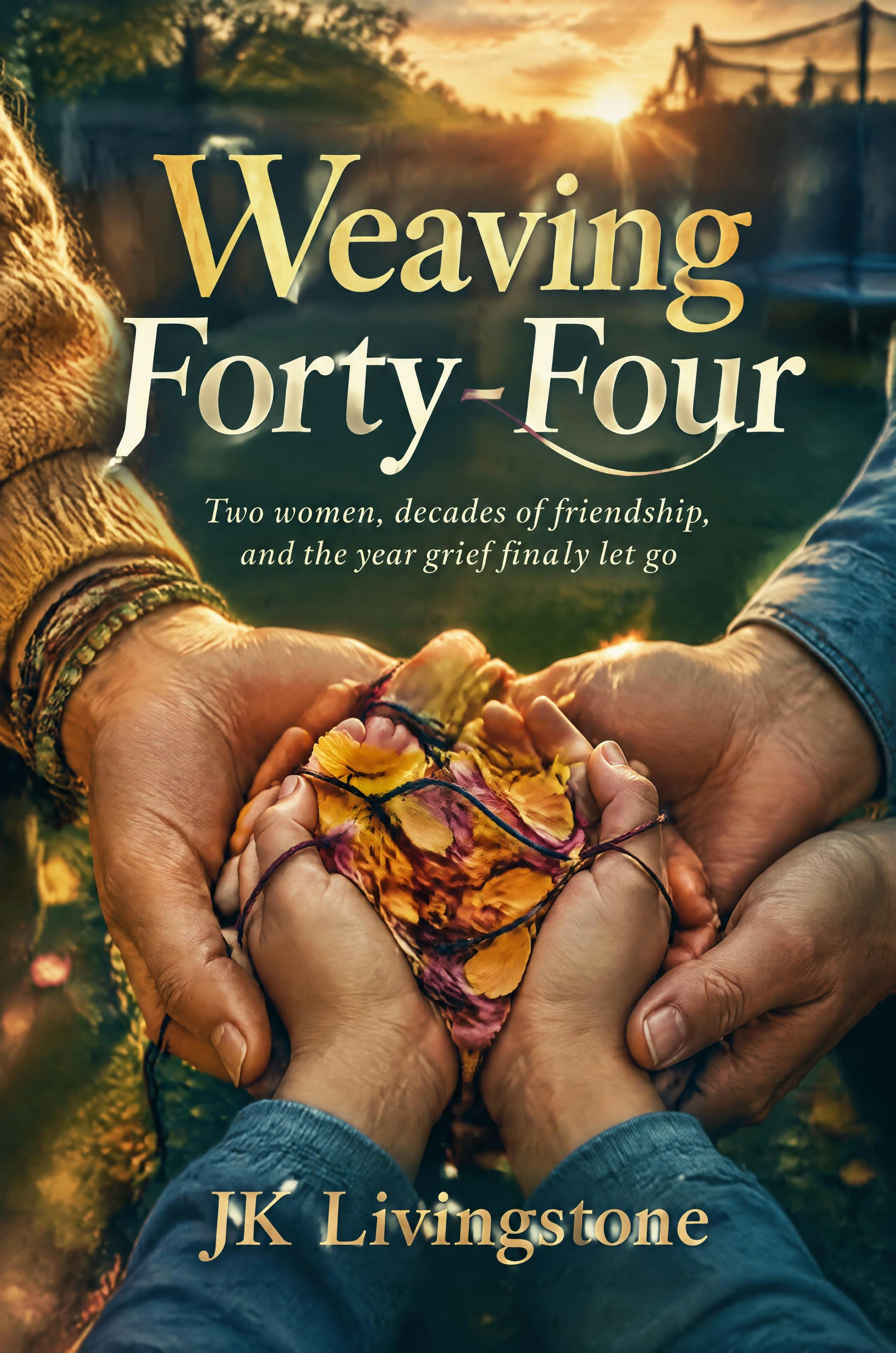
Weaving Forty-Four
Two women, decades of friendship, and the year grief finally let go
by JK Livingstone
They met in a central Indiana school and never quite let each other go. JK Livingstone and Sara carried each other through high-school secrets, messy early adulthood, and the long, quiet stretch of middle life. Then the worst arrived: Sara’s younger brother Scott was murdered in his own garage. Years later, Sara’s mother GG died under the same roof where she had lived for decades, and four-year-old Violet Rose was left asking how to visit heaven. When JK comes home with her son Unas, she is no longer only an old friend. She is a somatic therapist who knows flower petals, therapeutic touch, and how to sit still inside another person’s sorrow and joy. Sara is a nurse, a Marine veteran’s wife, and a woman who has held everyone else together at forty-four. In backyards and river walks, with neighbor Charles Hansen and peer Helen Conway nearby, two families braid grief into something livable. Children laugh. Ancestral spirit shows up in small hands. Forty-four stops looking like an ending. Weaving Forty-Four is an intimate literary memoir of womanhood, maternal legacy, and the slow work of healing together.
- Non-Fiction
- Literary Fiction
- Memoir
- Grief & Loss
- Women's Fiction
Smoke Rings and Honeycombs
One of my favorite things in life is weaving lives through time and space, catching up on developments, updates, insights, and experiences while parted separate ways. That has always been a genuine joy of mine, especially when aligned with sensitive nurturing value and appreciation. Looking back across the years, our lives often trace patterns we never could have mapped out in the middle of living them. We think we are merely walking from one suburban driveway to another, or piling into the backseat of an old hatchback, when really we are laying down the quiet threads that will hold us steady through much harsher seasons decades down the road.
This memory is about a friend I first came to know in high school during the late 1990s. I honestly do not remember the exact afternoon we first spoke, whether it was sharing a crowded hallway in between bells or meeting through mutual friends across the neighborhood. Somehow, our separate routines merged into a steady circle of girls who found solace in each other. It was central Indiana, where the suburban cul-de-sacs seemed designed to keep everything polite, trimmed, and quiet on the surface. Yet underneath that neat suburban exterior, many of us carried restless hearts and domestic tensions that we did not yet know how to name. We turned to each other to create our own small sanctuaries of relief.
Part of our regular teenage rhythm involved piling into parked vehicles with every window rolled up tight. Someone would bring along an old Subaru, and we would shut ourselves inside, passing a rolled joint around the circle until the glass was completely fogged over with sweet, gray herbal vapor. If you have never experienced a vehicle hotbox, the smoke becomes so dense that you can barely make out the dashboard clock. It turned the cramped interior into a warm, buzzing honeycomb of sorts. The heavy fog softened the sharp edges of our adolescent anxiety. It calmed our raw nerves, giving us room to giggle, talk, and drift into a tolerant, present state where none of us had to defend who we were or explain what went on behind our family doors.
From those smoky cars, the party inevitably migrated inside whenever parents were away for a weekend shift or traveling out of town. Sara's house was often the gathering place, an open port for our group. Sara had grown up with a natural grace, having taken dance classes from the time she was a very small girl. She had this light, energetic rhythm in her posture that still showed through whenever she walked across a room. Yet by our junior year, a certain weariness had begun to settle over her. She spent a lot of time dating older neighborhood boys who supplied an endless supply of green bud, and all that constant smoking dulled her physical drive. She danced less in formal studios, letting that early discipline slip away under the quiet numbness of routine escapism.
Even so, the music still found us in those carpeted suburban rooms. On those long, humid Friday nights, Daft Punk's "Around the World" would blare through cheap stereo speakers, rattling the thin wooden cabinets. Four of us girls, alongside whatever neighborhood friends managed to slip through the front screen door, would join hands in the center of the living room. We spun around in rhythmic, clumsy circles, our bare feet slapping against the worn rug. We danced until our lungs burned and our laughter spilled over the booming bass line. In those spinning circles, we felt completely connected. We possessed a collective feeling of territorial belonging that shielded us from whatever adult sorrows waited outside the front porch.
When the party finally wound down at three or four in the morning, the casual visitors always drifted off into the dark streets to find their own beds. I was always the girl who stayed behind. Long before I ever studied bodywork or therapeutic touch, my natural instinct was to anchor the domestic space and restore order to the room. While everyone else slept sprawled across mismatched couches, I would wake with the gray dawn light creeping through the blinds. I picked up the scattered red plastic cups, gathered the sticky soda cans, and swept the crushed potato chips off the kitchen linoleum. I tied up heavy trash bags and wiped down the counters with lemon cleaner so that when Sara's mother came home through the garage door, the house felt calm, orderly, and safe. That quiet caretaking was never a chore to me; it was simply my way of showing love to the people who opened their doors.
It was during one of those quiet, private mornings, away from the rest of the group, that Sara shared the heavy secret she had been carrying alone. We sat together near the open kitchen window, listening to the morning birds start up in the maples. Her face was pale, stripped of the carefree humor she wore when the crowd was around. She spoke quietly, telling me about a secret pregnancy from earlier that school year. She had been terrified, completely unready for motherhood, and paralyzed by the thought of what her family and peers would say. With no guidance and no safe adult to turn to, she had taken the matter into her own hands in the privacy of her bathroom. She described punching herself repeatedly in the lower stomach, desperate and weeping, until the cramping and bleeding finally started. She had endured the physical agony and the terrifying blood alone on the cold floor, feeling an overwhelming wave of relief once the pregnancy was gone, even as the raw shock of the trauma scarred her inside.
Hearing her confess that hidden pain broke my heart, but I stayed steady beside her. I did not judge her fear or flinch from the physical reality of what she had endured to survive her youth. I simply sat with her, offering an open heart and two steady hands. She explained that the constant smoking with her boyfriends had not just been about having fun; it had been her only way to numb the lingering ghost of that physical trauma and quiet the terrifying panic in her belly. Sharing that unspeakable secret forged a bond between us that ran far deeper than casual weekend socializing. She knew she could trust me with her deepest domestic wounds without fear of being abandoned.
That summer, when the school year finally closed, we passed our yearbooks back and forth across the front hood of a parked car. Sara took my book and wrote a long, heartfelt inscription in her looping cursive hand. Reading her words in the bright Midwestern sunshine grounded our friendship into something lasting:
"JK—Girl you have been a true friend for me all year. You are the sweetest yet most unique person I've ever met. I'm glad we started hangin out 2gether cause you're a fun girl. However, we haven't chilled a lot lately so that needs to change this summer. It's good to know that there is always someone I can talk to about anything. You helped me get thru the hardest & most painful experience of my life, and for that I thank you. I don't know what I would have done w/out you. I (heart) you always. See You lots & lots this summer. Love, Sara '2000"
Holding that printed page, I realized how much we ask of young women when they are barely learning how to inhabit their own bodies. We navigated high school trying to protect our fragile spirits while holding the messy weight of adult tragedies before our time. We leaned on each other through smoke, shared music, and quiet confessions, weaving a mutual safety that carried us past the edge of girlhood.
Cul-de-Sac Echoes
Life brings us into unexpected circles when we least plan for them. After several all-night parties at my friends' houses and the years rolling along, my mom went through her second divorce. We packed up cardboard boxes and went house shopping again, looking for a fresh start somewhere quiet. We ended up moving right into Oak Court, a circular subu…