

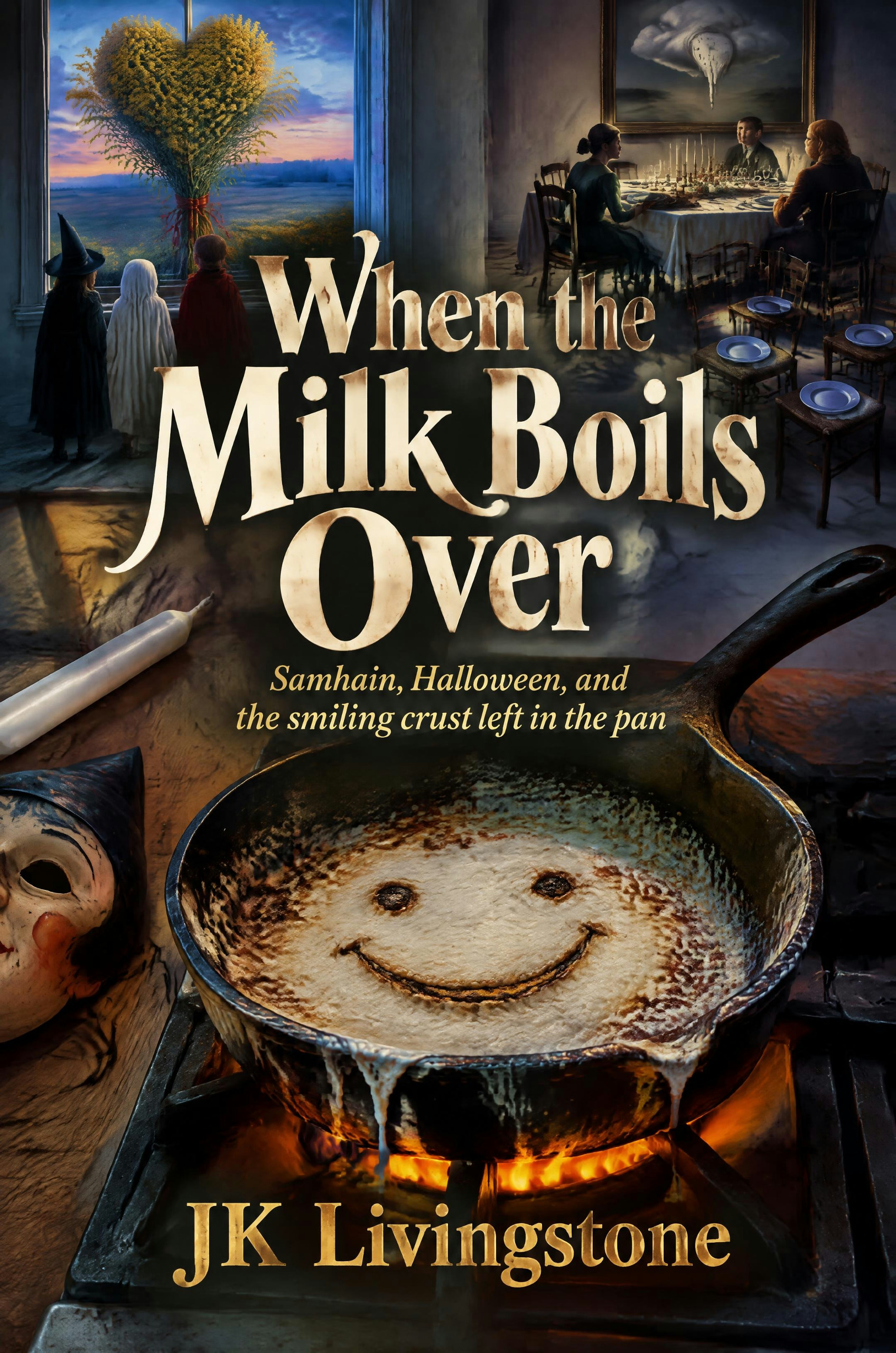
When the Milk Boils Over
Samhain, Halloween, and the smiling crust left in the pan
by JK Livingstone
Late October in the Midwest. Milk boils over on a gas range and dries into a smiling face in the crust. For dancer and somatic memoirist Linda Barnett, that uncanny mark is not a kitchen accident. It is the veil thinning. American Halloween wants costumes, candy, and a lighthearted mask. Older Samhain asks for empty chairs, food left out, and honest talk with the dead. Linda chooses the latter. Guided by herbalist Rosemary Simmons, printmaker Pauline Walsh, woodworker Raymond Lutz, and archivist Gerald Schultz, she maps thirty years of friends lost too soon: the touring dancer, the rooftop girl, the high school restroom, the one-legged companion, the woods, the studio, the gun. While her son Otto still wants trick-or-treat, Linda builds clean thresholds instead of spectacle. She wears the clothes of the gone, lights candles, and sits with survival guilt until it becomes a shared ancestral banquet. When the Milk Boils Over is a literary memoir of grief, subtle energy, and why we become the characters we choose when the dead come close. How do you do with your spirits?
- Non-Fiction
- Literary Fiction
- Halloween
- Science Fiction
- Memoir
- Grief & Loss
Milk on the Iron Grate
When I was a young girl, Halloween was a favorite time to become. It was fun to choose what I would become to hopefully be remembered as extra special to everyone. Long walks up many drives with a happy smiley face saying, "Trick or treat!?!" with an extra laugh or giggle and a "thank you" still beside mom or dad was ever so fun. It was not until middle school that we began to spook each other in group costumes, the first time a cute boy turned into a girl as his costume and I could never quite look him in the eye after. Angry middle schoolers who found empty or locked homes with no extra treat would become threatening and cruel in return with raw eggs smashed upon boring still homes and in highschool screaming as loud as I could as a victim in a dance performance of Dracula took place of feeling purgatory between serving and being treated. Those ages we understand spirits collect in our lives from normally elderly lived ones passed, but I also began to collect some early spirits that were still smiley faces in my life upon passing conversational happiness. Now when people threaten with scarier talk, seeking new beings to turn into spirits early I simply reply, "I have plenty still smiling at me nearby. Would you like to meet one or two? My living are still happy living so please be more kind with your thoughts and words." You may say, "Spirits? Smiling spirits at you?" "Yes, I reply, most certainly yes and with me they were all still happily alive. Would you like to meet one or two?" Some say the only spirits we should speak to are God and we should leave all others behind while others say it is healthier to also speak once a year alongside Samenhein.
And now in my 40's,
The milk is still on the stove when it happens, the pot tipped half off the burner where I left it, and I stand there with the apple core gone brown in my hand and look at the face it made in the crust. One eye larger than the other, the mouth curved up at the corner like somebody about to tell a joke they've told a hundred times before. I know this face. I knew it before I knew I knew it, the way you recognize a smell before you remember the kitchen it belongs to.
I reach for the spatula and then I don't use it. Scraping that off feels wrong, like waking someone mid-sentence. Instead I crouch down level with the stovetop, my knees cracking the way they do now that I'm past forty and still insist on dancing like I'm not, and I just look at it. The burner tick-ticks as it cools. Outside the window over the sink the sky has gone that particular gray that isn't quite rain and isn't quite clear, the kind of sky October specializes in, like it can't decide whether to be generous or not.
"Grandma," I say out loud, to the empty kitchen, to the milk crust, to whoever is listening. "Is that you? Or are you bringing someone with you?"
Nobody answers, which is the correct and expected response, and also the one I have never fully accepted.
I finally do scrape the pan, carefully, keeping the biggest piece of the crust intact and setting it on a saucer like it's something worth keeping, which maybe it is. Then I turn off the burner, because the smell of scorched milk has started to fill the kitchen, sweet and a little burnt, a smell I will now always associate with this particular morning and whatever just walked through my house uninvited, or invited, I'm not sure which yet.
I go out the back door because I need air that hasn't been touched by anything, and the porch boards are cold under my socks. The garden has gone leggy and wild the way it always does by the end of October, most of it ready to be cut back and put to bed, but along the fence line the goldenrod has kept blooming past when it should have quit, gold heads nodding in a long ragged row. Except they aren't ragged today. I stop at the porch rail and really look, because the goldenrod isn't growing in a row at all anymore, it's growing in a shape, two curved sweeps of yellow meeting at a point, wide at the top and tapering down, plain as anything.
A heart. A whole heart, made of flowers that have no business organizing themselves into anything at all, taking over the fence line like they knew I'd need to see it this particular week.
"Okay," I say, to the garden now, since apparently I'm talking to things that can't talk back today. "Okay, I see you. I see both of you."
The back door bangs and I don't jump, because I've lived with Otto's doors banging for ten years and my body has stopped registering it as an emergency. He comes tearing across the porch holding something out in front of him with both hands, which for Otto means one hand and the curled stump of his other wrist bracing it from underneath, a trick he's gotten so good at I sometimes forget to notice it anymore.
"Mom. Mom, look, it works, it actually works now."
It's the Lego tractor he's been building out in the workshop for two weeks, little motor whining as the back wheels spin and the front loader dips and rises on its tiny gray arm. He holds it up to show me the gearing underneath, a small tangle of yellow and black teeth that somehow translate the motor's spin into something that looks almost like breathing.
"I had the gear ratio wrong before," he says. "It was stalling out. I switched the sixteen-tooth for an eight, and now it doesn't fight itself anymore."
"It doesn't fight itself anymore," I repeat, because I like the phrase and because my son, at ten, understands machines better than most adults understand people. "Otto, that's beautiful."
"It's not beautiful, Mom, it's functional." But he's grinning when he says it, that one-sided grin he does when he's proud and trying not to show it too much.
I crouch down to his height to watch the loader dip again, and for a second the hum of the little motor and the hum still moving through the floorboards from the kitchen feel like the same frequency, like the house itself is vibrating on a note just under what I can name. I put my hand flat on the porch boards to check, and yes, there it is, something low and steady running through the wood, through my palm, up my arm.
"Do you feel that?" I ask him.
Otto frowns and presses his own hand down next to mine. "Feel what?"
"Nothing," I say, because he doesn't feel it, and that's fine, that's how it should be at ten, all gears and ratios and things you can hold in your hand and make better. "Nothing, son. Go show your grandpa's picture your tractor later, he'd have loved it."
"Which grandpa?"
"The one who used to fix tractors for real."
He nods like this satisfies him completely, the way kids can accept a fact without needing to turn it over first, and then he's gone again, back toward the workshop, tractor buzzing in his fist.
I stay crouched on the porch a minute longer, between the goldenrod heart and the kitchen with its saucer of scorched milk cooling on the counter, and I think about how early this is. Usually the air doesn't start doing this until closer to Halloween itself, the last week of October when the commercials run thick and the costume aisle gets picked over and everybody's decided which version of themselves they're going to wear to the door. This year it's not even the last week yet and already the milk has a face and the flowers have a shape and the floor is humming like it's trying to tell me something it doesn't have words for.
I go back inside and pick up the saucer, carry it to the windowsill where the morning light, gray as it is, still reaches, and I set it down facing out, toward the goldenrod, toward whatever is already arriving ahead of schedule this year.
"Well," I say to the crust, to the flowers, to the whole house, "you're early. I'll do my best to catch up."
The Goldenrod Hearth
The gravel road to Rosemary Simmons' place runs half a mile past the last streetlight in town, and I walk it with the saucer still on my mind, the goldenrod heart still blooming behind me on the fence line like it has somewhere better to be than wilting. The air out here smells like cut hay going soft and the particular mineral cold that comes befo…