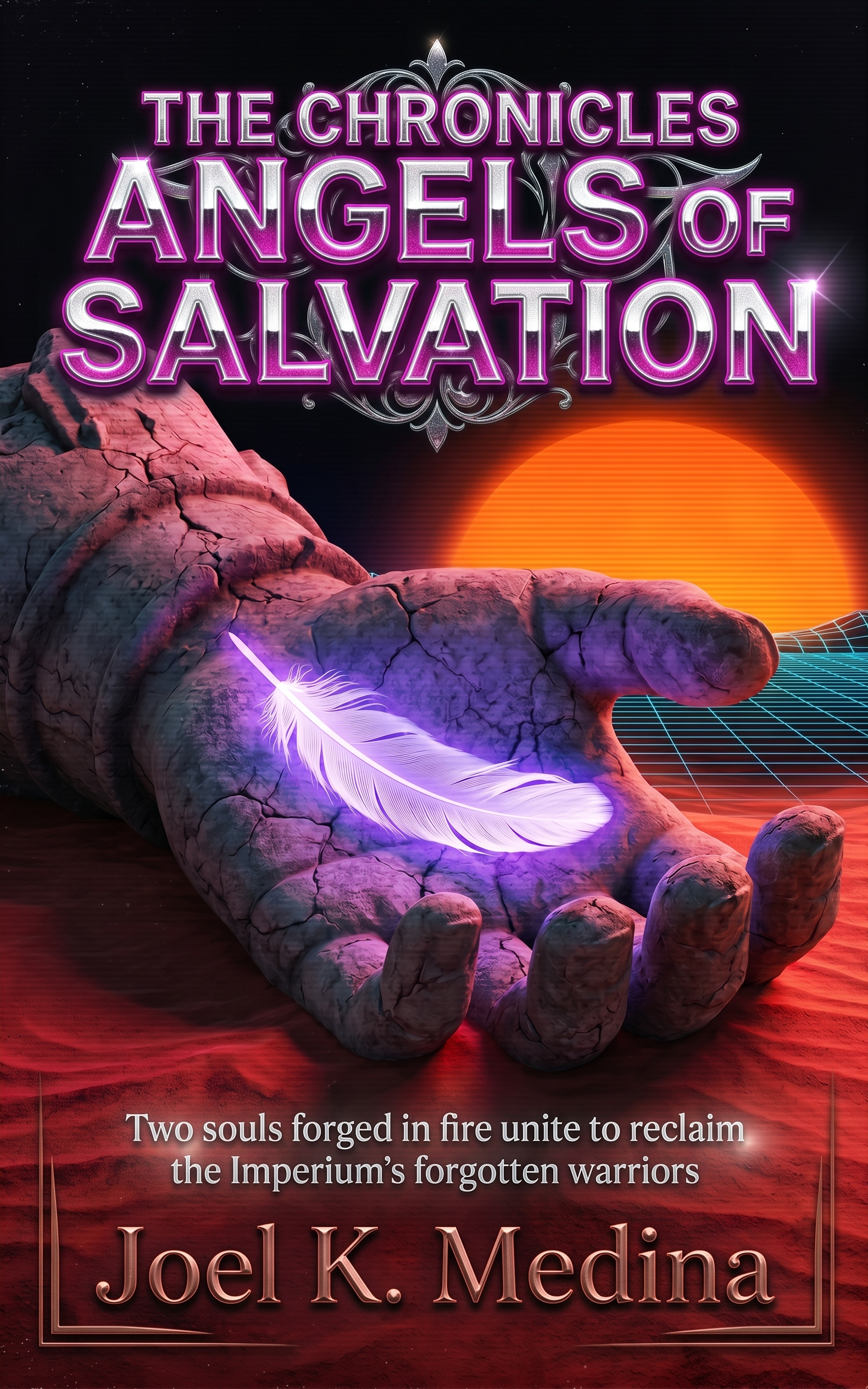
The Chronicles of the Angels of Salvation.
Two souls forged in fire unite to reclaim the Imperium's forgotten warriors
by Joel Medina
In the grim darkness of the 41st Millennium, the Imperial Fists are the shield of humanity. For Marcelino Jose Medina, becoming an Astartes was the ultimate honor, but his path leads to the charnel house of Orax. Surrounded by an endless tide of Orks, Marcelino stands as the last survivor of his cohort, his psychic scream for salvation echoing through the warp. Deep within the forbidden vaults of Terra, something ancient answers. Adán Arellano, the long-lost Eleventh Primarch, has awakened. No longer the Angel of Destruction, he emerges with organic white wings and a heart tempered by compassion. Transformed and reborn, Adán defies the cold bureaucracy of the Inquisition to answer the plea of a dying soldier. Together, the fallen recruit and the resurgent Primarch must forge a new destiny. They seek to rebuild the 11th Legion—not as conquerors, but as the Angels of Salvation. Their mission: to find and reclaim the lost warriors left behind by an uncaring empire. But in a galaxy fueled by religious fervor and eternal war, is there any room for mercy? The Chronicles of the Marcelino Jose Medina begins an epic saga of hope emerging from the crushing shadows of a dying universe.
- Science Fiction
- Military Sci-Fi
- Grimdark
- Space Opera
The Dust of Inwit
The cold on Inwit was not a weather condition. It was a philosophy.
It pressed down through the recruitment bastion's open parade ground the way a judgment presses through a courtroom, certain of its conclusion, patient in its application. The sky above was the color of old iron, and the wind that moved through the assembled ranks of aspirants carried frozen particles that found every gap in clothing, every exposed strip of skin, and went to work on them with the methodical patience of a craftsman. Marcelino Jose Medina stood in the fourth row and did not move. He had been standing for six hours. His feet had stopped hurting somewhere around hour three, which he understood, dimly, was not a good sign.
There were thousands of them. Boys and young men drawn from the hive-warrens and dust-settlements of Inwit's outer reaches, recruited by the promise of purpose in a galaxy that offered most of them only slow attrition. They had come with fear in their eyes and hunger in their frames, and the cold was already sorting them, the way cold always sorts things, by eliminating what cannot endure.
To Marcelino's left, a broad-shouldered boy from the lower warrens had been shaking for the past hour. The shaking had become fine and continuous, the tremors of a machine running past its operational tolerances. Marcelino watched him in his peripheral vision and said nothing. There was nothing to say. The Chaplains walking the rows said nothing either. They moved between the ranks in their black ceramite and their skull-faced helms and they looked at each aspirant the way a geologist looks at rock strata, reading the composition, calculating the yield.
The boy to his left collapsed at the four-hour mark. He went down without drama, his legs simply ceasing their function, his body folding into the frozen ground with a soft, final sound. The nearest Chaplain paused over him, looked down, and moved on. Two serfs emerged from the bastion's side entrance and dragged him away by his ankles, his heels carving twin furrows through the frost.
Marcelino looked straight ahead.
He had grown up in the dust. Not the romantic dust of old stories, but the grinding, chemical-laden particulate that settled over the outer settlements of Inwit's exhausted mining districts, the residue of centuries of extraction that coated everything and everyone in a fine grey film. He had eaten poorly and slept in spaces not designed for sleeping and had learned, early, that the body could be argued with. That pain was a voice, not a verdict. His mother had told him that once, and she had been talking about something else entirely, but he had taken it as a general principle and applied it to everything that had tried to break him since.
The gauntlets began at dawn on the second day.
They were not tests of strength. That was the first thing Marcelino understood, watching the aspirants ahead of him fail not because their muscles gave out but because their will did. The gauntlets were architectural, designed to locate and then specifically destroy whatever psychological structure a person had built around their sense of self. The load-bearing frames were stripped away, the walls were taken down, and what remained was either a foundation or nothing at all.
He was made to carry a weight that exceeded reasonable capacity across a course designed to maximize failure points. When he fell, the course reset. He fell eleven times. He got up eleven times, the eleventh rise paid for with the sound of a tendon in his thigh snapping like dry pine underfoot, a sharp, internal heat that he immediately compartmentalized and locked behind his teeth. His knees were bleeding by the third reset, the skin torn away on the frozen metal grating, and by the seventh he could feel something wrong in his left shoulder, a grinding discontinuity that suggested structural damage. He noted it the way he noted the cold, as a variable to manage rather than a reason to stop.
Around him, the sound of the selection was the sound of things breaking. Bone sometimes. Voices more often. A boy two positions ahead of him reached the wall climb on the final stage of the gauntlet and simply sat down at its base, his hands in his lap, his eyes fixed on the middle distance with the expression of someone who had located the precise boundary of what they could endure and chosen to remain on the near side of it. A Chaplain stood over him for a long moment. The boy did not move. The Chaplain moved on.
Marcelino climbed the wall.
By evening, the parade ground held far fewer bodies than it had at dawn. The survivors stood in loose formation, their breath coming in visible clouds, their faces carrying the particular hollowness of people who had recently learned something fundamental about themselves. Some of them looked proud. Marcelino only felt tired, and underneath the tiredness, something quieter: a faint, sourceless awareness, like a pressure behind his eyes, that had been there since morning and that he could not assign to anything physical.
The Chaplain who approached him was taller than the others, his helm marked with a single horizontal stripe in faded yellow. He stopped directly in front of Marcelino and studied him with the visor's blank, inhuman regard. Then he raised one gauntleted hand and pressed his thumb to Marcelino's forehead, and when he withdrew it, there was a symbol there, drawn in something that smelled of ash and promethium, the angular sigil of the VII Legion.
The Chaplain said nothing. He moved to the next aspirant.
Marcelino did not touch the mark. He stood in the settling dark of the Inwit evening and looked at the frozen ground where the broad-shouldered boy from the lower warrens had fallen that morning, at the two shallow furrows left by his heels in the frost. The wind had not erased them yet. They were still there, precise and quiet, a record of a departure that no one would formally note.
He filed them away, alongside everything else he was not allowed to carry with him, and walked toward the bastion doors with the others who had survived.
The Iron Crucible
The Phalanx did not welcome. It processed. The shuttle's docking clamps engaged with a heavy, metallic thud that vibrated through Marcelino's boots, and the pressure seal cycled open to release a draft of cold, sterile air smelling of antiseptic solution and recycled nitrogen. The fortress-monastery moved through space the way a verdict moves throu…