

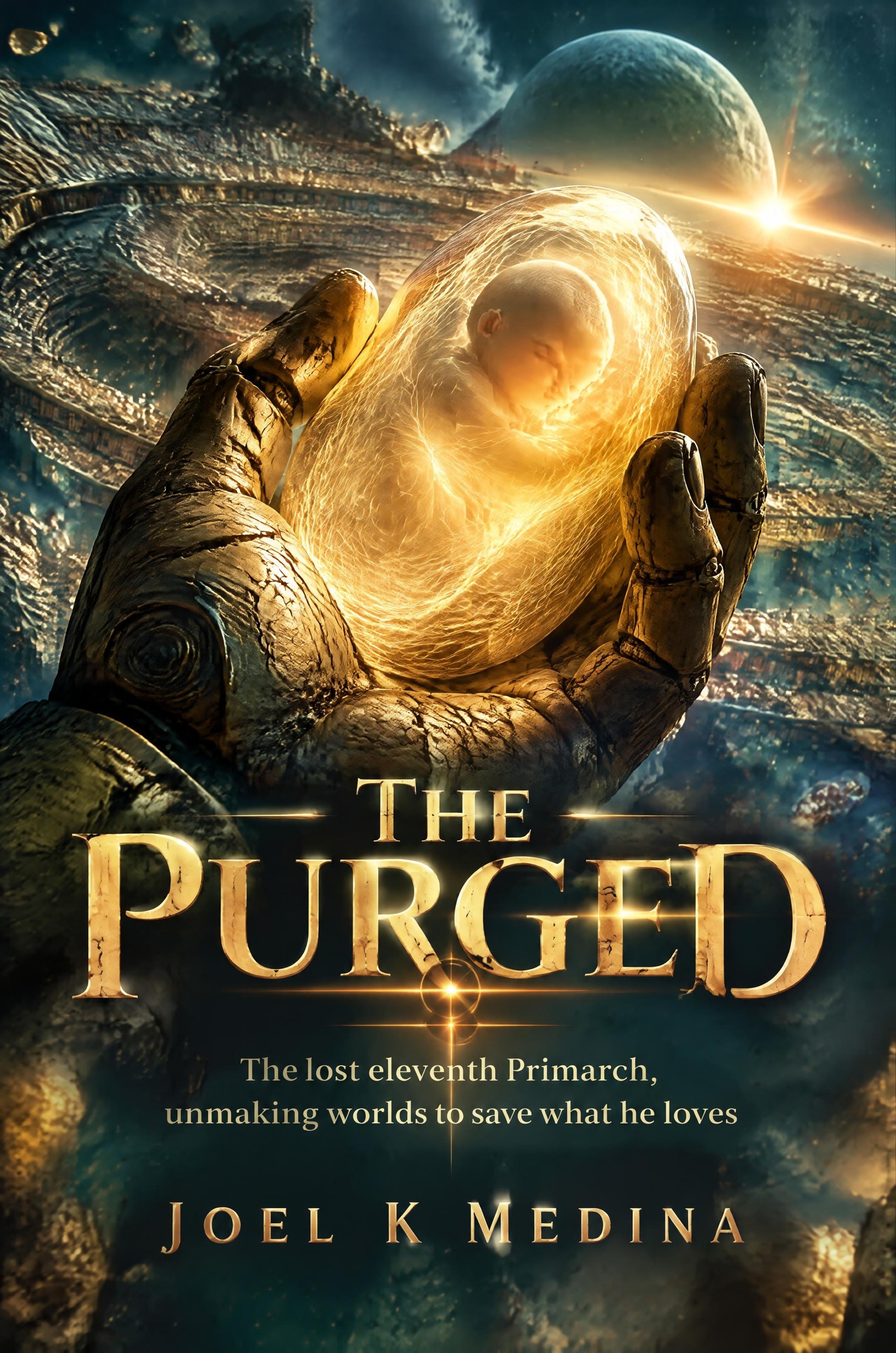
The Purged
The lost eleventh Primarch, unmaking worlds to save what he loves
by Joel Medina
Beneath Terra, the Emperor forges twenty sons to hold back the Warp. Chaos tears the wards apart. The infants vanish into the void. Nine years later, a psychic flare leads him to Mnemos, a library world of dust and memory. There lives Sorael, the eleventh, raised by Wren, a brass automaton who taught him to read the dead. Sorael can unmake matter. Each use steals a memory, a name, a piece of the people he loves. When Chaos fleets come for the archive, he spreads wings of unmaking and saves the fleet by killing the planet. Brought aboard the Imperial flagship, he learns the cradle was left unshielded because even a god can be tired. Whispers exploit the wound. He must choose: keep his power and lose himself, or sleep inside a null-lattice while his Legion is erased from history so the dark cannot find him. A dark space opera of fathers, machines, and the price of a gift that unwrites the self.
- Science Fiction
- Fantasy
- Military Sci-Fi
- Space Opera
- Dark Fantasy
The Long Vigil
Beneath the Himalazian range, below the foundations of the palace that would one day be called the Imperium's heart, there was a place the Emperor had never named. It had no door that a mortal could find, no corridor that appeared on any survey. It was simply down, and the only light in it was the pale blue glow of machines that had been burning for forty years.
He had stopped counting the days sometime in the third decade. Counting was for people who expected to be interrupted.
The Emperor stood at the center of the chamber with his hands clasped behind his back, looking at nothing. In front of him a lattice of light hung in the air, a single strand of genetic code unfurled to the height of a cathedral. It turned slowly, as it had turned for years, each rung of the helix a decision he had made and unmade a thousand times. To any other eye it would have been a thing of madness. To him it was a sentence half-written, and he was very tired of the silence between its words.
"Again," he said.
The machines obeyed. The lattice shivered and rebuilt itself, and a new simulation began to run. Somewhere in the walls, ancient cogitators that predated the Age of Strife clattered through ten million permutations in the space of a breath. He watched the projected organism take form in the light: the skeletal density, the cardiovascular architecture, the layered nervous system. Every system was tuned to resist the thing that waited beyond the veil of reality. He watched it live, and he watched it fail.
A flaw fractured the third cortical fold; the simulated mind shattered before reaching its ninth year.
"Again."
It had begun, as most great labors do, with a refusal. Long ago, when the species was young and the stars were still new, he had looked into the roiling dark that lay behind the world and understood what it would do to the people he had chosen to protect. He had lived through the rise of empires and the their collapse. He had watched humanity crawl from primordial dust into the stars, and he had watched the heavens answer back with fire and hunger.
They had broken their plows against frozen clay, raised timber palisades against the dark, and bled into the dust of ten thousand nameless sieges. They had built walled cities from sun-baked brick and ironclad hulls that crossed the black between stars, enduring plague, drought, and the quiet slaughter of their own foolishness. Yet flint, mortar, and stubborn grit were not enough, and the Emperor had spent millennia learning that hope without a weapon was only a prayer.
So he had decided to build the weapon.
Neither a machine, though he had built those too, nor an army of conscripts, though armies would come. What the Emperor wanted was something that had never existed: beings who could stand at the edge of the abyss and look into it without flinching. Warriors, commanders, and leaders, each one a perfect expression of what humanity could be if its potential were drawn out to the fullest. They would be his sons. They would be, he hoped, the greatest of his creations, and the last line of defense he would ever need to draw.
He had told no one the full extent of the plan. Not the Custodes who guarded his gates, not the Mechanicum priests who traded him secrets in exchange for his protection, not the handful of human advisers who believed they understood his purpose. To tell them would have been to invite questions, and questions would have required answers he was not yet certain he possessed.
"Lord."
The voice was quiet. It came from the entrance of the chamber, where no one should have been standing. The Emperor did not turn. He had known for some minutes that the Custodian was there, standing at the threshold with the discipline of a man who had been trained never to speak first.
"Valdor," the Emperor said. "You have come a long way for a conversation I told you I did not want."
Constantin Valdor stepped forward. His auramite armor was dull in the blue light, and his Guardian spear was held loosely at his side. He was the first of the Legio Custodes, the finest warrior mankind had ever produced before the work in this room had begun. He was also, in a way that none of the others were, a friend.
"It has been eleven days, my lord," Valdor said.
"Has it?"
"The palace has begun to ask where you are. The Mechanicum delegation arrived last week and was told you were indisposed. They did not accept it gracefully."
The Emperor almost smiled. "They never do."
"No." Valdor's gaze moved to the lattice, to the turning helix of light. He looked at it for a long moment, as a man looks at a storm he cannot stop. "I do not pretend to understand what you build here. But I have served you a long time, and I have seen your face when a task goes well and when it goes poorly. This one has gone poorly for a very long time."
"It has gone as it must."
"My lord, with respect, I do not think that is true."
The Emperor turned then. The face he turned toward Valdor was calm, ageless, and utterly devoid of ornament. It was the face of someone who had seen too much to be surprised by anything and had learned to hide the weariness of it. But behind it, in the depths of his eyes, there was a cold and hollow vigilance—the terrible stillness of an ancient mind calculating an encroaching catastrophe it had ceased to take personally.
"Come," the Emperor said. "Look."
He led the Custodian to a console set into the chamber wall, a dull slab of black metal covered in runes that no living scholar could read. At a gesture the surface woke, and the lattice of light contracted until it hung between them at the height of a man, small and bright and fragile.
"This is what I have been building," the Emperor said. "A template. A pattern for a single human being, but not any human being. Every gene in this strand has been chosen. Every sequence has been weighed against every corruption I could foresee. I have taken the best of what we are and distilled it down to its essence."
Valdor studied the glowing coils. "A warrior?"
"A warrior, yes. But more than that. A leader, a thinker, a will. The body is only the beginning." The Emperor reached out and touched one of the bright rungs with a fingertip. The light trembled. "This is where the work becomes difficult. To fashion muscle, bone, and blood is straightforward enough—mere problems of engineering, and I have solved them. But the mind is another matter. A mind strong enough to stand in the presence of the Warp is also a mind that the Warp will notice."
"And be tempted by."
"Yes."
Valdor said nothing for a time. In the silence, the machines murmured and the air tasted of ozone and old metal. When he spoke again, his voice was careful.
"Then why make them at all?"
The question hung in the air for a long moment. Valdor had asked it softly, almost apologetically, but the Emperor knew it for what it was. It was the question he had asked himself a thousand times in this room, in the long hours when the machines hummed and the simulations burned and the silence pressed against him from every side.
"Because the alternative is worse," he said at last.
He walked slowly around the lattice, one hand trailing through the light. "I have watched this species for a very long time, Constantin. I have watched it rise and fall and rise again. Each time it reaches for the stars, something reaches back. Something hungry. Something that has been waiting since before the first fire was lit." He paused, his gaze fixed on the turning light. "There are powers in the Warp that feed on mankind's fear and pride and hatred. They are not gods, though they will let humans call them that. They are appetite, given shape. And they are patient."
"You have fought them before."
"I have fought them for ten thousand years, and I have never once won. Only delayed." His voice was very quiet. "The Golden Throne will hold them at bay for a time. The Webway can give us a refuge and a road. But neither of these is a victory. If humanity is to survive, it will need more than walls. It will need champions."
"And these champions," Valdor said slowly, "will be what? Your sons?"
The Emperor stopped. For the first time since Valdor had entered the chamber, something moved across his face, and it was not quite a smile. It was older than that, and sadder.
"Yes," he said. "My sons."
They stood together in silence, the Emperor and his oldest friend, and watched the strand of light turn.
"Twenty," the Emperor said at last. "I will make twenty of them. I have the capacity for no more, and the Warp will not allow me to attempt it twice. Each will embody a distinct facet of what I have distilled. One will be a warrior without equal. Another, a statesman. Another, a scholar who sees patterns in the dark. Together they will be the pillars on which a new age is built."
"And if one fails?"
"None will fail."
"My lord." Valdor's voice was gentle, but there was iron beneath it. "You have not slept in eleven days. You have not left this room in longer than that. You say that none will fail, but a moment ago you ran a simulation and watched a flaw destroy a mind in its ninth year. I saw it on the screen when I came in."
The Emperor was silent.
"I do not question your wisdom," Valdor continued. "I question whether you are being kind to yourself. You have carried this alone for forty years. Perhaps it is time to let someone else carry some of the weight."
"There is no one else who can."
"Then let me stand beside you. Let me guard this room, at least, so that you may rest."
For a long moment, the Emperor did not answer. He looked at the Custodian, at the lines of faithful service written into that scarred and noble face, and something in his own expression softened. He had very few friends. He had even fewer who would tell him the truth.
"Thank you, Constantin," he said. "But I cannot rest. Not yet."
When Valdor had gone, the Emperor stood alone again in the blue dark. The machines hummed their endless hymn. The lattice turned. Somewhere above him, a mountain's mass of granite and a world's crushing anxieties pressed down on the only man who understood what was at stake.
He sat, for the first time in days, on a plain stool at the edge of the chamber. His hands rested on his knees. He closed his eyes.
He thought of the sons he had not yet made. He tried to imagine their faces, but he found that he could not, which was strange. He had seen the faces of a thousand generations of men and could recall every one. Yet when he reached for the faces of his children, there was only a bright blankness, as though the future itself were holding its breath.
What would they be like? Would they love him? Would they resent the burden he had made them carry? Would they understand why he had fashioned them for war instead of for peace? He did not know. He had spent forty years perfecting their bodies and minds, and he had spent almost no time at all thinking about their hearts.
It was, perhaps, the fatal flaw in his grand design—and the first of many.
For a long while, the chamber held only the rhythm of his breathing and the dry hum of transformers encased behind granite. No visions stirred; no answers came. Inside his own mind lay an immense, unpeopled silence—the heavy, patient void of a craftsman who has weighed every consequence and found no comfort, only the work that still waited to be done.
He opened his eyes and looked at the lattice again. The bright strand turned, indifferent. In its depths, a faint shimmer caught his attention. It was nothing—a stray reflection cast by the cogitators, or a phantom conjured by weary eyes. It flickered once and was gone.
The Emperor rose from the stool.
"Again," he said.
The simulation began. The helix shivered and reformed. Miles above, across jagged crests sealed in ancient ice, the night wind scraped bare stone under indifferent constellations—a dead, silent cold that knew nothing of the fevered azure radiance burning within the subterranean vaults, where one man stood ready to alter the shape of the galaxy.
Far away, beyond the reach of any telescope, something stirred within the cosmic depths and oriented its malignant hunger toward Terra.
It had begun to listen.
The Webway Gambit
When the Emperor left the deep laboratory on the twelfth day, the palace noticed.It was a small thing, the kind of change that no ledger would record. The Custodes at the upper gates straightened a fraction sooner. A servitor paused in its rounds as though some old instruction had tugged at it. In the Mechanicum enclave on the eastern terraces, a M…