

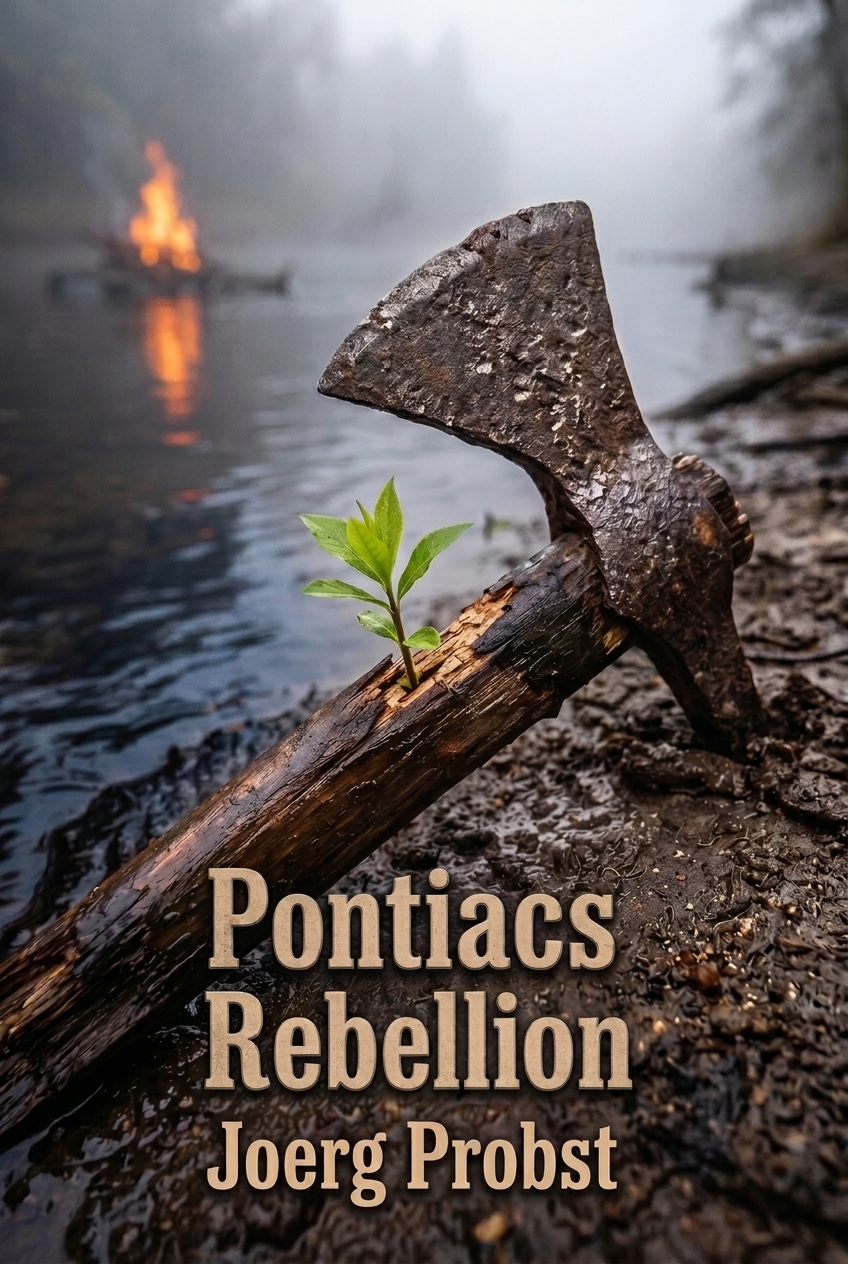
Pontiac's Rebellion
by Joerg Probst
North America, 1763: The Seven Years' War is over, yet on the frontier to the Wild West a new, far bloodier conflict smolders. Inspired by the visions of the prophet Neolin, the charismatic Ottawa chief Pontiac unites the tribes in a holy war against British dominion. In the midst of this storm of violence the peaceful Tygart Valley is visited by a cruel Seneca war party under the leadership of the merciless Sagonaska. Settlers are killed, houses burn, and the Harrington children Tom and Sarah are carried deep into the impassable wildernesses along French Creek. The experienced woodsman Sam and his Indian blood brother Awan do not hesitate. Together with a band of loyal Shawnee warriors of the Wolf Clan they take up the dangerous pursuit. A relentless hunt begins through treacherous moors and dense primeval forests, past the smoking wreckage of British forts. In a world where the boundaries between friend and foe blur, they must risk everything to save the children before the great war finally lays the land in rubble and ash. Joerg Probst crafts a gripping historical panorama of courage, loyalty, and the untamed soul of America.
- Historical Fiction
- Adventure
- Western
- Literary Fiction
- Frontier
- Wilderness
Prologue
The vast, unbroken forest of North America in the middle of the eighteenth century was a realm of shadowed silences, endless ridgelines, and deep, ancient river valleys. For generations, the dense canopy of oak, hickory, and chestnut had sheltered a world governed by the quiet rhythms of nature and the timeless traditions of the indigenous nations who called it home. From the misty heights of the Allegheny Mountains to the winding, muddy waters of the Ohio River, the wilderness was crossed only by narrow game trails and the silent tracks of hunters. It was a land where the rustle of dry leaves could mean the passing of a white-tailed deer or the swift approach of a war party, where every stream held a history carved not in stone or print, but in the memory of the elders who sat around the council fires.
Yet, the quiet majesty of this frontier was deceptive. For decades, the wild country beyond the eastern settlements had served as the grand, bloody stage for imperial ambitions born thousands of miles across the Atlantic Ocean. The great crowns of Europe, locked in an relentless struggle for global dominance, had cast their long shadows across the primeval forests of the New World. The Seven Years' War, known along the jagged borders of the colonies as the French and Indian War, had ignited the frontier in a blaze of fire and steel. It was a brutal, merciless conflict that pitted brother against brother, turned neighboring tribes into deadly enemies, and tore through the wilderness with unprecedented violence.
For long, bitter years, the French had held the upper river valleys, securing their vast network of fur trading posts through strong alliances with the native nations. From the Great Lakes down through the Ohio Country, French coureurs des bois and officers in faded blue coats had walked the woods alongside Ottawa, Wyandot, Delaware, and Shawnee warriors. They had shared the same trail bread, smoked the same sacred tobacco, and fought side by side against the relentless westward tide of British expansion. To the indigenous peoples, the French were trading partners rather than conquerors. The French built small, scattered forts that served as trading posts rather than permanent agricultural settlements. They did not clear thousands of acres of timber, build fences, or turn the rich black soil with heavy iron plows. They adjusted to the forest, and in doing so, they respected the ancient borders of the tribes.
On the other side of the conflict stood the British Empire, driven by an insatiable hunger for land and resources. From the crowded coastal towns of Virginia, Pennsylvania, and Maryland, thousands of settlers looked west toward the fertile valleys beyond the mountains with longing eyes. To them, the wilderness was a vast, untamed wasteland waiting to be conquered, cleared, and transformed into farmland. Driven by land speculators, ambitious colonial governors, and the desperate hopes of poor European immigrants, the British frontier surged relentlessly westward. Red-coated regulars of the King's army, supported by colonial militiamen in hunting shirts, marched into the deep woods with heavy artillery and supply wagons, carving rough roads through the ancient timber and building formidable stone and timber fortresses deep within native territory.
The turning point of this great struggle came in the dense forests around the forks of the Ohio River. For years, Fort Duquesne had stood as the undisputed symbol of French power in the region, a wooden stronghold perched at the confluence of the Allegheny and Monongahela rivers. It was from this fort that French commanders had directed war parties against the exposed frontiers of Pennsylvania and Virginia, striking terror into the hearts of the outlying settlements. But as the weight of British military power, naval blockades, and superior numbers began to tell, the tide of war shifted inexorably.
In the late autumn of 1758, the British commander Brigadier General John Forbes led a massive, disciplined force across the rugged peaks of Pennsylvania. Unlike previous disastrous expeditions that had ended in ambush and slaughter, Forbes advanced with methodical, crushing precision, building a chain of fortified posts behind his army to secure his supply lines. Realizing that their position was no longer tenable and abandoned by many of their native allies who saw the changing winds of fortune, the French garrison at Fort Duquesne made a desperate choice. Rather than allow their prized stronghold to fall into enemy hands, they set fire to the wooden ramparts, blew up the powder magazines, and retreated north up the river toward Canada in a fleet of birchbark canoes.
When the advanced guard of the British army reached the forks of the Ohio, they found only blackened ruins, smoking timber, and the charred remains of the once-proud French fort. Upon those red-stained ruins, the British army raised the Union Jack and began the construction of a new, far grander stronghold. They named it Fort Pitt, in honor of the British Prime Minister William Pitt. It was not merely a frontier outpost; it was a massive, star-shaped fortress built of heavy timber, brick, and earth, equipped with heavy brass cannon and designed to hold a garrison of hundreds of soldiers. Fort Pitt stood as an imposing, permanent monument to British dominance over the Ohio Country. With its rising walls, the power of New France in the region was shattered forever, and the French king abandoned his claims to the vast wilderness south of the Great Lakes.
With the signing of the Treaty of Paris in 1763, the Seven Years' War officially came to an end. On paper, the French monarch ceded all of his territorial claims in North America east of the Mississippi River to the British Crown. It was a sweeping, arrogant gesture made in the ornate halls of European palaces, where diplomats with powdered wigs drew lines across maps of lands they had never seen and could never hope to understand. With a single stroke of a quill, millions of acres of old-growth forest, fertile river bottoms, and ancient hunting grounds were declared the property of King George III.
Yet, the diplomats in Paris and the politicians in London had overlooked a fundamental, dangerous truth: the land they had so casually exchanged did not belong to the French king to give, nor did it belong to the British king to take. The native nations who inhabited the vast expanse between the Appalachian Mountains and the Mississippi River had never been conquered. They had not been present at the treaty negotiations, nor had they agreed to surrender their ancestral homelands to a foreign monarch. To the Shawnee, the Delaware, the Seneca, the Wyandot, the Miami, and the Ottawa, the forest was their mother, the river was their lifeblood, and the soil was sacred ground nourished by the bones of their ancestors.
In the immediate aftermath of the French defeat, a deceptive, uneasy calm settled over the western frontier. In places like the Tygart Valley, a lush, isolated river basin sheltered by the rolling, timber-covered ridgelines of Western Virginia, settlers began to believe that the long years of bloodshed were finally over. For a brief, shining moment, the frontier seemed to breathe a sigh of relief. Families who had spent years huddled in overcrowded, disease-ridden stockades ventured back out into the lonely coves and river bottoms to rebuild their homes. The sound of the iron ax echoed through the valleys once more as trees were felled to construct sturdy log cabins, expand vegetable gardens, and enclose pastures for cattle.
Along the banks of the Tygart Valley River, life began to take on a gentle, predictable rhythm. Small settlements took root, surrounded by fields of green corn and golden wheat. Trade flourished between the outlying farms and the nearby villages of the Shawnee, particularly the Wolf Clan, whose lands bordered the valley. White hunters and native trappers met along the riverbanks to exchange deerskins, beaver pelts, and hand-carved wooden goods for iron cookware, wool blankets, and salt. Friendships were forged across cultural divides, bound by mutual respect for the harsh realities of wilderness survival and the shared quiet of the deep woods. Men like the experienced white woodsman Sam, who had served in the militia during the war but had chosen a life of peace on the edge of the Shawnee village, stood as living bridges between two worlds. Married to a native woman and respected by the elders of the tribe, Sam represented the fragile promise of a future where white settler and indigenous inhabitant might dwell side by side in harmony.
However, this fragile peace was built upon an illusion, a foundation of sand that was rapidly being washed away by the arrogance and ignorance of the new British military administration. With the French threat removed, the British government saw no further need to cultivate the goodwill or friendship of the indigenous tribes. The delicate balance of diplomacy that had maintained frontier stability for over a century was ruthlessly discarded.
The chief architect of this disastrous new policy was General Sir Jeffrey Amherst, the Commander-in-Chief of British forces in North America. Amherst was a rigid, proud aristocrat who viewed the native peoples not as sovereign nations or valuable allies, but as conquered, inferior subjects who ought to be ruled with a iron fist. He held a deep, unyielding contempt for indigenous culture and traditional frontier diplomacy. In his eyes, the native tribes were a nuisance to be suppressed, disciplined, and controlled through military strength and economic hardship.
One of Amherst's first and most fateful decisions was the absolute prohibition of the traditional practice of giving gifts to native leaders. For generations, both the French and the British colonial authorities had participated in annual council gatherings where goods such as gunpowder, lead, trade cloth, iron tools, tobacco, and kettles were presented to the chiefs and headmen. To the European mind, these goods might have seemed like mere bribes or unnecessary expenses. But to the indigenous nations, the exchange of gifts was the very bedrock of diplomacy. It was a sacred, symbolic gesture that demonstrated respect, confirmed alliances, sealed treaties, and renewed the bonds of brotherhood between distinct peoples. It was a tangible proof that the white authorities recognized the sovereignty of the tribes and valued their friendship.
When Amherst abruptly cut off the supply of diplomatic gifts, the impact was immediate and devastating. The decision was not merely a cultural insult; it was a direct threat to the physical survival of thousands of native families. Over decades of contact with European traders, many tribes had adapted their traditional hunting practices to rely on firearms. Black powder and lead were no longer luxuries; they were necessities required to hunt deer, elk, and bear to feed their families and secure skins for winter clothing. By restricting the trade of powder and ammunition, Amherst effectively condemned entire villages to winter starvation and economic ruin.
Furthermore, Amherst ordered British commanders at posts like Fort Pitt, Fort Detroit, and Fort Niagara to drastically restrict trade and treat visiting native delegations with cold suspicion and open disrespect. Indian envoys who traveled long miles to speak with garrison commanders were turned away at the gates, spoken to like children, or threatened with military force. The warm hospitality that had characterized frontier councils was replaced by a frigid, military arrogance that deeply wounded the pride of proud chiefs and young warriors alike.
Compounding the anger over Amherst's economic policies was the ever-growing, unchecked encroachment of white settlers onto native lands. Despite official proclamations from London promising that lands west of the mountains would be preserved for the tribes, the British military did little to enforce these boundaries. Surveyors crossed the ridgelines to mark out vast tracks of land for wealthy land companies. Squatters built cabins along streams that had been guaranteed to the Delaware and Shawnee by solemn treaties. When native leaders complained to British officers about these illegal settlements, their words were met with empty promises or outright indifference. The trees were cut, the game was driven away, and the ancient burial mounds of the ancestors were cleared to make way for pastures.
As discontent and resentment simmered throughout the Indian country, a profound spiritual awakening began to sweep through the villages of the West. It began in the heart of the Ohio wilderness among the Delaware people, brought forth by a holy man and prophet named Neolin, known to his followers as the Enlightened One.
Neolin was a man who had walked deep into the solitude of the ancient forests, seeking guidance from the Great Spirit during a time of darkness and confusion for his people. According to his teachings, he had been granted a powerful vision. The Great Spirit had taken him to the top of a high, glowing mountain and shown him the condition of the land and its original inhabitants. In this vision, the Great Spirit revealed that the native peoples had strayed from the sacred path laid down for them by their ancestors. They had become dependent on the goods, weapons, and vices of the white men. The use of European clothing, iron tools, and above all, the destructive poison of rum had corrupted their spirits, weakened their bodies, and angered the Creator.
Neolin’s message was a passionate, radical call for spiritual and cultural purification. He preached that the native nations must cast off the ways of the white men and return to their ancient traditions. They were to throw away their wool blankets and dress once again in gegerbt skins. They were to put aside European trade goods, abandon the use of alcohol, and purify their bodies through ritual fasting and prayer. Most importantly, Neolin proclaimed that the Great Spirit was deeply angered by the white men who were taking the land, driving away the forest game, and destroying the ancient balance of creation.
"Why do you allow the white men to dwell upon your lands?" the Prophet’s voice echoed through the overcrowded council houses and ceremonial grounds. "Drive them out! Make war upon them! They are a plague sent to test your resolve. If you cleanse yourselves of their corrupting influence and stand together as one people, the Great Spirit will bless your arrows, restore the abundance of the forest, and sweep the white invaders back across the salt seas from whence they came!"
Neolin’s words struck a deep, resonant chord in the hearts of thousands of native listeners who felt trapped, humiliated, and desperate. His spiritual message spread like a wildfire through the dry timber of the frontier, carried by swift runners from village to village, from the headwaters of the Ohio to the shores of Lake Superior. It gave a higher, divine purpose to the growing anger of the young warriors. It was no longer merely a struggle over hunting grounds or trade prices; it was a holy war to preserve their spiritual identity, their culture, and their very existence as a free people.
While Neolin provided the spiritual spark that ignited the hearts of the people, it required a visionary military and political mind to transform that religious fervor into a coordinated, strategic uprising. That leader emerged in the north, near the shores of Lake Erie and the strategic post of Fort Detroit. His name was Pontiac.
Pontiac was an war chief of the Ottawa nation, a man of commanding presence, fierce intelligence, and formidable charisma. Broad-shouldered and sharp-eyed, he possessed a natural authority that commanded immediate respect in any council house. Unlike many traditional chiefs whose influence was limited to their own immediate clan or village, Pontiac possessed the rare ability to see beyond ancient tribal rivalries. He recognized that the fragmented native nations, acting individually, could never hope to withstand the overwhelming military might of the British Empire. Their only hope for survival lay in absolute, unprecedented unity.
Drawing deeply upon the spiritual teachings of Neolin, Pontiac began to forge a vast, secret military confederacy. It was an extraordinary political achievement, uniting tribes that had been bitter, blood-enemies for centuries. Under his leadership, Ottawa, Wyandot, Potawatomi, Ojibwe, Huron, Miami, Shawnee, Delaware, and Seneca warriors laid aside their historical grievances and bound themselves together in a sacred pact of mutual defense and total war.
Throughout the late winter and early spring of 1763, secret councils were held in dark ravines, hidden clearings, and smoke-filled longhouses across the Northwest. Pontiac traveled from camp to camp, his voice ringing out like thunder as he held up the wampum belts of war—strips of woven beads dyed dark red to symbolize blood and conflict. He spoke with passionate, hypnotic eloquence, painting a vivid picture of the destruction that awaited all native peoples if they failed to act now, while the British garrisons were still isolated and unprepared.
"The French king was our brother," Pontiac declared to the assembled council of chiefs along the Ecorse River, his hand gripped tightly around the handle of his war club. "He gave us gifts, he respected our boundaries, and his soldiers walked with us as friends. But these red-coated robbers come to take our land, to treat us like dogs, and to drive our children into the wilderness to starve. Look at their forts, rising higher every day! Look at their big guns pointed at our homes! If we do not strike now, before they grow any stronger, we will be destroyed forever. The Great Spirit has commanded us to rise! We shall strike every British fort on the same day, wipe out their garrisons, destroy their settlements, and take back the land that belongs to our children!"
Pontiac’s plan was brilliant in its simplicity and terrifying in its scope. Rather than engaging the British army in open field battles where superior European firepower and artillery would prevail, the uprising would rely on absolute secrecy, deception, and simultaneous strikes. Every British stronghold west of the mountains was to be targeted at once. Warriors were to gain access to the forts through ruses—pretending to hold peaceful councils, play traditional ball games, or trade furs—before drawing hidden weapons, overwhelming the unsuspecting garrisons, and slaughtering the defenders.
As the spring of 1763 turned to early summer, the dark clouds of war gathered over the entire North American frontier. The storm was ready to break, but in the peaceful valleys along the eastern slopes of the mountains, the British military authorities and the outlying colonial settlements remained completely oblivious to the mortal danger that rushed toward them.
British commanders at distant posts wrote complacent reports to General Amherst in New York, assuring him that the wilderness was quiet and that the native tribes were docile, divided, and powerless. Officers spent their days playing cards, drinking tea, and complaining about the monotony of wilderness duty, while sentries walked the ramparts of wooden forts with unloaded muskets. On the isolated homesteads of the Tygart Valley and along the green banks of the West Fork, settlers tended their crops, built fences, and rocked their young children to sleep, believing that the peace won by the blood of the previous war would last for generations.
They did not know that deep in the shadows of the forest, the red wampum belts had already been accepted by the war captains. They did not know that young warriors were painting their faces with black charcoal and bright red vermilion, sharpening their iron scalping knives, and stringing their heavy hunting bows. The long-simmering anger born of broken treaties, lost lands, economic tyranny, and cultural humiliation was about to explode into a wave of violence such as the frontier had never seen before.
The stage was set for a desperate, tragic conflict—a war of total annihilation where no quarter would be given, where peaceful homesteads would be reduced to ash, and where the ancient, shadowed wilderness would once again drink the blood of the innocent and the brave alike. The great holy war of Chief Pontiac had begun, and its bloody echoes were about to tear through the Tygart Valley, forever shattering the fragile peace of the borderland.
Across the wide expanse of the Ohio Country, the strategic layout of the British defensive network was remarkably frail, a thin line of isolated wooden posts scattered across thousands of square miles of untamed wilderness. Fort Detroit held the far northern approach, controlling the passage between the Great Lakes. Fort Pitt stood as the heavy, anchor stronghold at the head of the Ohio River, protecting the mountain passes that led back toward the heavily populated towns of eastern Pennsylvania. Between these two great strongholds lay a chain of smaller, poorly garrisoned outposts—Fort Presque Isle on the shores of Lake Erie, Fort Le Boeuf along French Creek, Fort Venango, Fort Sandusky, Fort Miami, and Fort Ouiatenon. Each of these small timber forts was garrisoned by a mere handful of British regulars, often no more than fifteen or twenty men under the command of an isolated lieutenant or ensign. They were tiny islands of British authority submerged in a vast ocean of hostile forest, completely dependent on long, vulnerable wilderness supply lines that could be severed in an instant.
In early May of 1763, Pontiac’s grand strategy went into action with stunning, devastating precision. The war erupted not with a single dramatic battle, but with a series of coordinated, sudden strikes that caught the British military completely unprepared. At Fort Sandusky, near Lake Erie, Wyandot warriors entered the fort under the guise of holding a peaceful council with the commander, Ensign Christopher Pauli. Once inside the officers' quarters, the warriors drew concealed knives, seized the commander, and slaughtered the entire seven-man garrison before burning the wooden blockhouse to the ground. Pauli was taken as a prisoner to the native camps, leaving Sandusky a smoking pile of rubble.
Days later, at Fort Miami on the Maumee River, the British commander, Ensign Holmes, was lured out of the wooden stockade by his native mistress, who claimed that a sick woman in a nearby village needed medical aid. As Holmes approached the native lodge, he was shot down by hidden warriors. The remaining garrison of nine soldiers, terrified and leaderless, surrendered without firing a single shot. The fort was promptly looted and burned.
At Fort St. Joseph, Potawatomi warriors rushed through the open gates under the pretense of visiting relatives. In less than two minutes, the garrison was overwhelmed, eleven soldiers were killed, and the fort commander, Ensign Francis Schlosser, was bound and dragged away into captivity. The same dark fate befell Fort Ouiatenon along the Wabash River, where Miami and Kickapoo warriors captured the fort without casualties, sparing the lives of the soldiers due to personal friendships with local French traders, but permanently removing the post from British control.
The destruction of the smaller outposts reached its grim climax along the vital trail connecting Lake Erie to the Allegheny River. At Fort Presque Isle, a strong timber blockhouse, over two hundred Seneca, Ojibwe, and Wyandot warriors laid siege to the defender's stronghold for three days, throwing fire arrows onto the wooden roof and digging trenches up to the wooden palisade. Exhausted, dehydrated, and facing imminent death by fire, the garrison of twenty-seven men under Ensign John Christie surrendered after receiving promises of safe passage to Fort Pitt—promises that were promptly broken as the soldiers were captured and the fort was burned to the ground.
From Presque Isle, the victorious war parties swept south toward Fort Le Boeuf and Fort Venango. At Le Boeuf, Ensign George Price and his small force managed to escape into the night through a rear window as warriors set fire to the wooden walls, fleeing through the dark swamps toward Fort Pitt. But at Fort Venango, no one escaped to tell the tale. A war party of Seneca warriors completely wiped out the small garrison, tortured the commander, Lieutenant Gordon, over a slow fire for nights on end, and left the fort a blackened graveyard in the wilderness.
Within a matter of weeks, nine of the eleven major British forts west of the Appalachian Mountains had fallen to Pontiac’s allied tribes. The British military structure in the West was effectively wiped off the map. Hundreds of British soldiers were killed or captured, vast quantities of gunpowder, rifles, and military stores were seized by the victorious warriors, and the long-held illusion of British invincibility in the wilderness was utterly destroyed.
Only two major strongholds managed to withstand the initial, ferocious wave of the native offensive: Fort Detroit in the north, which Pontiac personally subjected to a bitter, months-long siege, and Fort Pitt at the forks of the Ohio. As news of the fall of the northern outposts filtered back through the forest trails, Fort Pitt became the desperate haven for hundreds of panicked settlers, traders, and surviving militia men fleeing from the exposed river valleys.
Inside Fort Pitt, the Swiss-born British officer Captain Simon Ecuyer found himself commanding a garrison trapped in a nightmare. The fort was overcrowded with over five hundred women, children, and civilian refugees who had fled their farms with nothing more than the clothes on their backs. Smallpox broke out within the crowded, unsanitary confines of the brick walls, adding a horrific biological plague to the threat of external siege. Outside the ramparts, Delaware, Shawnee, and Seneca warriors under chiefs like Custaloga and Shingas surrounded the fortress, occupying the high ground along the rivers and keeping up a constant, harassing fire with rifles and fire-bearing arrows.
Captain Ecuyer, a veteran soldier hardened by years of European warfare, knew that his garrison could not hold out indefinitely if supply lines were cut off and no relief army arrived from the east. In a desperate, ruthless effort to break the siege, Ecuyer resorted to a dark and infamous tactic. During a parley with Delaware leaders outside the fort walls, the British officers presented the native envoys with gifts of goodwill—including two blankets and a handkerchief taken directly from the fort’s smallpox hospital. While the ultimate effectiveness of this early form of biological warfare remains a subject of historical debate, the intent was clear: the British military was willing to use any means, no matter how cruel, to survive the fury of the uprising.
As the strongholds fell and Fort Pitt remained ringed by fire and steel, the frontier line itself collapsed in total chaos. The war parties did not limit their attacks to military targets. Driven by the spiritual mandate of Neolin to cleanse the land of white invaders, groups of Seneca, Shawnee, and Delaware warriors swept down upon the exposed, undefended settlements along the mountain valleys. From the Susquehanna to the Kanawha, the frontier erupted in a nightmare of burning homesteads, ruined crops, and sudden, violent death.
Isolated farmhouses that had known years of quiet peace were transformed into bloody slaughterhouses in a matter of minutes. Settlers working in their fields were cut down by rifle fire before they could reach their weapons. Smoke from burning barns drifted across the valleys, visible for miles as a grim warning to neighboring farms. Families fled eastward in absolute terror, packing what little they could carry onto horses or pushing handcarts along narrow, muddy wilderness roads. Thousands of refugees poured into the eastern towns of Carlisle, Lancaster, and Winchester, telling horrific stories of loved ones killed, homes destroyed, and children dragged off into captivity deep within the dark, western forests.
It was into this atmosphere of mounting dread, shifting loyalties, and impending doom that the people of the Tygart Valley were dragged. Nestled deep within the rugged mountains of Western Virginia, the valley had long considered itself insulated from the worst of the frontier troubles, protected by its geography and its friendly relations with the nearby Shawnee of the Wolf Clan. The settlers who lived along the river knew the native families by name. They had shared meals, traded horses, and watched their children play together on the green river meadows. They believed that the bonds of neighborly friendship would shield them from the rising storm.
They did not understand that the war unleashed by Pontiac was a flood that respected no local agreements and spared no isolated valleys. The rise of radical spiritualism, the bitter hatred sparked by Amherst's policies, and the opportunistic cruelty of rogue war leaders like the Seneca war captain Sagonaska were sweeping away the old ways. Sagonaska, a feared chief from the northern reaches of French Creek, saw the widespread chaos not as a holy quest for cultural survival, but as a chance to gain immense personal glory, plunder rich colonial homesteads, and take war captives to replace the fallen warriors of his clan.
While the wise leaders of the Shawnee Wolf Clan—men like Chief Bald Eagle and the venerable medicine man Iron Cloud—strove to keep their young men away from Pontiac’s war, the pressure from radical emissaries was growing stronger every day. Pontiac’s messengers walked into the Shawnee villages carrying dark wampum and tales of great victories over the British redcoats, urging the young warriors to take up the hatchet and join the total war against all white men along the border.
The fragile peace of the Tygart Valley was hanging by a single, fraying thread. The air was thick with the scent of damp wood, drying deer meat, and the quiet, gathering storm of war. In the shadow of the great mountains, simple settlers and experienced woodsmen like Sam, Henry Hatfield, and the militia leader Acton looked toward the dark tree lines with growing anxiety, knowing that the peace they had worked so hard to build was slipping away, second by second, into the dark abyss of history.
The vast wilderness stood on the razor's edge between life and total destruction. The ancient trees, standing like silent sentinels over the forest trails, held their breath in the cool mountain air. The story of Pontiac's Rebellion was no longer a distant rumor brought by weary travelers or river traders; it had arrived at the very threshold of the frontier, ready to tested the courage, honor, and humanity of every soul who dared to dwell beneath the great green canopy of the West.
The Prophet's Vision
It was in the sultry summer of the year 1758 when, with the fall of Fort Frontenac, the first decisive blow was struck against the Bourbon power in the impassable wildernesses of North America. And when, in the late autumn of the same year, the flag of His Britannic Majesty was also raised over the smoking ruins of Fort Duquesne, that leaden tensio…