
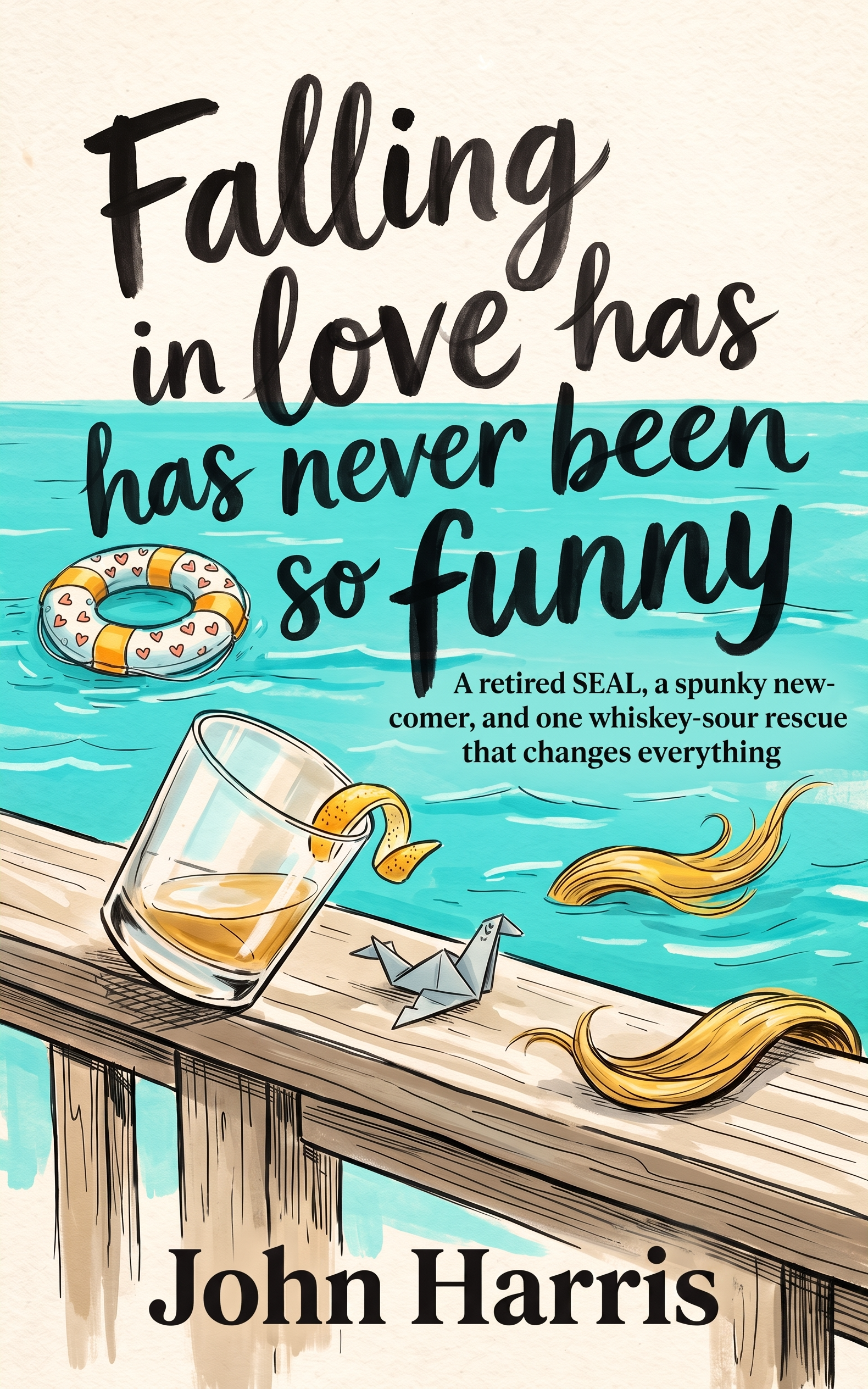
Falling in love has never been so funny
A retired SEAL, a spunky newcomer, and one whiskey-sour rescue that changes everything
by John Harris
He swore off love. She swore off trouble. Chemistry had other plans. Retired Navy SEAL Nathan Cross came to a quiet coastal town for peace—not for the prettiest, spunkiest woman he’s ever seen tumbling into danger after one too many whiskey sours. At forty, fit, and fiercely private, Nathan knows better than to risk his heart. He’s watched too many brothers get burned. Sarah Jenkins, thirty-three and newly arrived, is done picking the wrong guys. Mortified that the tall, emerald-eyed stranger had to peel her out of a sticky situation, she pushes him away—even as attraction hits like a riptide. When Nathan mistakes her for taken, he slots himself into the “big brother” role. Bad idea. Nothing about the way he wants her is brotherly. Between bakery disasters, self-defense classes gone sideways, and small-town gossip, their courtship becomes a laugh-out-loud game of cat and mouse… while heat builds underneath every near-miss. Then her past shows up. Walls crack. Hands stop staying off. Falling in love has never been so funny—or so steamy—as when a good man with an edgy streak decides the quirky blonde with green eyes is worth every risk.
- Romance
- Erotica
- Romantic Comedy
- Small Town Romance
- Slow Burn Romance
- Friends to Lovers
Whiskey Sours and Tactical Rescues
Sarah Jenkins had made exactly one promise to herself when she moved to Port Haven a week ago: no more bad decisions. She'd said it out loud in her new empty apartment, to the boxes still taped shut, to the ceiling fan that wobbled like it had one too many whiskey sours of its own. New town, new start, no more mistakes wearing expensive cologne and empty promises.
Which was probably why the universe had decided, on a Friday night exactly seven days later, that three whiskey sours counted as a personality trait rather than a decision.
The Anchor sat two blocks off the harbor, all weathered cedar shingles and strings of patio lights that some optimistic soul had wound around the porch railing sometime around the Clinton administration and never taken down. Inside, it smelled like fry oil and salt air and beer-soaked wood, and the jukebox in the corner had exactly one working button, which meant the entire bar had been treated to the same four Fleetwood Mac songs on a loop since seven o'clock.
Sarah did not mind. Sarah, currently, did not mind much of anything.
"You're doing the thing," Laura Holt said from across the sticky table, nursing a lemonade like the sensible human being she was. Laura had closed the bakery an hour ago and still had a smear of flour on her collarbone that she either hadn't noticed or had decided to wear as a badge of honor. "The thing where your eyes go soft and you start telling the bartender your whole life story."
"I did not tell him my whole life story."
"You told him about your ex-boyfriend's timeshare in Destin."
"That's relevant information! People should know about the timeshare! It's a cautionary tale!" Sarah lifted her glass, found it empty, and frowned at it with the deep personal betrayal of a woman who had trusted that glass to take care of her. "Also I'm fine. I'm celebrating. One week in Port Haven and I have not burned down a single building. That deserves a toast."
"That was toast number four."
"Then it deserves a toast number five."
Laura laughed, the warm, unbothered laugh of a woman who had clearly done this dance with reckless friends before and knew exactly how it ended, and signaled the bartender anyway, because that was Laura — soft heart, sharp eyes, always ready to catch you before you hit the floor even while she was telling you not to jump.
Sarah didn't remember agreeing to the fifth drink so much as she remembered it simply appearing, amber and glowing under the string lights like a small, treacherous sunset, and after that the edges of the evening went a little soft and golden, the way good nights sometimes did right before they turned into a story you'd tell at parties for the rest of your life.
She should have known the story was about to turn when the group of guys came in.
There were four of them, all boat shoes and popped collars and the specific, entitled swagger of men who'd had money handed to them their whole lives and had never once had to actually earn a room's attention. They'd claimed the pool table an hour ago, gotten loud about it, and the loudest one — tall, sunburned, a watch that cost more than Sarah's car — had been throwing looks her way since he'd walked in.
She'd clocked it. She wasn't that drunk. She was drunk enough to make questionable decisions about spinning kicks, apparently, but not so drunk she couldn't read a room.
Except then Laura got pulled away by the bakery's Saturday delivery driver, something about a flour order gone sideways, and Sarah was alone at the table with her sixth — or was it seventh — drink, and the jukebox kept playing the same four songs, and Sunburn Watch Guy decided that was his moment.
"Hey." He slid into the booth across from her without asking, which was rude, and smelled like tequila and too much cologne, which was worse. "You look like you could use some company."
"I have company. She's getting flour."
"I'm way better company than flour."
"Debatable," Sarah muttered, and reached for her glass, only to find his friend had already slid in next to her, boxing her into the booth, close enough that she could feel the heat off his stupid expensive shirt.
Something in her chest went tight and cold, the way it did every single time a man got too close too fast, an old alarm bell rung by too many wrong men in too many wrong rooms. She smiled anyway, because that was the reflex, the armor, the thing she did instead of screaming.
"I'm good, guys, thanks."
"C'mon, don't be like that." A third one had appeared, leaning on the table, all teeth. "We're just being friendly."
"Friendly people don't corner a woman in a booth," Sarah said, and her voice came out steadier than she felt, which she counted as a small personal victory. "Friendly people say hi and then go back to their pool table."
Sunburn Watch Guy laughed like she'd said something charming instead of true. "Feisty. I like feisty."
She did not know, in that moment, that she was being watched. She would learn that later, from a corner booth deep in shadow where a man had been sitting quietly with a club soda and a folder of paperwork he had no intention of reading, watching the whole bar the way he watched every room he'd ever walked into — cataloging exits, counting bodies, clocking the exact moment three friendly out-of-towners stopped being friendly and started being a problem.
Nathan Cross had noticed the group the second they walked in. Old habits. Twenty years of habits, actually, ones that didn't switch off just because he'd traded a trident for a fixer-upper cabin and a stack of home improvement videos he mostly ignored. He'd clocked the way the tall one kept circling back to the blonde at the corner table like a shark that hadn't decided yet whether it was hungry, and he'd clocked the exact second the decision got made.
He watched them slide into her booth. Watched her shoulders go stiff under a smile that didn't reach her eyes. Watched the one boxing her in lean an arm along the back of the seat, a small, casual gesture that wasn't casual at all, that was a fence going up, a woman being penned.
Nathan set down his club soda.
"Seriously, I'm fine," Sarah was saying, louder now, and there was an edge under the words that hadn't been there a minute ago, the edge of someone whose smile was starting to cost more than it was worth. "I'd like my space back, please."
"Or what?" The one wedged beside her grinned, and it wasn't a nice grin. "You gonna make us?"
That was the exact moment a shadow fell across the table, long and unhurried, and a voice cut through the jukebox's tired Fleetwood Mac loop like a blade through warm butter.
"She said she'd like her space back."
Sarah looked up. Way up.
The man standing at the end of the booth was built like something out of a recruitment poster, all shoulders and quiet weight, dark hair cropped close, a jaw dusted in five o'clock shadow, and eyes the exact green of sea glass, flat and calm and terrifying in a way that had nothing to do with volume. He wasn't shouting. He wasn't even raising his voice above conversational. That was somehow worse.
"This isn't your business, buddy." Sunburn Watch Guy tried a laugh that came out thin.
"Making it my business." Nathan's tone didn't change. It was the same low, even register he might have used to order a coffee, which was precisely why the three men at the table felt something cold settle in their stomachs, the primal, hindbrain recognition of a predator who did not need to posture because he had never needed to. "You're going to get up. All three of you. You're going to walk back to your friend at the pool table, and you're going to finish your drinks like gentlemen. And then you're going to leave a very generous tip for the trouble you almost caused tonight."
"Almost caused?" the one beside Sarah repeated, some drunk, misplaced bravado kicking in. "We didn't do anything—"
"You crowded a woman who told you three separate times to back off." Nathan's gaze didn't flick to Sarah once. It stayed locked, level, patient, on the man across from him, and something about that steadiness made the guy's throat move in an audible swallow. "I've spent my whole life around men who think that's a gray area. It isn't. So here's what's going to happen. You're going to get up, slow, hands where I can see them, and we're all going to have a very boring rest of our night."
Nobody moved for a second that stretched long and taut as wire.
Then the tall one laughed, too loud, and shoved back out of the booth like it had been his idea all along, muttering something about crazy small towns, and the other two followed, scrambling in that particular way men scrambled when their bodies understood a threat their pride refused to acknowledge. They didn't look back. They didn't apologize either, but Nathan hadn't expected one, and he watched them all the way to the pool table before he let his shoulders drop half an inch, the only outward sign that he'd been braced for something worse.
Sarah stared up at him from the booth, whiskey sours doing slow, syrupy laps behind her eyes, and thought, with the crystal clarity only the deeply intoxicated ever achieve: oh no. Oh no, he's hot.
"You didn't have to do that," she said instead, because pride was apparently the last thing to go, even after five — six? — drinks. "I had it handled."
"Sure you did." One corner of his mouth moved, not quite a smile, more the ghost of one passing through. "That's why your voice went up two octaves in the last thirty seconds."
"It did not."
"It really did."
"I don't even know you," Sarah informed him, with the dignity of a woman who had just slid halfway out of the booth and was now attempting, with great and terrible confidence, to stand. "I don't need saving. I'm a strong independent woman who has watched several action movies."
"Is that right."
"I know moves."
Later, Sarah would not remember deciding to demonstrate this. She would only remember the sensation of the room tilting, gently, like a boat catching a wave, and the sudden, overwhelming conviction that a spinning back kick — the exact one Michelle Yeoh had thrown in a movie she'd watched approximately eleven times — was the correct and necessary response to being rescued by a stranger with shoulders like a doorframe.
She planted one foot. She rotated. For half a glorious second, in her own head, she was an action hero, golden hair whipping, righteous fury incarnate.
Then her sneaker caught the leg of the booth, her whole center of gravity abandoned ship without notice, and Sarah Jenkins went down.
Except she didn't hit the floor. She hit a wall of warm, solid, startled muscle, and two arms came up on pure reflex to catch her before her brain had even finished registering the fall, and suddenly she was pressed against a chest that felt like it had been carved rather than born, one hand splayed flat against his forearm, her face approximately four inches from a jaw she was fairly sure had been drawn by a cartoonist with a very specific fetish.
Nathan felt her hit him and something in his chest did a thing he hadn't authorized, a hot, electric jolt that ran clean down his spine and set off every alarm he'd spent years very deliberately not listening to. She smelled like whiskey and something sweeter underneath, vanilla maybe, and her hair was soft against his jaw, and she was looking up at him with green eyes gone wide and glassy and absolutely unashamed.
"That," Sarah announced, "was a controlled landing."
"Sure it was."
"I meant to do that."
"You meant to fall into a stranger's chest."
"I'm a ninja in training," she said, with the utter, unshakable conviction of the truly hammered. "This was, like, level one. Falling gracefully."
"You didn't fall gracefully. You fell like a tree."
"A very graceful tree."
He should have set her back on her feet right then. He knew that, some rational, disciplined corner of his brain knew it clear as day, the same corner that had kept him alive through six deployments and a hundred rooms far more dangerous than this one. Instead he stood there a beat too long, her palm still flat against his forearm, her whole small, furious, golden-haired self pressed against him, and let himself feel exactly how right it felt before he shut that thought down hard and set her, gently, back on her own two feet.
"Alright, ninja," he said, low. "Let's get you home before you demonstrate level two."
"There is no level two. I made that up."
"Figured."
Laura reappeared from the flour crisis just in time to watch Nathan Cross — a man whose name she absolutely knew, because everyone in Port Haven knew everyone, and half of them knew Nathan Cross specifically as the retired something-or-other with the jaw and the cabin up on Marsh Point — steer Sarah toward the door with one hand hovering at the small of her back, not quite touching, the careful, controlled hover of a man used to making sure something fragile didn't hit the ground.
"Oh," Laura said, to no one in particular, watching them go. "Oh, honey, you have no idea what just happened to you."
Outside, the coastal air was cool and thick with salt, and the sidewalk in front of The Anchor stretched dark and gently curving toward the harbor, streetlights buzzing overhead in a lazy amber rhythm. Sarah took a deep breath of it and felt marginally more human, though the world still had a soft, unreliable wobble to it, like she was viewing everything through the bottom of a glass.
"I can walk," she informed the man beside her, whose name she did not yet know, which felt suddenly like an enormous oversight.
"Never said you couldn't."
"You're hovering."
"I'm walking next to you on a public sidewalk. That's a normal human activity."
"You're hovering like you think I'm gonna fall into a storm drain."
"Given the last five minutes," he said, and there it was again, that almost-smile, the one that didn't fully commit, "I'm not ruling it out."
Sarah squinted up at him. Under the streetlight his eyes weren't just green, they were that impossible sea-glass color, the kind you found on a beach after a storm and pocketed because it seemed too good to leave behind, and his jaw had a scattering of dark stubble that made her want to reach out and touch it, which was an insane thought, an unacceptable thought, the kind of thought that got a woman into three whiskey sours' worth of trouble in the first place.
"What's your name," she demanded, "Rescue Man?"
"Nathan."
"Nathan," she repeated, testing it out like she was trying on a coat. "Nathan sounds like a guy who irons his jeans."
"I don't iron my jeans."
"You look like you iron your jeans."
"You look like you're about to fall into a storm drain."
"Rude," Sarah said, delighted, and then her ankle chose that exact moment to prove his point by rolling slightly on a crack in the sidewalk, and before she'd even fully registered the stumble his hand was under her elbow, steady and sure, holding her upright without so much as a change in his breathing.
"Uh huh," Nathan said. "Truck's this way."
"I don't get in trucks with strange men."
"Good policy. You want to walk home instead? Where do you live?"
Sarah opened her mouth to answer and discovered, with mild horror, that she could not currently locate that information anywhere in her own head. "I... live somewhere. In this town. It has a door."
"Great. Real specific."
"It's the one with the blue mailbox," she said, triumphant, as though this settled everything.
"There's about forty blue mailboxes in this town."
"Well then it's a very popular color."
Nathan sighed, the long-suffering sigh of a man who had clearly signed up for a very different Friday night than the one he was currently having, and steered her — gently, one hand at her elbow, the other resting light as a suggestion at the small of her back — toward a truck parked two spots down from the bar. It was black, immaculate, the kind of clean that suggested either obsessive discipline or a complete absence of children, and when he opened the passenger door for her she climbed in with the exaggerated care of someone who suspected the floor might be lava.
"This truck is spotless," she said, once he'd rounded the hood and settled into the driver's seat. "Like, unnervingly spotless. Are you a serial killer?"
"If I was, would I tell you?"
"That's exactly what a serial killer would say."
"I was in the military," Nathan said, pulling out onto the quiet street, streetlights sliding gold across the windshield. "You get used to keeping things squared away."
"Military," Sarah repeated, nodding slowly, like this was a very important piece of intelligence she was filing away for later. "That explains the arms."
"The arms?"
"You have, like, alarming arms. Cartoon arms. Nobody's arms should look like that in real life."
"Noted."
"I'm just saying it's suspicious."
"You said serial killer two sentences ago. Now I've upgraded to suspicious cartoon arms. I'd like to know where this is going."
"It's going nowhere," Sarah said, with great seriousness, twisting in the seat to face him despite the seatbelt's polite objection. "Because I don't trust men with jawlines like yours. That's, like, a rule I have. A personal policy."
"A jawline policy."
"Every guy I've ever dated who looked like a walking cologne ad turned out to be a walking disaster. There was Brian, who had a jaw like a Ken doll and also three secret credit cards. There was Marcus, who did CrossFit and cheated on me with his CrossFit instructor, which, I mean, credit to efficiency. And then there was—" She waved a hand, the whole gesture loose and expansive. "You know what, it doesn't matter. Point is, jaw plus arms plus you being suspiciously nice to me equals red flag. Giant red flag. Like a parade of red flags. A red flag festival."
"Duly noted," Nathan said, and there was something careful in his voice now, something that had gone quiet under the dry humor, though Sarah, three sheets to the wind and rambling at speed, didn't catch it. "I'll be sure to file a permit for the festival."
"You should. It'll have floats."
"Sounds like a good time."
She kept talking. She talked about the vintage Fleetwood Mac shirt she'd bought at a thrift store in her old city for four dollars and had never once regretted, and how she owned exactly eleven band tees and would fight anyone who suggested that was excessive, and how her mother used to say a woman only needed one good black dress and Sarah had decided at age nineteen that her mother was wrong about several things, that being one of them. She talked about her new apartment and the ceiling fan that wobbled and the box of art supplies she still hadn't unpacked because unpacking felt like admitting she actually lived here now, which was a weirdly big step for a woman who'd been in town seven whole days.
Nathan listened. He didn't say much, just made low sounds of acknowledgment at the right places, hm and yeah and that so, and let her talk herself in slow, drunken circles while he watched the road and, more than the road, watched her out of the corner of his eye — the way her hands moved when she talked, quick and expressive, the way her whole face lit when she landed a joke she found funny even if he was the only audience, the way underneath all that noise there was something soft and a little bruised, something that flinched, just slightly, every time she mentioned an ex by name, like she was braced for him to judge her for the choices those names represented.
He didn't judge. He filed it away instead, the way he filed everything, quiet and careful, in some back room of his mind he didn't examine too closely.
What he did notice, with a flicker of something between amusement and unease, was the little silver flashlight now sitting in the cup holder of her lap, turning slowly between her fingers as she talked, like a fidget toy she'd picked up without ever registering where it had come from.
His tactical flashlight. The one that had been clipped to his belt not twenty minutes ago.
He didn't ask. He was fairly sure the story of how it had migrated from his hip to her hands somewhere between the booth and the truck was one she didn't even know she was starring in, and honestly, he decided, watching her turn it over like a lost artifact from some civilization she couldn't quite place, it was a better story if he let her keep it a while longer.
"This is a cool flashlight," she said, holding it up to admire against the passing streetlights. "Where'd I get this."
"No idea," Nathan said.
"It's very heavy. Very official-looking. Like something a spy would carry."
"Could be."
"You think it fell out of the sky?"
"Stranger things have happened tonight."
He turned onto her street a few minutes later, guided mostly by her increasingly unreliable directions — it's the one with the blue mailbox, no wait, that's not it, ooh that porch light is pretty, keep going — until she finally slapped a palm against the window and announced, with the triumph of Columbus sighting land, "There! That one! The blue one!"
It was, in fact, one of at least six blue mailboxes they'd passed, but Nathan pulled the truck into the driveway of a small clapboard house with a sagging porch swing and a garden gone slightly feral, and something in his chest went still and sharp all at once, a small internal alarm ringing under everything else.
Jenkins. The name on the lease he'd glanced at last month, back when he'd been doing a quiet favor for a buddy at the county office, running a routine check on a rental property that had sat empty for two years before the new tenant signed. He hadn't thought twice about it at the time. Just a name on a page, one more piece of paperwork in a stack of them.
Sarah Jenkins.
He looked at her now, swaying slightly in the passenger seat, whiskey-warm and glowing under the dome light, blissfully unaware that he'd already known her name before she'd ever slurred it at him, and felt something shift and settle into place, quiet and certain as a lock turning.
"This is me," Sarah announced unnecessarily, since he'd already put the truck in park. "Home sweet home. Home sweet slightly crooked home."
"Looks like it."
"You don't have to walk me up."
"I'm walking you up."
"I said you don't have to."
"And I said I'm doing it anyway. We're at an impasse. I'm bigger than you, so I win."
"That's not how impasses work," Sarah said, already fumbling with the door handle, losing the battle with her own seatbelt in a way that would have been mildly tragic if it weren't so genuinely funny, and by the time Nathan came around the hood she'd finally freed herself and half-tumbled out onto the driveway, catching her balance against the truck's fender with both hands.
He walked her up the short path to the porch, one hand hovering near her back again, not touching, just present, a steady gravitational field keeping her roughly on course. The porch light was out — one more thing for a growing list, apparently, of small repairs this house needed and its new tenant hadn't gotten around to — and the moon threw everything into soft silver and shadow, the garden gone quiet except for the tick of cooling engine behind them and the distant hush of the harbor two streets over.
"Well," Sarah said, turning to face him on the top step, swaying just slightly, close enough now that he could see the freckles scattered across her nose, close enough that the whiskey-sweet scent of her filled the small space between them. "Thank you for the rescue, Nathan-with-the-arms. I appreciate you not letting those creeps use me as a conversation piece."
"Anytime."
"I mean it. Even though I had it handled."
"Sure you did."
"I did! I was two seconds from decking that guy."
"With the spinning kick."
"With the spinning kick," she confirmed, with total, unblinking sincerity, and Nathan felt his mouth twitch, the smile he'd been holding back all night finally getting the better of him.
"Well," Sarah said, straightening up, squaring her shoulders in a way that suggested she was about to attempt something dignified, "I would like to conclude this encounter with a respectful, professional high five. As colleagues. Or, like, rescue-related acquaintances."
"A high five."
"A very solid, very professional high five." She lifted her palm with great ceremony, aiming it, more or less, at the general vicinity of his chest.
She missed by roughly a foot and a half, her hand slapping empty air with a soft, defeated whiff, the momentum spinning her half a step sideways before she caught herself on the porch railing, laughing, loud and unselfconscious, the kind of laugh that came from somewhere real underneath all the whiskey and the noise.
Nathan stood there on her crooked porch, in the dark, watching a woman he'd known for exactly forty-five minutes laugh at her own catastrophic failure to complete a high five, and felt something in his chest crack open just slightly, just enough to let a little light in where he hadn't planned on any getting through.
"That," he said, dry as sand, "was a controlled landing."
"Shut up," Sarah said, delighted, pointing an unsteady finger at him. "You don't get to steal my line."
"Seemed appropriate."
"It's my line. I own it. Copyright Sarah Jenkins."
"I'll be sure to file the paperwork."
She fumbled her keys out of her back pocket, and it took her three attempts and one soft, muttered curse to get the front door open, and when she finally managed it she turned back to look at him standing at the bottom of the porch steps, hands in his pockets, watching to make sure she got inside safe before he'd let himself walk away, and something in her chest did a slow, warm roll that had nothing at all to do with whiskey sours.
"Goodnight, Nathan-with-the-arms," she said, softer now, some of the bravado slipping.
"Goodnight, ninja."
"I really was going to make that kick work."
"I believe you."
"You're lying."
"A little," he admitted, and there it was again, that smile, fuller now, unguarded, the kind that made his whole hard face go soft for just a second before he caught it and pulled it back in. "Get some water before bed. And a lot of aspirin."
"Yes, Dad," Sarah said, and immediately winced. "Ugh, no, don't — forget I said that. That was weird. You're not — that's not what I — goodnight."
She shut the door before he could answer, and Nathan stood on the dark path a moment longer, listening to the deadbolt turn, the porch swing creaking faintly in the sea breeze behind him, and let out a breath he hadn't quite realized he'd been holding all night.
He walked back to the truck slower than he needed to. Behind the wheel, he sat for a minute without starting the engine, staring at the little crooked house with its dead porch light and its half-feral garden, running one hand back through his hair.
Sarah Jenkins. New in town. Renting the old Hargrove place on Pelican Lane. He'd known that much for a month, from a stack of county paperwork he'd flipped through without a single flicker of interest.
He had a great deal more interest now.
He thought about the way she'd gone stiff in that booth before he ever reached her, the flash of real fear under the bravado, gone the second his shadow fell over the table but not gone, not really, just tucked back under the noise where she kept it. He thought about the three names she'd rattled off in the truck, tossed out light and easy like punchlines, though he'd clocked the flinch underneath every one of them. He thought, mostly, uselessly, unhelpfully, about the exact weight of her against his chest for that one suspended half-second before he'd set her back on her feet, and the way something in him, something he'd nailed shut a long time ago after watching too many good men get gutted by the wrong woman, had rattled the hinges just slightly, testing the lock.
"Not your business, Cross," he told the empty cab, low, the way he might have delivered an order to himself on a bad op. "Not your circus."
The engine turned over easy under his hand, and he pulled out of the driveway and didn't look back at the house, though some part of him, driving the quiet dark road toward Marsh Point, kept replaying the sound of her laugh anyway, unbidden, refusing to file itself away with the rest of the night.
Inside, Sarah leaned back against her own front door, boots still on, world still gently spinning, and looked down at the strange, heavy silver flashlight still clutched in her hand like a souvenir from a battle she barely remembered fighting.
"Huh," she said, to no one, to the empty living room, to the unpacked boxes stacked like small cardboard monuments against the wall. "Where'd this come from."
She set it on the kitchen counter, next to a bowl of keys and a stack of unopened mail, and made a mental note — one that would, predictably, dissolve completely by morning under the weight of a whiskey-sour hangover — to figure out later exactly whose it was.
She did not think, not once that night, that its owner already knew her name, her address, and the exact shape of the small, stubborn, laughing thing currently cracking its way through the wall around his heart.
She just climbed the stairs, kicked off her boots somewhere around the fourth step, and fell face-first into bed still smiling, murmuring something about cartoon arms into her pillow before sleep took her under.
Outside, two streets over, a black truck rolled to a stop in front of a half-renovated cabin on Marsh Point, and its owner sat behind the wheel a long moment before he finally cut the engine, staring at nothing, feeling, for the first time in longer than he wanted to admit, distinctly and thoroughly unarmed.
The Realtor and the Red Mist
Sarah Jenkins woke up to the specific brand of regret that only whiskey sours could deliver, a slow, throbbing ache behind her right eye that felt like someone had installed a tiny, malicious drummer directly into her skull. She lay very still for a long moment, staring at the ceiling fan that wobbled above her bed, and took inventory of her sins. …