

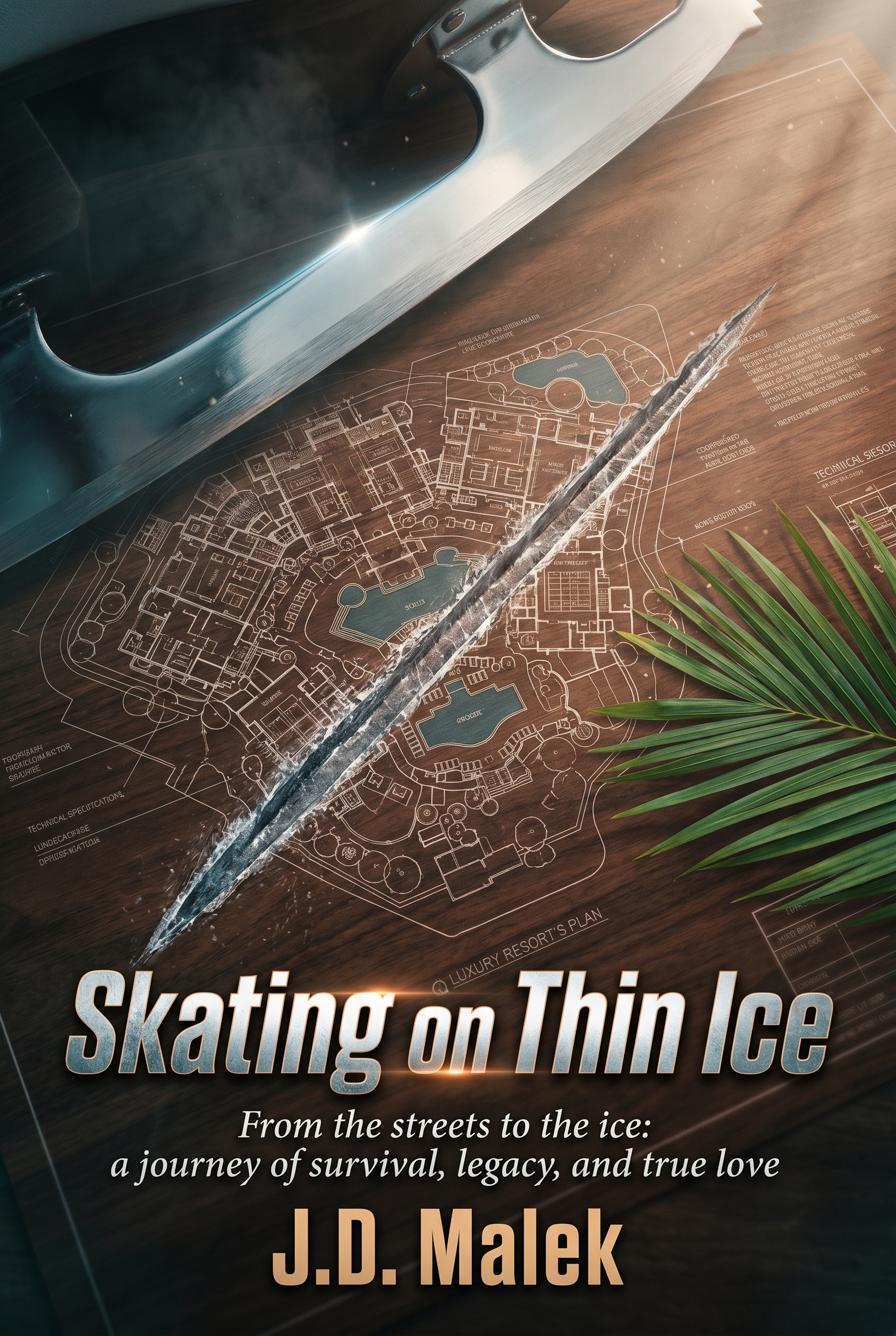
Working title something to do with skating
From the streets to the ice: a journey of survival, legacy, and true love
by John Malek
At fourteen, Jarrod lost everything—his home, his safety, and his sense of belonging. Thrown onto the Florida streets by a father lost to alcoholism, he survived on grit and the quiet grace of his blades on the ice. But a boy can only last so long in the shadows. When his grandmother and coach pull him from the brink, Jarrod meets Simon: a former MMA fighter with a hardened exterior and a heart built for protection. What begins as a rigorous mentorship under Simon’s watchful eye slowly transforms over a decade into a profound, unbreakable partnership. Together, they don't just chase Olympic gold; they build an empire. From the roar of international skating arenas to the high-stakes world of luxury design and resort development, Jarrod and Simon redefine what it means to win. But as they reach the pinnacle of success and prepare for their greatest challenge yet—fatherhood—the ghosts of Jarrod’s traumatic past return to demand a final reckoning. A sweeping saga of resilience and slow-burn romance, this story proves that the families we choose are the ones that finally bring us home.
- Literary Fiction
- Romance
- Generational Saga
- Contemporary Romance
- Age Gap Romance
- Sports Romance
The Year Without a Door & Nonna to the Rescue
The door did not slam.
It clicked.
That was worse.
Jarrod was fourteen the night the lock turned behind him. The sound was small, almost polite, but it vibrated straight through the soles of his shoes, a tiny metallic snap that felt like a physical blow to his chest. Final.
He stood there for a moment, staring at the chipped white paint, waiting for it to open again. Waiting for someone—his mother, his father, anyone—to say this had gone too far.
No one did.
Inside that house, his father had once been a formidable man—precise in speech, sharp in mind, immovable in presence. Now alcoholism had carved him hollow, and dementia had moved into the empty spaces. The doctors used careful language. Cognitive decline. Behavioral disturbance.
Jarrod knew it as something else.
It was the way conversations bent into accusations.
The way misplaced keys became betrayal.
The way a glass left in the sink could spark an eruption.
It was the way his father sometimes looked at him as if he were a stranger who had broken in.
Moods shifted without warning. Tenderness could curdle into fury in seconds. Paranoia sharpened into something jagged and searching. And in a house learning to survive an unpredictable storm, everyone chose a strategy.
His mother moved through rooms in a fog of exhaustion and denial, as though clarity itself might shatter her. His older siblings mastered disappearance—doors closed softly, cars started quietly, excuses rehearsed in advance.
Jarrod never learned how to shrink.
Not for being gay.
Not for figure skating.
Not for speaking with his hands when he was excited. Not for caring too much. Not for shining in ways that irritated a house committed to dimness.
At school, the rink bag slung over his shoulder might as well have been a target.
“Sissy.”
“Princess.”
“Go spin in a tutu.”
He absorbed the words the same way he absorbed his father’s rage—quietly. Tightly. Storing each one somewhere deep, where pain could harden into something useful.
Resolve, maybe.
Or armor.
The final argument was barely about anything at all.
A tone.
A look.
A truth no one wanted spoken aloud.
It was about who he was.
About what he loved.
About a father who no longer recognized the son standing in front of him—and perhaps never had.
The door clicked.
And Jarrod left.
Or he was thrown.
The distinction stopped mattering somewhere between the driveway and the corner.
The streets did not welcome him, but they did not reject him either. They were indifferent.
Indifference, he learned, was survivable.
He kept going to school.
Exhaustion would not take this too. He studied beneath fluorescent lights that hummed overhead while his stomach folded in on itself. He learned how to sit still through hunger. How to answer questions when he had slept on concrete. His grades did not slip.
If anything, they sharpened.
Control over his academics became control over something.
He lied about his age and bagged groceries at a local store. He learned which managers avoided paperwork. Which coworkers did not pry. He learned how to stretch one meal across two days. How to shower quickly at the rink before anyone noticed.
At night, he slept behind the ice rink.
The dumpsters shielded him from view. The building exhaled a faint industrial chill that mixed with Florida humidity. Asphalt, melted ice, and old trash clung to everything. His life fit inside a worn backpack: textbooks, a change of clothes, a cracked phone.
He studied by flashlight, the beam balanced between his shoulder and chin. Mosquitoes hummed. Sweat soaked the same shirt he had worn for days. When he collected enough quarters, laundromats felt like luxury—bright, humming sanctuaries of temporary dignity.
And when his phone battery allowed it, he escaped.
Old design shows flickered to life. Rooms transformed. Walls brightened. Candice Olson spoke about intention and space and belonging. Jarrod watched the way she made broken rooms beautiful and wondered if people worked the same way.
Other nights, it was Barefoot Contessa—Ina Garten stirring sauces in sunlit kitchens, calm and unhurried. He watched her cook without urgency, without fear. He imagined a stocked refrigerator. A table set on purpose. A home where doors did not lock him out.
The screen would go black when the battery died.
But the spark did not.
Somewhere beyond dumpsters and slurs and fluorescent exhaustion, there was a life he could build.
He would not stop skating.
On the ice, gravity loosened its grip. The world tilted toward mercy. For a few fleeting minutes, balance felt possible.
He had first stepped onto the ice at six years old, in Weston, Florida, when mornings began before sunrise and the rink air bit at his lungs. Back then, skating had felt like obligation. He would have preferred books. Lego cities. Anything warmer.
Coach Nancy saw something he didn’t.
“Be patient,” she told his parents when he dragged his blades across the ice. “Once he lands his triples, you won’t be able to pull him off.”
She was right.
By fourteen, the reluctant child had become disciplined. Focused. Driven. In 2016, he claimed the title of U.S. National Juvenile Novice Champion.
There was no one in the stands screaming his name.
No celebratory dinner.
No arms waiting at the boards.
Victory echoed differently when there was no one to witness it.
That year, Jarrod learned something about doors.
Some close behind you.
Some never open at all.
And some—you build yourself.
Nonna knew Jarrod was missing.
She had suspected it the moment her daughter’s excuses became too thin to believe, but for a year, every lead dissolved into nothing. Neighbors who might have seen him had gone quiet. Alleyways and side streets offered only shadows. Every rumor ended in a dead end.
A year.
A whole year of waking with the same gnawing fear: Where is my grandson?
She had asked questions. Made calls. Visited every rink, every grocery store, every friend who might have noticed him. Every day ended with her hands empty and her fury mounting. Fury at the city, fury at circumstance—but most of all, fury at her daughter. How could she allow a father, clouded by alcohol and dementia, to throw a child into the streets? How could she let him vanish without a single alarm sounded?
Nonna refused to surrender. She refused to hope without action.
Then, one ordinary afternoon, the call came.
Rink fees had gone unpaid. Costume deposits sat untouched. Jarrod’s coach, concerned but unaware of the depth of his survival, had reached out to Nonna’s daughter.
Her daughter answered sheepishly, caught off guard. Nonna’s fury erupted silently across the line.
Within hours, she was on the streets, following scraps of information like threads through tangled fabric. Every tip pulled her closer. Every alley could hold him. Every shadow could be the boy she had feared lost.
And then she saw him.
Behind the dumpsters.
He was thinner, taller, clothes hanging loose. Dark eyes, wide and wary, lifted at the sound of her voice.
“Jarrod,” she whispered.
He froze. Hunger, exhaustion, disbelief: he looked at her as if she were a ghost conjured from memory.
Slowly, cautiously, he moved toward her, bracing for disappointment.
Nonna did not flinch. She wrapped him in her arms, holding him as though she could shield him from every danger in the world.
He was fifteen. Worn down. But alive.
Relief tore through her like a storm breaking over parched earth.
“You will not sleep here again,” she said into his hair. “Do you hear me?”
And at that moment, he believed her.
The Trainer & The Assessment
The house smelled of fresh pasta and slow-simmered bolognese.Hibiscus bloomed along the driveway, their sweet perfume drifting through the warm afternoon air. Sunlight filtered through lace curtains, scattering gold across polished floors. Jarrod lingered near the entryway, taking it all in. For the first time in months, he could breathe. Really br…