

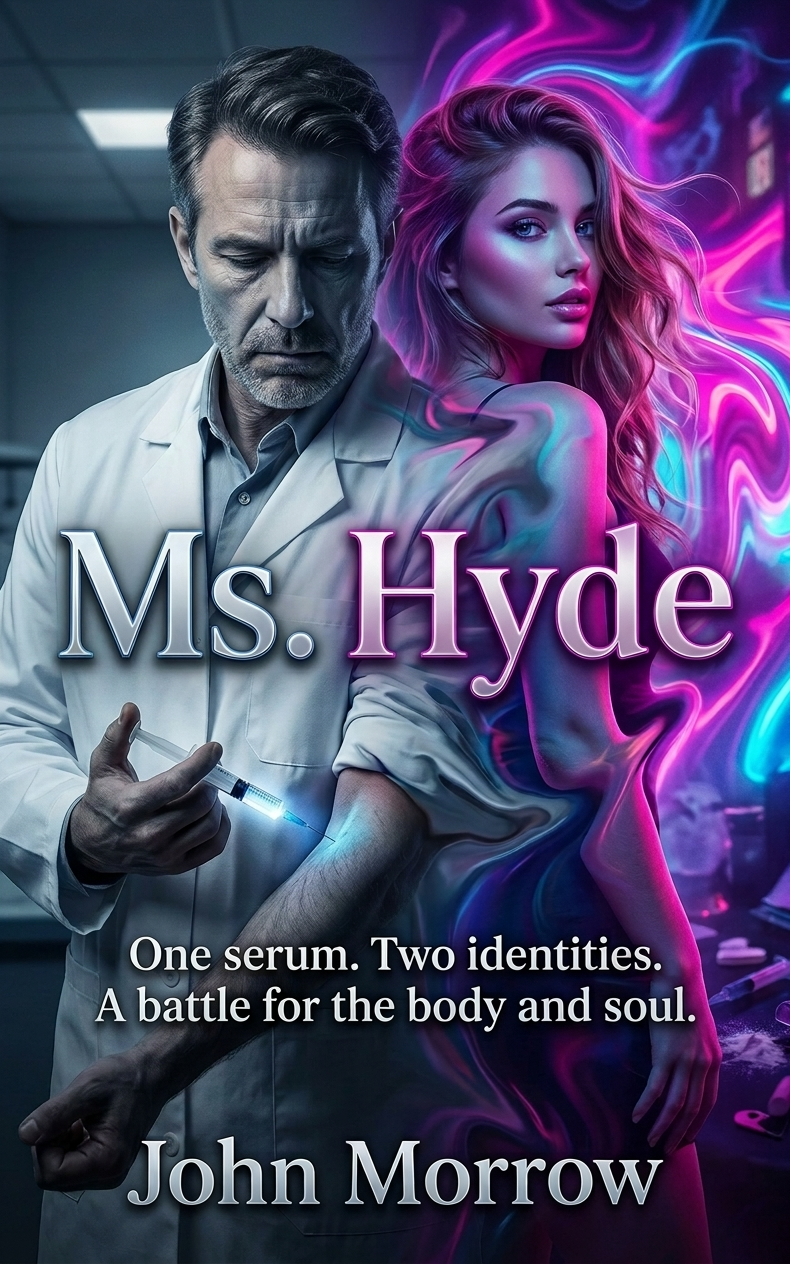
Ms. Hyde
One serum. Two identities. A battle for the body and soul.
by John Morrow
Dr. Henry Jekyll has it all: prestige, a corner office, a lifetime of accolades. But at 52, after a bitter divorce and a brush with death, he feels invisible—fading into irrelevance as younger rivals circle. Desperate for escape, Henry uncovers his late mentor's forbidden research on chemical personality dissociation. He brews a serum to silence his exhaustion and doubts. But the transformation is beyond his wildest dreams—or nightmares. Eden emerges: a stunning, fearless 20-something with a body built for sin and an appetite for every vice the city offers. She dives headfirst into neon-lit raves, designer drugs, and raw, uninhibited sex, living the youth Henry craves. At first, it's a perfect release. But Eden wants more. She resents slipping back into Henry's aging shell. Transformations linger. Memories bleed. And when ambitious colleague Dr. Lila Voss uncovers the lab, the line between man and monster blurs forever. From John Morrow comes a pulse-pounding erotic sci-fi thriller that peels back the terror of midlife, the rush of forbidden youth, and the addiction that devours everything.
- Erotica
- Thriller
- Science Fiction
The Weight of the Lab Coat
Dr. Henry Jekyll paused in the sterile hallway of the Whitaker Institute, his polished loafers silent on the linoleum floor. Fluorescent lights buzzed overhead, casting harsh shadows on the walls lined with framed patents and awards. At fifty-two, he felt every ache in his joints, every subtle sag of skin that no amount of grooming could hide. His tailored suit hung a bit looser now, a silent testament to the weight he'd lost since the divorce.
A door swung open down the hall, and Dr. Lila Voss emerged, her low heels clicking with purpose. She was early forties, compact and sharp, her chestnut bob framing a face that mixed ambition with a practiced smile. She spotted him and veered over, clipboard in hand.
"Henry," she said, her voice smooth with that mid-Atlantic polish. "Still burning the midnight oil on the grant proposal? Your synaptic models were foundational, but the board's leaning toward something more... disruptive these days." Her hazel eyes flicked over him, lingering just long enough to sting. It was flirtatious in tone, but the condescension cut deeper.
He forced a thin smile. "Disruptive often means unproven, Lila. My methods have stood the test of time." His words came out measured, academic, but inside, resentment simmered. She was the rising star, recruited five years back with her flashy AI-brain interface work. Now she nipped at his heels for the senior partner spot, charming the board while he faded into the woodwork.
She laughed lightly, touching his arm. "True enough. But evolution waits for no one. Let's chat over coffee sometime—brainstorm how we can modernize it." She breezed past, leaving a faint scent of citrus perfume.
Henry watched her go, his steel-gray eyes narrowing. A ghost in his own building. He straightened his tie and headed to the boardroom, where the day's meetings waited like a gauntlet.
The conference table gleamed under recessed lighting, surrounded by younger faces—postdocs with fresh PhDs and the kind of energy he remembered from his own thirties. Henry took his seat at the head, but no one deferred to it anymore. The discussion turned to grant allocations, and Lila's voice dominated, pitching her neural tech with buzzwords that made his research sound quaint.
"Henry's approach has merit," she said at one point, her tone gracious, "but integrating real-time adaptive algorithms could accelerate outcomes by thirty percent."
He cleared his throat. "Algorithms without rigorous baseline data lead to artifacts. We've seen it before." A few nods, but mostly blank stares. Sidelined again. The meeting dragged, each minute etching lines deeper into his forehead. By the end, his proposal was tabled indefinitely.
He gathered his papers with steady hands, ignoring the pitying glance from the admin assistant. Outside, the autumn air bit at his pale skin as he walked to his car. The drive home blurred into gray city streets, rain starting to speckle the windshield.
His townhouse loomed at the end of a quiet row, handsome brick facade hiding the emptiness inside. He parked in the garage and entered through the mudroom, the door clicking shut behind him. Silence rushed in like a tide. No clatter of dishes from the kitchen, no murmur of evening news from his ex-wife Claire. She'd left two years ago, her parting words echoing: You're not here, Henry. Even when you are.
He hung his coat and loosened his tie, the house's oversized rooms swallowing his footsteps. The divorce had left financial scars, but worse was the void. His children, both in their twenties, existed at the edges of his life—sporadic texts, obligatory holidays. He pulled out his phone and dialed his daughter Sarah, needing something human amid the quiet.
It rang four times. "Dad?" Her voice was clipped, background noise of a cafe humming.
"Sarah. Just checking in. How's the new job?"
"Busy. Look, can we do this later? Meeting in five."
He gripped the phone tighter. "Of course. Tell your brother I said hello."
"Sure. Bye." Click.
The coldness settled in his chest. Distant, like him. He poured a scotch from the sideboard, the amber liquid glinting under the pendant light. One drink to blunt the edges. He carried it to his study, where boxes from his late mentor's lab waited, stacked against the oak-paneled walls.
Dr. Lanyon had died six months back, a stroke in his sleep. As senior partner, Henry had taken charge of clearing out the old man's abandoned workspace at the institute. Most of it was junk—outdated spectrometers, yellowed notebooks. But duty called, and tonight he unpacked.
He sliced open a dusty box labeled Personal Effects and lifted out an antique desk, mahogany with brass fittings. It fit perfectly in the corner. As he polished it, his fingers caught on a seam in the drawer. A hidden compartment. Heart quickening, he pried it open.
A leather-bound journal slid out, embossed with faded gold letters: The Partition Protocol. Henry's breath caught. Lanyon's handwriting filled the pages, meticulous loops detailing a fringe theory on chemical personality dissociation. "The burdened consciousness," one passage read, "weighed by regret, inhibition, fatigue—can be partitioned from the primal self through targeted neurochemical intervention. A volatile compound isolates these maladaptive clusters, allowing emergence of unencumbered vitality."
Henry's scientific mind raced. Pseudoscience, surely. Lanyon had dabbled in the eccentric, but this bordered on alchemy. Formulas followed: precise ratios of rare neurotransmitters, stabilizers, a shimmering violet precursor. Risks outlined in red ink—synaptic overload, cardiac arrhythmia, permanent dissociation.
He set the journal down and sipped his scotch, the burn steadying him. Yet curiosity flickered, the spark he'd thought extinguished by years of safe research. His hand absently touched the faint scar on his chest from the cardiac event three months prior—a sharp pain during a lecture, monitors beeping in the ER. Doctors called it mild, prescribed statins. But it had cracked something open: mortality, sharp and undeniable.
The evening wore on. He paced the study, rain pattering against the windows. Images assaulted him—Lila's knowing smile, the board's indifference, Claire's empty closet upstairs, Sarah's hurried goodbye. At 11:47 p.m., it hit. A vise clamped his chest, pain radiating down his left arm. He gasped, stumbling to the desk, clutching the journal. Sweat beaded his forehead; vision tunneled. This was it—the real one, not some warning. His heart stuttered, rebelled against the years of neglect, the isolation.
He sank into the chair, breaths shallow. Drugs? No time. The pain crested, then ebbed, leaving him trembling, alive but shattered. He stared at his reflection in the darkened window: gaunt face, graying hair, eyes hollow. If nothing changed, he'd die here—lonely, forgotten, a footnote in journals gathering dust.
The journal lay open, its pages whispering possibility. Henry's pulse steadied, mind sharpening. Lanyon's equipment was in storage at the institute—centrifuges, incubators, vials. Secrecy was paramount; the board would never approve such heresy. But his basement was perfect: soundproofed, separate entrance, power outlets galore.
Decision crystallized. He closed the journal and stood, resolve hardening his features. Tomorrow, he'd requisition the gear under "mentor memorial project." No one would question it. In secrecy, he'd test the protocol—synthesize, calibrate, escape the weight. Not madness, but salvation. A release valve for the man he'd become.
He poured another scotch, smaller this time, and raised the glass to the empty room. To partitions. To whatever primal self waited beneath the surface. Sleep came fitful, dreams laced with violet light and a woman's distant laughter.
The First Drop
Three weeks blurred into a haze of black coffee and sleepless nights. Henry Jekyll worked in the basement laboratory he'd pieced together from Lanyon's salvaged gear. The space was cool and dim, concrete walls lined with humming centrifuges and banks of monitors glowing blue. He'd requisitioned the equipment without raising eyebrows, labeling it a …