

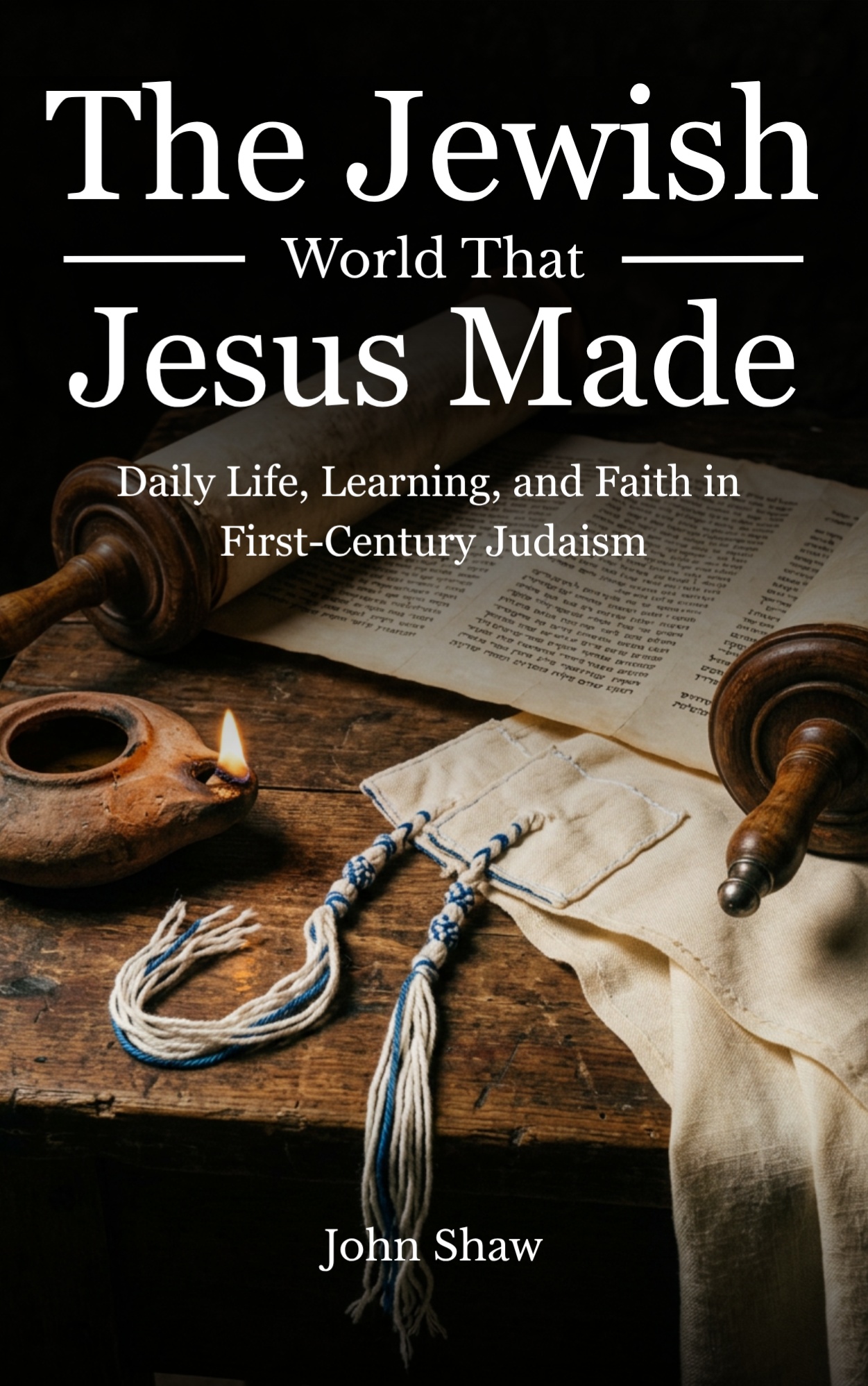
The Jewish World That Jesus Made
Unlocking the First-Century Cultural and Historical Context of the Gospels
by John Shaw
To truly understand the teachings of Jesus, we must first understand the world in which he lived. In The Jewish World That Jesus Made, historian John Shaw takes readers on an illuminating journey through first-century Judea and Galilee. Far from a distant historical backdrop, the daily realities of ancient Jewish life—from synagogue schools and scribal trade to Temple economics and agrarian debt—profoundly shaped every parable, miracle, and sermon recorded in the New Testament. Discover how a rabbi's yoke defined discipleship, why calling working-class fishermen was a radical act, and how ancient two-stage marriage customs illuminate the promise of the Bridegroom. By examining purity laws, covenant hospitality, and sacred pilgrimage feasts, Shaw reveals the rich, layered meanings that the original first-century listeners immediately understood. Deeply researched yet immensely readable, this book bridges the gap between ancient history and modern faith. Step into the vibrant Jewish world of the First Century and experience the Gospels with fresh eyes, deeper clarity, and renewed awe.
- Religion & Spirituality
- Historical Non-Fiction
- Christianity
- Judaism
- Sacred Texts & Scripture
- Ancient History
How Children Learned Torah
In the modern West, education is something that happens in a building. A child leaves home, rides a bus, walks into a school, sits at a desk, and learns. When the bell rings, education is over for the day, and life resumes. For a Jewish child in the first century, no such separation existed. Education was not a place you went. It was the air you breathed.
To understand the world Jesus grew up in—and to hear his words the way his first listeners heard them—you have to understand how deeply Scripture was woven into the fabric of everyday Jewish life, beginning from the moment a child could speak.
The Home as First Classroom
Every Jewish home was, before anything else, a school. The foundation for this was not a cultural preference or a parenting philosophy. It was a command from God himself, embedded in the most important declaration in all of Judaism: the Shema.
The word shema is Hebrew for “hear” or “listen,” and it comes from the opening line of Deuteronomy 6:4: “Hear, Israel! The Lord is our God, the Lord is one!” What follows is not merely a prayer, though it became one of the most recited prayers in Jewish history. In its original context, the Shema is a covenant declaration—a confession of loyalty to the God of Israel and a command to build an entire way of life around his words.
The heart of the command comes in verse 7: “And you shall repeat them diligently to your sons and speak of them when you sit in your house, when you walk on the road, when you lie down, and when you get up.” The Hebrew word translated “teach diligently” carries the idea of sharpening, impressing, or engraving. This was not casual instruction. It was repeated, intentional, and relentless—the kind of teaching that etches words into a child’s memory so deeply they become part of who the child is.
The great medieval rabbi Rashi, commenting on this verse, made two observations that reveal how seriously Jewish tradition took this command. First, he noted that “teach them diligently” implies the words should be so sharp in the student’s mind that if someone asks a question, the student can answer immediately and clearly—not vaguely, not eventually, but with precision. Second, Rashi expanded the meaning of “your children” to include students, not just biological offspring. In doing so, he reflected a tradition that saw every act of teaching as a sacred extension of the command God gave at Sinai.
The Shema was recited twice daily—morning and evening—as a declaration of faith and covenant identity. But it was also embedded in the physical space of the home. Deuteronomy 6:9 commanded the words to be written on the doorposts of the house, which gave rise to the mezuzah, a small scroll affixed to the doorframe as a visible reminder that this household belonged to God and lived under his word. Deuteronomy 6:8 led to the practice of wearing tefillin—small leather boxes containing Scripture, strapped to the arm and forehead during prayer. The Shema worked on every level: spoken devotion, household formation, and embodied ritual.
Jewish tradition held that as soon as a child could speak, the father was to begin teaching him two foundational verses: Deuteronomy 33:4 (“Moses commanded us a law, an inheritance for the assembly of Jacob”) and the Shema itself. These were among the very first words a Jewish child would learn to say. Before a child knew how to tie a sandal or count coins, he was learning to declare the oneness of God and the centrality of Torah.
The Talmud, in tractate Kiddushin 29a, lays out a father’s obligations to his son: circumcise him, redeem him if he is a firstborn, teach him Torah, find him a wife, and teach him a trade. Some authorities added a sixth: teach him to swim. The list is striking for what it reveals about priorities. Teaching Torah comes before finding a career. A child’s identity in the covenant community comes before his economic usefulness. And the inclusion of swimming—because “his life may depend on it”—shows a remarkably practical streak alongside the spiritual intensity. This was not an abstract, ivory-tower education. It was preparation for real life in a dangerous world, anchored in the conviction that knowing God’s word was the most important skill a person could possess.
From Home to Synagogue: The Stages of Learning
Around age five or six, a Jewish boy would begin formal education at the local synagogue in a setting called Bet Sefer, which means “House of the Book.” The teacher, often called the hazzan or a designated instructor, would lead a small group of boys through the Torah—the first five books of Moses—with an emphasis on reading, reciting, and memorizing.
The method was oral and repetitive. The teacher would read a passage aloud; the students would repeat it back, again and again, until the words were fixed in memory. Ancient sources describe the sound of children reciting Scripture as a kind of “chirping” that could be heard throughout the village—a daily soundtrack of young voices absorbing the words of God. There were no textbooks and few families owned personal scrolls. The text lived in the community’s shared memory, passed from mouth to ear to mouth again.
By the time a boy completed this stage—roughly age ten—he would have memorized substantial portions of the Torah. The tradition recorded in the Mishnah, in Pirkei Avot 5:21, maps out an idealized progression: “At five years old, the study of Scripture. At ten, the study of Mishnah. At thirteen, subject to the commandments. At fifteen, the study of Talmud.” While this likely reflects a later, more formalized system than what existed uniformly across all first-century villages, it captures the principle: education was staged, cumulative, and built on a foundation of memorized Scripture.
The next stage, sometimes called Bet Talmud or Bet Midrash (“House of Study” or “House of Learning”), was not open to everyone. Only the most capable students continued. Here, the focus shifted from memorization to interpretation. Students learned to ask questions, to debate meaning, to engage with the oral traditions that surrounded the written Torah. The method was dialogical—teachers posed questions, students answered, and the back-and-forth sharpened both understanding and rhetoric.
Most boys, however, did not continue past the elementary stage. By age ten or twelve, the majority returned home to learn the family trade alongside their fathers. This was not considered a failure. It was the normal, expected path. A boy who came home to work as a fisherman, a carpenter, or a farmer had still spent years immersed in Scripture. He could recite the Torah, knew the great stories of Israel’s history, and understood the rhythms of prayer and Sabbath. He was, by any modern standard, remarkably well-versed in his faith—even if the religious establishment would not have considered him a scholar.
The few who showed exceptional promise might eventually seek out a rabbi for advanced study—but that story belongs to the next chapter.
Synagogue Life Beyond the Classroom
The synagogue was more than a school. It was the center of communal life — the place where a Jewish village gathered each Sabbath to hear the word of God read aloud, discussed, and applied.
A typical Sabbath synagogue gathering followed a recognizable pattern. It opened with the recitation of the Shema and a series of prayers and blessings. Then came the central act: the public reading of Scripture. A portion of the Torah was read aloud from a handwritten scroll — the reader standing, as a sign of reverence for God's word. In many communities, the Hebrew text was followed by a translation into Aramaic, the common spoken language, so that everyone in the room could understand what was being read. After the Torah reading, a corresponding passage from the Prophets — called the haftarah, meaning "completion" — was also read. The service then opened for teaching: a qualified member of the congregation, or a visiting teacher, could offer a brief exposition connecting the readings and drawing out their meaning for the community.
This is exactly what we see Jesus doing in Luke 4:16–21. Luke tells us that Jesus went to the synagogue in Nazareth "as was His custom" — a detail confirming that weekly synagogue attendance was a normal part of his life. He stood up to read, was handed the scroll of Isaiah, found the passage he wanted, read it aloud, then sat down — because in that culture, a teacher sat to deliver his exposition. Every eye in the room was on him. What he said next — "Today this Scripture has been fulfilled in your hearing" — was explosive not because the setting was unusual, but because the claim was. The setting was perfectly ordinary. A Jewish man, in a Jewish synagogue, on the Sabbath, reading from the Prophets and offering his interpretation. The format was one every person in that room had experienced hundreds of times. What stunned them was the content.
Understanding the synagogue also explains why being expelled from one was devastating. When John's Gospel records that some Jews were afraid to confess Jesus publicly because they feared being "put out of the synagogue" (John 9:22), the threat was not merely religious. It was social, economic, and communal. To lose your place in the synagogue was to lose your place in the community — your network, your support system, your identity as a member of the covenant people. It was, in a village-sized world, a form of social death.
The synagogue was where the education described earlier in this chapter came to life in communal practice. The child who had memorized Torah at home and recited it in Bet Sefer would grow up to hear those same words read aloud every Sabbath, discussed by teachers, and applied to the questions of ordinary life. Scripture was not something you studied once and set aside. It was a living conversation that continued, week after week, year after year, in the same room, among the same people, for an entire lifetime.
The Scribes - Guardians of the Written Word
While children memorized Torah through recitation and communities heard it read aloud each Sabbath, someone had to preserve the physical text itself. That task fell to the scribes — and the labor involved was extraordinary.
A scribe, known in Hebrew as a sofer, was not simply a copyist. He was a trained specialist whose work was considered sacred. Copying a Torah scroll was one of the most demanding and exacting tasks in Jewish life. The Torah contains 304,805 Hebrew letters, and every single one had to be written by hand, in ink, on specially prepared parchment made from the skin of a kosher animal. The scribe could not work from memory. He was required to copy letter by letter from an existing verified scroll, speaking each word aloud before writing it — a practice designed to engage both the eye and the ear as safeguards against error.
The rules governing the work were remarkably precise. If a single letter was malformed, missing, or touched an adjacent letter, the entire section could be rendered invalid. If the scribe made an error while writing one of the sacred names of God, the mistake could not simply be corrected — the parchment had to be set aside and buried with the reverence given to a damaged scroll. The ink had to be black and durable. The spacing between letters, words, and sections followed prescribed patterns. The process of completing a single Torah scroll could take a year or more of full-time work.
The result of this painstaking tradition is one of the most remarkable facts in textual history. When scholars compare Torah scrolls from Jewish communities separated by centuries and thousands of miles — scrolls from Yemen, Europe, North Africa, and the Middle East — the texts are virtually identical. The worldwide agreement rate across all known Torah scrolls is astonishing, with only a handful of letters in dispute across the entire text. The scribal tradition did not just preserve the Torah. It transmitted it with a level of accuracy that has no parallel in the ancient world.
This is the context that makes Jesus' statement in Matthew 5:18 land with its full weight: "For truly I say to you, until heaven and earth pass away, not the smallest letter or stroke of a letter shall pass from the Law, until all is accomplished!" When Jesus spoke of the "smallest letter" — the yod, the tiniest character in the Hebrew alphabet — and the "least stroke of a pen" — the keri'ah, the small decorative serif that distinguishes one letter from another — he was speaking to an audience that understood exactly what it took to preserve those letters. They had watched scribes labor over every stroke. They knew that entire scrolls were invalidated over a single imperfection. Jesus was not making a casual metaphor. He was affirming, in the most culturally loaded terms available, that the word of God had been preserved down to its smallest detail — and that not one piece of it would fail.
The scribes also functioned as legal experts and interpreters of the law, which is why they appear so frequently in the Gospels alongside the Pharisees. When Jesus warned about "the scribes who devour widows' houses" (Mark 12:40), he was speaking about men who held enormous social authority — men trusted with preserving and interpreting the very words of God, who had leveraged that trust for personal gain. The indictment was severe precisely because the responsibility was sacred.
What Western Readers Miss
For a modern Western reader, several things about this system are surprising, even disorienting. First, the sheer volume of memorization. A Jewish boy who completed Bet Sefer had committed to memory far more Scripture than most modern seminary graduates encounter in three years of professional training.
The entire Torah—Genesis, Exodus, Leviticus, Numbers, Deuteronomy—was not a reference book sitting on a shelf. It was internalized, carried in the mind and heart, available for recall at any moment. When Jesus quoted Scripture during his temptation in the wilderness or in debates with the Pharisees, he was doing what any well-educated Jewish man could do. The difference was not access to the text but the authority and insight with which he deployed it.
Second, education was communal, not individual. A child did not learn alone with a tutor in a private room. He learned alongside other children in the synagogue, surrounded by a village that shared the same texts, the same prayers, the same stories. The entire community was, in a sense, the classroom. When Josephus, the first-century Jewish historian, wrote about his people, he boasted that “our principal care of all is this, to educate our children well; and we think it to be the most necessary business of our whole life to observe the laws that have been given us.” He was not describing an elite practice. He was describing a cultural identity.
Third, the goal of education was not information but formation. A modern school asks: what does this child know? A first-century Jewish community asked: what kind of person is this child becoming? The Torah was not merely content to be mastered. It was a way of life to be inhabited. The Shema’s command to teach “when you sit, when you walk, when you lie down, when you rise” envisions an education that never stops, because the formation of a human soul is not a project with a completion date.
This is why the story of the twelve-year-old Jesus in the Temple is so revealing. Luke tells us that when Mary and Joseph found him after three days of searching, he was “sitting in the midst of the teachers, both listening to them and asking them questions. And all who heard Him were astonished at His understanding and answers.” He was doing exactly what a bright Jewish boy at the transition between elementary
Torah study and more advanced learning would do—engaging with learned teachers through the question-and-answer method that defined Jewish education. The teachers were not amazed that a boy was asking questions. They were amazed at the depth and quality of his engagement. Jesus was a product of this educational world—and at the same time, he was something far more than it had ever produced.
For Western readers accustomed to thinking of Jesus as a wandering preacher who appeared out of nowhere with a message, this background changes everything. He grew up in a culture that prized the word of God above all else, that drilled it into children from infancy, that measured a person’s worth not by wealth or status but by knowledge of and faithfulness to the Torah. When Jesus opened his mouth to teach, he was not introducing something foreign. He was speaking the language his listeners had been learning since before they could walk.
Understanding this is the first step toward hearing the Gospels the way the first audiences heard them—not as abstract theology delivered to blank slates, but as the words of a rabbi who emerged from the richest educational tradition the ancient world had ever produced.
Rabbis, Disciples, and the Meaning of “Follow Me”
When a modern reader encounters the moment in Mark’s Gospel where Jesus walks along the shore of the Sea of Galilee, sees Simon and Andrew casting their nets, and says “Follow me”—and they immediately drop everything and go—it can seem impulsive, even reckless. Two grown men abandon their livelihood on the spot because a stranger issues a two-word …