

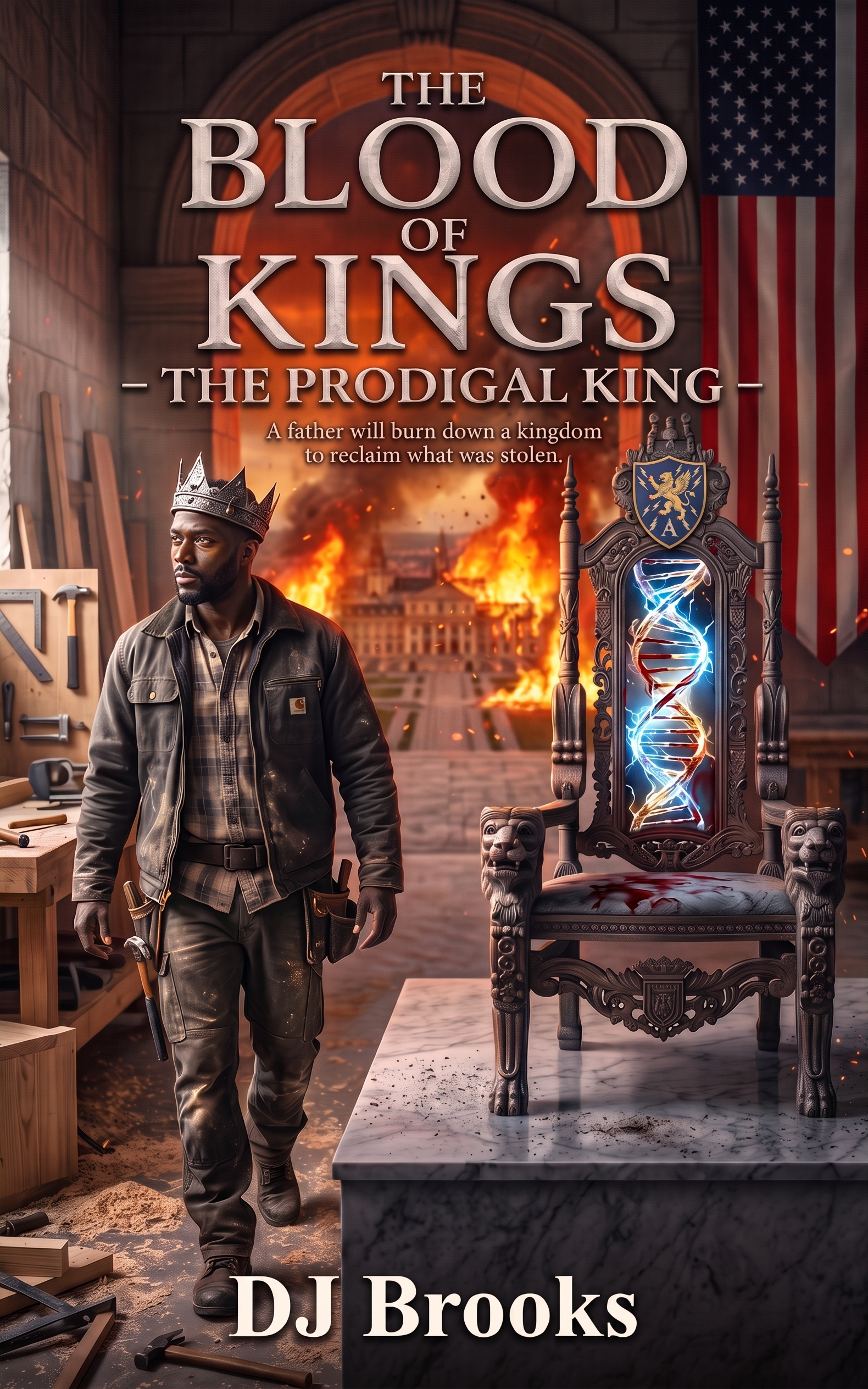
The Blood of Kings - The Prodigal King
A father will burn down a kingdom to reclaim what was stolen.
by DJ Brooks
Fifteen years ago, Prince Lincoln Ashford walked away from a throne built on lies. But when a suspicious plane crash claims his father and brother, the exiled prince is dragged back to a New Washington he no longer recognizes. The North America that rose from the Century of Ash is a golden cage of constitutional monarchy and lethal secrets. Lincoln soon discovers his family’s bloodline holds more than just a title. It carries Royal Blood Lightning—a rare genetic marker that has made his hidden sons targets of a terrifying hunt. From the elite Brownstone family to the mysterious Covenant of Ascension, shadow forces are harvesting the gifted to fuel their own rise. When his son Nehemiah is snatched by the state’s own guards, Lincoln realizes he can’t just be a king; he must be a commander. To save his children and purge the corruption rot within the empire, he must embrace the very power he once feared. In a world where blood is currency and loyalty is a death sentence, the hunt is on—and a king’s wrath knows no bounds.
- Science Fiction
- Thriller
- Dystopian
- Genetic Engineering
- Political Thriller
- Conspiracy Thriller
Prologue: The Fall And Rise
The history books would later call it "The Century of Ash"—those hundred years between 2400 and 2500 when the United States of America burned, bled, and was reborn from its own ruins into something unrecognizable to the founders who had once dreamed of a democratic republic. It began not with a declaration of war, but with silence.
On the morning of March 15th, 2401, President Marcus Whitfield was found dead in the Lincoln Bedroom, a single puncture wound behind his left ear so precise that the Secret Service initially believed he had died of natural causes. It wasn't until the bombs began falling six hours later that anyone understood the truth: the war had already begun, and America had lost its first battle before it even knew it was fighting.
The coordinated strikes came at 3:47 PM Eastern Standard Time. Washington, D.C. was first—a series of explosions that turned the Capitol Building into a crater and sent a mushroom cloud of marble dust and human ash into the spring sky. New York followed seventeen minutes later, then Los Angeles, Chicago, Houston, Kansas City, Miami, and Denver in rapid succession. The attacks were surgical, devastating, and perfectly timed to coincide with peak population density in each city's downtown core. By nightfall, an estimated 47 million Americans were dead.
The Mexican Intelligence Service had spent fifteen years infiltrating every level of American government and infrastructure. Their agents had posed as janitors, interns, mid-level bureaucrats, and even Secret Service personnel. They had mapped every weakness, identified every vulnerability, and when the moment came, they struck with the precision of a surgeon's scalpel cutting out a cancer mass. Vice President Jonathan Thompson was in Colorado Springs when the bombs fell, touring NORAD's Cheyenne Mountain Complex in what historians would later recognize as either extraordinary luck or careful planning by those who wanted him to survive. He was sworn in as President in an underground bunker, his right hand on a Bible held by a trembling Air Force chaplain, his left hand clenched in a fist so tight his knuckles had gone white.
"We will respond with the full might of the American military," Thompson declared in his first address to what remained of the nation, broadcast from the bunker on every available frequency.
"We will make them pay for every American life lost. We will—"
He never finished that sentence. The feed cut out as the first wave of ground troops crossed the borders. Ten million soldiers poured into the United States from the north and south. The Canadian forces, bolstered by their alliance with Mexico and Cuba, swept down through Montana, North Dakota, Minnesota, and Michigan with a speed that shocked military analysts. They had been planning this for decades, building up their forces in secret, training in the frozen wastes of the Northwest Territories for a war everyone thought would never come. From the south, Mexican and Cuban forces advanced through Texas, New Mexico, Arizona, Louisiana, Alabama, Florida, and California. They moved like a tide, overwhelming the scattered and disorganized American military units that tried to mount a defense.
The destruction of the major port cities had crippled America's ability to resupply or reinforce its positions. The death of most of the government's leadership had created a command structure that existed only in theory.
President Thompson called for help. He reached out to the European Union, to the Asian Coalition, to the African Federation, to anyone who would listen. No one answered.
The international community had turned its back on America years before the first bomb fell. The litany of crimes was long and damning: the mass incarceration programs that had turned entire cities into prison camps, the forced labor initiatives that had essentially reinstated slavery under a different name, the brutal suppression of dissent that had seen thousands of journalists, activists, and ordinary citizens disappeared into black sites scattered across the country.
The United Nations had issued seventeen separate resolutions condemning American human rights violations. The International Criminal Court had indicted twelve sitting members of Congress and four Cabinet secretaries. Economic sanctions had been imposed, then strengthened, then expanded until the American economy was choking under the weight of international isolation.
And then came the reparations. Like Germany after the First World War, America was forced to pay. The victims of its human rights abuses—primarily Black Americans who had suffered under the new Jim Crow laws that had been enacted in the 2380s—received compensation that bankrupted the federal government. Foreign nations that had been damaged by American military adventurism received their due. Veterans who had been abandoned by the VA system received back pay and benefits that should have been theirs all along.
It was just, it was necessary, and it destroyed the country. The Great Depression of the 2390s made the economic collapse of the 1930s look like a minor recession. Unemployment reached 67%. The dollar became worthless. Hyperinflation meant that a loaf of bread cost a million dollars one week and ten million the next. Banks failed. Businesses closed. The social safety net, already threadbare, disintegrated entirely.
And then Americans began killing each other. It started small—a father shooting his son over a can of beans, a neighbor poisoning another neighbor's well, a town turning on the refugees who had fled from the bombed-out cities. But violence has a way of metastasizing, of spreading like cancer through the body politic until it consumes everything.
The Second American Civil War wasn't like the first. There were no clear battle lines, no Union versus Confederacy, no grand armies marching to the sound of drums. It was chaos—pure, unfiltered, anarchic chaos. Militias formed and dissolved. Warlords rose and fell. Entire regions became no-go zones where the only law was the law of the gun.
Historians estimate that 89 million Americans died in the Second Civil War, though the true number will never be known. Entire towns were wiped off the map. Cities became graveyards. The infrastructure that had once made America a superpower—the roads, the bridges, the power grid, the water systems—crumbled into ruin.
And while Americans were busy killing each other, the invaders were consolidating their hold on the territory they had seized.
For fifty years, the North American War raged across the continent. Canada and Mexico, initially united in their conquest of the United States, soon turned on each other as the question of who would control the conquered territory became paramount. Cuba, seeing an opportunity, allied itself with Mexico and turned the conflict into a three-way struggle for dominance.
The American people, those who survived, found themselves caught in the middle of a war that wasn't theirs but was being fought on their land. Cities that had been rebuilt were destroyed again. Farms that had been replanted were burned. Children who had been born in the chaos grew up knowing nothing but war.
But something remarkable happened in those fifty years of horror: the American people remembered who they were.
A resistance formed, scattered and disorganized at first, but growing stronger with each passing year. They called themselves the New Continental Army, and they fought with a ferocity born of desperation and rage. They used guerrilla tactics, hit-and-run attacks, sabotage, and assassination. They made the occupiers pay for every mile of American soil they held.
And they remembered the submarines. In the chaos of the initial invasion, twelve Ohio-class nuclear submarines had slipped away from their bases and disappeared into the depths of the Atlantic and Pacific. Their crews, cut off from command and uncertain of what orders to follow, had maintained radio silence and waited. They waited for fifty years. When the signal finally came—a coded transmission from the remnants of the American government that had been hiding in the Rocky Mountains—the submarine commanders faced an impossible choice. The orders were clear: launch a full-scale nuclear strike against Mexico City, Toronto, and Havana. End the war with fire and radiation. Commander Sarah Chen of the USS Pennsylvania was the first to turn her key. "God forgive us," she whispered as the missiles launched.
The nuclear strikes killed an estimated 200 million people in the span of three hours. Mexico City was vaporized. Toronto became a radioactive crater. Havana simply ceased to exist.
The war ended not with a peace treaty but with a surrender so complete and unconditional that it redrew the map of North America entirely. Canada, Mexico, and Cuba—what remained of them—were absorbed into the United States adding an addition of 70 new states to union. Guam and Puerto Rico, having achieved statehood seventy years earlier during a brief period of American imperial expansion, brought the total to 120 stars on a flag that now represented a nation that stretched from the Arctic Circle to the Caribbean.
But the United States that emerged from the Century of Ash was not the democratic republic that had existed before. It couldn't be. The old system had failed catastrophically, had led to corruption, abuse, and ultimately to the near-destruction of the nation itself.
What rose from the ashes was something new, something that would have horrified the Founding Fathers but that the exhausted, traumatized survivors embraced with desperate hope: a constitutional monarchy.
The Ashford family had led the resistance during the darkest years of the occupation. Edward Ashford, a former Army colonel who had survived the bombing of Denver, had united the scattered rebel groups under a single banner. His wife, Kennedi, a former federal judge, had provided the legal and philosophical framework for what would become the new government. Their eldest son, Louis, had been a brilliant military strategist who had planned many of the resistance's most successful operations.
When the war ended and the question of who would lead the reunified nation arose, there was surprisingly little debate. The Ashford had proven themselves in fire and blood. They had sacrificed everything for the country. They had earned the right to rule.
For five hundred years, the Ashford family had ruled the United Republic of North America with an iron grip wrapped in velvet—a dynasty built on careful alliances, strategic marriages, and the delicate balance of power shared among five great families. The Ashford's wore the crown, but they did not rule alone. The Brownstones, Johnsons, Flaughtons, and Brighton-Bauers formed the invisible architecture of governance, their influence woven so deeply into the fabric of the state that to separate them from the throne would be to unravel the nation itself.
The modern era of Ashford rule began in 2602, when King Edward, weary from decades of service and sensing the winds of change, stepped down from the throne in favor of his son, Louis. It was a peaceful transition, rare in the annals of history, and it set a precedent that would echo through the centuries. King Louis proved himself to be a capable ruler, guiding the nation through a century of unprecedented technological advancement and territorial consolidation. When he abdicated in 2702, passing the crown to his son Edmunds, few could have predicted the darkness that would follow.
King Edmunds' reign began with promise. He was charismatic, intelligent, and seemingly committed to the progressive ideals his father had championed. But power, as it so often does, revealed the fractures in his character. Fifty years into his rule, the carefully constructed facade crumbled. An international human trafficking scandal erupted—a web of corruption so vast and so vile that it shook the foundations of the monarchy. The details, when they emerged through a massive data breech and leakage of videos and documents, were damning. There were multiple networks spanning continents, complicity at the highest levels, and the King's own signature on documents that could not be explained away.
The five families moved swiftly. In a closed-door session that lasted three days, they deliberated the fate of the crown. Edmunds was forced to abdicate, and his eldest twin son—also named Edmunds, who would become King Edmunds II—ascended to the throne amid a storm of public outrage and institutional crisis. It was a desperate gambit to preserve the dynasty, a hope that the son might redeem the father's sins.
King Edmunds II married Queen Victoria, a woman of considerable political acumen and ambition. Together, they sought to rebuild the monarchy's tarnished reputation. Victoria, in particular, cultivated a relationship with the Brownstone family, one of the five great houses known for their pioneering work in medical technology and biotechnology. She brokered deals that brought Brownstone innovations into the public sphere, funding research that promised to extend human life, cure previously incurable diseases, and push the boundaries of what it meant to be human. On the surface, it seemed like enlightened governance—a queen using her position to advance the common good.
But beneath the surface, something far more sinister was taking root. The deals Victoria struck with the Brownstones were not merely about medical advancement. They were backdoor arrangements that compromised national security, violated retribution agreements with foreign powers, and created dependencies that threatened the sovereignty of the Republic itself. King Edmunds II, whether through willful participation or willful ignorance, allowed these arrangements to flourish. For fifty years, the rot spread.
By 2802, the nation teetered on the brink. Civil unrest simmered in the provinces. Foreign powers, sensing weakness, began to test the Republic's borders and resolve. The threat of global war loomed like a thunderhead on the horizon. The five families, watching the crisis unfold, knew they could not allow another scandal to destroy the monarchy—and with it, the delicate power-sharing arrangement that had kept the Republic stable for three centuries.
In an unprecedented move, they withdrew their support from King Edmunds II and threw their considerable weight behind his twin brother, Francis. It was a calculated risk, a bet that blood alone might not determine fitness to rule. Francis Ashford, who had spent his life in his brother's shadow, suddenly found himself thrust into the light. The transition was swift, almost surgical. Edmunds II and Victoria were removed from power, their fates sealed by the very families that had once elevated them.
King Francis Ashford took the throne in 2802, and what followed was nothing short of remarkable. Where his brother had been reckless, Francis was cautious. Where Edmunds II had been secretive, Francis was transparent—at least as transparent as any monarch could afford to be. He rebuilt relationships with foreign powers, rooted out the corruption that had metastasized under his brother's rule, and restored a measure of faith in the institution of the crown. His reign stretched across two centuries, the longest in Ashford history, a testament to his political skill and the genuine support he cultivated among both the five families and the people.
Francis and Catherine had five children: two sons and three daughters. Ashton, the eldest son, was groomed from birth to inherit the throne—intelligent, charismatic, committed to public service, and beloved by the people, yet kept at a careful distance from them, untouchable behind the palace walls. Then came Mira, the eldest daughter, followed by Leah and Shellbie. And finally, Lincoln, the youngest son and youngest of all the siblings.
Lincoln possessed the same intelligence, the same charisma, the same deep commitment to public service that defined his elder brother. But where Ashton had been shaped by tutors and protocol, Lincoln had chosen a different path entirely. He lived among the citizens of the United Republic, not in gilded halls but in the streets and neighborhoods where ordinary people struggled and hoped and built their lives. He was independent, self-determined, driven by an empathy that could only come from genuine experience rather than abstract study.
This choice—to walk among his future subjects as one of them rather than above them—had made Lincoln beloved in ways Ashton, for all his virtues, could never be. Lincoln understood hunger, frustration, aspiration. He knew the Republic not as a map or a set of statistics, but as a living, breathing reality.
His relatability made him a trusted figure among the people—a bridge between the palace and the streets. The Ashford’s and the Brighton-Bauers saw value in this connection, a way to maintain the dynasty's legitimacy in an age when citizens demanded more than distant royalty. But the other families—the Brownstones, the Johnsons, the Flaughtons—saw only danger. They had built their power on mystique, on being untouchable, unreachable, feared. Lincoln threatened that carefully constructed distance.
The friction began as whispers in council chambers, pointed remarks at state dinners. Lincoln volunteered at food drives while his parents entertained foreign dignitaries. He helped build homes in struggling districts while Ashton studied constitutional law. He provided financial education to families drowning in debt while the five families calculated their investments. To Francis and Catherine, their youngest son was becoming an embarrassment. To Ashton, he was becoming a problem. Lincoln was increasingly labeled the rebel child of the Ashford family—well-meaning, perhaps, but dangerously naive.
The friction simmered for years, a low heat that everyone pretended not to feel.
Then came Egypt.
Lincoln was given a command—eliminate a threat to Republic security. The intelligence briefing had been clear: a Fifth Blood carrier embedded in the ruins of Cairo, a threat to national and world security. The kind of threat that required immediate neutralization. Lincoln went without question, trained and capable, ready to serve his nation and his family.
But when he arrived, when he sifted through the intelligence and followed the coordinates to a collapsed apartment building in a devastated neighborhood, he found no terrorist cell, no weapons cache, no armed insurgent.
He found a three-year-old boy.
The child sat in the rubble, covered in dust and blood, crying for parents who would never answer. His small hands clutched at the bodies beside him—a man and a woman, presumed dead, their faces peaceful despite the violence of the building's collapse. And when the boy looked up at Lincoln through his tears, his eyes glowed white-blue in the darkness.
Fifth Blood. The rarest marker. The thing Lincoln had been sent to eliminate.
The cruel irony wasn't lost on him. He'd been sent to kill a threat to national security, and he'd found a terrified child sitting next to his dead parents, glowing eyes marking him as something the Empire feared.
Lincoln didn't hesitate. He pulled the child from the debris, held him close, and made a choice that would define the rest of his life. He adopted the boy. Brought him home. He asked him his name and the child spelled out the name Remmy in Arabic. Lincoln translated it and called him that from now on. Loved him as if he was his own biological son.
For two years, Lincoln raised the child in defiance of protocol, in defiance of his family's cold disapproval. He built a life around that boy—a life that felt real, purposeful, untainted by the politics and calculation that poisoned everything else in the palace. For two years, he was happy.
And then his parents took the boy away.
It happened on a Tuesday morning. Lincoln was reading to Remmy in the nursery—a story about a knight who saved a kingdom—when he heard the footsteps in the corridor. Heavy. Military. Wrong.
The door opened without a knock.
Royal guards. Six of them. Captain Elias at the front, his face carved from stone, his eyes refusing to meet Lincoln's.
"Your Highness," Elias said, his voice flat and professional. "By order of Queen Catherine Ashford and King Francis Ashford, we are here to take custody of the minor child known as Remmy."
Lincoln stood slowly, placing himself between the guards and his son. "What order? I've received no notification. No hearing. No—"
"The decree was issued under royal seal," Elias interrupted. He held out a document—thick parchment, red wax seal, signatures at the bottom. Catherine's elegant script. Francis's bold strokes. Both of them. Together. "It is effective immediately."
Lincoln snatched the document, his hands shaking as he read. The words blurred together, but certain phrases leaped out with brutal clarity:
...poses unacceptable risk to national security...
...Fifth Blood carrier requires specialized containment and study...
...Prince Lincoln Ashford is hereby forbidden from any contact, communication, or attempt to locate said minor...
...violation of this decree constitutes treason against the crown...
"No." Lincoln's voice was barely a whisper. "No, you can't—this is my son. He's my son."
"Your Highness, please step aside."
"He's four years old! He's a child!"
Behind him, Remmy began to cry. He'd been quiet until now, watching with those glowing white-blue eyes, but now the fear broke through. "Papa? Papa, what's happening?"
Lincoln turned, kneeling beside the boy, pulling him close. "It's okay, buddy. It's going to be okay. I won't let them—"
Hands grabbed Lincoln's shoulders. Strong hands. Trained hands. They pulled him back, away from Remmy, and Lincoln fought—God, he fought—but there were six of them and they were armored and trained and he was just a man who'd spent two years learning to be a father.
"Papa!" Remmy screamed, reaching for him, his small hands grasping at air. "Papa, don't let them take me! Please! Please!"
"Remmy!" Lincoln's voice broke. "I'm coming for you! I promise! I'll find you!"
But the guards were already lifting the boy, carrying him toward the door. Remmy was sobbing, thrashing, his eyes glowing brighter with terror and confusion. "Papa! I want my papa!"
"The child will be placed in a secure facility for his welfare and the welfare of the nation," Elias said, his voice still flat, still professional, as if he were reading from a script. "The location is classified. Any attempt to discover or access this location will be considered an act of treason."
Lincoln stopped fighting. Not because he wanted to. But because the words finally penetrated through his rage and grief.
Treason.
His own parents had made it treason to search for his son.
They'd planned this. Calculated it. Made it impossible for him to fight back without destroying himself and, by extension, any chance of ever seeing Remmy again.
The guards released him. He collapsed to his knees on the nursery floor, surrounded by toys and books and the life he'd built, and watched them carry his screaming son down the corridor.
Remmy's cries echoed through the palace. "Papa! Papa, please! Don't leave me!"
And then the door closed.
Silence.
Lincoln knelt there for hours. Or maybe minutes. Time had stopped meaning anything.
When he finally stood, when he finally walked to his parents' private chambers, he found them waiting. Catherine in her chair by the window. Francis standing by the fireplace. Both of them calm. Composed. As if they hadn't just ripped his world apart.
"How could you?" Lincoln's voice was raw. "He's a child. He's my child."
"He's a weapon," Catherine said quietly. "And you were too blind to see it."
"He's four years old!"
"He's Fifth Blood," Francis said. "The rarest and most dangerous genetic marker we've ever identified. Do you have any idea what the other families would do if they knew we were harboring him? What foreign powers would do?"
"So you took him. You made it treason for me to find him."
"We made it survivable," Catherine said. "For you. For him. For the nation."
Lincoln stared at them—these people who'd raised him, who'd taught him about duty and honor and sacrifice—and saw strangers.
"I will never forgive you for this," he said.
"We know," Catherine replied. "But you'll understand. Someday."
He didn't understand. Not that day. Not the next. Not during the year he spent searching—calling in every favor, following every lead, bribing officials and threatening bureaucrats and begging anyone who might know where they'd taken his son.
Every door closed. Every lead went nowhere. The five families had made sure of it.
Remmy had vanished as completely as if he'd never existed.
And Lincoln—Crown Prince, heir to the throne, son of the most powerful family in the empire—was powerless to find him.
It broke him.
The argument that followed was volcanic. Words were said that could never be unsaid, truths spoken that shattered whatever fragile bonds had remained. Catherine called him reckless. Francis called him a liability. Ashton said nothing, but his silence was its own condemnation. When Lincoln left that room, a canyon had opened between him and his family—vast, unbridgeable, permanent.
He spent a year searching for the boy. Every lead went nowhere. Every door closed in his face. The five families had made sure of it.
Desperate, grieving, Lincoln turned his focus elsewhere. If he couldn't save one child, perhaps he could save thousands. He threw himself into policy work, into systemic reform, into the kind of structural change that could prevent other families from suffering what he had suffered. The royal family and council initially thought that Lincoln had changed and understood what his purpose was now as a royal. This was good in their eyes until they saw, read, and heard about what he was speaking and writing. He drafted proposals. He built coalitions. He spoke truth to power in ways that made the council deeply, dangerously uncomfortable.
And then, on a cold evening in March, Lincoln appeared on television—broadcast live across the Republic and to the world beyond—and did the unthinkable.
He named his son.
"His name is Remmy," Lincoln said, his voice steady despite the tremor in his hands. "He's four years old. I rescued him from the ruins of Cairo when he was three. I adopted him. I loved him. And my parents—King Francis Ashford and Queen Catherine Ashford—took him from me without warning, without trial, without any legal justification beyond a secret decree that made it treason for me to search for him."
The cameras captured everything. The raw grief in his eyes. The controlled fury in his voice. The way his jaw tightened when he said his parents' names.
"This isn't an isolated incident," he continued. "For decades, the five families have used child separation as a tool of political control. They identify children with genetic markers they consider valuable or threatening, and they remove them from their families. They place them in facilities. They experiment on them. They erase their identities. And they do it all under the protection of laws they wrote, enforced by courts they control, justified by a system designed to protect their power rather than our people."
He leaned forward, his hands gripping the podium.
"I'm not speaking theoretically. I'm speaking as a father whose son was stolen by his own family. I'm speaking about Remmy, who cried for me as royal guards carried him away. I'm speaking about the hundreds—maybe thousands—of other children who've disappeared into this system. And I'm asking the question no one is supposed to ask: Who gave the five families the right to destroy families? What accountability exists for these crimes? Why should any citizen trust a government that operates in shadows, that values genetic control over human dignity, that treats children as assets to be managed rather than people to be protected?"
His voice rose, filling the studio, carrying across the airwaves to millions of viewers.
"I challenge the legitimacy of this crown. I challenge the authority of Parliament to enforce laws that separate parents from children. I challenge the royal council's right to operate without oversight. And I challenge every citizen watching this to ask themselves: If they can do this to a prince, what can they do to you?"
The silence that followed was deafening.
Lincoln had just accused his own parents—the King and Queen—of crimes against children. On live television. In front of the world.
There was no walking this back. No diplomatic solution. No way to pretend this was anything other than what it was: a declaration of war against his own family and the system they represented.
The council moved to retaliate immediately. Treason, they called it. Sedition. An attack on the very foundations of the Republic. The shadow groups
But before they could act, Ashton moved first.
In a single, calculated stroke, the Crown Prince stripped Lincoln of his royal status. Removed his titles, his birthright, his place in the line of succession. Banned him from the royal court unless a future regency—one that would never come—chose to forgive his "treason" and restore what had been removed.
It was swift. It was decisive. It was exactly what the families needed.
Lincoln left the palace with a suitcase and the clothes on his back. He didn't look back at the gates, didn't acknowledge the guards who had once saluted him, didn't spare a glance for the family that had just erased him from their history. He walked into the city he had always loved, now as an exile, and disappeared into the crowds that had always welcomed him.
The royal council watched it all unfold and approved. Ashton had proven himself—not just capable, but ruthless when necessary. He understood what Lincoln never had: that power required distance, that rule required sacrifice, that the dynasty's survival mattered more than any individual's conscience. When the time came for Crown Prince Ashton to take the throne, the transition would be seamless. The Ashford dynasty would continue, stronger than ever, and the royal council would have someone they could advise in ways that best served their goals, their plans, their purposes, their needs.
But fate, indifferent to the plans of kings and the machinations of great families, had other designs—especially for those who hungered and thirsted for the crown.
Chapter 1: The Forgotten Prince
Frost clung to the ground as a pale sun struggled to rise, throwing long shadows over the city on a cold morning in November 3022. The royal plane carrying King Francis and Crown Prince Ashton took off from the capital, bound for a diplomatic summit in the western territories. Somewhere over the Cascade Range, as Mount Rainier loomed in the distanc…