

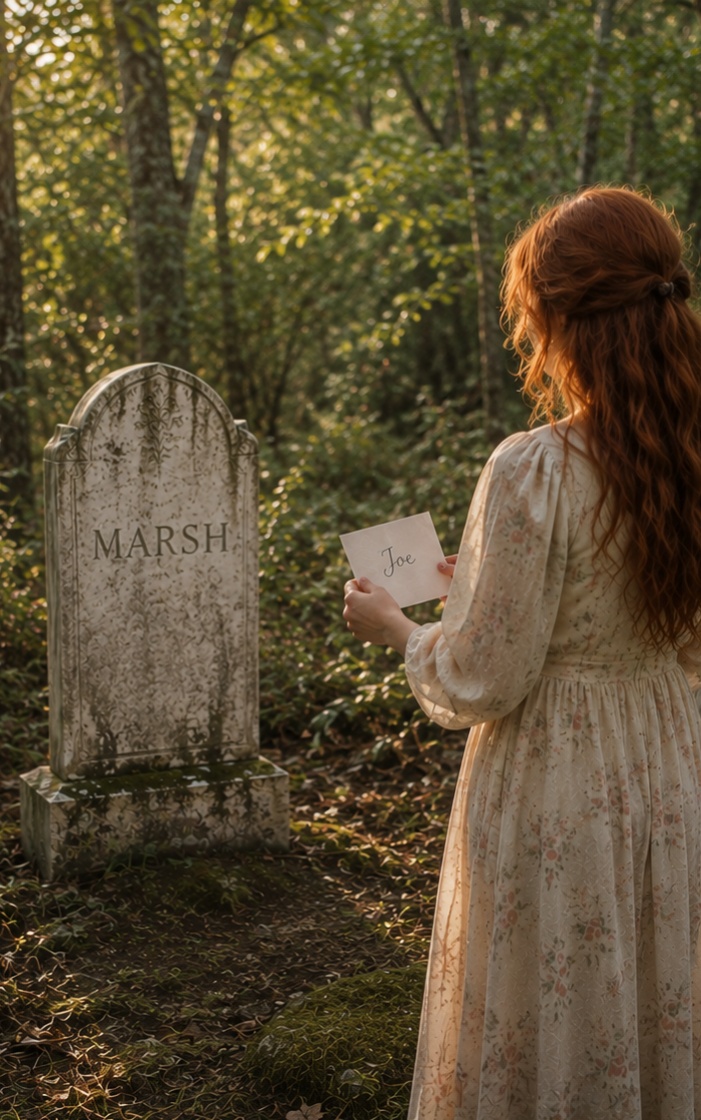
Love, Willow
Two wounded hearts find healing through secret letters left in an ancient, forgotten cemetery.
by Kathleen Connolly
Thirty-nine-year-old Willow Jons has retreated to her aunt's farm in upstate New York to hide from the world. Devastated by the tragic loss of her husband, Joe, and their unborn daughter, her grief feels insurmountable. Seeking solace in an unexpected place, Willow finds therapy in visiting a small 18th-century cemetery at the edge of the property. Once a week, she leaves a letter on the headstone of a young man who died at her late husband's age, signing each note with a tender ending: Love, Willow. Across the field lives Ian Marsh, a rugged, divorced father watching from afar. Intrigued by the red-haired stranger who visits his family’s ancestral graves, Ian finally approaches and reads her raw, vulnerable notes. Moved by her aching heartbreak, he takes a leap of faith and leaves a reply. What begins as a secret correspondence across time and loss slowly blossoms into a delicate connection. As their unspoken bond turns into real-world encounters, Willow must decide if she can honor the memories of her past while opening her heart to a brand-new future. From Kathleen Connolly comes an emotionally resonant, slow-burn novel about grief, hope, and the unexpected ways love finds us when we need it most.
- Romance
- Literary Fiction
- Small Town Romance
- Slow Burn Romance
- Grief & Loss
- Women's Fiction
The Ghost of Warwick
The train station in Tuxedo hadn't changed at all, and that alone nearly undid me. I sat on the same wooden bench I used to perch on at seventeen, waiting to sneak off with friends for a day in the city, back when the only thing I worried about was whether my aunt would notice I'd taken the early bus instead of the one after church. Back then, getting caught meant a stern lecture and an extra week of chores. Now I sat there as a thirty-nine-year-old widow, waiting for a driver instead of a girlfriend with a fake ID, and there was no lecture large enough to cover what I'd lost since.
The driver was a quiet man named Hal who didn't ask about my life or comment on my two small suitcases, and I loved him instantly for it. The drive to the farm passed in silence, and I was grateful for every mile of it. I pressed my forehead lightly to the window and watched Main Street go by, the grand old houses standing exactly where I'd left them, white clapboard and wraparound porches, gardens gone a little wild with the last warmth of the season. Some part of me recognized every crooked mailbox and chipped shutter, and it startled me how much comfort a place could hold even when the person looking at it had nothing left to give back.
I thought of Joe then, like he was standing just behind my shoulder waiting for me to turn around. I thought of Faith too, the daughter I never got to hold, one loss reaching for the other until I couldn't tell where one ended and the other began. The weight of them sat on my chest the entire ride, heavier than any suitcase, and I pressed my hand flat against my sternum like I could hold myself together by force if I just pressed hard enough.
When the car turned up the long gravel drive, I saw Aunt Rose already coming down the porch steps, moving so fast I was certain she'd take a tumble before she reached me.
"Rose, slow down," I said, half laughing, half terrified, reaching out to steady her small frame as she nearly collided with me.
She swatted my hands away and held me out at arm's length instead, her sharp blue eyes traveling the length of me like she was inspecting livestock at auction. "Good Lord, Willow, a strong wind could carry you clean to Pennsylvania. Look at you. Skin and bone."
"It's good to see you too," I said. "And thank you, as always, for the vote of confidence in my figure. Really does wonders for the ego."
She swatted at me again, this time affectionately, and laughed a small dry laugh that turned into a cough. "Don't sass me, girl. I've been feeding this family for fifty years and I intend to keep at it. You'll be eating a proper breakfast tomorrow if I have to sit on you to make it happen."
I let her guide me up the steps and through the front door, her arm looped through mine the same way it had been when I was ten years old and freshly orphaned, arriving with nothing but a duffel bag and a hollowed-out kind of quiet. The house smelled the way it always had, like woodsmoke and dried lavender and something baking that I couldn't name, and it hit me harder than I expected, that particular alchemy of scent and memory. Rose walked me up the grand staircase, her hand trailing the banister the way it always did, and stopped in front of the door that had been mine since childhood.
Nothing had changed. The baby blue wallpaper with its faded silver flowers still covered every wall. The corkboard above my old desk still held photographs from high school, curling at the edges now, girls I hadn't spoken to in twenty years frozen mid-laugh at some dance or bonfire I could barely remember. The same quilt, hand-stitched by Rose's own mother, lay folded at the foot of the bed. It was a room built for a girl who still believed her life was ahead of her, and I stood in the doorway feeling like a stranger wearing that girl's old clothes.
"I'll leave you to get settled," Rose said, patting my arm once before shuffling off down the hallway, her footsteps fading into the creak of old floorboards.
I closed the door and stood there a long moment, just breathing, before I turned to my suitcases. Unpacking gave my hands something to do, which was the only thing that made it bearable. The closet was empty and smelled of cedar, and I filled two dresser drawers with the little I'd brought, sweaters mostly, a few dresses I doubted I'd ever wear again. I was moving through it well enough, almost mechanically, until my fingers closed around the golden frame at the bottom of the second bag.
Joe's photo. The one that used to sit on my nightstand in the city, the one where he was laughing at something just out of frame, sunlight catching the gold in his hair, the ocean behind him the same blue as a summer sky. I set it on the dresser with hands that had gone unsteady, and the moment it touched the wood, something in me broke loose.
I sat down hard on the edge of the bed and let it come. Three years of holding myself together in front of doctors and well-meaning friends, three years of nodding along at grief counseling and telling people I was doing better, and none of it had prepared me for how much it would hurt to unpack a photograph in my childhood bedroom. I cried until my chest ached and my throat went raw, until the tears simply stopped because my body had nothing left to give them; I was spent.
I don't remember lying down. I only remember waking sometime later with my face swollen and sticky, the window gone dark, the wind outside picking up through the branches of the old apple trees Rose had never had the heart to cut down. It sounded almost like a voice, that wind, low and constant, and for one disoriented moment I thought it might be Joe calling my name the way he used to, Will, just Will, like I was the only person worth saying it to.
It wasn't him. It was only the trees.
I pulled the quilt around my shoulders and understood, in the dark quiet of that room, that I had not left my grief behind in the city at all. I had packed it carefully, right alongside my sweaters, and carried it every mile of the way home.
Conversations with Stone
Morning came with a stiff neck and an ache along my spine that reminded me I hadn't slept in that bed for twenty years. Still, the window told a different story than my back did. The woods beyond the far field had gone gold and rust overnight, or maybe I'd just been too tired to notice it the day before, and for a moment I sat there just looking at…