

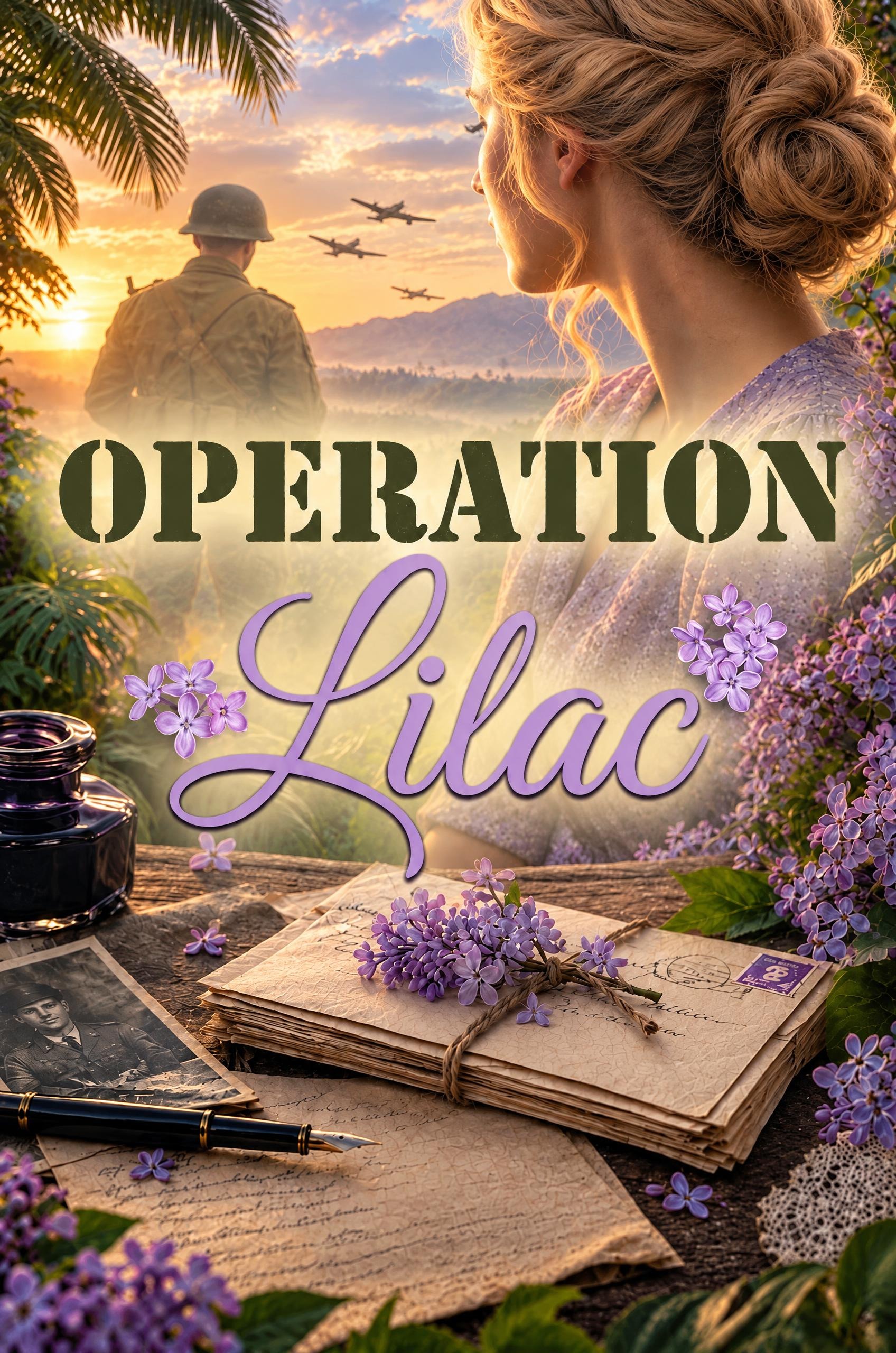
Inspired from Helen Pease’s
by Kaycee Chamberlain
Fleeing an abusive, alcoholic father and a dead-end timber mill job, young August Bennett forges his age to enlist in the U.S. Army during World War II. Meanwhile, Rosemary Whitman leaves Nevada to join the Cadet Nurse Corps in San Francisco and is deployed to the Pacific. Through the anonymous military pen-pal initiative Operation L.I.L.A.C., the two begin exchanging heartfelt letters, signing only as 'A' and 'R', unaware of each other's true identities. As August battles the brutal conditions of the Solomon Islands and grave injuries on Bibilo Hill, he is transported to a field hospital on Rendova, where Rosemary fights to save his life in triage. Clinging to each other's letters and their developing, anonymous bond, both face the harsh realities of combat, trauma, and military rules against fraternization.
- Historical Fiction
- Romance
- World War 2
- Military Romance
- Slow Burn Romance
Timber and Bottles
The steam whistle blew at six in the evening. It was a flat, sour shriek that cut through the thunder of the belts, shivering the dust down from the crossbeams. August Bennett wiped his forearm across his forehead, but the motion only smeared sawdust into his hairline. His knuckles were raw from feeding wet timber into the carriage, skin scuffed down to red meat where the bark had caught him around noon. The smell of pine resin and sweat clung to his flannel like grease.
He dropped his leather work mitts onto the bench beside the planer. They landed with a dull slap on the pine planks. Some of the other men were already shuffling toward the yard gate, shoulders stooped under the gray sky, their boots dragging through the yellow sawdust drifts. Nobody talked much when the whistle blew. Talk took breath, and twelve hours of wrestling green logs did not leave a man with much air to spare.
August did not turn toward the road that led out of town. He crossed the yard, ducked under the loader tracks, and cut down toward the rail spur where the tavern sat hunkered against the embankment.
The building was crooked, clad in unpainted siding that had turned the color of ditch water. Light spilled from its low front windows, greasy and yellow against the gravel path.
Inside, the noise was different from the mill. It was lower, a rumble of clinking bottles and boots scraping floorboards, but it worked the same way. It filled up the quiet so a man did not have to listen to his own head. August reached into his trouser pocket, counted out two nickels and three pennies, and slid them across the scarred pine bar. The barkeep set down a small, heavy tumbler without asking. The glass was thick, cloudy with grease, but the whiskey was amber and warm.
August tipped it back without breathing. The heat bit into his tongue, sharp and harsh, and hit his empty stomach like dropped lye. He had skipped midday beans to clear a cedar jam in the pond, and the liquor took hold instantly, spreading through his ribs in a fierce, rushing wave. He pushed his nickel back across the wet ring. "Another," he told the barkeep, his voice raspy against the din.
“Look at him,” a voice barked over the din. “Boy moves like he got hemlock in his knees.”
August did not turn his head right away. He swallowed the third pour, his knuckles white against the rim, his ears buzzing with a heavy, sweet hum. Beside him at the corner of the warped mahogany rail stood Joe Callow and Tommy Vane, both of them still wearing their grease-stiffened canvas aprons from the edger tables. Tommy’s hair was matted with resin, a yellow ring of sweat staining his collar, while Joe held a cracked pitcher in one big paw like he owned every sour drop inside it.
“Leave him be, Tommy,” Joe said, slurring the words around an unlit tobacco plug. “August spent half his shift dragging green hemlock off the skidway because your dumb ass dropped the chain again.”
“Chain slipped on its own,” Tommy spat, slamming an empty jelly jar down onto the bar so hard the cloudy glass rattled against the brass edge. “Barkeep! Don’t play deaf. Fill this jar before I dry up and blow out the door.”
The barkeep, an old German with ears like dried apricots and an apron that had not seen a tub in six months, did not even blink. He took Tommy’s two nickels, scraped them off the wood with his thumb, and poured another four fingers of the cheap, corn-heavy mash.
“You’re slow tonight, Bennett,” Tommy said, leaning his shoulder into August’s arm. His breath was thick with cabbage and cheap rotgut, warm against August’s neck. “Usually you got two down before I even wash the bark off my teeth. What’s the matter with you? Mill boss chew you out over that cull pile?”
“Mill boss can choke on it,” August said, his voice flat. He did not look at Tommy. Instead, he looked at the reflection of the row of bottles against the smoky mirror behind the bar.
“Hear, hear,” Joe laughed, though the laugh ended in a wet, rattling cough that shook his broad ribs. He wiped his nose on his forearm and nudged August’s elbow with the lip of the pitcher. “Drink up, Augie. It’s Friday night. We got sixteen hours before they blow the sunrise horn tomorrow, and I intend to spend fourteen of them not knowing my own name.”
“Ain’t Friday,” August said.
“Don’t matter,” Tommy said loudly, waving a hand toward the ceiling where the kerosene lanterns swung faintly in the draft. “When you work sixty hours a week for pennies, every night you don’t die under a runaway log is Friday night. Ain’t that right, boys?”
Two older men down the rail, men who had lost fingers to the trim saws years ago, muttered their agreement into their beer foam without lifting their heads.
“Here,” Joe said, splashing another generous dose of whiskey straight into August’s glass without waiting for permission. The amber fluid rose to the greasy brim, sloshing over the side and pooling around August’s thumb. “Put that away. You look like a funeral looking for a ditch.”
August stared at the glass. The heat in his stomach was already a coiled serpent, heavy and familiar, spreading out into his shoulders and dulling the throb in his bruised knuckles. He hated how sweet it tasted when it first hit the tongue, and how bitter it turned going down, but somehow. Yet his hand gripped the glass with an instinctive, vicious certainty. His fingers curled around the curve of it.
“Drink it, Bennett, or give it to somebody with hair on their chest,” Tommy scoffed, already tipping his own jar back, his throat working in hard, convulsive gulps.
August brought the rim to his mouth and drank it straight down. The alcohol hit his throat like kerosene and fire, burning all the way into his ribs until his eyes watered. He set the empty glass down with a sharp click against the wood.
“There he is,” Joe roared, slapping August’s shoulder with enough force to pitch him forward against the rail. “See? Boy’s got grit in him after all.”
“I got to get going,” August mumbled. The words felt thick and clumsy in his mouth, sliding together like wet pine boards. He rubbed his eyes with the heel of his palm, but the room had already taken on a loose, heavy sway. The lanterns overhead doubled into smeary yellow halos, and the floor tilted under his work boots as if the whole tavern were adrift on a swollen river.
“Sit down, boy,” Tommy laughed, pushing a freshly filled jar toward him. “You ain’t even walked the slack out of your knees yet.”
Tommy slid a few more coins across the counter. Each coin, replaced with a new glass and new liquid. August downed two more. After nearly half an hour more, August sat swaying slightly in his chair.
“I really,” August said, swallowing a hiccup, his tongue tangling around the consonants. “I really gotta go now.” He reached for the edge of the bar to brace himself. His fingers felt numb, distant, like they belonged to a stranger’s coat.
“Go where?” Joe jeered, grabbing August by the collar of his denim coat. “Back to that shack on the ridge?Stay here and have another round with men who know how to live.”
Tommy slowly let his hand drop, though he scoffed to save face. “Suit yourself. Go home and sleep with the owls. Joe, pour that pitcher before it grows mold.”
“Goodnight boys.”August fumbled. His friends, drowning with drink, waved wildly as August headed towards the door.
August turned away from them, his boots dragging heavily on the sawdust that covered the plank floor. His hip bumped against an empty stool, nearly sending it clattering into the sawdust, and a couple of bark peelers cursed at him. He hardly heard them over the roar inside his skull.
He pushed his way past the cluster of haulers near the potbellied stove, the room spinning around him in drunken, uneven circles. At the heavy pine door, the heat from his belly rushed up into his eyes, making the walls slide out of plumb. He caught the jamb with both hands, swaying hard against the timber frame, before shoving through into the dark.
The cold air struck him like an open palm, shock-chilled and raw, smelling of damp coal smoke and dead pine needles. For three steps, August felt entirely clear, the winter bite cutting through the fog in his lungs. But then the blood rushed into his ears, and the whiskey took hold with doubled fury, turning his legs to water and his boots to cast iron.
He stumbled off the wooden stoop, his knees buckling under his weight. He hit the gravel hard on one knee, tearing the denim open, a dull thud rattling all the way up his spine. The cold dirt bit into his skin, but the pain felt far off, muffled behind the whiskey humming in his blood. He scrambled to his feet, lunging sideways to catch himself against the rusted iron flank of an idle boxcar before he could pitch face-first into the ditch. His forehead pressed against the cold steel. The metal was freezing, crusted with soot, and he stood there gasping, his stomach heaving, bile and rotgut burning the back of his palate as the ground continued to roll beneath his soles.
“Stupid,” he whispered to the dark yard. His own voice sounded thick, like wool pulled through teeth. “Just like him. Exactly like him.”
He could not go home like this. If he walked through the screen door reeking of mash, his mother would look at him with those pale, exhausted eyes that never blamed him out loud, which made the shame ten times worse. And if his father was in his cups, two drunks in a twelve-foot kitchen meant broken furniture and blood on the linoleum. August knew that balance down to the grain of the floorboards.
He pushed away from the boxcar, forcing his boots to find the packed dirt between the ties. His head spun slowly, a heavy, sick wheel turning behind his brow. He needed water. He needed to wash the liquor out of his spit before he climbed the hill.
Fifty yards past the loading dock, where the timber road met the creek bridge, an old cast-iron municipal pump stood beside the road. It had been installed for the teamsters twenty years ago when horses still hauled the big white pine down from the cut, long before the steam trucks took over. August dragged himself toward it, weaving across the ruts, his boots catching on frozen mud. His breath came in ragged, liquor-sour plumes, and the trees on either side of the road seemed to lean toward him, bending like tall shadows ready to fall.
When he reached the iron casing, he collapsed forward onto the wet stones surrounding the drain. His hands found the pump handle. It was stiff, frozen around the leather valve, and he had to throw his weight down on the lever twice before the cylinder groaned in the casing. A gush of black, silt-heavy water poured over the spout, splashing his knuckles. He pumped three more strokes, working the handle until the flow ran clear and smelling of stone.
August plunged his head under the spout.
The water was so cold it felt like needles driving straight through his skull. He gasped, choking on the shock, his teeth aching down into the roots. He stayed there beneath the rush, letting the icy mountain runoff drench his hair, soak through his collar, and run in freezing rivers down the small of his back. When he finally pulled back, he fell onto his elbows on the frosted gravel, heaving for breath, his chest burning while his scalp went numb.
He wiped water and grease from his face with both hands, rubbing his eyes until red rings danced in the darkness. The icy water had shocked his skin, but the whiskey was deep in his marrow, refusing to let go. His head pounded in heavy, sluggish beats, and when he tried to swallow, his mouth tasted like iron filings and stale corn liquor. He spat into the drain. The water trickled away through the stones, black under the starless sky.
"Get up," he growled aloud to himself, his own voice slurred and hollow. "Stand up, you fool."
He pushed himself upright, clinging to the iron pump casing until his balance returned, though his legs still felt rubbery and loose inside his denim trousers. His soaked shirt clung to his chest like a sheet of ice, setting off violent, uncontrollable shivers that rattled his teeth. The drunk fog had receded just enough for the sharp sting of reality to leak back in, but the alcohol still weighed down his limbs, slowing his hands and clouding his vision around the edges.
He set his jaw, tucked his chin into his damp collar, and started the long walk up the dirt track toward the homestead, every breath tasting of cold iron and dread.
He was still twenty yards from the gate when the first sound reached him. It was the sharp, violent crack of stoneware shattering against the wall, followed by the heavy thump of a chair tipping onto pine boards. August tried to sprint, but his drunken feet betrayed him.
His boot caught on an exposed pine root in the dark, sending him staggering sideways into the fence post. He clawed his way forward, swearing under his breath, stumbling up the two porch steps. He did not bother with the iron latch. He threw his shoulder against the timber door, the wood flying back on its hinges and banging hard against the inner wall.
The lamp on the table was smoking, its wick turned too high. His father stood over the counter, shoulders hunched, his gray work shirt torn open at the throat. He was swaying on his heels, a dark bottle clutched in his left fist like a club. On the floor by the dry sink, August’s mother cowered against the cabinet base, both hands pressed over her face. A smear of dark blood trickled through her knuckles, dripping down onto her faded gingham apron. White shards of her good blue mixing bowl lay scattered across the linoleum, swimming in spilled vinegar and grease.
“You useless woman,” his father snarled, voice thick and slurred with liquor. His arm pulled back, the heavy glass bottle swinging wide toward her unprotected head. “Can’t even keep grease in the pan.”
August moved without thinking, his drunken reflexes clumsy but frantic. He lunged across the narrow kitchen, his boots slipping on a wet patch of vinegar, and threw himself directly into the path of the blow. The meat of his father’s fist caught August squarely across the right cheekbone.
The force cracked against his skull, tearing the skin wide. White sparks burst behind his eyes, and the world tilted sideways into darkness. August slammed hard into the cupboard, copper and rotgut flooding his mouth, his knees nearly giving out completely before the raw animal panic pulled him back upright.
“G-get your hands off h-her!” August roared, trying his hardest to mask the slur.
August did not wait for the second blow. Blind rage ripped through the whiskey haze. He grabbed his father by the soiled front of his work shirt, his clumsy, trembling hands twisting the rough flannel into tight knots. With a wild, desperate heave fueled by every ounce of muscle from the saw carriage, he threw his entire weight forward.
His own feet nearly slipped out from under him, but the momentum was enough. His father, equally drunk and far slower, lost his balance with a strangled gasp. His heels tangled in the hem of the fallen tablecloth, and he went down hard against the brick hearth of the woodstove. The back of his gray head struck the iron fender with a sickening, hollow thud. The bottle slipped from his fingers, rolling into the soot, its amber contents hissing and spitting against the red-hot iron.
The man did not get up. He let out a long, wheezing groan, rolled onto his side, and began to snore into the floor dust, completely dead to the world.
The room went quiet except for the sputter of the smoking wick. August stood over him, chest heaving, his fists still curled into tight knots at his sides. His right cheek throbbed with a dull, heavy pulse that matched the beating of his heart. Slowly, the rage drained out of his limbs, leaving behind a cold, shaking exhaustion.
He dropped to his knees beside his mother. Her hair had come loose from its pins, graying strands clinging to the tear tracks on her cheeks. She was shivering so violently her teeth clicked together in the drafty room.
“Mama,” August whispered, his voice trembling as he reached for her shoulders. “Mama, look at me. You all right?”
She did not look at him right away. Her gaze was fixed on the man snoring on the hearth bricks, her pale eyes wide and glazed with terror. Then she turned her head, seeing the split on August’s face where the blood was running down into the hollow of his throat. A sob caught in her chest, small and broken.
“Oh, Augie,” she breathed, her trembling fingers rising to touch the air beside his torn cheek. “Your face. Look what he did to your face.” Then her hand froze just inches from his jaw. Her small, red-rimmed eyes widened, the sorrow in them sharpening into something stark and piercing. She drew back as if scalded, the air catching hard in her chest. “You’ve been drinking,” she whispered, her voice tightening into a trembling accusation that cut deeper than any strap. “Augie, you reek of it. You smell just like him.”
“I’m fine,” he muttered, glancing away from her pity. “It ain’t nothin’. Come on, Mama. Help me get this mess cleaned up before he wakes up mean again.”
He fetched the tin dustpan and the broom from behind the larder door. Together, they knelt on the cold boards, picking up the blue stoneware fragments one by one. August used his bare fingers to gather the largest pieces, careful not to let her cut herself on the sharp rims. His mother’s hands were shaking so badly she dropped a piece twice, the ceramic clicking against the floor like dry bone. She smelled of tallow and lavender water, a soft, familiar scent that felt entirely out of place in the ruined kitchen.
She caught his wrist suddenly, her grip surprisingly tight for someone so frail. Her blue eyes were wet, staring directly into his with a desperate, suffocating weight.
“Promise me, Augie,” she whispered, her voice cracking beneath the hum of the stove. “Promise me you won’t turn out like him. You can’t let that stuff take you. Please, son. Don’t end up on the floor.”
August looked at her, his throat locking tight around a bitter knot. He kept his face turned away, terrified that she would catch the thick reek of whiskey on his breath, the stale smell that had soaked through his skin and flannel at the tavern. He could still feel the drunkenness sloshing in his belly, heavy, warm, and humiliating, mocking the split on his lip.
The room was still spinning at the edges, a nauseating tilt that reminded him with brutal clarity that he was carrying the exact same rot as the monster sleeping on the bricks. He swallowed hard against the burn in his chest, unable to utter a single promise. He could only dip his chin once, a short and miserable jerk of his head, before gently easing his wrist from her trembling fingers and dropping another blue ceramic shard into the pan.
When the floor was cleared of glass, he helped her to her feet and guided her toward the small bedroom off the kitchen. He closed the door softly behind her, waiting until he heard the bedsprings creak under her weight before he turned back to the dry sink.
A chipped white pitcher sat beside a tin basin. August pumped cold water until the rust cleared, filling the bowl until the water slopped over the rim. He dipped a gray rag into the cold liquid, took a ragged breath, and pressed it against his cheekbone. The sting made him bite down on his tongue, his knuckles turning white against the edge of the wooden counter.
He leaned forward and looked into the small, speckled mirror hanging from a nail above the basin. The glass was cloudy, its silver backing peeling away in long gray scabs, but the reflection was clear enough. His own blue eyes stared back at him out of the grime, dark and fierce under a shelf of brown brow. His lip was split down the middle, swollen and ugly, and a jagged purple welt was already rising along his cheek.
As he stared, the dread took root deep in his ribs, cold and unyielding. The jaw was his father’s jaw. The broad set of the shoulders was his father’s. The rage that had just flooded his veins, blinding and hot, was the very same poison that drove the man on the hearth.
If he stayed here, if he spent another year pulling logs and drowning the days at the rail spur, the rot would take him completely. It would hollow him out until there was nothing left but fist and bottle. He looked at the blood dripping into the clean water, turning the basin pink, and knew the truth of it. Staying here would kill his mother, and it would turn him into the devil he hated.
The Stamp For The Future
The morning shift began under a low ceiling of damp gray clouds. Cold air seeped through the cracks in the mill wall, carrying the sour bite of wet sawdust and coal smoke. August kept his head down over the sorting table, his swollen cheek throbbing with every hard thud of the machinery. Nobody asked about his split face. Bruises were common enough…