

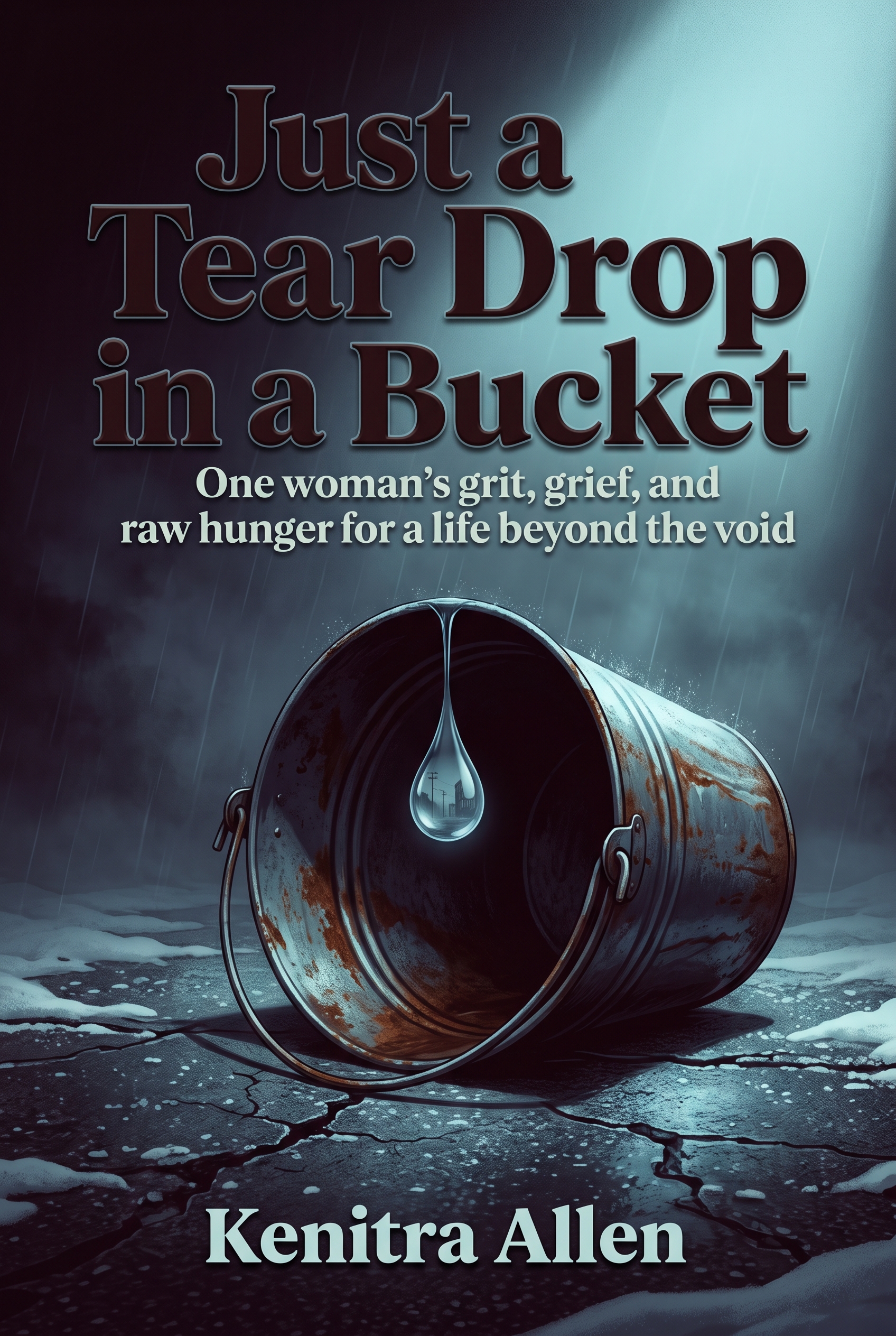
Just a Tear Drop in a Bucket
One woman's grit, grief, and raw hunger for a life beyond the void
by Kenitra Allen
Some wounds never dry. Anita Langston was forged in the ruins of Christmas Day 1972, when her father Kenneth was murdered on the streets of Champaign, Illinois. Raised in the hush of her mother Delores's catatonic grief and cold withdrawal, Anita learned to move through the world numb and sharp. She sees her life as a bucket—every trauma, every failed love, every fleeting sexual conquest just another tear drop that never fills the emptiness. In her mid-thirties she still uses explicit, detached intimacy as anesthesia for a past she barely remembers yet cannot escape. Then Isaiah Crowe appears—a man who refuses performance and demands presence. Her armor cracks. Pushing for the truth about her father's killer forces her mother from decades of silence and drags Anita back to the projects of Birch Village, where poverty, systemic violence, and ancestral pain still haunt the ground. She must decide: keep collecting empty victories, or finally feel the weight of the water in the bucket. A raw, literary reckoning of Black womanhood, desire, and the fight to reclaim a self buried under grief.
- Erotica
- Literary Fiction
- Identity Journey
- Character Study
- Relationship Drama
- Coming of Age
The Anesthesia of Skin
The wind in December does not just blow through Chicago; it searches for you. It slips under the collar of your coat, bites at the small of your back, and reminds you of every empty space you have ever tried to fill. Outside, the city was already dressing itself in that aggressive, blinking holiday cheer that always made my stomach turn. Red and green lights bled onto the wet pavement, reflecting off the slush like spilled ink. I walked fast, my head down, keeping my eyes fixed on the gray concrete. I hated the lights. I hated the music drifting out of store doors every time a customer walked in. Most of all, I hated the way everybody seemed to be hustling toward some warm, perfect living room that I knew did not exist. For me, the winter season was not about family or gatherings. It was about survival. It was about finding a way to quiet the noise in my own head before the cold could settle into my bones.
I found my escape at the Blue Velvet Lounge. It was a dark, low-ceilinged joint off the main strip where the air smelled of stale whiskey, spilled beer, and cheap men’s cologne. The jukebox in the corner was playing blues, not carols, which was exactly why I paid the cover charge. I did not want to think about my mother, Delores, who I knew was currently pulling double shifts at the post office, sorting other people’s Christmas wishes until her fingers bled just so she would not have to sit still in an empty apartment. Sitting still was dangerous for women like us. Sitting still let the ghosts in.
That was when I saw him. He was sitting alone at the end of the bar, nursing a dark liquor. His name was Marcus. He had the kind of quiet, heavy presence that did not ask for attention but took up space anyway. He had deep brown skin, broad shoulders that stretched the fabric of his dark leather jacket, and eyes that looked like they had seen their own share of bad winters. I liked him instantly because he did not smile when I sat down next to him. He did not try to offer me a cheap pickup line or ask me what my plans were for the holidays. He just ordered me a gin and tonic, slid the glass toward me, and let the silence sit between us like a heavy blanket. He was a stranger, and in his silence, he was perfect. He looked just enough like the faded, imagined shadow of my father Kenneth—that tall, dark presence I only knew from a single photograph—to make my chest ache in a way that felt like home.
“Your place or mine?” he asked after we finished our second round.
“Mine,” I said. “It is closer.”
We did not speak on the cab ride back to my apartment. I kept my hand on his thigh, feeling the hard muscle beneath his jeans, using the heat of his skin to keep the freezing wind at bay. When we let ourselves into my place, the apartment was dark and cold. I did not bother turning on the overhead lights. I did not want to see the bare walls or the lack of decorations. I just wanted the heat.
Marcus did not waste time with gentle words. He pulled me into him right there in the narrow hallway, his hands sliding under my leather jacket to grip my hips. He tasted like liquor and cold air. I let out a low breath, wrapping my legs around his waist as he lifted me, pressing my back against the hard drywall. The physical intensity was immediate, a sudden rush of blood that drowned out the hum of the city outside. He carried me into the bedroom, throwing me onto the mattress without breaking the kiss. He stripped off his shirt, revealing a chest that was broad and mapped with muscle. When he came down on top of me, his weight was a solid, grounding force that anchored me to the bed.
I reached down, pulling at his belt, wanting him inside me before the cold could catch up. The intimacy was raw and athletic, entirely stripped of the soft, lingering tenderness that people write about in songs. We did not need tenderness. We needed to collide. Marcus pushed my dress up over my waist, his fingers digging into my thighs with a grip that would leave dark bruises by morning. I wanted those bruises. I wanted the physical proof that I had been touched, that I was still solid. When he slid into me, a sharp gasp caught in my throat. He moved with a heavy, driving rhythm that left no room for thought, no room for memory. I arched my back to meet him, my fingers clawing at his shoulders, burying my face in the crook of his neck where the scent of his sweat was thick and clean. For those minutes, the world narrowed down to the sound of our breathing, the wet heat of our skin rubbing together, and the friction that promised to burn away everything else. I pushed myself against him, seeking the absolute boundary of my own body, using his weight to crush the rising panic that always threatened to swallow me this time of year. It was a high-intensity release, a desperate attempt to stay present in the flesh because the mind was too dangerous a place to inhabit.
Afterward, the silence in the room changed. It was no longer the heavy, comfortable quiet of the bar; it was the cold, hollow silence of a space that had just been emptied. Marcus got up, his bare feet padding softly across the hardwood floor as he gathered his clothes. I lay tangled in the damp sheets, watching him dress in the dim light filtering through the window. He pulled on his jeans, zipped his boots, and threw his leather jacket over his shoulder. He did not look back at the bed, and I did not ask him to stay. This was the deal. We had traded heat, and now the transaction was over.
When the front door clicked shut, the cold returned, settling into the corners of the room like dust. I pulled the blanket up to my chin, but it did not help. The familiar hollowness was back, stretching wide inside my chest. I thought about my mother, probably standing at a sorting table right now under the harsh fluorescent lights of the post office, her back aching, her mind locked in her own private cocoon. We were so much alike, both of us running from the same shadow, using different kinds of labor to keep from looking back. My labor was the skin of strangers; hers was the mail.
I got out of bed and walked over to the small wooden dresser in the corner of the room. On top of it sat a faded, creased photograph in a cheap metal frame. It was Kenneth. He was smiling, holding a baby with chubby cheeks and a tuft of black hair. He looked so young, so full of a future that had ended in a pool of blood on a Champaign street before he could even see his daughter grow up. I stared at his face, searching for some reflection of myself in his eyes, but there was only the flat glare of the glass. He was a ghost, and every man I brought to this bed was just another attempt to touch a shadow.
Suddenly, the sharp ring of my phone cut through the quiet. I picked it up from the nightstand. The caller ID showed my mother’s name. I hesitated, then pressed the button.
“Hello, Mama,” I said, my voice tight.
“Anita,” she said. Her voice was flat, carrying that heavy, exhausted post-office rasp. “I am calling to let you know I sent a package. It should be at your building by tomorrow.”
“Mama, you did not have to do that,” I said, looking down at my bare feet. “I told you, I do not need anything.”
“It is just some things,” she replied quickly, her tone hardening. She always got defensive when I pushed back against her gifts. It was her only way of showing love, buying things to cover up the silence. “Just open it when it gets there. I am working late all week, so do not try to call the house.”
“Are you coming down for the day?” I asked, even though I already knew the answer. We went through this dance every year.
“No,” she said, and the line went quiet for a long second. “I have the holiday shift. You know how it is. Somebody has to keep the mail moving.”
“Right,” I whispered. “Somebody has to work.”
“Take care of yourself, Anita.”
“You too, Mama.”
The line went dead. I set the phone back down on the nightstand, my chest tight. I looked at the small pile of unopened mail near the door, knowing that tomorrow there would be another box filled with expensive sweaters or jewelry that I would never wear. It was the start of our seasonal cold war, the exchange of material things to avoid the one conversation we actually needed to have.
I walked to the window and looked out at the city. The snow was beginning to fall now, light and silent, dusting the roofs of the cars below. I thought about my life, about the string of men and the empty rooms, and I realized that every single encounter was just another tear drop in a bucket that would never be full. The water just kept evaporating, leaving me dry, cold, and waiting for the next storm.
Kitchen Logic and Old Scars
My grandmother’s kitchen always smelled of Bergamot brass press spray and Sunday roast. It was a thick, heavy scent that clung to the yellowed wallpaper and settled deep into the fabric of the floral sofa in the front room. Stepping through her door was like stepping back into Birch Village, even though the projects had been torn down years ago and…