

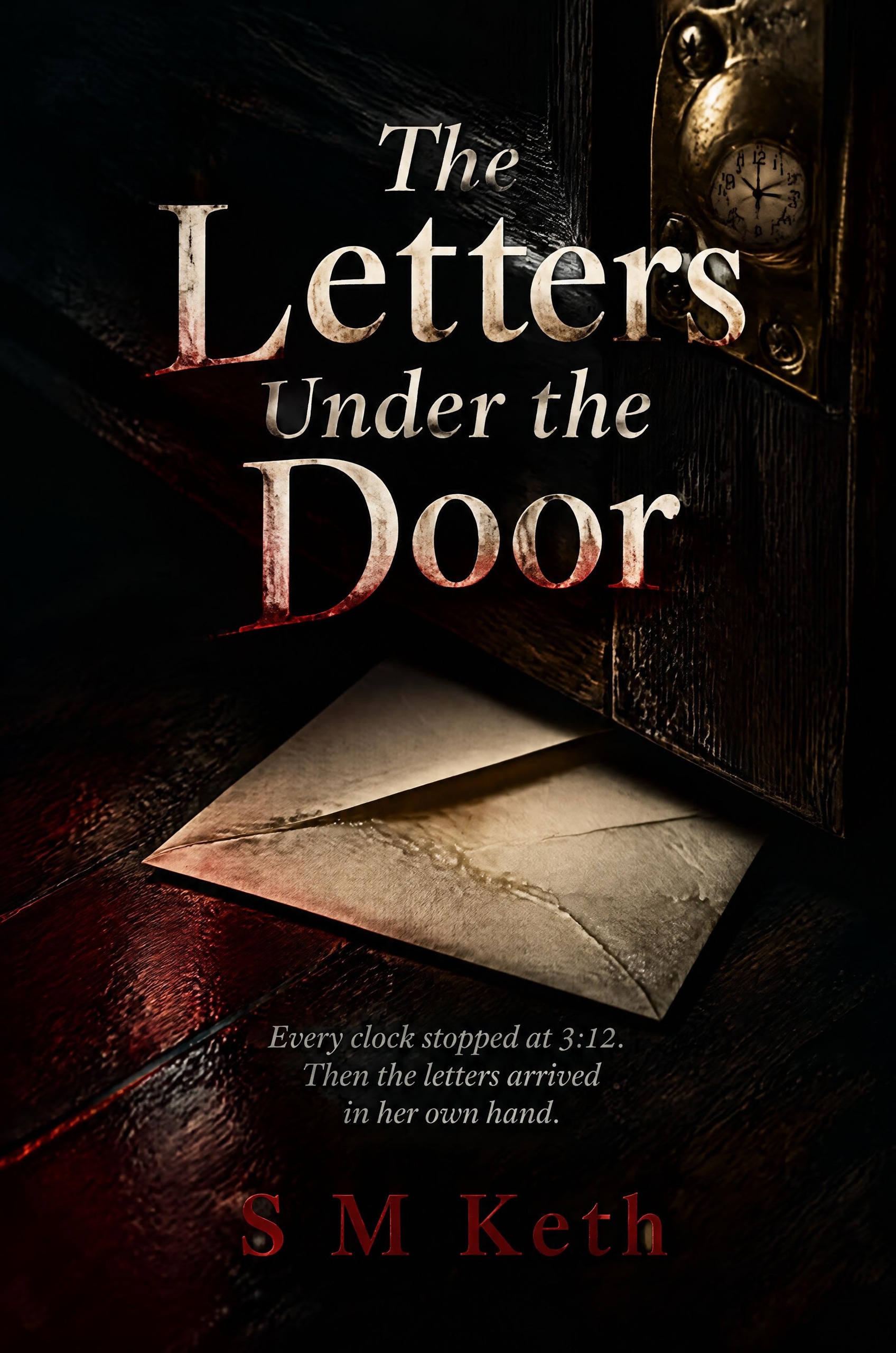
The Letters Under the Door
Every clock stopped at 3:12. Then the letters arrived in her own hand.
by Keth S M
Nora Vale comes home to Saltmere to sell her grandmother’s cliffside house and leave the coast behind. At 9 Cinder Lane every clock is frozen at 3:12. At 3:12 a.m. envelopes slide under the door, written in Nora’s handwriting, with her gel pen, predicting leaks, broken stairs, and the people she should not trust. In the attic she finds a trunk of identical letters spanning decades. Neighbor Mrs. Harrow’s journals prove time resets every two weeks. With handyman Elias Marsh, Nora traces a sealed well in the cellar, where something that never draws breath feeds on Vale grief and copies living voices. To starve it she must say words the house has never heard: real forgiveness. Burn the archive. Close the lid. Let Thursday, October 15 begin. Then, months later in the city, her grandmother’s clock stops again, and a new envelope waits.
- Horror
- Thriller
- Mystery
- Supernatural Horror
- Gothic Horror
- Haunted House
The Stopped Clocks
Part One: The House
The road into Saltmere ran along the cliffs for the last six miles, and for all six of them Nora Vale told herself she was only here to sell a house.
The sea on her left was the color of old pewter. The sky above it was the same color, so that the horizon had disappeared and the whole world looked like a sheet of metal someone had forgotten to polish. Rain came and went in thin, sideways bursts. Her car's wipers squealed every time they crossed the glass, and she had stopped hearing it about an hour ago, the way she stopped hearing most things after an hour. That was the job, or it had been. A sound engineer learns to listen to everything and then learns, as carefully, to ignore most of it.
She had been good at the job. Then the studio had closed, and the email had used the word restructuring four times, and three months later her savings account had a number in it that made her stomach turn whenever she looked.
And then the letter from the lawyer had come.
We regret to inform you of the death of Mrs. Edith Vale. As her only living relative, you are the sole beneficiary of her estate, which consists principally of the property at 9 Cinder Lane, Saltmere...
She had read it standing in her kitchen in the city, and felt nothing. That was the strange part. She had waited for grief, or guilt, or even relief, and nothing had come. A flat gray quiet, like the sea outside her window now.
The funeral had already happened by the time the letter reached her. The lawyer had tried to call. Nora had a habit of not answering numbers she didn't know. By the time she listened to the voicemail, her grandmother was in the ground in the little churchyard above the harbor, and the people of Saltmere had stood around the grave and noticed, no doubt, that the granddaughter hadn't come.
Sell the house, Nora thought. Pay the debts. Go home. Don't look at anything too long.
The town appeared around a bend all at once, the way it always had: a cluster of gray stone houses tumbling down a hill to a small harbor, a church tower, a row of shops with faded awnings. A fishing boat sat tilted on the mud where the tide had gone out. Nothing had changed. That was the thing about Saltmere. It had looked exactly like this when she was twelve, when she came here to live after her mother died. It had looked like this at eighteen, when she left for university and swore she would only come back for holidays. It had looked like this eight years ago, the last time she drove out, shaking so hard she had to stop the car at the top of the cliff road and sit with her forehead on the steering wheel.
She didn't stop this time. She drove through the town, past the closed-up fish shop and the pub called the Anchor, and turned up the steep narrow road that led away from the harbor toward the headland.
Cinder Lane was a dead end. There were only three houses on it. The first was a small white cottage with a neat garden, where Mrs. Harrow had lived since before Nora was born. The second had been empty for as long as Nora could remember, its windows boarded. The third sat alone at the very end of the lane, where the land ran out and the cliff began.
Number 9.
Nora stopped the car and turned off the engine, and the silence came in around her like water.
The house was tall and narrow and built of dark stone, three stories plus the attic, with a steep slate roof and two chimneys. The windows were tall too, and in the gray light they looked black. A low wall ran around a front garden that had once been her grandmother's pride. Now it was wild: rosemary gone woody and huge, roses grown into thorny arches, long grass bent flat by the wind. The gate hung from one hinge.
She sat looking at it for a long time.
When she was a child, she had loved this house. That was the truth, and it was the truth she least liked to remember. After her mother died, after the long confused weeks of hospitals and police and people speaking in low voices, she had come here, and the house had felt like the only solid thing in the world. Her grandmother had given her the room at the top of the second staircase, the one with the round window that looked out over the sea. She had taught her to make bread in the big kitchen. She let her play the old upright piano in the front room, badly, for hours.
She had also kept the cellar door locked, always, with a key that she wore on a string around her neck. And every night, before bed, she had walked through the whole house checking the doors, and she had stood for a long moment at the front door, looking down at the mat. Nora had asked her once what she was looking for.
"Post," her grandmother had said, and smiled, and the smile hadn't reached her eyes.
Nora got out of the car.
The wind off the sea was cold and wet, smelling of salt and seaweed and something else, something green and rotten from the garden. She pulled her coat tighter, took her bag from the back seat, and walked up the path. The key the lawyer had sent her was heavy and old-fashioned, iron gone dark with age. It turned stiffly in the lock, and the door swung inward with a long low groan.
The smell hit her first. Dust and damp and old wood, and under that, faintly, lavender, her grandmother's lavender soap. Nora stood on the threshold, and for one terrible second she was twelve years old again, and she had to put her hand on the doorframe to steady herself.
She stepped inside and closed the door behind her.
The hall was long and dim. A staircase rose on the right, its banister dark and polished by years of hands. On the left, doors opened into the front room and the dining room. At the far end of the hall was the kitchen, and beside the kitchen, under the stairs, was a narrow door painted the same dark green as the walls, so that you almost didn't see it.
The cellar door.
Nora looked at it and then looked away. Her grandmother had died in her bed upstairs, the lawyer had said. Peacefully, in her sleep. Mrs. Harrow had found her.
There was a thin layer of dust on everything. Someone had covered the furniture in the front room with white sheets, so that the room was full of pale shapes, like a crowd of people standing very still. The piano stood against the far wall, uncovered, its lid closed.
Above the piano hung a clock.
It was a small brass clock with a white face and black hands, and Nora remembered it well, because she had learned to tell the time from it. It said twelve minutes past three.
She frowned and checked her phone. It was a quarter to five in the afternoon.
Well. Clocks stopped. Nobody had wound it.
She walked through to the dining room. There was a tall grandfather clock in the corner there, the kind that had chimed every hour through her childhood, loud enough to make her jump. Its pendulum hung still behind the glass.
Its hands said twelve minutes past three.
Nora stood looking at it. A small cold prickle rose at the back of her neck, and she told herself firmly that it was the draught from the hall.
In the kitchen there was a round clock above the stove, white plastic, the cheap kind that ran on a battery. Twelve minutes past three. On the little table beside her grandmother's armchair in the kitchen corner, where Edith had sat every evening with her tea and her crossword, there was a travel alarm clock with a folding leather case.
Twelve minutes past three.
"Okay," Nora said out loud, and her voice sounded small in the big kitchen. "Okay. That's weird."
She went back through the house and checked them all again, as if they might have changed while she wasn't looking. They hadn't. Four clocks, one wound by a key, one by weights, one by a battery, one by a little spring inside a travel case. All of them stopped at the same minute.
There was probably a simple explanation. Maybe her grandmother had set them all, for some reason Nora would never know. Maybe Mrs. Harrow had done it, after, some old local custom about stopping the clocks when someone died. Nora had heard of that. Stopping the clocks at the hour of death. That must be it. Edith had died at twelve minutes past three in the morning, and Mrs. Harrow had walked through the house and stopped every clock, and it was a sad old-fashioned gesture and nothing more.
Nora felt better, having decided this. She also found that she did not want to wind the clocks again, not yet.
She carried her bag upstairs. The first floor held her grandmother's bedroom, a bathroom, and a spare room full of boxes. She did not go into her grandmother's room. She stood outside its closed door for a moment, her hand not quite touching the handle, and then she turned and climbed the second, narrower staircase to the top floor.
Her old room was exactly as she had left it.
The narrow bed with the patchwork quilt. The small desk under the round window. The shelf of books, her childhood books, their spines faded by the sun. On the wall above the bed, a poster of a band she had loved at fifteen and been embarrassed by at seventeen. Her grandmother had not changed a thing. She had not even taken down the poster.
Nora sat down on the bed, the springs creaking under her exactly the way they used to, and that was what finally did it. She buried her face in her hands and cried, hard and ugly and silent, for a long time.
She was not sure, afterward, what she had been crying for. For her grandmother, maybe. For the girl who had lived in this room. For the eight years of silence, for the funeral she hadn't gone to, for the last words she had said in this house, standing in the hall downstairs with her bag in her hand, shouting.
You're out of your mind. You're a sick, frightened old woman and I'm never coming back here.
And her grandmother's voice, low and shaking: Good. Don't. Never come back to this house, Nora. Promise me.
She had promised. She had kept the promise. And here she was.
When she finally lifted her head, the round window had gone dark. The rain had stopped. Far below, the sea moved against the bottom of the cliff, a slow heavy breathing.
She went down to the kitchen, found that the electricity still worked, and made herself a cup of tea with a teabag from her own bag and long-life milk from a carton in the cupboard. She ate a sandwich she had bought at a petrol station four hours ago. She did not sit in her grandmother's chair.
At ten o'clock she walked through the house turning off lights. She checked that the back door was locked. She did not try the cellar door. She stood in the hall, at the front door, and checked the lock, and then, without quite knowing why, she looked down at the mat.
It was empty. Just old brown bristles and dust.
She went up to bed, and she lay for a long time in the narrow bed under the round window, listening to the house. Old houses talked at night. Pipes ticked as they cooled. Wood creaked as the temperature dropped. The wind found small gaps around the window frames and hummed in them. Nora listened to all of it with her professional ear, sorting it, labeling it, putting each sound in its place.
There was only one sound she could not place. It came from very far below, so faint that she was not sure she was really hearing it. A slow, soft, regular sound, like breathing.
The sea, she told herself. It's the sea.
She fell asleep before she could decide whether she believed it.
The Neighbor
She woke to gulls screaming and white light pouring through the round window, and for a few seconds she didn't know where she was.Then she did, and the knowledge settled on her chest like a cold hand.Saturday. She had told herself, on the drive, that she would give it a week. One week to clear the house, sort out what was worth keeping, meet the es…