

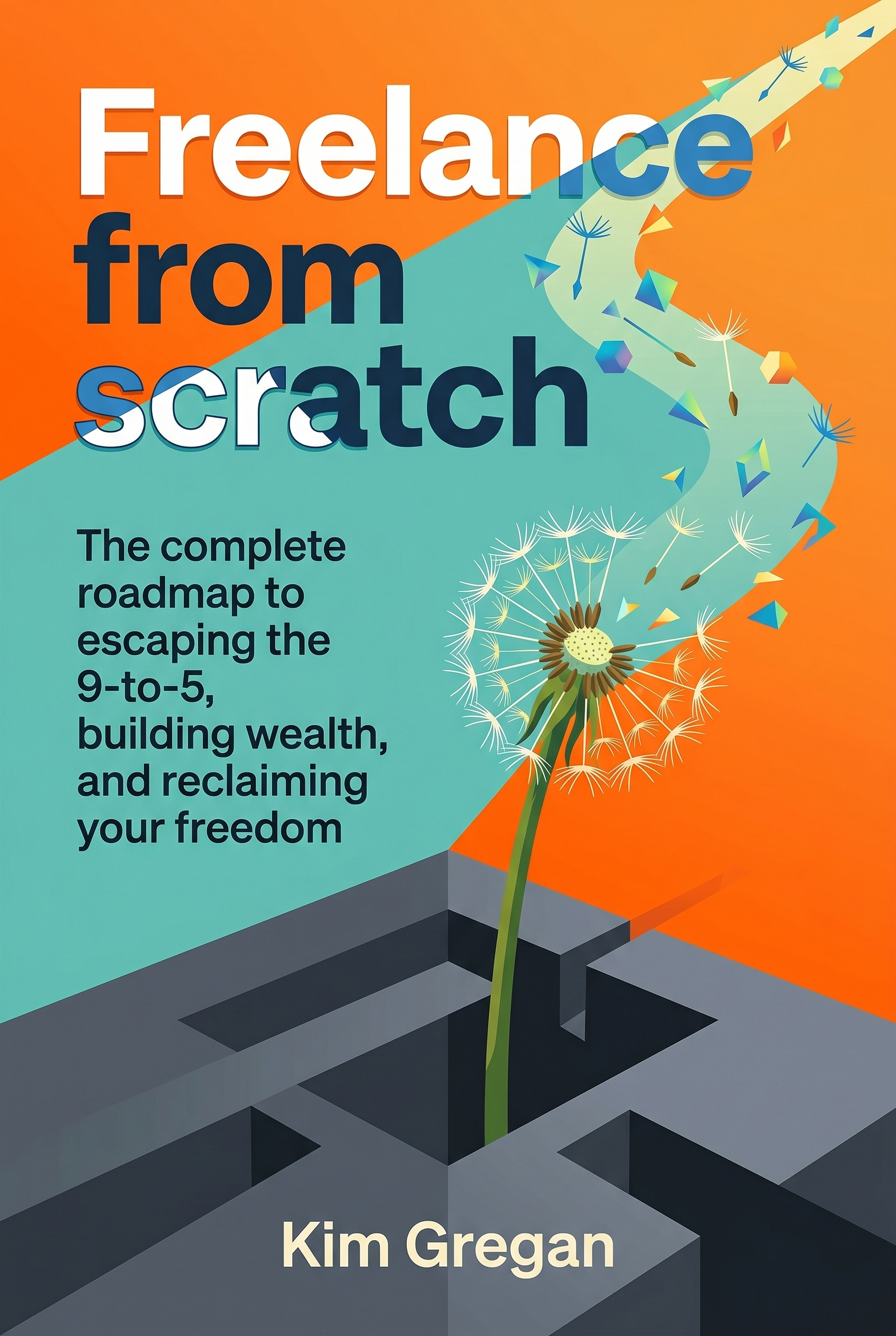
Freelance from scratch
The complete roadmap to escaping the 9-to-5, building wealth, and reclaiming your freedom
by Kim Gregan
Are you tired of the endless cubicle grind and the ceiling on your income? The dream of working from anywhere on your own terms is no longer a fantasy—it is a strategic move. Freelance from Scratch is your definitive blueprint for building a sustainable, high-profit career from the ground up. Kim Gregan breaks down the complex transition from employee to entrepreneur, offering a masterclass in mindset, logistics, and long-term scaling. This isn't just about finding a gig; it's about building a business that supports your life, not the other way around. Learn how to translate your existing skills into services that command premium rates. Discover the secrets of effective self-marketing, contract negotiation, and tax management without the headache. Beyond the business basics, Gregan integrates essential mental wellness and physical health strategies to ensure your new freedom doesn't lead to burnout. From landing your first client to investing your profits for true financial independence, this book provides the actionable exercises and real-world checklists you need to succeed. Whether you are starting with a nest egg or starting from zero, it is time to build a life of location independence and professional purpose.
- Self-Help
- Finance
- Wellness & Fitness
- Business & Entrepreneurship
- Productivity & Time Management
- E-Commerce & Online Business
The Freedom Mindset: From Employee to Entrepreneur
Somewhere right now, a 34-year-old accountant is sitting in a fluorescent-lit office, updating a spreadsheet she could finish in her sleep, wondering if this is really how the next thirty years are supposed to look. A stay-at-home dad is watching his kid nap and thinking about the graphic design skills he shelved when life got busy. A college student is staring at a job board, realizing the degree he just paid for doesn't guarantee anything anymore. All three of them have more options than they know. The freelance economy isn't a backup plan — it's a legitimate path that millions of people are walking right now, and the door is wide open.
The Freelance Opportunity Is Real, and It's Right Now
Here's what's actually happening in the job market. Companies have figured out that hiring a full-time employee costs far more than just a salary. When you factor in benefits, office space, onboarding, equipment, and the time it takes to manage someone long-term, businesses are paying a premium to keep workers on payroll. Increasingly, they're choosing not to. Instead, they hire specialized freelancers for exactly the work they need, exactly when they need it, and nothing more. This shift isn't a blip. It's a structural change in how work gets done globally.
The numbers back this up. Freelancers now make up a significant and growing portion of the American workforce, contributing hundreds of billions of dollars to the economy each year. Platforms like Upwork report that a large share of Fortune 500 companies regularly hire freelancers for specialized tasks. Small businesses, startups, and solopreneurs rely on them even more heavily. The demand is real, the work is there, and the barrier to entry is lower than at any point in history. You don't need a corner office. You need a laptop, an internet connection, and a skill someone else needs.
That last part is what stops most people. They assume they don't have the right skills. They think freelancing is reserved for web developers and graphic designers with expensive portfolios. But the reality is that the market needs writers, virtual assistants, bookkeepers, social media managers, data entry specialists, customer service reps, translators, video editors, tutors, and hundreds of other professionals. If you've held a job, raised children, managed a household, or learned anything in school, you have something marketable. The first job is finding it.
The Internal Audit: Finding What You Already Have
The most effective starting point isn't a personality quiz or a career coach. It's a simple, honest inventory of your own experience. Call it the Internal Audit. Set aside an hour, open a notebook or a blank document, and list every task you have ever been paid to do — or that you've done consistently well without being paid. Go back as far as you can remember. Include the job you had at 19, the volunteer work, the side projects, the things you do for friends and family because "you're just good at it."
Most people fill two or three pages. Then they look at the list and realize they've been sitting on skills they never thought to monetize. The woman who spent years managing a retail team has project management and scheduling skills that small businesses desperately need. The guy who handled customer complaints at a call center has communication and conflict resolution abilities that translate directly to client relations work. The parent who homeschooled their kids has curriculum design and instructional skills that online tutoring platforms pay well for.
Once you have your raw list, group the skills into categories: technical skills (things that require specific tools or knowledge), communication skills (writing, speaking, teaching, explaining), and organizational skills (planning, coordinating, managing details). Most people find they're strong in at least two of these areas. That's your starting point, not a polished portfolio.
The Internal Audit also helps you identify where your skills overlap with market demand. A useful filter is to ask three questions about each item on your list: Can someone else use this? Would they pay for it? Can I deliver it remotely? If the answer to all three is yes, you have a viable freelance service. You don't need to pick just one right now. You just need to identify your top two or three candidates and start there.
The Freedom vs. Security Spectrum
There's a mental shift that every new freelancer has to make, and it doesn't happen automatically. Most of us have been conditioned to think of a paycheck as security and self-employment as risk. That framing is backwards. A single employer is a single point of failure. If that company downsizes, restructures, or simply decides your role is no longer needed, your income goes to zero overnight. Freelancers with five or six clients lose one and still have income coming in from the others. That's actually a more stable financial position than most employees are in.
This isn't about pretending freelancing has no risk. It does. Income can be uneven, especially early on. Benefits aren't automatic. You have to manage your own taxes. But these are manageable problems with known solutions. The fear of leaving a job is mostly psychological — it's the discomfort of the unfamiliar, not an accurate assessment of actual danger. Once you understand that, you can start making decisions from a clearer place.
Think of it as a spectrum. On one end is total security — a full-time job with benefits, a steady paycheck, and zero uncertainty. On the other end is total freedom — full-time freelancing with multiple income streams, location independence, and complete control over your schedule. Most people don't jump from one end to the other overnight. They move gradually, building freelance income alongside their existing job until it makes financial sense to shift the balance. That's the smart play, and it's exactly what this book helps you do.
The Financial Blueprint: Calculating Your Runway
Before you make any moves, you need to know your numbers. Specifically, you need to calculate your Runway — the amount of cash you need in reserve before you can safely pursue freelancing full-time. The formula is straightforward:
Runway = (Monthly Expenses × 6) + Business Startup Costs
Start by tracking every dollar you spend in a month. Use a free tool like Mint to pull your actual spending data — not what you think you spend, but what you actually spend. Include rent or mortgage, utilities, food, transportation, insurance, subscriptions, and any debt payments. That's your monthly expense number. Multiply it by six to give yourself a six-month buffer. Then add whatever you realistically need to launch your freelance business, which for most service-based freelancers is shockingly low. A decent laptop, a professional email address, and a simple website can cost under $300 total.
The second number you need is your Hourly Survival Rate: the minimum you need to earn per hour just to cover your basic living costs. The formula is:
Hourly Survival Rate = Monthly Expenses ÷ 160 billable hours
160 hours assumes roughly 40 billable hours per week over four weeks. In reality, early-stage freelancers often bill closer to 20 hours per week while they're still finding clients, so this number is conservative. Use it as a floor, not a ceiling. If your monthly expenses are $3,200, your survival rate is $20 per hour. That's the minimum you need to charge to stay afloat. Your actual rates should be much higher — but knowing this number keeps you grounded when you're setting prices.
One expense that many new freelancers forget to plan for is health insurance. If you're currently covered through an employer, losing that coverage is a real cost that needs to go into your calculations. Research marketplace plans in your area before you make any transition decisions. The cost is manageable, but it can't be ignored.
Step-by-Step: Building Your Foundation
Once you understand your financial picture, you're ready to take the first concrete steps. Here's the sequence that works:
- Complete your 10-year skill audit. Go back through the last decade of your life and document every skill, task, and responsibility you've handled — paid or unpaid. Write it all down. Nothing is too small. This is your raw material.
- Set up a dedicated workspace. It doesn't need to be a home office with custom shelving. It needs to be a consistent place where you do focused work. A cleared kitchen table with good lighting and headphones works. The physical habit of going to a specific place to do freelance work matters more than how the space looks.
- Define your "why." Write a 100-word mission statement for your freelance career. Why are you doing this? What does your life look like in three years if this works? Be specific. "More money" isn't enough. "Be home when my kids get off the school bus and take one international trip per year on my own schedule" is specific enough to keep you going during the slow months.
- Open a dedicated savings account. Open a separate high-yield savings account and label it your business tax reserve. Every time you earn freelance income, move 25-30% of it into this account immediately. Taxes as a self-employed person are your responsibility, and the penalty for ignoring this is painful. Start the habit before you earn your first dollar.
- Draft a transition timeline. If you have a current job, map out a realistic schedule for building your freelance income alongside it. Set a benchmark: you'll consider transitioning to full-time freelancing when your side income reaches 50% of your current salary and you have at least 80% confidence in your core service offering. Those two benchmarks together give you a much safer launch point than most people work from.
Risk Mitigation: Your Plan B Has a Plan
Fear of failure is the most common reason people never start. The antidote isn't motivation — it's preparation. When you have a concrete Plan B, the fear shrinks to a manageable size.
Your Plan B is simply the answer to this question: if freelancing doesn't work out in 12 months, what do you do? For most people, the honest answer is that they go back to a job. That's not a catastrophe. The skills you built while freelancing make you a more attractive employee than you were before. The professional network you developed is still yours. The savings habits you formed don't disappear. You lose nothing permanently.
A few specific risks are worth addressing head-on. The biggest one is quitting your job before you have three months of savings and at least one paying client. Do not do this. The freelance ramp-up period is real, and financial pressure in the early months causes bad decisions — taking low-paying clients out of desperation, undercharging because you're scared, burning out trying to do everything at once. A financial cushion gives you the patience to do things right.
Two other common mistakes are worth naming because they trip up a lot of beginners. First: buying expensive equipment or software before you have a single client. A $2,000 camera or a $500 design subscription is not an investment if you haven't validated that anyone will pay for the service. Start with what you have. Second: thinking you need a degree or certification to start. The freelance market pays for results, not credentials. Your portfolio and your client testimonials will matter far more than any piece of paper.
The Beta Test: Earning Your First Dollar
Theory is useful. But nothing rewires your brain about what's possible like actually getting paid. That's why the first exercise in this book is called the Beta Test, and it's simple enough to do this week.
Think of one person in your life — a friend, a family member, a former colleague, a neighbor — who runs a small business or has a project they've been putting off. Reach out to them. Don't pitch a service. Just ask what they're struggling with. Listen. If what they describe is something you can help with, offer to do it for free or a nominal fee in exchange for honest feedback and, if they're happy, a testimonial.
This does several things at once. It gets you past the paralysis of "I'm not ready yet." It gives you real-world feedback on how you deliver the service. It starts building the habit of talking to potential clients without the pressure of a formal sales pitch. And it proves to you, at a gut level, that someone will pay for what you know how to do.
Don't skip this exercise because it feels too small. The goal isn't money right now. The goal is proof of concept — for you, not for anyone else. Once you've delivered something and someone says "this was great, thank you," the mental switch flips. You stop being a person thinking about freelancing and start being a freelancer.
Tell your friends and family what you're doing. This is one of the most underestimated steps beginners skip. The people closest to you are your first network. They know people who need services. They'll refer you before you ever build a formal marketing strategy. You don't need to make a big announcement — a simple "hey, I'm starting to do freelance [writing/bookkeeping/design/whatever] on the side, let me know if you know anyone who could use help" is enough to plant the seed.
What Comes Next
By the end of this chapter, you should have a clearer picture of three things: what skills you already have that the market will pay for, how much money you need before making any big moves, and what your first concrete action is this week. Those three things are enough to get started.
The exercises below will anchor everything you've read into something tangible. Do them before you move on. Skipping them means you'll read this whole book and end up with a lot of ideas and no traction. The work is in the doing, not the reading.
- Complete your 10-year skill audit on paper or in a document. Aim for at least 20 items.
- Calculate your Runway and your Hourly Survival Rate using your actual monthly expenses.
- Open a separate high-yield savings account for business taxes today.
- Write your 100-word mission statement. Keep it somewhere you'll see it daily.
- Identify one person to reach out to this week for your Beta Test.
The next chapter covers the legal and financial foundations of your freelance business — how to structure it, how to handle taxes, and how to protect yourself from day one. But all of that infrastructure only matters if you've done the internal work first. The mindset shift from employee to entrepreneur doesn't happen by reading about it. It happens when you take the first small step and find out the ground holds.
The Logistics of Liberation: Legal and Financial Foundations
Most freelancers don't fail because they lack talent. They fail because they treat their freelance work like a hobby instead of a business. They deposit client payments into their personal checking account. They spend money as it comes in without setting anything aside for taxes. They shake hands on a project and start working without a written agr…