

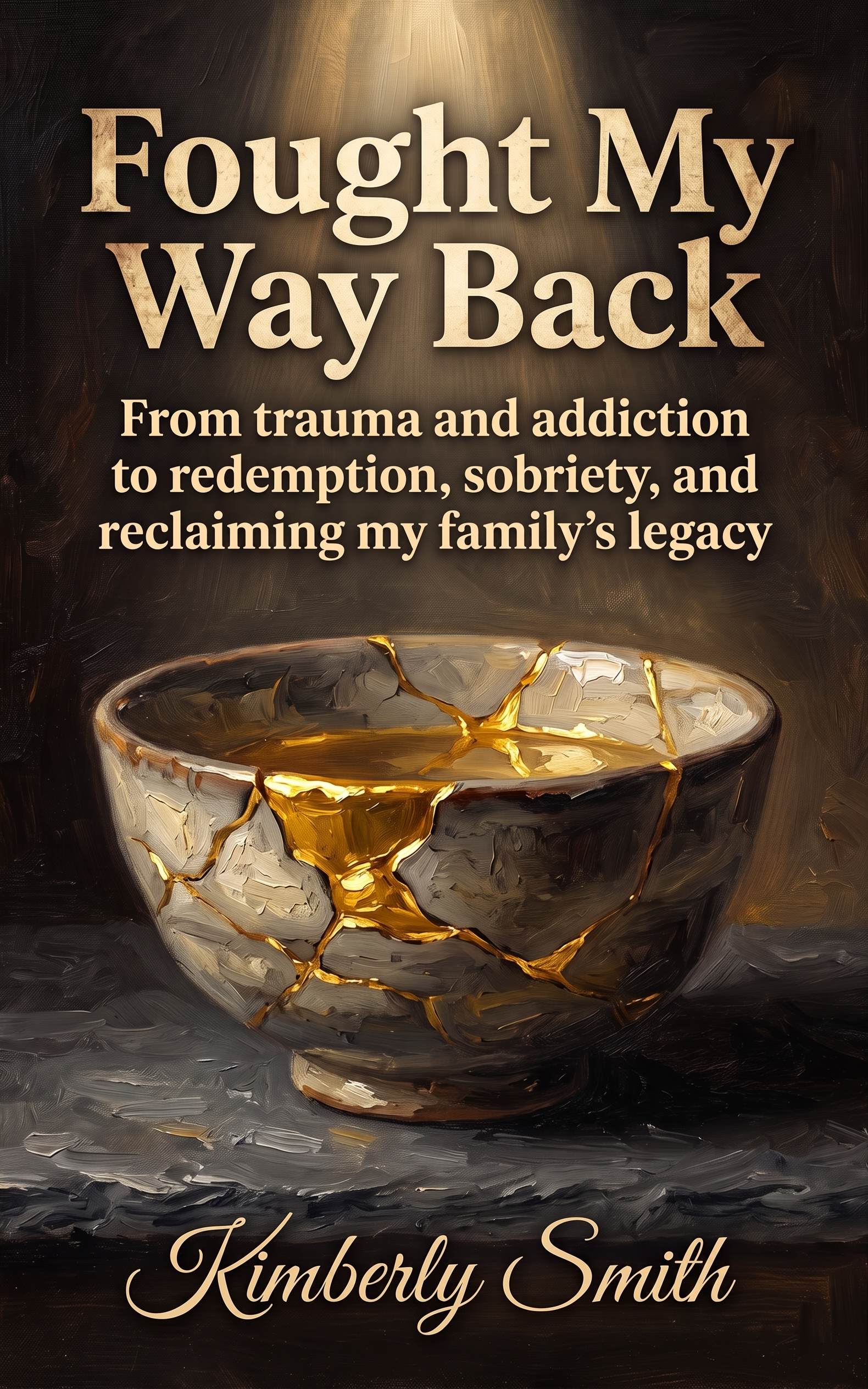
Fought My Way Back
From trauma and addiction to redemption, sobriety, and reclaiming my family's legacy
by Kimberly Smith
How far down can you fall before you lose your way forever? Born into privilege, Kimberly Smith's life shattered before it truly began. Betrayed by childhood abuse, she sought escape in wild rebellion, street life, addiction, and a decade as an exotic dancer—a downward spiral that ultimately cost her custody of her beloved children. Then, at age fifty, a near-fatal crisis in the intensive care unit forced a final, terrifying choice: surrender to the darkness or fight for her life. She chose to fight. Ten years sober, with a college degree and a reclaimed sense of self-worth, Kimberly tells the unflinching truth of her journey back to light. Written as a heart-wrenching legacy for her children and grandchildren, Fought My Way Back is a raw testament to resilience. It proves that no matter how deep the trauma or how devastating the loss, redemption is always within reach for those willing to do the hard work of healing.
- Biography
- Parenting & Family
- Addiction & Recovery Memoir
- Overcoming Adversity
- Family Memoir
- Survival Memoir
The Big House on the Hill
From the street, our house looked like the very picture of the American dream. It was the late 1970s, and we lived in a sprawling, beautiful home situated in a quiet, wealthy suburban neighborhood. Everything about the neighborhood was polished to absolute perfection. The lawns were manicured every single week, green and neat without a single dandelion out of place. Big trees shaded the wide streets where kids rode their bicycles without a single care in the world, and cars pulled into long asphalt driveways after long days at the office. To anyone passing by, our lives looked complete, comfortable, and envied. People thought money meant peace, and looking at our big house on the hill, nobody had any reason to suspect that anything was wrong.
I remember looking out of my bedroom window as a young girl, taking in those peaceful streets and trying so hard to match what I was feeling on the inside with what I saw on the outside. But outer prosperity is a funny thing. It creates a smooth, glossy surface that masks the deepest kinds of pain, convincing the outside world that everything is fine while everything on the inside is falling apart. People assume that if you have a roof over your head, food on your table, and nice clothes on your back, you are protected. They think that wealth shields a family from trouble. But safety is not found in the brick and mortar of a big house. Safety is built in the trust between the people living inside it, and in our house, that trust was crumbling quietly behind closed doors long before anyone ever said a word out loud.
Inside our home, the atmosphere was a stark contrast to the perfect image we projected to the neighborhood. The air felt heavy, filled with an emotional distance that was hard to explain but impossible to ignore. My mother worked hard to keep up appearances, making sure the house was spotless, the decor was tasteful, and our public reputation remained spotless. But beneath that organized surface, there was a quiet, growing tension. We did not talk about real feelings in our home. We did not sit down to clear the air when things felt wrong. Instead, uncomfortable emotions were pushed deep down, brushed under the rug so we could maintain the impression that we had it all together. Domestic issues were treated like dirty secrets that had to be hidden at all costs, because looking good to the neighbors mattered more than fixing the actual hurt taking place in our living room.
This dynamic only grew worse when my mother started dating a new man, who eventually moved into our house. His arrival brought a subtle, uneasy shift in the daily rhythm of our lives. At first, everything seemed normal enough on the surface, but it did not take long for the energy in the house to change completely. He stepped into our home and carried an authority that felt heavy and imposing. My mother was focused on her relationship and on maintaining the smooth routine of the household, which left very little room for her to notice the quiet shifts happening right in front of her. The house remained grand, the manicured lawn outside stayed green, but the space inside felt smaller, colder, and increasingly dangerous.
It was not long before my bedroom, the one place that was supposed to be my sanctuary, turned into a space of constant, inexplicable dread. A bedroom should be where a child feels most secure, a quiet place to sleep, dream, and drop their guard after a long day. But for me, that feeling of security completely disappeared. Every time evening came and the rest of the house grew quiet, a thick knot of anxiety settled deep in my stomach. I would lie awake in the dark, my heart pounding in my chest, listening to every slight creak of the floorboards down the hallway. I found myself staring at the bedroom door, waiting and watching, filled with a terrible fear that I could not talk about with anyone. The big, comfortable house could not protect me from the fear that lived right down the hall.
The constant, heavy burden of that fear began to spill over into the rest of my life, even though I did my best to hide it. I started pulling away from school activities and distancing myself from my friends. Things that used to bring me joy, like playing outside or hanging out after school, suddenly felt exhausting and meaningless. I was carrying an invisible weight every single hour of the day, a heavy cloud of confusion and terror that consumed all my thoughts. When you are a child living with that level of fear, you learn how to make yourself invisible. You walk quietly, you keep your head down, and you try not to take up too much space. I stopped talking as much, stopped sharing what was going on in my head, and withdrew into a shell just to survive each day.
What hurt just as much as the fear was the total silence from the adults around me. No one seemed to notice that I was drowning. The teachers at school saw a quiet girl who was sitting still in her seat, so they assumed everything was fine. The neighbors saw a well-dressed child living in a beautiful suburban house, so they had no reason to ask questions. And inside the house, my mother was too wrapped up in her own life and her desire to keep up appearances to see the radical change in her daughter. When a child is suffering in plain sight and no one reaches out to help, that child learns a very dangerous lesson: that their pain does not matter, and that they are entirely on their own in the world.
Now, looking back on those days as a sixty-year-old woman who has lived through the fire and come out on the other side, I see those years with complete clarity. I have spent decades processing the wreckage of my past, fighting my way through addiction, loss, and recovery, and I can look back at that young girl in the big house with deep empathy and understanding. I realize now how easily external wealth masks internal devastation. People are so easily fooled by nice things. They look at a big house on a hill, a manicured lawn, and nice clothes, and they assume that the people inside are thriving. But material abundance can be the biggest illusion of all, hiding severe family dysfunction under a layer of comfort and privilege.
When a home lacks genuine emotional connection, when real feelings are suppressed and domestic problems are hidden away to protect an image, children become profoundly vulnerable. Early emotional neglect creates a quiet emptiness inside a child, a void that makes them feel worthless and unprotected. Abusers can sense that vulnerability from a mile away. They prey on children who live in homes where communication is shut down, because they know those children have nowhere to turn and no one to confide in. When a child feels isolated within their own family, an abuser knows that the silence in the home will act as their greatest shield.
For four long years, I kept that terrifying secret locked deep inside myself, carrying a burden that no child was ever meant to bear. The weight of it grew heavier with every passing month, corroding my spirit and making me feel completely disconnected from the world around me. Finally, when I could not hold it in any longer, I gathered every ounce of courage I had left and confided in my best friend. I told him everything that had been happening behind the closed doors of our home for those past four years. I just needed one person to know the truth, one person to hear me and acknowledge the pain I was living through every single day.
My best friend was horrified by what I shared, and he went straight to his mother and told her what was happening in my home. His mother did what any responsible adult should do when a child is in danger: she reported it, and Child Protective Services got involved. For a brief moment, it felt as though the truth was finally breaking through the walls of silence that had kept me trapped for years. I thought that maybe, just maybe, the adults were finally going to step in, make the horror stop, and protect me from the person who was hurting me.
But the reaction I received at home completely shattered whatever small piece of hope I had left. When the authorities contacted my family and my mother found out that the truth was out, she did not pull me into her arms. She did not cry for what I had experienced, nor did she rage at the man who had harmed her daughter. Instead, her anger was directed right at me. She turned to me, cold and furious, and said words that would stay burned into my mind for the rest of my life: "This is why I told you to wear a robe around the house."
Those words felt like a physical blow, knocking the breath completely out of my chest. In that single, terrible sentence, my mother shifted the entire blame of four years of abuse squarely onto my shoulders. She made me feel as if the terrible things done to me were my fault, as if a child's choice of clothing could somehow justify or cause a grown man's predatory behavior. Instead of holding the abuser accountable, she blamed her frightened, traumatized daughter for exposing the family's dark secret and ruining the neat, tidy picture she had worked so hard to maintain. That moment crushed something deep inside me. It taught me that I was responsible for my own abuse, a lie that took me decades of suffering, addiction, and hard work to unlearn.
It is important to understand that this kind of dynamic is not unique to my childhood. Family dysfunction that hides behind a wall of suburban wealth happens in countless homes every single day. Take the case of Jerry Garrett, for example. Jerry grew up in an affluent suburban neighborhood very much like mine. On the outside, his family had everything: a massive home, high-end cars, expensive vacations, and a standing that made them look like the ideal family. But inside his house, severe domestic issues and emotional neglect were constantly swept under the rug to protect the family's public image. Jerry's parents were far more concerned with what the neighbors thought than with addressing the pain and isolation growing within their own walls.
As Jerry grew older, that deep emotional isolation followed him into adulthood. Because he had been taught from a young age that appearances mattered more than reality, he learned to hide his real feelings behind a polished mask. He struggled with intense anxiety, severe trust issues, and an inability to form meaningful, authentic relationships with anyone. On paper, Jerry was successful, but on the inside, he was completely disconnected and hollowed out by the silent neglect of his childhood. His story is a clear example of what happens when a family chooses public image over genuine emotional care. The material comfort of his youth could not prevent the deep emotional scars that stayed with him for decades.
When I think about Jerry's story and my own childhood in that big house on the hill, I am reminded of how easy it is to confuse material security with genuine emotional safety. We live in a world that constantly tells us that if we have enough money, a big enough house, and all the right possessions, our families will be safe and happy. But prosperity cannot heal a broken heart, and a large house cannot protect a child who feels utterly alone inside its walls. Real safety requires something far deeper and much harder to build than physical wealth.
To help process these truths, consider these reflection questions about your own upbringing:
- How did the environment you grew up in influence your understanding of safety?
- Were there unspoken truths in your childhood home that you felt forced to keep silent?
Taking the time to honest answer these questions is essential for anyone looking to heal from past family trauma. We have to look at the reality of our upbringing, stripped of the excuses and the polished appearances, if we are ever going to build something better for ourselves and the people we love.
Writing this book now, after fighting my way back from the absolute brink of death and spending ten years in complete sobriety, I am writing directly to you—my precious children and my wonderful grandchildren. I want you to hear this truth loud and clear, and I want you to carry it in your hearts for the rest of your lives. Money, big houses, expensive things, and beautiful surroundings do not equal emotional safety. They never have, and they never will. You can live in the grandest mansion on the hill and still be surrounded by coldness, fear, and pain. Never let the world trick you into thinking that material wealth is the measure of a good life or a safe home.
True security comes from the things that money can never buy. It is built on open communication, absolute trust, and deep, unconditional love within the home. A safe home is a place where you can speak your truth without fear of being blamed, dismissed, or silenced. It is a place where your feelings are heard, your pain is acknowledged, and your emotional well-being is valued far above what the neighbors might think. I spent so many years of my life lost in darkness, running from the pain that started in that big house, because I believed the lie that I was to blame for what happened to me. But I fought my way back so that I could break that cycle once and for all, and pass a different legacy down to you.
I want our family legacy to be one of radical honesty, absolute safety, and unwavering support. I want you, my children and grandchildren, to know that you can always come to each other—and always could have come to me—with your truths, no matter how uncomfortable or difficult they might be. We do not sweep things under the rug in our family anymore. We do not protect image over people. We protect each other, we speak the truth in love, and we build our lives on a foundation of real trust. That is the true wealth I want to leave for you, a gift far greater than any big house on a hill could ever offer.
Stolen Trust
The bright daylight would hit the front yard of that suburban house, washing over the manicured grass and reflecting off the grand glass windows, but inside, the shadows stayed trapped in the dark room down the hallway. It was a space defined by a heavy, suffocating silence that made the air feel cold even in the heat of summer. You could look out …