

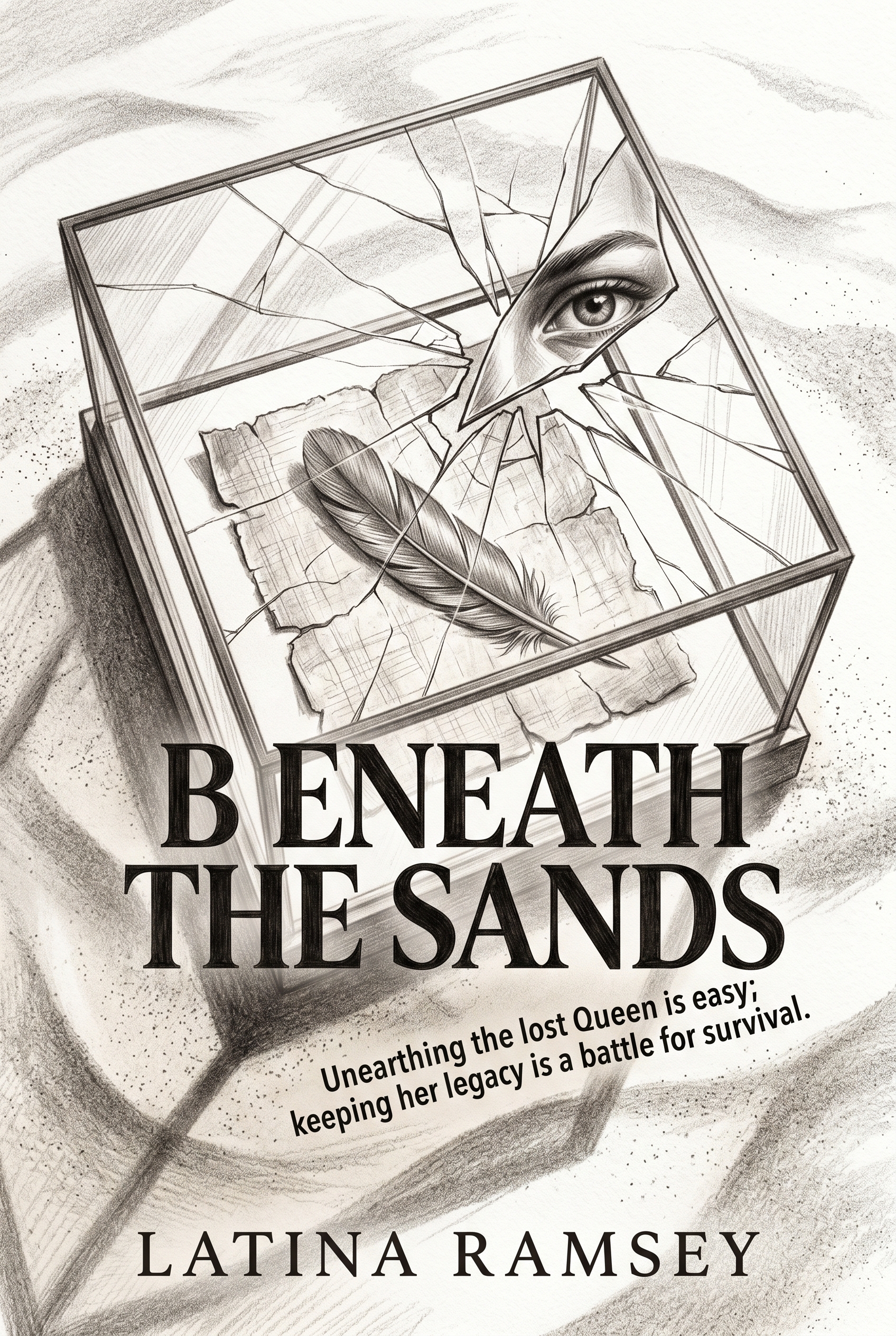
Beneath the Sands
Unearthing the lost Queen is easy; keeping her legacy is a battle for survival.
by Latina Ramsey
Dr. Arianna Jefferson has spent a lifetime listening to the whispers of the Egyptian desert, searching for the one queen history tried to forget. As a Black woman in an academic field built on exclusion, Arianna is used to working twice as hard for half the recognition. But when she discovers the undisturbed tomb of Nefertiti, she isn't just making history—she’s disrupting it. The world erupts in a frenzy of flashbulbs and fame, but beneath the surface, the jackals are circling. Her former mentor and a ruthless corporate executive move to seize the find, using legal warfare and character assassination to erase Arianna from her own achievement. In the high-stakes world of international archaeology, the truth is a commodity to be bought and sold. From the sun-scorched Valley of the Queens to the cold marble halls of power, Arianna must navigate a web of betrayal. As her relationships fray and her safety is threatened, she is forced to decide: How much is she willing to sacrifice to protect the dignity of the dead? Beneath the Sands is a powerful exploration of identity, institutional greed, and one woman's refusal to be buried by the very history she uncovered.
- Literary Fiction
- Women's Fiction
The Geometry of Intention
The first time I saw the pyramids, I almost cried. It was not because of their ancient majesty, though they rose against the horizon like jagged teeth biting into the blue sky. It was because the air conditioning on the tour bus had died halfway from Cairo, and I was already sticky, overdressed, and suffocating under the weight of my father’s expectations. My linen shirt clung to my ribs, and the collar of my heavy cotton jacket felt like a hand pressing against my throat.
“Smile, Arianna,” my father said, holding his phone high above his head to catch the light. The screen caught the glare of the noon sun, reflecting my sullen scowl back at me. “You’re in Egypt, baby. Look like you’re enjoying the trip of a lifetime.”
I was seventeen years old, hopelessly jet-lagged, and clutching a dog-eared paperback history of the Eighteenth Dynasty that I had practically memorized during the flight over the Atlantic. My mother had double-checked my passport three times at the gate in Atlanta, her fingers trembling as she smoothed down my braids. She had held onto me as if I might dissolve into the humid southern air before the plane could even taxi onto the runway.
“We are so proud of you, Ari,” she had whispered, her voice cracking as she pressed a folded stack of twenty-dollar bills into my palm. It was her own secret stash, kept in a ceramic jar behind the flour bin, away from my father’s practical ledger. “But you call me every Sunday. And you eat. I do not care how busy those professors keep you, you make sure you eat.”
I had not felt proud then. I had only felt incredibly out of place. I was too tall, too dark, and far too quiet for the glossy promotional pamphlets the study abroad office had handed out, which featured smiling blond students in crisp white pants laughing against a backdrop of sand dunes. On the bus ride from the airport, I had pressed my forehead against the hot glass, watching Cairo reveal itself in a dense, chaotic rush of satellite dishes, laundry lines, minarets, and massive billboards. It looked nothing like the sanitized, static plates in my textbooks. It looked alive, which was both terrifying and deeply thrilling.
When the bus finally hissed to a halt at the Giza plateau, the other students spilled out into the heat in a loud, chaotic cluster. They shrieked and laughed, immediately raising their phones to snap selfies against the desert backdrop. I hung back in the shadow of the metal steps, hugging my backpack to my chest and feeling the sweat pool along my spine.
One of the program coordinators, a tall woman with sunburned shoulders and a clip-on badge, clapped her hands to gather our attention. “Okay, everyone! Group photo by the low wall in five minutes, and then you are free to wander a bit. Remember to stay where we can see you.”
I wanted to run. I wanted to escape the chatter and the bright, superficial energy of the group and find a quiet corner of the plateau where the stone could speak. Instead, I stood on the very edge of the gathering, half-submerged in the shadow of a limestone block, watching them. I was close enough to be included in the frame, but far enough away to ensure I did not truly belong.
Later that afternoon, when our group moved through the high, echoing halls of the Egyptian Museum, I found my chance. The chatter of the students faded as they clustered around the glittering treasures of Tutankhamun, their voices echoing off the high ceilings. I slipped away from the main corridor, my boots making no sound on the worn floor tiles. My feet seemed to carry me forward with a strange, quiet certainty, navigating past massive sarcophagi and dusty glass display cases with hand-written labels.
I stepped into a smaller, dimly lit gallery that smelled faintly of dry paper and beeswax. And there, resting on a simple pedestal, was the bust of Nefertiti.
In the middle of the crowded museum, she existed in a sphere of absolute stillness. The light seemed to gather around the painted limestone of her face, pooling like water on stone. A crowd of tourists stood before her, a barrier of cameras and raised phones, their voices murmuring in French, German, and Japanese. I stood at the very back of the room, my fingers tightening on my backpack straps until my knuckles turned gray.
She was smaller than I had imagined from the full-page plates in my library books. Her neck was longer, more delicate, tilting slightly under the weight of her tall blue crown. Yet, there was an undeniable authority in the curve of her jaw and the quiet symmetry of her features. In every lecture I had attended, in every chapter I had read, she had been relegated to the role of a supporting actress. She was Akhenaten’s beautiful consort, a lovely face in the background of a king’s religious revolution. A footnote to a man’s history.
But standing there, looking at the painted limestone, I felt something shift in my chest, a sudden alignment like a fractured bone clicking back into place. I knew, with a certainty that defied my lack of credentials, that they were wrong. She was not a shadow. She was a co-ruler, a woman whose power had been so formidable that those who came after her had spent lifetimes trying to scrape her name from the stone.
I mouthed her name silently, testing the weight of the syllables in my mouth. Nfr.t iy.t. The beautiful one has come. It felt less like learning a new word and more like remembering a name I had forgotten.
Now, seventeen years later, the memory of that museum gallery still lingered in the quiet corners of my mind. I stood in the center of my small Cairo apartment, looking down at the single battered suitcase resting on my unmade bed. The walls of the room were bare, stripped of the maps and archaeological surveys that had covered them for the past three years. The air in the room was warm and heavy, smelling of the chicory coffee I had brewed that morning and the dry dust drifting in through the open window.
The transition from that teenage wonder to my current reality was etched into the skin of my hands, which were rough, calloused, and permanently stained with graphite. I was no longer the girl hiding in the shadows of a tour bus, but the weariness in my shoulders was a different kind of weight. The phone on my small wooden table was silent now, but the email from the Permits Office remained open on the screen, a digital promise that felt as fragile as ancient papyrus.
I folded my remaining linen shirts and packed them neatly into the suitcase, alongside my sketchbooks and my measuring tapes. Every object had its place, a tight, efficient geometry of survival. As I zipped the bag closed, I felt the phantom pull of my mother’s voice from across the ocean, a recurring theme in our weekly phone calls. When are you coming home, Ari? When is enough, enough?
She wanted a normal life for me, one measured by steady paychecks, backyard barbecues, and a quiet house in the suburbs. But my life had become tethered to a woman who had been dust for three thousand years. I walked to the window, looking out over the crowded roofs of Cairo as the afternoon heat began to settle over the city. I was leaving for the southern wadis in the morning, moving closer to the silence of the desert. I had no safety net, and my savings were gone, but as I locked the apartment door behind me, I knew there was no turning back.
The Girl in the Margins
The sand remembers everything. It remembers the weight of kings and the hush of queens. It remembers craftsmen’s hands, the drag of sledges, the hiss of wind over stone. Today, it remembers the shape of my boots as I walk alone along the low ridge skirting the Valley of the Queens. The sun hasn’t fully risen yet, but the heat is already coiling a…