

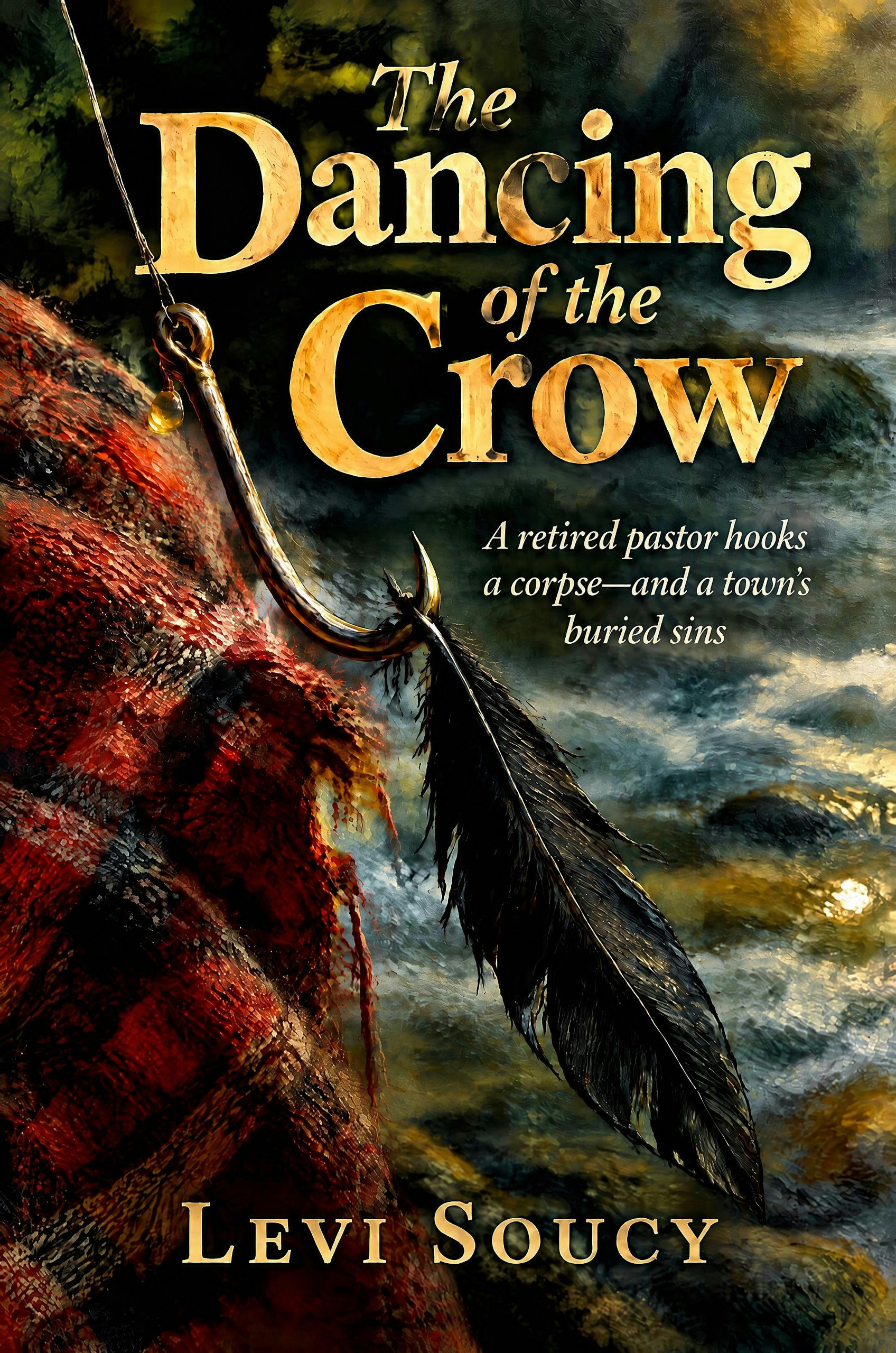
The Dancing of the Crow
A retired pastor hooks a corpse—and a town’s buried sins
by Levi Soucy
Ernest Galloway came to the Piscataquis for quiet water and smallmouth bass. Retirement was supposed to mean fly rods, not funerals. On his second backcast, the barbed hook snags torn flannel in the brush. The body belongs to Arthur Overton, a man Ernest once baptized, buried in name only among the cattails. County investigator Clara Mason treats it as homicide and eyes Arthur’s younger brother, Carl. Ernest knows Carl’s gentle nature. Duty, not curiosity, pulls him in. With librarian Lillian Cross he follows fraudulent riverfront deeds, midnight trucks on the mill road, and a salvage operator who will burn, frame, and kill to keep the land grab hidden. Before the killer strikes again, a retired pastor must choose between the peace he wanted and the truth a congregation still needs.
- Mystery
- Amateur Sleuth
- Murder Mystery
- Small Town Mystery
- Cozy Mystery
A Snag in the Current
The dawn fog hung low over the Piscataquis River, clinging to the dark water like steam rising from a kettle. On the porch of his cabin, Ernest Galloway set down a chipped porcelain mug of black coffee and pulled on his fleece-lined flannel shirt. The wood planks were damp beneath his thick woolen socks. For forty years, the early hours of his mornings had belonged to parish bulletins, hospital rosters, and the steady ring of the church office telephone. Today, the only schedule lay in the steady pull of the current a few hundred yards down the path.
He lifted his wicker creel by its leather shoulder strap, checking the brass buckle. Inside, his small tackle boxes sat neatly beside a spool of fresh tippet and a pair of brass hemostats. His nine-foot graphite fly rod rested in its cloth sleeve against the railing. He drew the rod sections out, aligned the snake guides with practiced hands, and fitted the ferrule joints snugly together. The air smelled of wet spruce, decaying maple leaves, and the sweet, mineral chill of northern Maine in early October.
Ernest walked down the narrow trail through the alder thickets. His wading boots crunched into gravel and soft moss. The river emerged before him, wide and gray-green in the first light, curving gently between steep banks lined with tangled willows and hemlock. Smallmouth bass favored the slow pools behind the boulders here before the autumn frost pushed them into the deep winter holes. He pulled on his chest waders, checked the straps, and stepped into the water.
The river was cold, pressing the rubber hard against his shins and knees. He took three careful paces out, feeling the slick, rounded river stones underfoot. The bottom was firm enough. He tied an olive woolly bugger to the tapered leader, wet the knot with saliva, and pulled it tight before snipping the tag end with his teeth. Raising the rod, he drew eight yards of line from the reel and began his cast.
The graphite flexed smoothly, sending the pale green fly line in a tight loop above the mist. His first cast landed softly fifteen feet out, near an eddy behind a drowned birch log. He stripped the line in short, rhythmic pulls, feeling the subtle tug of the current. Nothing struck. He lifted the line off the surface for a second cast, turning his shoulder slightly toward an overgrown willow bend where the water ran dark and deep against the bank.
His backcast went wide, cutting through the frosty air. When he brought the rod forward to shoot the line, the tip bowed sharply. The rod strained in his grip, bending almost double.
Ernest held the cork handle with both hands, his boots shifting on the cobbles. He had caught the brush. Still waters can harbor cold snags, he thought with a rueful smile. It was an old fisherman's truth, as familiar to him as the beatitudes. He pointed the rod tip straight toward the obstruction and stripped the slack in with his left hand, hoping to pull the fly loose from whatever submerged branch had claimed his hook.
The line gave slightly, but it did not pop free. Something heavy moved against the river bottom, rolling upward through the tea-colored water. A tangled clump of waterlogged fabric broke the surface near the tangle of deadfall beneath the willows. Red and black wool, soaked to near blackness, drifted into view.
Ernest stopped reeling. He stepped two paces closer, the water pushing heavily against his thighs. The shape beneath the surface was not a waterlogged branch. Through the clear, cold water, pale skin showed against the river mud. The hook of his woolly bugger was embedded deep in the frayed shoulder seam of a heavy flannel jacket. Entangled within the alder branches and cedar roots lay a man, wedged face down among the sunken timber.
Ernest worked his way through the push of the current, water rippling against his waist. He reached down and gripped the sodden wool, pulling back the branches that held the body trapped. The river rolled the corpse onto its side, and the pale, water-bleached face broke the surface.
The air left Ernest's chest in a ragged gasp. The face was bloated, the lips pale blue, but the square jaw and broken ridge of the nose were unmistakable. It was Arthur Overton.
For a long second, the river made no sound except the cold lap of water against Ernest's waders. Arthur had sat in the fourth pew of his Dover-Foxcroft chapel for nearly a decade. He was a quiet, broad-handed carpenter who repaired storm windows for the widows in town and never charged a dime. Just last spring, Arthur had helped Ernest shore up the church basement steps, laughing quietly about the stubborn frost heaves in the valley.
Now Arthur lay staring into the gray sky with cloudy, lifeless eyes.
Ernest reached out with a trembling hand, closing the man's eyelids with his thumb. "The Lord bless you and keep you, Arthur," he whispered into the morning mist. His pastoral training took over for a moment, anchoring him against the rising horror. Then his practical senses returned. He secured the heavy flannel jacket against a sturdy root so the current would not carry Arthur downstream, unhooked his fly with careful fingers, and waded backward out of the river.
The mud on the bank sucked at his boots. Ernest scrambled up the dirt slope, breathing hard. He hurried up the path toward his cabin, dropping his rod onto the porch boards, and went straight to his old pickup truck parked by the gravel drive. He picked up the handset of his two-way radio and dialed through to the county dispatcher, speaking with calm precision despite the tremor in his hands.
Deputy Clara Mason arrived twenty minutes later, her patrol vehicle kicking up wet gravel as it braked near the cabin porch. She stepped out in a crisp khaki county sheriff's uniform, utility belt shifting with a clatter of leather and metal. Her dark brown ponytail was pulled back tightly beneath her cap, and her gray eyes were narrow and alert.
"Reverend Galloway," she said, nodding once as she reached into the trunk for a reel of yellow barricade tape. "Dispatch said you found someone by the willows."
"Arthur Overton," Ernest said, walking beside her down the trail. "He is wedged in the brush near the south bend. I found him while casting my line."
Clara stopped at the edge of the riverbank, assessing the water and the dark shape visible among the submerged branches. She unspooled the tape, stringing it between two young hemlocks to seal off the approach. "Why this spot, Reverend? You only bought the cabin last month. Most folks don't fish this stretch because of the snag hazards."
"A neighbor at the hardware store mentioned the smallmouth bass gather in the tail of the eddy," Ernest replied gently. "I had no purpose here beyond an hour on the water."
Clara pulled a pair of heavy rubber boots from her kit, swapped her shoes, and stepped cautiously down to the waterline. She leaned over Arthur's body, parting the reeds and the floating hem of his jacket. She did not touch the body directly, but her gaze lingered on Arthur's hands, which were half-submerged in the silt.
"Look at his forearms," Clara said, pointing with a pen. "Deep scrapes and purple contusions across both wrists. Those didn't come from rocks or driftwood. Those are classic defensive wounds. Someone attacked him before he went into the river."
Ernest stepped to the edge of the bank, his hazel eyes following the line of her pen. He looked away from the body and toward the muddy slope just five yards upstream from the willow thicket. The dark soil was churned, and deep, rectangular tread marks cut through the ferns, ending right at the water's edge.
"Deputy," Ernest said quietly, pointing toward the bank. "Those tire tracks are fresh. The rainwater hasn't pooled in them yet, and the fern stems are still snapped green. Whoever brought Arthur here came down by vehicle, and they didn't do it long ago."
Clara turned her head, her slate-gray eyes fixing on the crushed vegetation and then on Ernest. Her posture stiffened, rigid and formal.
"Let's stick to verifiable facts, Reverend," she said, her voice brisk and devoid of warmth. "The sheriff's office handles forensic analysis. Don't touch anything, and step back behind the line. We have a homicide investigation now, and I will not have my scene compromised."
Ernest inclined his head and stepped back behind the yellow tape, watching the gray current sweep past the willows.
The Deputy's Ledger
Heavy tires ground over gravel before the county van even rounded the hemlock bend, and Ernest heard it coming a full minute before he saw it. The van rocked on its axles down the private lane, its wheels found every washboard rut on the way to the water. Behind it came an unmarked white sedan, which was kicking up a rooster tail of fine gray grit …