

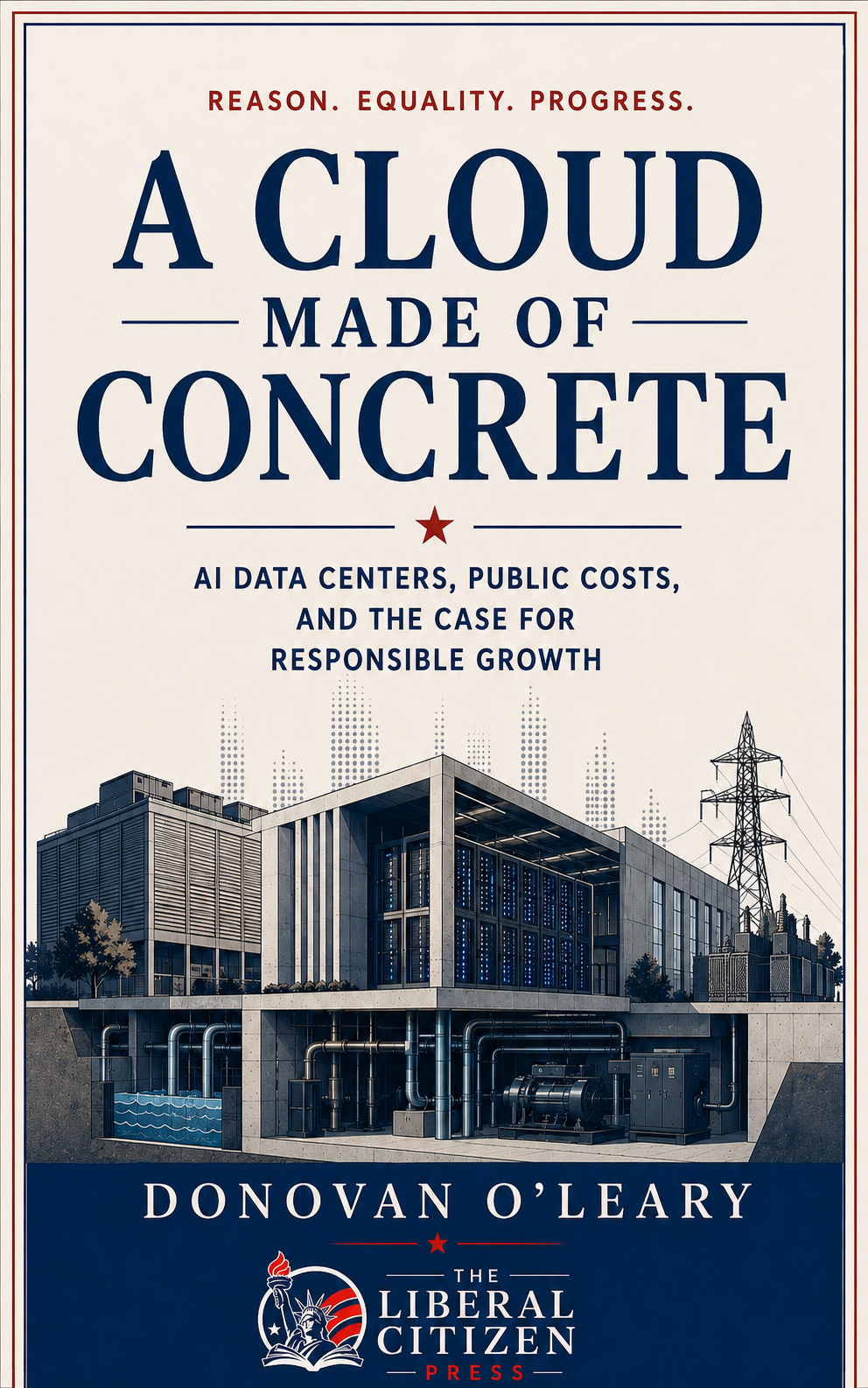
A Cloud Made of Concrete
AI Data Centers, Public Costs, and the Case for Responsible Growth
by Donovan O'Leary
The cloud is not vapor. It is concrete, copper, water, and megawatts. Artificial intelligence is driving the fastest build-out of industrial infrastructure in a generation. Data centers now draw as much power as small nations, tap regional aquifers, and rewrite local tax bases—while communities inherit the heat, noise, and e-waste. This book is a legislative playbook, not a manifesto. Donovan O'Leary maps the real economic gains against grid strain, water loss, public-health costs, mineral supply chains, and fossil-fuel bundling. He compares cooling technologies, additionality rules, and overseas regulatory models, then delivers a three-pillar framework and a ready-to-file Model Data Center Act. The window is short. Lobbying is already reshaping statehouses. Grassroots pushback is rising. If lawmakers wait, growth will lock in the worst costs and forfeit the best benefits of AI. A Cloud Made of Concrete is the bipartisan case for building the future without bankrupting the commons.
- Science & Technology
- Educational & Academic
- Artificial Intelligence
- Environmental Studies
- Political Science
- Law & Legal Studies
The Digital Tectonic Shift
A woman types a question into ChatGPT at her kitchen table. A teenager streams a show while a search bar autocompletes his next thought. Neither person pictures a warehouse of humming servers a thousand miles away. That gap between the tap of a screen and the machinery behind it is the story this book tells.
The numbers involved are almost hard to believe. Companies are pouring roughly one trillion dollars a year into data center construction. By 2026, these facilities will consume 565 terawatt-hours of electricity, and that figure climbs past 1,200 terawatt-hours by 2030. That is more power than entire industrialized nations use in a year, with projections placing data center consumption on par with Japan's national grid [1].
These buildings are the cathedrals of our era: massive, expensive, and built to last for decades. Unlike medieval cathedrals, though, most people will never see one, let alone know it exists. This is invisible infrastructure, hiding the true cost of convenience.
Here is the urgency: once concrete is poured, decisions are locked in for a generation. Lawmakers have three to five years to get this right. This book is the playbook.
The Economic Engine
\*Purpose: Make the case for data centers as economic drivers\* Write a chapter that: 1\. Presents the economic benefits honestly and comprehensively 2\. Covers: tax base revitalization, job creation (construction and permanent), multiplier effects 3\. Discusses the geopolitical imperative: national security, AI dominance, and global competition…