

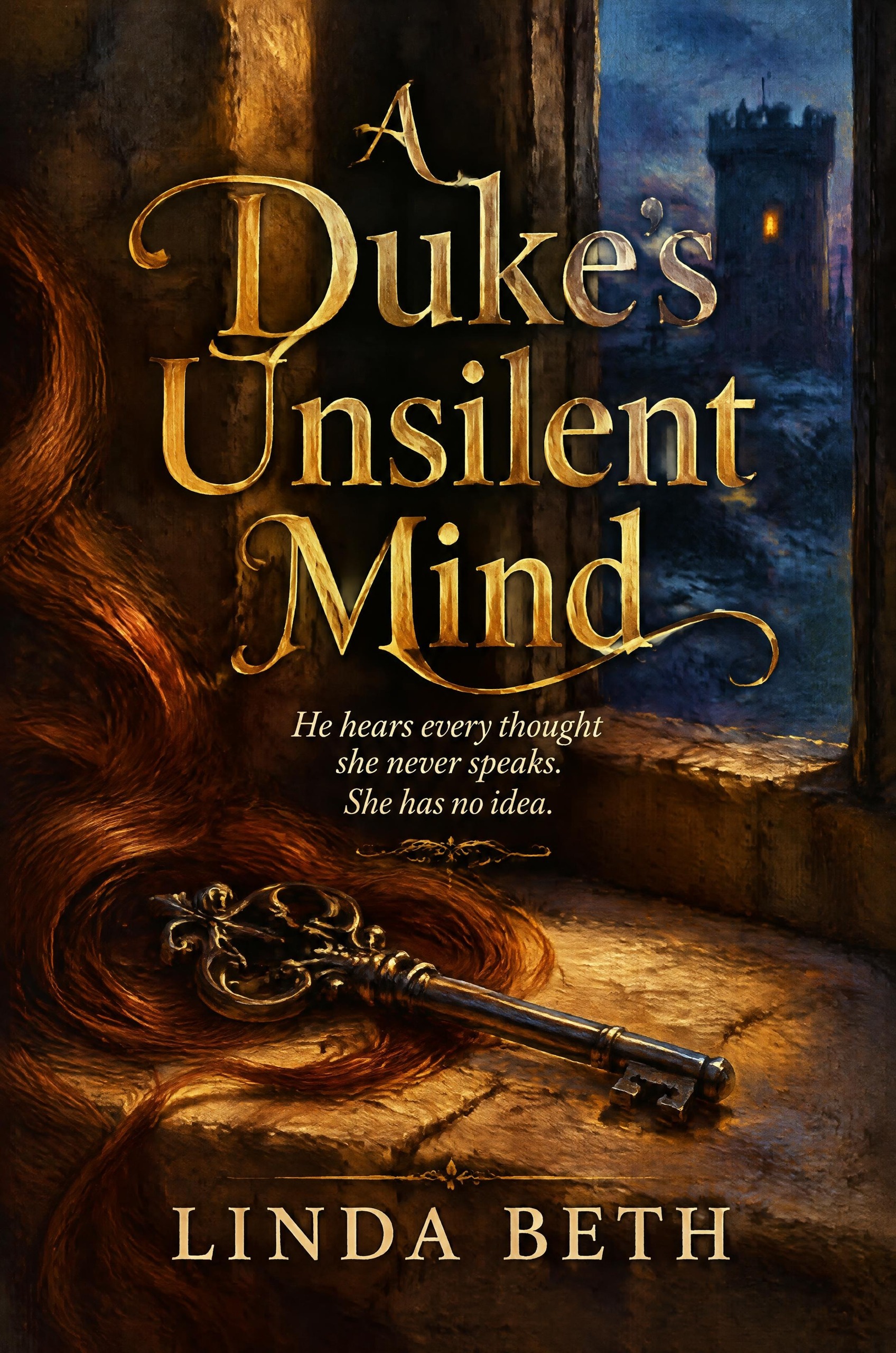
A Duke's Unsilent Mind
He hears every thought she never speaks. She has no idea.
by LINDA BETH
William Taylor rules his fortress with cold precision and a reputation that makes grown knights flinch. He does not smile. He does not laugh. He certainly does not tolerate foolishness. Then Margery Webb arrives for a winter visit, and everything unravels. Margery is perfectly polite. Her curtsies are flawless, her conversation agreeable, her demeanor everything a noblewoman's should be. But inside her head, she is roasting William's brooding silences, mentally redecorating his dreary great hall, and imagining elaborate schemes involving the castle cats that would scandalize the entire household. William knows all of this because a bizarre magical mishap has given him the ability to hear every single unfiltered thought in her head. She has no idea. One moment he is enduring her polite small talk about the weather. The next he is choking on his wine while her internal monologue dissects his intimidating stare as looking rather like a constipated owl. Surrounded by a fussy steward, a cook with a long-standing feud, and a grieving captain of the guard who has somehow adopted a stray goat, William finds himself helplessly drawn to the one woman who sees right through him without even knowing it. But a scheming rival has her own plans for the duke, and Margery's inner world may not stay secret forever. When the truth comes out, both of them must decide whether being truly known is a violation or the most precious gift either has ever received. A Duke's Unsilent Mind is a laugh-out-loud medieval romantic comedy about the chaos of being seen for exactly who you are.
- Romance
- Historical Fiction
- Historical Romance
- Romantic Comedy
- Medieval
The Arrival
The carriage rattled across the drawbridge with a sound like dying furniture, and Margery Webb pressed her forehead to the cold window glass and thought: Well. This is either the beginning of a romance novel or a cautionary tale about accepting invitations from brooding warlords one has never met.
Ashworth Fortress loomed above her, gray and immense and entirely unapologetic about it. The battlements were crenellated in that particular way that said the architect had been thinking primarily about pouring boiling oil on people. November wind whipped across the outer bailey, snatching at the carriage curtains and making the guards on the gatehouse huddle deeper into their cloaks. It was, Margery decided, exactly the sort of place where a heroine might be imprisoned by a scarred duke with a dark past and a heart waiting to be thawed.
Or, she thought as the carriage jerked to a halt, it is the sort of place where I will spend four months being aggressively polite to people who wish I would leave, and then I will go home and write a very long letter to my sister about the draft.
A servant opened the carriage door, and Margery arranged her face into its traveling expression: pleasant, agreeable, the face of a woman who had never once in her life composed a ballad about a cook's feud with a butcher. She stepped down into the bailey, her practical blue wool skirts immediately picking up mud at the hem, and was met by a slight man in a steward's chain who looked as though he had been worrying about her arrival for approximately six weeks.
"Lady Webb. Hugh Clerk, steward of Ashworth. I do hope your journey was not overly arduous. The roads are quite dreadful this time of year, and the rain has been simply relentless, and I must apologize for the state of the courtyard. The grooms were meant to have swept it, but there was some confusion about the roster, and—"
He looks like a hedgehog, Margery thought. A worried hedgehog in spectacles. I wonder if he frets about the weather in his sleep.
Aloud, she said: "The journey was perfectly comfortable, Master Clerk. You are most kind to concern yourself."
Hugh blinked at her, his spectacles slightly askew, and then seemed to remember that he was supposed to be doing something. He began fussing over her trunks, issuing contradictory instructions to two serving boys, and apologizing for the drafty corridors before they had even entered the castle proper. Margery followed him through the gatehouse and into a great hall that was exactly as drafty as promised.
The hall was enormous, stone-walled and high-ceilinged, with tapestries that looked as though they had not been beaten since the last crusade. A fire crackled in a hearth large enough to roast an entire ox, and the light it cast was the color of old whiskey. Suits of armor stood at intervals along the walls, their visors down, their gauntlets empty, and Margery thought: I have seen livelier expressions on furniture. At least the armor probably does not expect me to make small talk about the wool trade.
And then she saw the duke.
He was standing before the hearth with his arms crossed over his chest, and he looked exactly like every brooding warlord Margery had ever imagined and then some. Tall, broad-shouldered, dark-haired, with a face that seemed to have forgotten how to smile somewhere around the age of twelve and never bothered to remember. A faded scar ran from his jaw down beneath his collar. His eyes were gray and sharp and fixed on her with an intensity that made her want to check whether she had mud on her face.
Good heavens, she thought. He looks like a cliff face that forgot to evolve into a human being. Those cheekbones could cut cheese. I bet he practices brooding in the mirror. I bet his study smells like old leather and repressed emotions and he has not laughed since his father's sword broke in the Battle of Something Terribly Important.
She curtsied, because she had been trained to curtsy before she could walk, and delivered her prepared greeting. "Your Grace. I am Margery Webb. My family sends their deepest regards and their gratitude for your hospitality. It is an honor to be received at Ashworth."
William Taylor opened his mouth to respond. He had a standard welcome for these occasions, a speech he had given to a hundred tedious guests over the years, and he deployed it now with the mechanical precision of a man who had long ago stopped thinking about the words. "Lady Webb. You are welcome at Ashworth. I trust your journey was—"
I wonder if the cook really does have a feud with the butcher, said a voice that was bright and irreverent and entirely inside his head. She looks like the sort of woman who has been nursing a grudge since the reign of the previous duke. I bet she could reduce a man to tears with a single comment about his sausage casings. I should write a ballad. "The Ballad of the Cook and the Butcher." It would have at least twelve verses and a chorus about improperly salted pork.
William stopped speaking.
Margery's lips had not moved. Her expression was perfectly, flawlessly pleasant, the face of a woman who was thinking about the weather and nothing else. She was still looking at him with that polite, attentive gaze, waiting for him to finish his welcome.
He has stopped speaking, her thoughts continued, apparently unaware that they were being monitored. Perhaps he forgot his lines. Perhaps brooding takes up so much mental energy that there is none left for conversation. I shall count to ten and then say something about the tapestries. Everyone likes talking about tapestries. No one actually does, but it fills the silence.
"I trust your journey was tolerable," William heard himself say, and his voice sounded strange to his own ears, distant and mechanical. His hand had tightened around his wine glass. He forced himself to loosen his grip before the stem snapped.
"Oh, entirely tolerable," Margery said. "The roads were a trifle muddy, but the scenery was lovely. One does so enjoy the autumn colors."
I have now discussed the weather and the roads. I have exhausted my supply of acceptable small talk. If he asks me about the wool trade I am going to climb into that suit of armor and refuse to come out. The one on the left looks roomy. I could live in there. I could start a new life as a decorative breastplate.
William stared at her. She smiled back at him, serene and unremarkable, a minor noblewoman in a practical wool gown who had absolutely no idea that her every thought was echoing through his skull like a bell.
"Hugh will show you to your chambers," he said. "We dine at seven."
"You are most kind, Your Grace."
Most kind. Most broody. Most likely to be secretly pining for someone who brings him pastries and makes him laugh. I am not volunteering. I am absolutely not volunteering. That man possesses cheekbones and problems, and I have enough of my own.
Margery curtsied again and followed Hugh out of the hall, her practical blue skirts swishing against the stone floor. William stood motionless before the hearth, the wine glass forgotten in his hand, and listened to her thoughts fade as she climbed the stairs: I wonder if there are cats. A fortress this size must have cats. I shall name them after political factions and train them to steal sausages from the kitchen. It will be my winter project.
Then the door closed behind her, and the great hall was silent except for the crackle of the fire.
William set down his wine glass with a hand that was not quite steady. He had fought in three campaigns, survived two sieges, and once stared down a cavalry charge without flinching.
He had absolutely no idea what to do about this.
The Voice in the Hall
William pressed both palms flat against his desk and did not move. The voice had stopped. Margery Webb was somewhere in the upper corridors, escorted by Hugh to her chambers, and the inside of William's skull was finally, blessedly silent. He could hear the fire popping in the hearth, the distant clang of the kitchen preparing for dinner at seven,…