

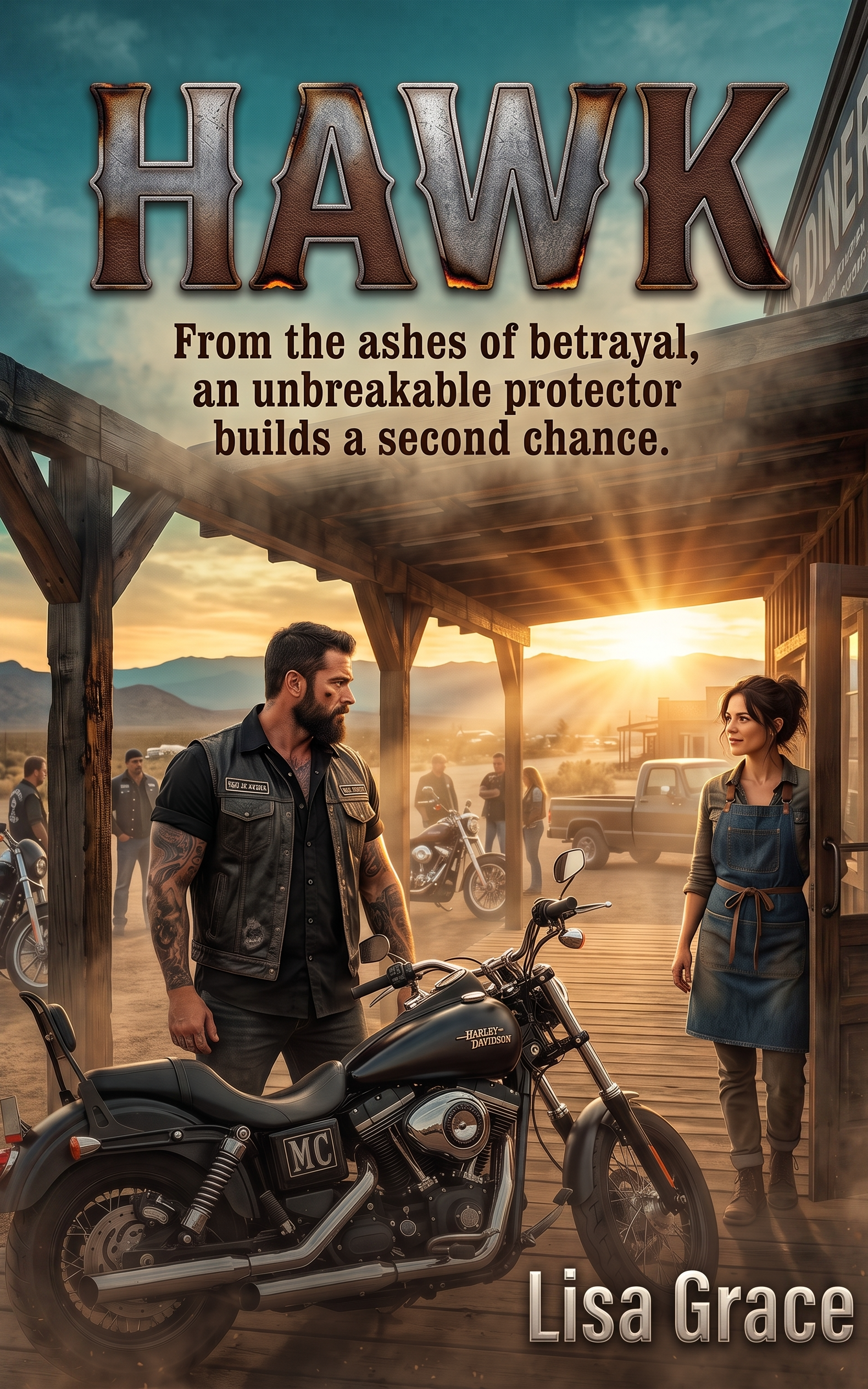
Hawk
From the ashes of betrayal, an unbreakable protector builds a second chance.
by Lisa Grace
Chef Nell Hayes lost everything in the city: her restaurant, her savings, and the credit for her culinary genius, stolen by the man she trusted. Stripped of her pride, she returns to Sable Cross, Arizona, determined to rebuild her family's burned-out diner from the ground up. She expects to face the ruins alone. Instead, she finds Hawk. The silent, imposing sergeant-at-arms of the local motorcycle club has spent two months in the shadows, painstakingly rebuilding the diner's charred oak counters with his own calloused hands. Bound by an old debt to her family, Hawk speaks through action and fierce protection. But as their undeniable connection ignites into a searing passion, Hawk's protective instincts are tested to the limit. When a club brother is dragged into a brutal underground fighting ring, Hawk must wage a violent war to save him. As Nell's ruthless ex arrives to seize what remains of her legacy, Hawk's silence risks driving Nell away forever. To heal her guarded heart, he must prove she is no longer invisible—and fight for the only woman he'll ever love.
- Romance
- Contemporary Romance
- Small Town Romance
- Motorcycle Romance
Ashes and Oak
The reduction on station three is splitting, the grill cook is already four tickets behind, and the walk-in door has a broken latch that requires three solid kicks to seal. It is five-fifteen on a Friday night at Marrow, and I am entirely in my element.
I step in beside Marco without breaking his rhythm, pull the pan off the direct flame, add a splash of cold stock, and whisk the emulsion back together before the butter fat can separate completely. The glossy sheen returns instantly. I slide the pan back to him with a quick tap against the range edge, catch the sauté cook about to overcrowd his pan with wild mushrooms, and redirect his hand with a single gesture.
"Mushroom caps need space, Leo," I say, keeping my voice level beneath the roar of the hood vents. "If they touch, they steam. If they steam, they don't caramelize."
"Yes, Chef," Leo mutters, adjusting the pans immediately.
I know every square inch of this line. I know the cool spot on the flat top, the exact second the broiler elements flare, and the precise weight of the bone china plates we spent six months sourcing from Oregon. Six of the eight main courses on the printed menu tonight are recipes I spent three years developing, refining through eighty-hour workweeks until every single element hit with absolute precision. This kitchen was built on my sweat, my burned forearms, and every ounce of creative capital I possessed.
The swinging stainless door pushes open, and Julian walks into the kitchen. He looks immaculate as always in his custom charcoal shirt, sleeves rolled twice with calculated precision, his blond hair styled to look effortlessly undone. He carries a leather-bound folder tucked beneath his arm. As front-of-house director and the managing partner whose name sits on the bank documents, he radiates calm, polished authority.
"Nell," Julian says, his tone smooth and quiet enough that only I can hear it over the ventilation hum. "A moment in the office, please."
"Tickets are starting to print, Julian," I say, wiping the edge of the pass with a clean towel. "Service starts in fifteen minutes."
"It will only take three minutes," he says with that warm, reasonable smile that has disarmed investors and food critics for five straight years. "Marco can hold the line for three minutes."
I set my towel down, wipe my hands, and follow him into the small, glass-walled office off the dry storage hallway. The room smells of expensive aftershave, cedar, and the espresso machine Julian insisted on installing last month. He closes the door behind us, cutting the kitchen's low rumble to a distant murmur, and gestures toward the leather chair across from his desk.
"I'll stand," I say. "What's going on?"
Julian sits down, rests his forearms on the polished mahogany desk, and folds his hands. His hazel eyes are soft, filled with what looks like profound, regretful sympathy. It is the exact look he gives disappointed diners when their preferred vintage is out of stock.
"The board approved the expansion package this afternoon," Julian says gently. "Along with the private equity funding for the downtown location."
A knot in my stomach tightens, though I try to keep my face neutral. "We haven't finalized the menu adjustments for that yet. I told you the dry-aged duck needs another round of testing before we scale it."
"That is actually what we need to talk about, Nell," he says, his voice dropping into that smooth, measured cadence he uses when delivering difficult news. "The investors were very clear. The new direction requires a different culinary philosophy. A more streamlined, modern profile. And after a lot of thought, I agreed with them."
I stare at him. "A different philosophy? Six of those dishes are mine. The braised short rib is the entire reason the city weekly put us on the cover last month."
"And you did brilliant work with that foundation," Julian says warmly, leaning forward as if sharing an intimate truth. "Truly brilliant. But Marrow needs to evolve. We need leadership that aligns with where the brand is heading. I have brought in Chef Mercer to take over the executive role starting tonight."
The words hang in the cool air of the office. They do not register immediately because they are delivered with such calm, casual grace that my brain struggles to reconcile the polite tone with the absolute destruction of everything I have built.
"You hired someone else," I say, the words coming out flat. "For my kitchen."
"It is the restaurant's kitchen, Nell," he corrects gently, not a hint of malice in his eyes. "And frankly, our personal dynamic has made the professional boundary increasingly blurred. It has not been healthy for either of us for months now. This allows for a clean break. For the business, and for our relationship."
"A clean break," I repeat. "We share a lease. We built this menu together. My name was supposed to go on the LLC amendment last month."
"The lease is in my name, Nell. As is the corporate entity," Julian says, tilting his head with genuine concern. "You know the investors required a single managing principal for liability. I am not doing this to hurt you. In fact, I have already arranged for a generous three-month severance package. And of course, I would be more than happy to provide a glowing reference for your next endeavor. You are immensely talented. You just need a project that fits your particular scale."
He is so smooth, so entirely reasonable, that for two terrible seconds I actually feel the crazy urge to apologize for making things awkward. That is his gift. He takes your life, puts it in his pocket, and convinces you that you ought to thank him for carrying the weight.
"The recipes," I say, my voice dropping an octave. "The duck, the smoked trout tartare, the short ribs. Those are mine."
"Those were developed during operating hours under Marrow's contract," Julian says with an easy smile. "They belong to the restaurant. It is standard industry protocol. You understand that."
He looks at me, waiting for me to scream, to break something, or to beg him to reconsider. If I shout, he gets to be the calm, rational executive dealing with an emotional woman. If I cry, he gets to comfort me while escorting me out the back door.
I do neither.
I reach down, untie the strings of my apron, and fold it into a precise, sharp square on the corner of his mahogany desk. Then I step over to the prep table by the door where my canvas knife roll sits. I slot my eight-inch chef knife into its sheath, slide the paring knives into their pockets, and pull the heavy leather straps tight, buckling them with steady hands.
"You can keep the plates, Julian," I say, looking straight into his calm, calculating eyes. "And you can print my dishes on your new menus. But when the reviews drop because nobody in that kitchen knows how to balance the acid without me standing on the line, don't call."
Julian's smile falters for half a fraction of a second, the mask slipping just enough to show the hollow vanity underneath. "Nell, please. Don't be dramatic."
I turn my back on him, tuck my knife roll under my arm, and walk out the service entrance into the alley. The cold evening air hits my face like a slap. My chest feels hollowed out, empty and raw, but I refuse to stop. I reach the sidewalk, tuck my chin against the chill, and start counting in my head.
Two, four, six, eight, ten.
I glance down at the worn leather roll in my hands. "Don't say anything," I mutter aloud to the knives. "Not a single damn word."
Thirty-one hours later, my battered sedan coughs its way past the rusted boundary sign of Sable Cross, Arizona. The exhaust rattles like a tin can full of nails, and the dashboard temperature gauge has been hovering dangerously close to the red line since I crossed the county line. The town is wrapped in the quiet, suffocating dark of two in the morning. Desert dust hangs in the air, smelling of dry sage, distant mesquite smoke, and old heat radiating off the cracked asphalt.
My grandmother Della had not asked a single probing question when I called her from a gas station payphone in New Mexico. She had merely listened to the silence on my end of the line, sighed softly, and said, "Come home, Nelly."
Her house sits on the south ridge overlooking the valley. When I pulled into her gravel driveway five hours ago, she had a plate of warm cornbread and slow-cooked pinto beans waiting on the kitchen table. She sat across from me in her faded flannel robe, her silver hair loose over her shoulders, watching me eat with eyes that had seen seventy-odd years of hard desert life.
That was when she told me about the diner.
"Burned three months back during the trouble with the Moretti outfit," Della had said, her voice steady but tired. "The motorcycle club cleared the rubble and put up fresh framing, but I don't have the knees for it anymore, Nell. I'm seventy-two. That kitchen belongs to the past now."
I couldn't sleep. The silence of my old childhood bedroom had been too loud, the memory of Julian's polished voice too persistent. So I put on my jeans, pulled a heavy wool cardigan over my tank top, and walked down the dirt road toward the center of town.
The diner sits at the bend where Main Street turns into the highway. Even in the dark, the silhouette of the building looks raw and wounded. The original stone foundation remains intact, but the roofline has been freshly framed in pale pine studs that smell of resin and recent sawdust. Plywood covers the front windows, though a faint, amber glow seeps through the seams of the double entrance doors.
I step onto the cracked concrete apron, my sneakers crunching over gravel. As I look at the dark shape of the structure, my chef brain takes over automatically, running calculations in the shadows. The walk-in cooler would have to go along the north wall to stay out of the afternoon sun. The cooktop needs ten feet of clearance from the pass to keep the expo lane clear. You could seat forty at the booths, but the counter is where the real life of the room has to live.
A rhythmic, scraping sound cuts through the desert silence from inside the building.
I freeze. The sound repeats, steady and deliberate, like heavy sandpaper dragging across dense hardwood. It is two-fifteen in the morning. Nobody should be inside a half-built diner in the middle of nowhere.
I spot an old, rusted tire iron lying in the weeds beside a stack of cinder blocks near the foundation. I pick it up, testing its cold, solid weight in my right hand, and walk quietly toward the plywood door. The door sits unlatched, resting slightly ajar against the jamb. I push it open with the toe of my boot and step inside.
A single high-powered halogen work light sits on a yellow tripod in the center of the room, casting stark, sharp shadows across the concrete floor. The air inside smells intensely of fresh pine, old charcoal, and sweet cedar wood dust.
A man is standing beside the salvaged oak counter.
He is massive. Broad shoulders stretch the fabric of a gray short-sleeved shirt, revealing arms corded with muscle and layered in dark, intricate tattoos that disappear beneath the edges of a worn black leather vest. A patch over his left chest reads SGT AT ARMS in faded white lettering. His dark hair is cropped close to his scalp, his jaw shadowed by dark stubble, and his pale blue eyes are entirely fixed on the wood beneath his hands. His large palms, dusted in pale yellow sawdust, are working a sanding block along the heavy oak grain with rhythmic, absolute precision.
He doesn't jump when the door creaks. He doesn't flinch. He just pauses the motion of his arm, staying completely still.
"Step away from the counter," I say, lifting the tire iron slightly, trying to make my voice sound like someone who hasn't spent the last three days crying in gas station parking lots. "The property is private."
The man turns his head slowly. Those pale blue eyes lock onto mine, moving over my face, my messy hair, the oversized cardigan, and finally down to the rusty iron bar in my grip. He looks at me the way a mountain might look at a passing breeze. Unbothered, solid, and entirely immovable.
"You're holding that wrong," he says.
His voice is a low, gravelly rumble that seems to vibrate right through the concrete floor. Four words. That is all he offers.
"Excuse me?" I say, my grip tightening on the metal. "I don't care how I'm holding it. Who are you, and why are you breaking into my grandmother's diner at two in the morning?"
The man sets the sanding block down on the oak surface. He wipes his hands on a clean shop towel tucked into his back pocket. He doesn't make any sudden moves, but his physical presence seems to expand until he fills the entire half-framed room. He reaches into his pocket, pulls out a heavy, bronze military challenge coin, and begins rolling it across the knuckles of his left hand. The metallic clicking is steady, rhythmic, almost hypnotic.
"Hawk," he says simply.
"That is a bird, not an explanation," I shoot back, my irritation rising as the initial surge of adrenaline begins to fade into exhaustion. "The club isn't supposed to be doing construction at night. Della said Cruz handles the rebuild schedule."
"He does," Hawk replies. He doesn't offer anything else. The coin flips smoothly over his thumb and lands back in his palm.
"Then why are you here?"
Hawk looks at the counter. The oak slab is massive, easily twenty feet long, bearing deep burn marks along the edges that have been carefully, meticulously sanded down until the smooth, honey-colored heartwood shows through the black char. The amount of labor required to hand-finish wood that dense is staggering. His large, scarred fingers lightly trace the edge of the grain with a gentleness that looks entirely out of place on a man built like a brick wall.
"Wood needs work," he says.
"You're doing this by hand," I say, stepping a few inches closer despite myself, my curiosity momentarily overriding my caution. "Why aren't you using a belt sander? It would take a quarter of the time."
"Belt sander tears the grain," he answers, his eyes lifting back to mine. "Ruins the old growth. This slab is eighty years old."
He stands there, perfectly relaxed with his back positioned near the reinforced support beam, watching me with an intensity that feels heavy and direct. He isn't sizing me up as a threat, and he isn't looking at me the way men in city bars usually look at women. He is reading me with quiet, thorough precision. He sees the dark circles under my eyes, the slight tremor in my fingers, and the stubborn set of my jaw, but there is no pity in his expression. Only an unyielding, calm acknowledgment.
"You're Nell," he says. It isn't a question.
"I am," I reply, lowering the tire iron an inch. "And I'm trying to figure out why the sergeant-at-arms of a motorcycle club is spending his Friday night doing custom carpentry in the dark."
Hawk slips the challenge coin back into his leather vest pocket. He picks up the sanding block again, his movements deliberate and unhurried. "Diner needs a counter."
"My grandmother isn't reopening," I say, the words slipping out before I can stop them. "She's tired, Hawk. The diner is done."
Hawk doesn't pause his work this time. The block moves smoothly across the wood, sending a fine cloud of oak dust into the amber beam of the halogen light. "Building's still here."
I let out a short, frustrated breath. Talking to him is like trying to negotiate with a granite boulder. He offers no apologies, no justifications, and not a single unnecessary syllable. Yet there is something undeniably compelling about the absolute focus he gives to that ruined piece of wood, restoring something broken and charred while the rest of the town sleeps.
"You're wasting your time," I say, turning toward the doorway.
"Maybe," Hawk rumbles behind me.
I step outside into the cold desert air, the tire iron dangling at my side, my heart beating at an entirely different tempo than it was twenty minutes ago. The exhaustion is still heavy in my bones, and the ache of Julian's betrayal still burns in my chest, but the sharp, steady image of those sawdust-covered hands on the oak counter refuses to leave my mind.
I start the walk back up the ridge toward Della's house, looking back once over my shoulder at the faint amber light glowing through the plywood seams. I tell myself I am just making sure he doesn't burn the place down, but deep down, in the quiet spaces I refuse to name, I know I will be walking down this same road tomorrow night just to see if he shows up again.
Night Shift
The morning meeting at the clubhouse chapel starts without ceremony, the way everything does under Cruz. A heavy pine table occupies the center of the windowless room, scarred by pocket knives and coffee mugs, the air thick with stale grounds and motor oil. Mace sits to Cruz's left with a tactical clipboard, while Brynn stands near the doorway with…