

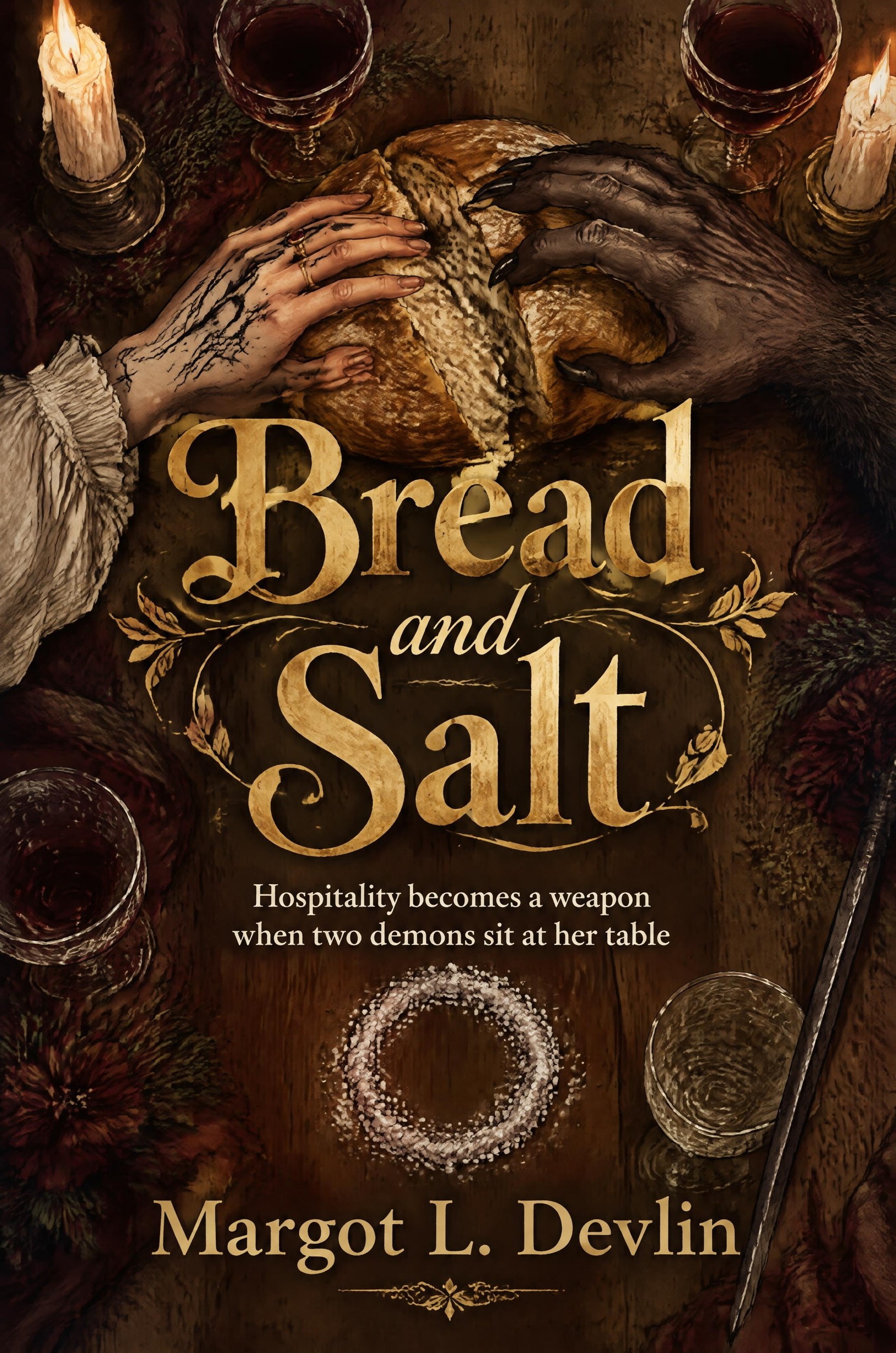
Bread and Salt
Hospitality becomes a weapon when two demons sit at her table
by Luna Asli Kolcu Uslu
On the seventh day after her grandmother's death, Odette Varrow faces a forced marriage and the loss of Varrow House to Master Corvell. At the dining table she attempts a necromantic rite. She does not raise Constance. She summons two bound guests: Sevrin, an ink-marked clerk-demon who feeds on broken promises, and Ruk, a horned huntsman who lives on mortal fear. Bread and salt. Wine. The hearth. Ancient laws of hospitality become the only armour she has. Bargains are struck. Forty years of family secrets unravel. Passion blurs the line between host and captive. At dawn Corvell lays iron across the threshold. Odette binds herself and her household to the land, turning welcome into a lethal snare. When the collector accepts bread and wine, he steps inside a law he cannot break—and Odette reclaims her freedom on terms no man would dare write.
- Fantasy
- Romance
- Erotica
- Dark Fantasy
- Paranormal Romance
- Menage
The Sixth Night
At first light I will belong to a man I have met once, across a solicitor's desk, and I have spent my last free evening laying a table for one.
Habit. Six years as guest-mistress of the pilgrim house at Saint Wenna's, and my hands set places whether I ask them to or not. Bread to the left. Salt above the knife. The dining room at Varrow House seats thirty. Tonight it seats me, one candle, and the pewter.
My grandmother has been in the ground six days. On the seventh morning, by the law of this county, an unwed heiress with no household passes to whomever holds her wardship: her hand in marriage, her house, and everything under its roof. Her mortgages were bought, quietly and entirely, by Master Corvell of the town. I came with the mortgages.
At the funeral his clerk, a soft man in good grey wool, leaned close while the vicar droned and told me what the county already seemed to know. The Varrows have a way with their dead. A woman of the blood, saying the old words at the old table, can call one of them back for a single night. And a Varrow called back may void any paper signed over her grave.
I found the words in my grandmother's hand, tucked into the back of her prayer book. As if she had wanted them found.
At a quarter to midnight I take the long way round, past the east wing.
The east-wing door is black oak, iron-banded; I am seven again the moment I see it. The brass cold under my palm. Unlocked, which it never was. Something on the other side, breathing, slow and enormous as the sea. I opened it a hand's width and smelled struck flint and warm fur. Then my grandmother's hand closed on my shoulder, and I was on the cloister coach before breakfast, and nobody ever told me why.
It's locked tonight. I check. I'm not proud of checking.
Back in the dining room I set the candle at her place and say the words, all of them, ugly and full of consonants. Where the page says name her, I say, "Constance Varrow," in the voice I keep for bishops.
The flame lies down flat. The salt cellar beside my plate tips over on its own, and the cold that comes into the room is cellar cold. Grave cold.
She doesn't come.
At the far end of the table, beyond the candle's reach, are two figures that weren't there a breath ago, and neither of them is my grandmother.
They're wound together like a knot tied in anger. One is tall and thin as a rake, black-haired, his skin looks like a page left out in the rain: lines of grey writing, crowded and faded, running down his throat and under his collar. The other is larger than any man I have ever served at table. Barefoot, bare-chested. Two ridged horns curl back from his temples, the left one cracked clean across.
The thin one has his fist in the big one's hair. The big one has his mouth on the thin one's jaw. Kissing, or about to tear each other's throats out. After however long they've been at it, I suspect they no longer know which.
Then they turn and look at me.
The horned one breathes in through his nose, slow and scenting.
"That's not her," he says.
Bread and Salt
When a stranger appears at a guest-mistress's table unannounced, her body moves before her mind has finished screaming. It happened at Saint Wenna's with drunk lords, bleeding pilgrims, and once, memorably, a bear-ward and his bear.It happens now.I take the loaf from the board and tear it, because cutting bread for a guest is an insult in this coun…