

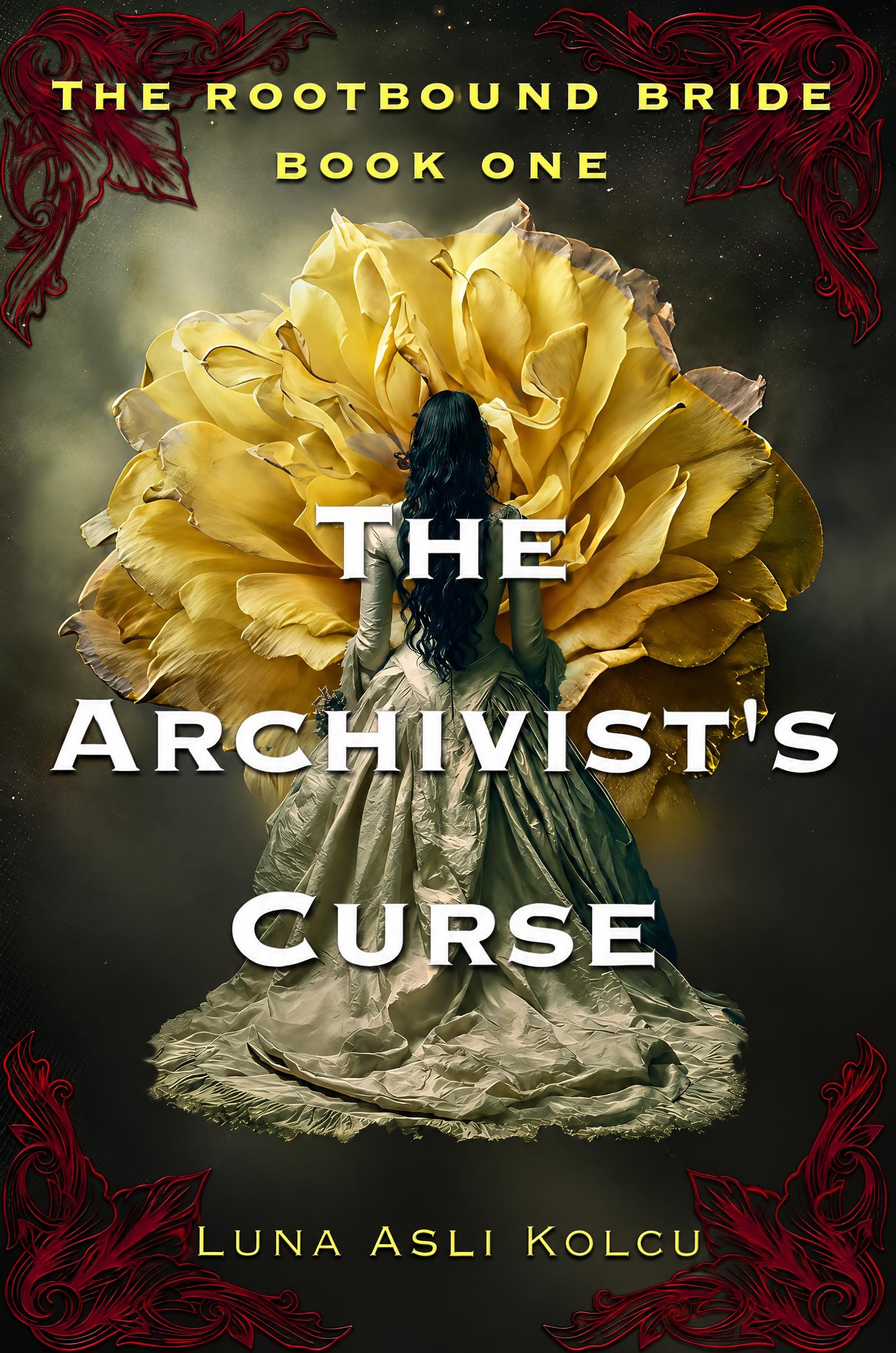
The Archivist's Curse
by Luna Asli Kolcu Uslu
Elisabeth Hargrove, an archivist from the Bodleian Library, agrees to an arranged marriage with Matthew Sedgewick and enters Aldermere Hall, an ancient estate cursed to absorb twelve brides over three centuries into its sentient maze and living root network. Armed with an ancestral glass and a hidden sketchbook left by an earlier bride, Elisabeth works alongside her new husband to decode the supernatural contract binding them before the impending winter solstice. As the house's intelligence tests her understanding, Elisabeth must confront the tragedy of the eleven previous brides and discover how to enact an escape clause without losing herself or her husband.
- Fantasy
- Romance
- Horror
- Romantic Fantasy
- Gothic Horror
- Slow Burn Romance
The House
Eleven brides had walked through the doors of Aldermere Hall in three hundred years, and not one had walked out. I knew this as I knew water damage on a manuscript: by the buckle beneath it, the wrongness of a surface that should lie flat. And I had come anyway.
The house sat at the top of the hill like a sentence someone had started and refused to finish, its stone facade the colour of old bone, its windows catching the late-September light and holding it a moment too long. Beautiful. Every account I’d read had said so. Beautiful as a jaw is beautiful when it opens.
From the carriage, the formal gardens spread south and east, clipped geometries giving way to wilder growth near the boundary walls, and beyond them the dark mass of the maze, its yew hedges tall enough to eclipse the low sun, casting shadows eastward across the lawns like fingers laid flat against the grass. A pull behind my navel, low and deep: a thread that had recognised this place before I had.
Three months ago I had a conservation post at the Bodleian. A desk, and a future among colleagues who respected my eye for damaged text. Two months ago I resigned. Margery’s letter had been sitting on my worktable for a week by then, and I’d read it so many times the paper had softened along the folds: stop being careful and start being brave. Margery, who had spent more than twenty years researching the curse and was dying now, had written to me not as an aunt recruiting an operative but as the woman who had taught me to press flowers and read gravestones and believe damaged things were worth the saving. One month ago I accepted a marriage proposal from a man I had never met, conveyed through a letter written in handwriting so careful it might have been a fair copy.
And now I was here, and the house watched me with the same patience I brought to a new acquisition. Deciding what I was worth. The Sedgewicks sent a carriage for their brides; they always had, and in 2024 it still met the train. My phone had lost its signal at the station and not found it again. My hand went to the leather satchel on my lap and found the sketchbook’s spine through the lining. Still there. It was the only thing in this carriage I was certain about, and it was mine.
The road curved through an avenue of elms. Symmetrical wings, Jacobean roofline, the asymmetry of the eastern wing leaning toward the garden — someone had built this house to look in two directions at once. I was cataloguing. I knew I was cataloguing. It was what I did when I was frightened: the neat partitioning of the world into observable details so there was no room for the feeling underneath, and the feeling underneath was this: I have done a mad thing, and I cannot undo it.
The carriage wheels found the gravel drive and the sound changed, softer than it should have been, the stones yielding with a give that mineral shouldn’t possess. I gripped the edge of the seat. The iron gate we’d passed through two minutes earlier had stood open, and no one had been there to open it. Hedgerows along the drive, trimmed with military exactness at first, then wilder, until the last hundred yards became less a drive through a garden than a swallowing by one.
The roses. God, the roses.
They were everywhere, climbing the stone walls and threading through the wrought iron in a profusion that was wrong. Late September. These should be hips and bare canes.
Instead: hundreds of white roses, open-faced and fragrant, and the smell reached the carriage before the house did, a sweetness that coated the back of the throat and stayed there, thick and wanting. This was the first sign, the one Annabel had drawn on page one.
I wanted to go home. The thought arrived without permission, plain and childish: I want to go back to the third desk from the window in Duke Humfrey’s reading room, where the morning light falls on the conservation table at the angle I need and the air smells of old leather and the only sound is the turn of a page and no one in the room wants anything from me except careful work. My palm ground against the satchel.
The carriage stopped and the driver climbed down and opened my door without meeting my eyes. Below the terrace, someone was in the rose garden, a man, sleeves rolled to the elbow, cutting dead blossoms with a deliberation that did not pause for our arrival. He did not look up.
I stood in the doorway of the carriage and watched him for longer than I should have. He was going to be my husband. Tomorrow morning I would stand beside this man and say words that could not be unsaid, and he was not looking at me. He knew I was here. The gravel had announced it, the whole drive had announced it, and he kept his head down and his hands in the roses and the thought came plainly: He doesn’t want this either.
I didn’t know yet whether that was meant to comfort me. The wind shifted, carrying the rose-scent upward with a mineral note beneath it, and a blackbird startled from the yew hedge with a cry that sounded too deliberate for a bird.
I stepped out. The gravel shifted under my boots, that same unsettling give, the ground breathing shallowly beneath my weight. The air was too close for September, too alive for a house whose stone should have been radiating the cold of last night’s frost. Attention pressed against my skin, directional, focused. Being looked at by something that has no eyes.
I stood in the drive and stared at Aldermere Hall, and Aldermere Hall looked back, and the small hairs on my arms rose, and I did not reach for my journal.
The housekeeper met me at the door. Tall, taller than me, and I am not short, with a stillness that was discipline. Grey hair, severe, a ring of keys at her waist that she did not touch, hands folded at her front, fingers laced, thumbs pressed together hard enough to whiten the nails.
“Miss Hargrove,” she said. “I am Mrs McAllister. Welcome to Aldermere.”
Miss Hargrove. Not Miss Elisabeth, not the warmer address a housekeeper might use for a woman about to become mistress of the house. A voice that had said these words before, to other brides, and did not require them to mean anything beyond their function. “Thank you, Mrs McAllister.”
“Your rooms are prepared in the east wing. Mr Sedgewick is in the garden and will return for dinner. The ceremony is tomorrow at ten. Is there anything you require?”
Yes, I thought. I require someone to look me in the eye and tell me I am not walking into my own disappearance. No one was left to ask: Margery in London, my mother still thinking the family stories were about love, my father ten years dead. And Annabel, who had drawn every room in this house and documented every phenomenon, had vanished more than two centuries ago, which was rather the point.
“I’d like to see the portrait gallery,” I said. A flicker moved behind Mrs McAllister’s eyes, not surprise; she’d suppressed surprise years ago. The hall’s light caught the edge of her jaw, the tendons in her neck, and I thought of how museum guards stand in front of paintings they’ve seen ten thousand times: vigilant, and entirely elsewhere.
“Of course,” she said. “This way.”
The gallery ran the length of the house’s first floor, windows on one side and paintings on the other. Oak floorboards darkened to the colour of strong tea by three centuries of footfall and polish. The air was cooler and drier here than in the corridors, with a faint undertone of linseed oil and old varnish that my conservation training identified before my conscious mind could. The late-afternoon light fell through the glass at an angle designed for one purpose: lighting the faces of the Hargrove brides. Eleven of them.
I stepped into the gallery and the scale of it stopped me. The repetition. Eleven gilt frames of identical dimensions, evenly spaced with the precision of a cataloguing system, each showing a young woman in the same dress. Cream silk, seed pearls, high collar, long sleeves. The same position before the same mirror in what would prove to be the dressing chamber of the room Mrs McAllister had assigned me; only the first sat elsewhere, in a panelled library.
And every one of these women was gone. My hands were cold. I curled them at my sides and moved down the gallery as I would through any archive, reading with my eyes first, then my hands. The floorboards creaked beneath me, one creak to each frame, as if the house were tracking my progress along the row.
The first painting was dated 1701. Bride One: Elspeth. The name engraved on a brass plate beneath the frame, tarnished to deep gold. She had dark hair and a direct gaze. Her expression I could not read; it was more considered than period portraiture usually allowed. They all looked young. I moved on. Eleven different painters across three centuries, eleven techniques, the stiff formality of the early portraits giving way to Georgian softness, then Victorian detail, then the looser brushwork of the twentieth century.
And yet.
Every bride after the first was smiling.
Ten different smiles, rendered by ten different hands, and all identical in quality, the same curve of the mouth, the same light in the eyes. The expression I had seen on Annabel’s face in the sketch she had drawn of herself on page twelve of the sketchbook and labelled, in her small, precise handwriting: the expression the house gives you. My teeth set. It was the look of a woman who knew what was coming and had decided to smile anyway. And I was going to stand before that same mirror tomorrow, and I did not know, could not know yet, whether the smile would come for me too.
I stood before the eleventh portrait: Bride Eleven, Helen, painted in 1987. Fair-haired, fine-boned, and the artist had captured what the others had missed or chosen not to render: a tension in her left hand, resting on the mirror’s frame, knuckles whitened. The dress sat differently on Helen. Stiff, the silk resisting her posture rather than accommodating it. Four months: the shortest tenure of any bride, and she was twenty-one, too young for the lines at her eyes. And she looked directly at me, at me, with a face that said: I know what you’re here for, and what this house will ask. Pay attention.
I looked at the wall beside Helen’s painting. The plaster here was different from the rest of the gallery, a faint discolouration, the kind I’d seen in archives where a document has been removed and the wall remembers what hung there by the light it blocked. The brass picture hook gleamed, polished, set at the same height and interval as the others, ready for a twelfth frame, and it was old: original, placed there in 1702, before the first painting was brought from the library. Someone had built this gallery three hundred years ago knowing it would hold twelve portraits. And the twelfth hook had waited, empty and patient, for me.
My legs threatened to buckle. I locked my knees and kept my face still and thought: You knew this. You read the sketchbook. You chose this. You are the reader this text requires. But beneath the twelfth hook, the prayer felt thin. Academic. A woman reciting her credentials to an empty room while the room decided whether to keep her.
“The dress will be in your rooms,” Mrs McAllister said behind me. She had approached in silence. “It was aired this morning.”
“Aired,” I repeated. “Not altered?”
A pause. Half a second, perhaps less. I was trained to read pauses, and this one said: she noticed.
“The dress does not require alteration,” Mrs McAllister said. “It fits every bride.”
She said it flatly, as she had told me the hour of the ceremony. But her thumbs, pressed together at her waist, whitened further. “Thank you, Mrs McAllister.”
“Dinner is at eight. Mr Sedgewick keeps country hours.”
She left without a sound on the gallery floor. The light from the windows fell across the portraits and each bride’s eyes followed me, an optical trick, nothing more, and the silence between the paintings was the wrong kind, the silence of a reading room with one other reader in it. I returned to the first portrait, Elspeth, 1701, and pressed my fingers to the wall beside her frame.
The plaster was warm.
A living heat, generated from within. I flattened my palm and it pushed back, in direct response to my touch, as a heartbeat quickens when a hand is placed against a chest. A rhythm that matched itself to my pressure, calibrating.
I should have pulled away. Every rational instinct said pull away. Instead I pressed harder, and the heat intensified, two degrees, maybe three, and the rhythm beneath the plaster quickened to meet me. I stood there with my hand on the living wall of a house that was learning what I felt like, and my arm was shaking to the shoulder, and I kept my palm flat. It was as if I had pressed against a door I had been walking toward my whole life and felt, for the first time, the knocking from the other side.
I pulled my hand away and the pulse slowed. Pressed my palm back. The rhythm quickened again, with no delay at all. Repeatable.
There it is, I thought. The archivist again. Repeatable. You just felt something impossible and your first instinct is to test whether it’s consistent.
I opened my journal and wrote:
Aldermere Hall. 27 September. The wall behind the portraits has a pulse, and it responds to contact. Two-degree thermal increase under direct touch. Phase One: observation and trust nothing.
The words on the page looked steady, the handwriting too. Good. Let the journal be steady. Underneath, I was frightened, and my hand, the hand I’d pressed against the wall, was tingling where this house had reached back. My mouth tasted of roses. I closed the journal. Along the wall, eleven brides smiled their knowing smiles, and the twelfth hook gleamed in the last of the light.
I went to my rooms without unpacking. The bedroom was in the east wing, as Mrs McAllister had said, and the low September light came through the windows at an angle that turned the dust motes into gold and made the four-poster bed look like a scene from the gallery downstairs. The wallpaper was old, hand-blocked, a pattern of climbing roses that my training told me not to touch — the surface would be fragile, the pigment sensitive to oils. I took out the sketchbook and opened it to page one, where Annabel had drawn Aldermere Hall from the same approach I’d taken, the elm avenue and the gravel drive up to the stone facade with its bone-coloured symmetry. The drawing was meticulous, and almost everything I’d seen matched it. Almost.
Annabel had drawn the roses climbing the eastern wall in a loose, natural pattern, the growth following the mortar lines as climbing plants do. What I’d seen from the drive was different: there the roses had grown into a pattern too intentional to be organic, massed around the windows of my room.
I recorded the discrepancy in my journal. Then I read what Annabel had written beneath the drawing, in handwriting I had memorised months ago: The house knows when a bride is coming, and it prepares itself, and the roses bloom. The air warms. The portraits — I cannot explain the portraits yet, but their eyes move. I am certain of it. Their eyes move when you are not looking directly at them, and they stop when you are. The effect is not menacing so much as attentive, as a mother watches a child who has just learned to walk, with love and fear and the exact, dreadful knowledge that the walking will lead somewhere she cannot follow.
I closed the sketchbook and put it back in its cloth bag, inside the satchel, behind the travelling case in the wardrobe. Triple-hidden. The most important document I had ever handled. The roses pressed their sweetness past the window glass, the scent finding the gaps in the old frame with the persistence of something that had been practising entry for centuries.
Somewhere below, in the garden, a man I had not yet met was tending roses with hands I had not yet seen. Tomorrow I would stand beside him in a dress that had been waiting as the hook had been waiting, as the eleven names carved into a fountain I had only read about would wait beside the empty space meant for mine. I would say I do to a man I was not marrying for love. Not for duty or family, either.
I was marrying him because there was a text that needed reading, and I was the only one left who could read it. The clean, defensible reason, the one I could carry like a lantern into any dark room. But in a house that breathed, the other reason lay underneath it. The one I hadn’t written in my journal and wouldn’t. The Bodleian had been safe, its manuscripts still. Nothing in the conservation lab had ever looked back at me, and nothing had ever pressed back against my palm like a hand reaching through a wall, and I had been so careful for so long that the carefulness had become a kind of death, a preservation of a woman who was not yet alive enough to need preserving.
I had come to Aldermere because something here was alive. And I wanted to be near it — that frightened me more than the house did. Annabel had written, on the sketchbook’s final page: be careful what you understand, and I had read the warning a hundred times and filed it as caution and not yet considered that she was describing a mechanism.
I sat on the bed. Mattress soft, sheets smelling of lavender and beneath that a deeper note, roses, always roses, the scent threaded through every fabric in this house like ink through paper. The journal came open in my lap, and the words my pen made looked clinical and steady and said nothing about the wall’s pulse or the twelfth hook or the man in the garden who hadn’t looked up. When the page was full I closed the journal and turned down the lamp.
The room shifted.
It was the air: a change in pressure, the kind you feel when a door opens in another part of a building and the draught reaches you before the sound does. The roses outside my window exhaled all at once, thick enough to taste, and the warmth in the room gathered itself and moved, closing against my skin like a hand cupping a face.
Every nerve fired.
I sat still, my fingers digging into my knees. The warmth pressed closer, along my jaw to the hollow beneath my ear, and it was not hostile — that was the worst of it — it was not hostile at all. It felt curious, like the touch of something that had been alone for a long time and had forgotten how to be careful with its wanting.
In the portrait gallery below, a small sound: metallic. The sound a brass hook makes when it is touched, as if something were testing whether it would hold.
I stayed upstairs. Sat on the edge of the bed with my hands flat on my knees, and I thought: It knows I’m here. It has always known I’m here, and it is not waiting passively. And then, quieter, underneath: Its touch was warm. And I did not pull away.
The warmth held for another breath. Then it released me, gently, as you set down a document you have finished reading. I lay awake until dawn.
The Wedding
The dress fitted perfectly. It would.Annabel’s sketch on page four showed measurements that matched no standard sizing, and Margery’s notes described the phenomenon with the detachment of a woman who had stopped being surprised by impossibilities: The dress accommodates. But Margery had never stood inside it. The silk moved with me, not as fabric m…