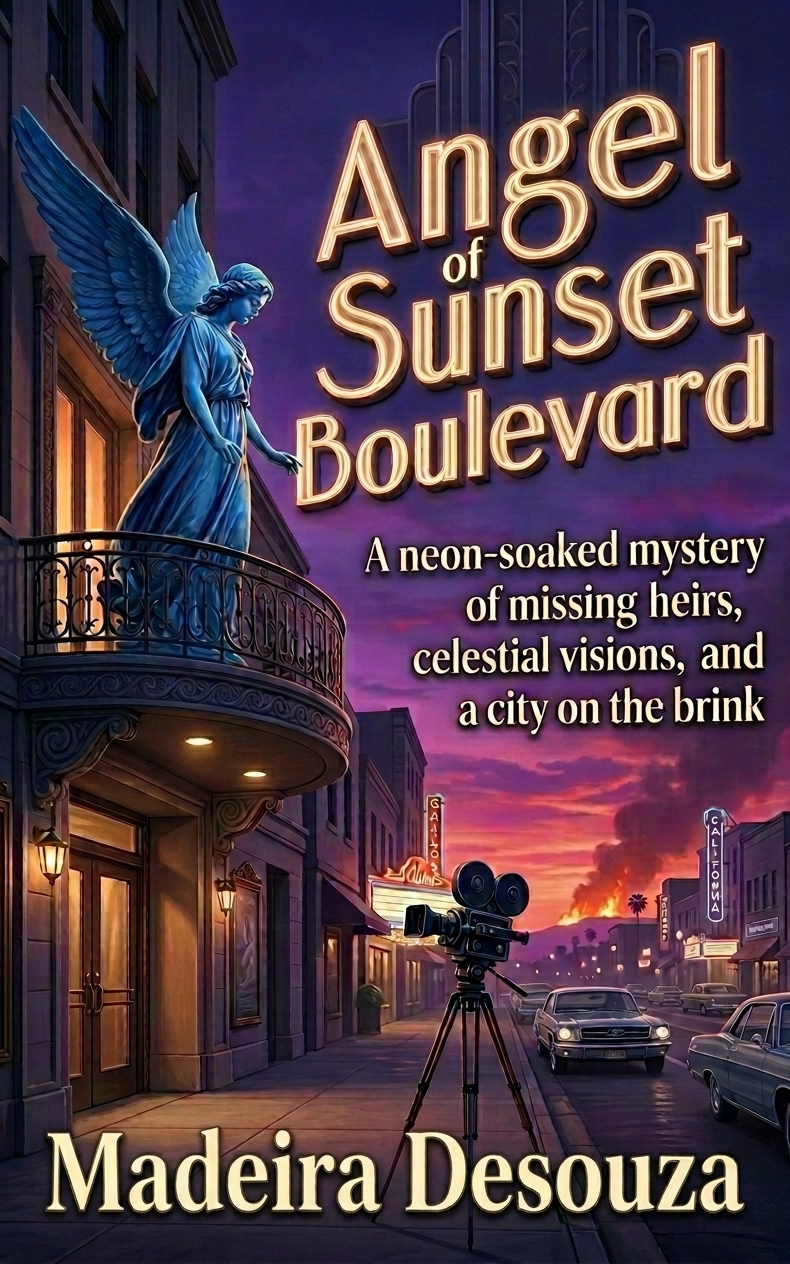
Angel of Sunset Boulevard
A neon-soaked mystery of missing heirs, celestial visions, and a city on the brink
by Madeira Desouza
Hollywood, 1965. The air is thick with the scent of jasmine and the static of 'Boss Radio.' When Vince L'Enfant, the seventeen-year-old heir to a music mogul's empire, vanishes without a trace from Sunset Boulevard, the city's glittering facade begins to crack. Enter Bartolo Sandoval, a cynical Spanish filmmaker documenting the rise of radio station 66 KZI. As he navigates a landscape of psychic DJs and corrupt power players, he encounters a fallen nun with a scandalous secret and a living statue—the Blue Angel—who whispers warnings of a coming apocalypse. While the music plays louder, racial tensions simmer in the California heat, and a drug-fueled underworld threatens to swallow the truth. From the neon-lit clubs of the Strip to the smoke-filled streets of Watts, Sandoval is pulled into a grit-covered dreamscape where the line between reality and divine intervention blurs. As the city prepares to burn, he must find the boy before the music stops forever. Angel of Sunset Boulevard is a haunting exploration of innocence lost and the ghosts that haunt the City of Angels.
- Mystery
- Missing Person
Reel of First Impressions
Bartolo Sandoval pulls his battered Ford Falcon to the curb outside 66 KZI on Sunset Boulevard. The Arriflex camera hangs heavy on his shoulder, its weight a familiar ache. Gabriel Soto follows close behind, lugging the reel-to-reel tape recorder with the boom microphone coiled like a snake at his side. The May sun beats down on the boulevard, turning the asphalt into a shimmering mirror. Palm trees line the street, their fronds swaying lazily in the hot breeze.
The air hangs thick with the scent of ozone from distant power lines and expensive tobacco drifting from open car windows. Bartolo wipes sweat from his brow and adjusts the camera strap. He has come to document the rise of Boss Radio, this new format that's sending ratings through the roof. But whispers of something darker already taint the excitement. Vince L'Enfant, the seventeen-year-old son of music mogul Dominick L'Enfant, has vanished. Forty-eight hours gone, and the Hollywood elite murmur in the shadows of their hillside mansions.
Gabriel mutters under his breath in Spanish as they approach the station's glass doors. "Este calor es un demonio," he says, shifting the recorder's weight. Bartolo nods but says nothing. His focus sharpens on the building ahead, a squat concrete bunker pulsing with the throb of top-forty hits leaking through the walls. Inside, the lobby buzzes with activity. Receptionists in sharp skirts field calls, and a poster proclaims "Boss Radio: Number One and Only!" in bold red letters.
They are waved through to the control room by a harried assistant. The space feels alive, electric. Dials glow under dim lights, and the air hums with the low drone of equipment. Brandon Irons sits at the console, his jet-black pompadour gleaming under the studio lights. He taps his fingers rhythmically on the microphone stand, a manic energy radiating from him like heat from a radiator. His velvet suit jacket hangs open, revealing a silk shirt unbuttoned at the collar.
Bartolo raises the Arriflex to his eye, framing Irons through the viewfinder. The lens captures the frantic glint in the DJ's eyes, the way his foot bounces against the stool leg. "Action," Bartolo whispers to Gabriel, who unfurls the boom mic overhead. The tape recorder whirs to life, hungry for sound.
Irons spots them and breaks into a wide grin, his radio voice kicking in even off-air. “Brothers! You caught the wave just in time. The airwaves are vibrating tonight, man. It’s the sound of the end, can’t you hear it?” He leans forward, eyes wide, as if sharing a cosmic secret. Bartolo keeps filming, steady. The camera drinks in the details: the sweat beading on Irons’ forehead, the desperate twitch at the corner of his mouth. Bartolo knows he will have to wait for the film laboratory to process the negative before he can see if he captured that specific look in the DJ’s eyes.
"Tell us about Boss Radio, Mr. Irons," Bartolo says, his voice carrying that slight Spanish cadence, smooth and measured. "The ratings climb, the city listens. What's the magic?"
Irons laughs, a sharp bark that echoes in the booth. "Magic? It's boss, Sandoval. Tight playlists, no chatter, hits that hit like lightning. But listen closer." He presses his ear to the speaker, as if communing with ghosts. "There's static in the mix. Not noise—presence. The kid, Vince L'Enfant. He's in there, man. Screaming through the frequencies. I feel it in my bones."
Bartolo lowers the camera slightly, his weary brown eyes narrowing. The room feels smaller now, the ozone scent mixing with Irons' cologne. Outside the booth, station staff exchange glances but say nothing. The disappearance hangs over everything like a pall. Bartolo pans the lens to capture the rhythmic tapping of Irons' fingers, the way they dance across the console like spiders on glass.
Gabriel adjusts the boom, catching every word. He shoots Bartolo a look that says, This guy's lost it. But Bartolo presses on. He senses the story shifting under his feet, pulling away from radio triumphs toward something murkier. Vince L'Enfant, gone without a trace—no body, no ransom, just empty streets and nervous whispers.
The studio door swings open, and two LAPD officers step in. Their uniforms are crisp, badges glinting. One, a stocky man with a red-veined nose, scans the room with tired eyes. Detective Raymond Haze, Bartolo guesses from the badge. The other cop nods deferentially to the station manager hovering nearby, a slick man in a narrow tie who murmurs something about protecting the equipment.
Bartolo swings the camera toward them. Haze spots it and raises a hand. "No filming here, pal. Official business." His voice is gravelly, laced with cigarette smoke. Bartolo keeps the lens steady. "Just documenting the station, Detective. The boy's father has connections here. Ratings and missing kids—Hollywood's favorite double bill."
Haze steps closer, his face a mask of weariness. "Kid's not here. No crime scene, no leads. Save your film for the hits." He glances at the manager again, almost apologetic. The deference is clear: cops guarding gear, not chasing shadows. The manager claps Haze on the shoulder, steering him away. "Appreciate the protection, Ray. Equipment's worth more than gold these days."
Irons pipes up from the booth, undeterred. "See? The static's thickening. Boy's out there, trapped in the signal. You film that, Spaniard—film the truth bleeding through." Bartolo captures it all: the cops' retreat, Irons' wild eyes, the manager's forced smile. Gabriel reels in the boom mic, his thick hands steady despite the tension.
They step outside into the glare of Sunset Boulevard. Billboards tower overhead, proclaiming Boss Radio's dominance in electric lights that haven't yet ignited for the night. They loom like digital gods, watching the traffic crawl. Palm trees cast long shadows between them, stretching toward the Hollywood Hills. Bartolo slings the Arriflex back over his shoulder, feeling the first real tug of the story. This has nothing to do with music charts anymore. It's the shadows between the palms, the static in the air, the vanished boy whose absence echoes louder than any top-forty hit.
Gabriel lights a cigarette, exhaling smoke into the heat. "¿Qué piensas, jefe? Psychic DJ, cops playing guard dog. This gig just got interesting." Bartolo stares down the boulevard, where neon flickers to life in the fading light. The city pulses with secrets, and his lens hungers for them. Vince L'Enfant's disappearance feels like the first crack in the facade, a mystery pulling him in deeper than any rating surge.
Back inside, Irons' voice blasts from a speaker: "Boss Radio, keeping it real, keeping it boss!" But Bartolo hears only the undercurrent, the hum of something ominous building. The police cruiser pulls away slowly, lights off, as if the case is already closed. He feels it then—the weight of the city pressing down, full of hidden alleys and unspoken deals. His camera, heavy as truth, waits for more.
The sun dips lower, painting the boulevard in oranges and reds. Bartolo and Gabriel pack their gear into the Falcon. Engines rumble nearby, horns blare. Hollywood never sleeps, but tonight it whispers of a boy lost in its glitter. Bartolo slides behind the wheel, the Arriflex on the passenger seat like a silent witness. The story has found him, and he knows he won't shake it loose.
The Vanishing Heir
Bartolo Sandoval grips the steering wheel of his battered Ford Falcon as he winds up the twisting roads into Bel Air. Gabriel Soto sits beside him, the reel-to-reel tape recorder secured in the back seat next to the coiled boom microphone. The Arriflex camera rests heavy on Bartolo's lap. They left the electric hum of 66 KZI behind, but the whisper…