

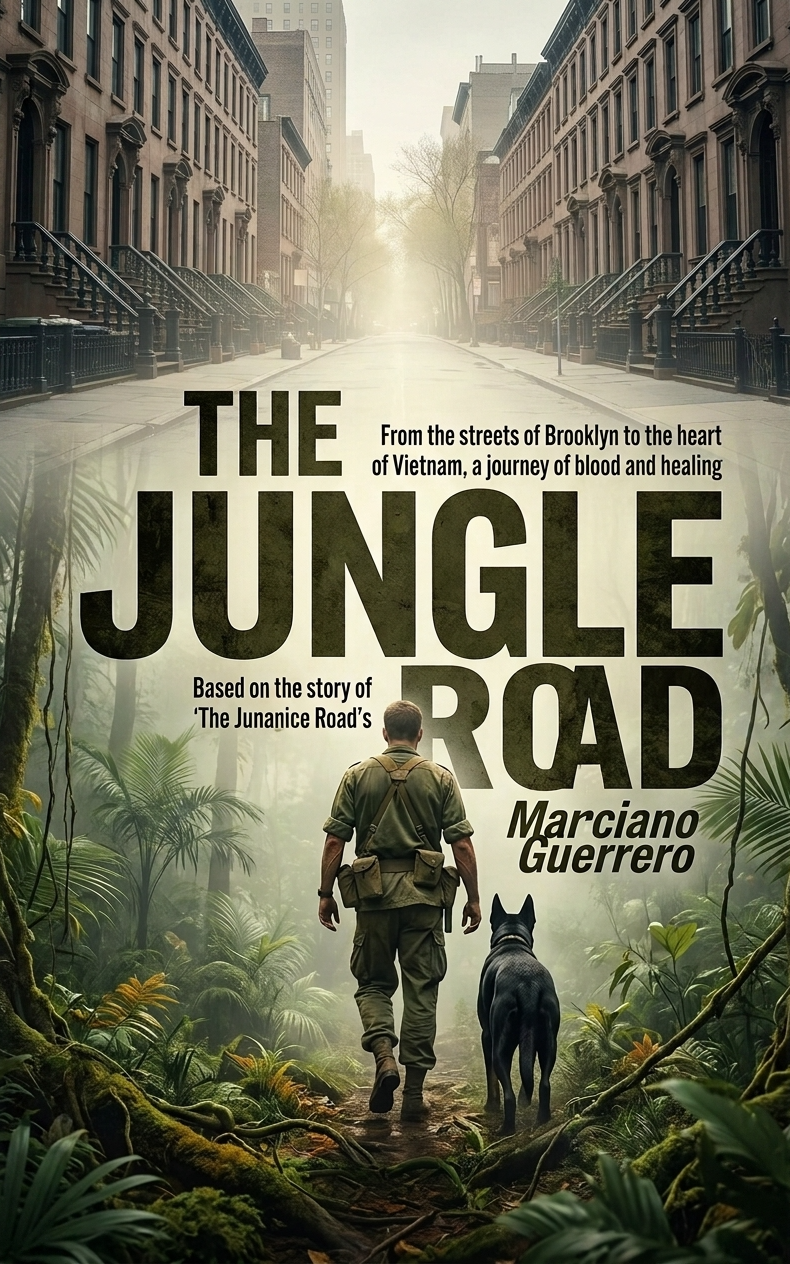
THE JUNGLE ROAD
From the streets of Brooklyn to the heart of Vietnam, a journey of blood and healing
by Marciano Guerrero
Sabino Vargas was a son of Brooklyn, a student with a future until one violent outburst at Columbia University changed everything. Drafted into the heat of the Vietnam War, he is thrust from his family’s bakery into the lethal green shadows of the Long Vinh province. Under the command of the disciplined Major Joseph Bates and alongside his brothers-in-arms Pepino and Geeter, Sabino learns the brutal language of the jungle. It is a world of sudden ambushes and deadly booby traps, governed by the brilliant and ruthless Viet Cong commander Xuan Nguyen. As the Tet Offensive ignites, the war becomes a personal duel between two men from different worlds. When Sabino is captured, he must summon every ounce of strength to survive a harrowing escape, carrying a wounded commander through enemy territory with only his loyal dog, Vinonegro, by his side. But the return to a fractured America offers no easy peace. The ghosts of the jungle follow him home, leading to a final, tragic confrontation on the streets of New York. The Jungle Road is a powerful epic of sacrifice, the unbreakable bonds of brotherhood, and the long, arduous path to redemption. It is a story that proves even in the wake of total destruction, the seeds of healing can find a way to grow.
- Historical Fiction
- War & Military
- Thriller
Brooklyn Shadows
Sabino Vargas sat on the worn hardwood floor of the Brooklyn apartment, his back against the warm radiator. A schoolbook lay open in his lap, its words blurred and unread, his mind wondering whether his mother's angelic ways outweighed his father's fiendish acts. Was it a competition? heck no, a war it was!
Outside, an empty plastic bottle rattled along the sidewalk, chased by a winter wind. Boys shouted over a disputed stickball call. A bus exhaled a cloud of diesel at the corner. But inside, the apartment held a different sound: his father’s footsteps in the hallway.
They were not steady. They were not hurried.
Victor Vargas’s shoulder scraped against the plaster. A pause. Then, a shadow filled the doorway.
“Sabi. Ven aquí.”
Sabino looked up but did not rise. Victor stood with one hand braced against the frame, his shirt wrinkled and collar open. The smell of stale beer reached the center of the room before he did. His eyes were dark, restless, and rimmed with red.
“I’m talking to you,” Victor said.
Sabino stood slowly. He had learned to read the weather of this man—the tight jaw, the unfocused stare, the breath drawn too sharply through the nose. The apartment always seemed to shrink when Victor was angry, the walls closing in until the air felt thin.
“Look at me.”
Sabino lifted his eyes. For a moment, neither spoke. They shared the same deep-set eyes, the same barrel chests, features that always unsettled the boy; it felt like looking into a mirror that showed a future he didn't want.
Without warning, Victor swept a glass off the small side table. It shattered against the far wall, the crash echoing like a gunshot.
Sabino did not flinch. What now? Other men on the block worked double shifts and came home exhausted. They cursed the cold and argued about the Mets, but they did not carry storms inside their coats to terrorize their families.
Then the buzzer rang from downstairs.
Clear. Bright. A rescue.
Stepping past his father without asking permission, Sabino took the narrow stairs down to the street level.
The bakery was warm. Heat from the massive ovens rolled through the room in comforting waves. Scents of roasted apples and cinnamon hung heavily in the air, masking the city’s grit. At a corner table, a small black-and-white television flickered with a grainy image of Washington. A newsreader’s voice droned over the hum of the refrigerators, mentioning President Kennedy and a place called Vietnam. The President spoke of "advisory capacities" and "supporting the South," but the words felt distant, like a report from another planet.
Magda, Sabino's mother, stood behind the marble counter; sleeves rolled to her elbows and flour dusting her forearms like lace. She looked at Sabino once, her eyes searching his face for bruises, then nodded toward the prep table.
“Take the register, Sabino, and then work the dough.”
Magda’s voice carried a sweet Hungarian lilt, a soft counterpoint to the city's harshness.
Sabino took the heavy rolling pin. The dough resisted at first, cold and stubborn, then it gave.
“We persuade,” Magda said softly, her hands moving with a rhythmic grace as she folded and turned. “We apply even pressure—we do not punish the bread for being firm.”
She met the eyes of every customer who walked in, listening to their small talk of the weather or the rising price of milk. Upstairs, something heavy fell. The ceiling creaked. Magda didn't look up; she simply continued slicing apples into perfect, uniform crescents.
Sabino pressed the rolling pin harder than necessary, his knuckles white.
She touched his wrist lightly. “Even,” she repeated.
He adjusted his weight. Here, the world followed laws. If you worked, something rose. If you waited, something baked. If you burned it, you learned and started again.
Near closing, Victor came down. He did not remove his coat. “Another day,” he muttered, leaning heavily against the counter. He looked around the shop as if the smell of sugar was an insult. “This isn’t what we came for. The great American dream... a big lie.” He laughed, a short, dry sound that lacked any real humor.
Sabino kept boxing pastries, his eyes fixed on the cardboard tabs. He did not look up.
That night, the apartment returned to its brittle silence. Victor sat in the chair by the window, a bottle loose in his hand. Eventually, his grip failed. The bottle struck the floor, and glass scattered across the boards like diamonds in the dark.
“Pick it up, woman!” Victor yelled, his voice thick with sleep and spite.
Magda moved to gather the pieces, her knees hitting the floor, but Sabino reached the glass first. He stood between them, the dustpan in one hand and a newfound weight in his chest.
“Enough,” Sabino said. His voice was steady, surprising him. It hung in the room, louder than the shout that preceded it. “You broke it. You pick it up.”
Victor opened one menacing eye. Sabino didn't retreat; he gripped the back of a wooden chair, lifting it just an inch off the floor, ready.
“Tough man, eh?” Victor sneered, though he didn't move. “You think you’re grown?”
“I won’t let you talk to mom like that.”
Victor stared at him, weighing the defiance in the boy’s stance. For a long moment, Sabino thought the storm would finally break over him. Instead, Victor stood slowly, pulled on his coat, and walked out the door without another word.
The latch clicked shut. Magda’s hands trembled once before she tucked them into her apron.
“Szívem, Drága szívem,” she whispered, drawing Sabino toward her.
He realized then how small her shoulders felt, yet how solid she remained. Later, when the apartment was still, Sabino swept the final shards into the trash. They caught the weak hallway light like bits of ice. He thought of the men in the bakery, the boys in the street, and the flickering images of soldiers on the small TV.
What would he become? He didn't know. He only knew he was tired of waiting for the sound of footsteps.
As he emptied the dustpan, a distant siren wailed, its high-pitched cry cutting through the Brooklyn night and bleeding into the low drone of the television news still humming from the shop below. The sound of the city was indifferent, a mechanical rhythm that bridged the gap between the quiet war inside the apartment and the one brewing across the sea. Upstairs, in the dark, Sabino lay awake, his heart beating a rhythm he didn't yet recognize as a march.
Joseph Bates
The apartment on Park Avenue had ceilings high enough to swallow sound. It was a cathedral of shaped silence, where even the air felt expensive. Young Joseph Bates sat on the Persian rug beneath a wall of leather-bound books, a volume of Thucydides open across his knees. While outside traffic moved along 71st Street in orderly, muffled waves, insid…