

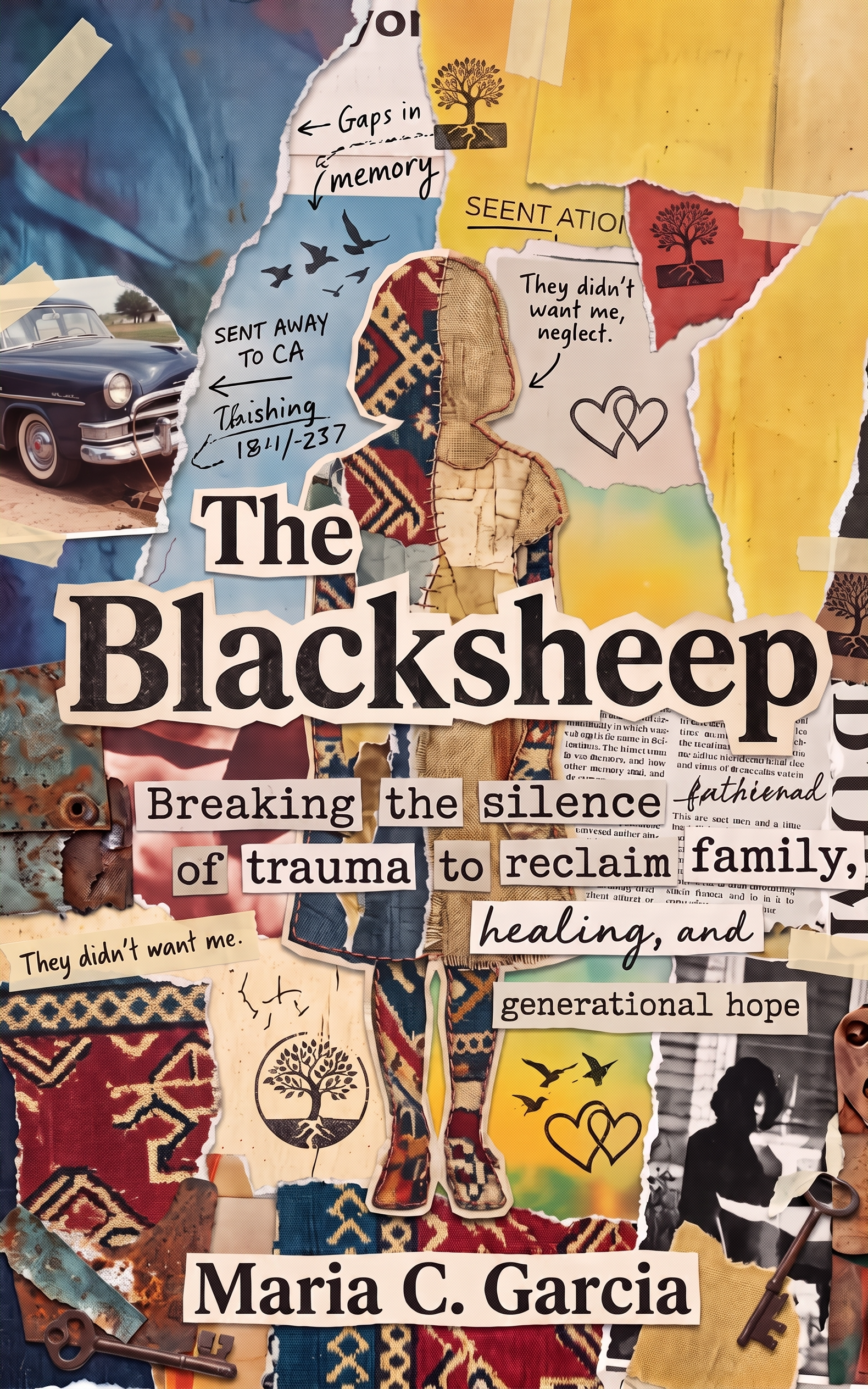
The Blacksheep
Breaking the silence of trauma to reclaim family, healing, and generational hope
by Maria Garcia
How do you rebuild a life when the people meant to protect you are the ones who shattered you? For years, Maria C. Garcia lived with large gaps in her memory, holding onto scattered fragments of a turbulent Texas childhood. Amid fleeting moments of warmth with her father lay a painful reality of emotional coldness, severe physical abuse, and profound neglect. Sent away to California after her domestic trauma was exposed, Maria felt isolated, rejected, and pushed to the brink. Yet, driven by a deep inner strength and a refusal to be defined by her family's silence, Maria fought back. She reclaimed her education, survived the grief of living family members who refused to admit harm, and embarked on a grueling journey toward self-discovery. In this fiercely honest memoir, Maria exposes the painful process of confronting forgotten memories and overcoming deep-seated trauma. Ultimately, becoming a mother allowed her to achieve the ultimate victory: breaking the cycle of abuse to offer her own children the unconditional love and safety she was always denied. The Blacksheep is a testament to the power of resilience, healing, and the choices that define us.
- Biography
- Self-Help
- Overcoming Adversity
- Family Memoir
- Coming of Age Memoir
- Healing & Trauma
I Don't Remember Half of My Life
I don't remember half of my life.
Not because it didn't happen, but because
somewhere along the way my mind decided I
couldn't carry all of it. Some memories
disappeared. Others stayed hidden, buried
beneath layers of survival. Trauma has a way of
doing that. It doesn't always erase the pain; sometimes
it simply hides the memories while leaving the scars behind.
For a long time, I thought something was wrong
with me. Other people could tell stories about
their childhoods in vivid detail—their favorite
birthdays, vacations, traditions, funny moments
around the dinner table. They remembered the
color of their bedroom walls, the names of
elementary school teachers, the smell of their
grandmother's kitchen.
I had silence.
The harder I tried to remember, the thicker the
fog became.
I don't remember much.
What I do remember are fragments. Small
moments that somehow survived while
everything else disappeared. Tiny snapshots
frozen in time, disconnected from one another,
like scattered photographs from an album that
lost most of its pages. I don't know why these
moments stayed when so many others
vanished. Maybe they were ordinary enough that
my mind didn't see them as dangerous. Maybe
they were reminders that not every part of my
childhood was dark.
Or maybe they're all I had left.
Burying the past didn't make the pain disappear.
It followed me anyway, for years I fought battles I couldn't explain.
I lived with self-doubt, fear of rejection,
fear of closeness, and an overwhelming sense
of loneliness. I questioned my worth before
anyone else had the chance to. I apologized for
things that weren't my fault. I expected people to
leave, even when they gave me every reason to
stay.
I spent years surviving a childhood I could barely
recall, years trying to somehow make the fog come
back to light, only to come up empty-handed
every single time.
It's a strange thing to grieve memories you can't
even remember having.
People assume that forgetting means healing,
but it doesn't. Forgetting just means you don't
have access to the story anymore. Your body
remembers what your mind refuses to. Your
reactions remember. Your fears remember. Your
heart remembers.
Even when you don't.
Still, there are pieces that remain.
I remember my dad, my brother, and me
spending afternoons fishing at Cravens Park.
We'd throw our lines into the water and wait for
catfish to bite while eating hot dogs—the same
hot dogs we'd use for bait whenever we fished
there instead of heading out to the lake.
My brother and I always turned it into a "friendly"
competition to see who could catch the most
fish.
He usually lost.
He was never thrilled about that.
He'd pout all the way home while Dad and I
laughed about it, teasing him just enough to
make him roll his eyes. Looking back now, I
wonder if he let me win sometimes. Either way,
those afternoons felt simple. The world seemed
smaller then. It was just the three of us, hoping the next bite would bring be the biggest fish yet.
I remember one night after picking up Wendy's.
The three of us were riding home in my dad's old
silver Chevy truck. Dad was driving, my brother
sat by the passenger window holding the bags
of food, and I squeezed between them in the
middle, carefully balancing everyone's drinks.
Dad made a U-turn where he wasn't supposed to.
Though, if you asked him, that sign hadn't always
been there.
The flashing red and blue lights came on behind
us.
A police officer walked up to the truck and
shined his flashlight through the windows. After
a short conversation, he let Dad off with a
warning. We drove away laughing, relieved that
our burgers and fries were still warm.
It's funny the things your brain decides are worth
keeping.
Not birthdays.
Not holidays.
Not major milestones.
But a traffic stop and a bag of hamburgers.
Memory doesn't always make sense.
I remember kicking field goals with my dad and
brother at the junior high school down the street.
For the longest time, I wanted to be a kicker
when I grew up. I tried convincing my mom that
kickers weren't really allowed to be hit, so I'd be
perfectly safe.
She wasn't convinced.
Football wasn't for girls, she said.
That dream faded pretty quickly, but I never
stopped enjoying the feeling of watching the
football sail through the air after a good kick. For
those few moments, I wasn't thinking about
anything else. I was just a kid chasing
something that made me happy.
I remember mornings before we were old enough to go to school our dad would wake us up before sunrise to take us to my grandparents' house before he went off to work.
We'd climb into the truck half asleep, rubbing our
eyes while the Texas morning was still dark.
Before long, though, we'd all be wide awake,
singing country songs at the top of our lungs
with 99.5 The Wolf playing through the speakers.
None of us could actually sing.
That never stopped us.
We'd howl along anyway, laughing more than
singing until the station's familiar jingle played
through the radio.
Those drives never felt rushed.
They felt safe.
Looking back, I realize it wasn't really about the
music. It was about the feeling of belonging
somewhere, even if only for the length of the
drive.
Those memories are warm.
They're safe.
And almost every one of them includes my dad.
When I think about my mother, I come up empty.
Well... not completely empty.
There are memories.
But there is no light.
No warmth.
No feeling of home.
I've spent weeks, months, even years trying to
remember just one happy memory that included
her.
One laugh.
One hug.
One conversation that made me feel loved.
One moment where I felt like her child instead of
simply someone she was responsible for.
I've searched every corner of my mind, hoping
maybe there was something I had forgotten.
Something hidden beneath all the pain.
Something worth holding onto.
I still haven't found one.
For a long time, I blamed myself for that.
Surely every child has at least one happy
memory with their mother.
Didn't they?
Maybe I just wasn't trying hard enough to
remember.
Maybe I had buried the good along with the bad.
But as the years passed, I slowly realized
something I wasn't ready to admit.
Sometimes there isn't a memory waiting to be
found.
Sometimes the emptiness is the memory.
As much time as I spent searching for one
happy memory, I spent just as long trying to
accept that there may not be one.
That realization hurts almost as much as the
memories I lost.
Because memories aren't just stories.
They're proof that something happened.
Proof that someone loved you.
Proof that, at least for a moment, you felt safe.
When those memories don't exist—or when you
can't find them—you begin questioning
everything. You wonder whether the love was
ever there at all.
I've learned that grief isn't always about losing
someone.
Sometimes it's grieving the childhood you never
got to have.
The mother you needed but never really had.
The memories you wish existed.
Sometimes the loudest memory...
is the absence of one.
The Father I Remember
When I was little, my dad traveled a lot for work.He was—and still is—a highly sought-after welder. His work took him all over because he was good at what he did, and companies were willing to pay for that skill he had. Some people despise the smell of burnt metal, but I love it because, to this day, it reminds me of him. I can tell when someone is…