

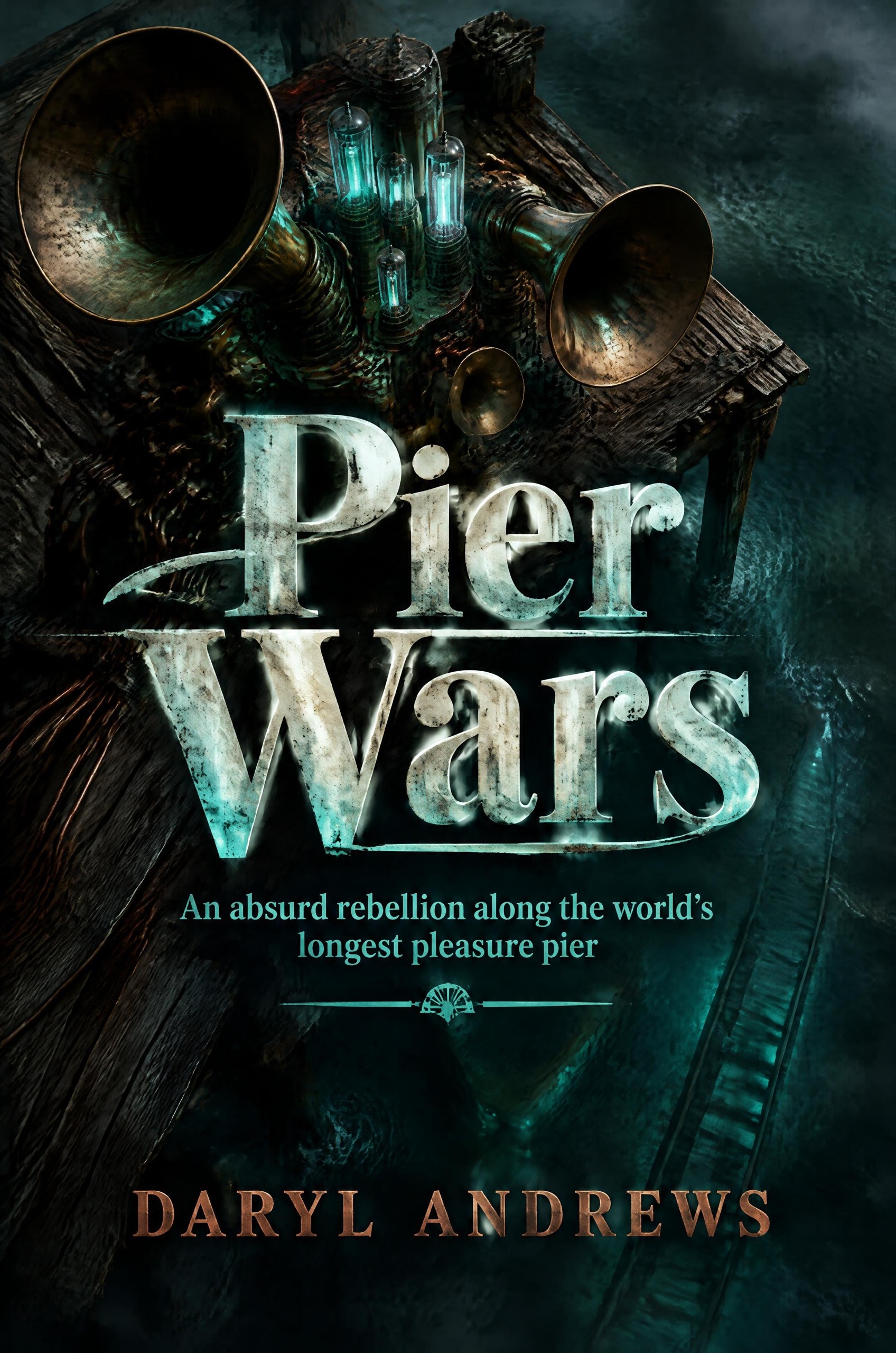
Pier Wars
An absurd rebellion along the world's longest pleasure pier
by Mark House
In the wake of global collapse, the world's surviving elite have claimed the coastal resort of Southend-on-Sea. Holed up in the glittering glass towers of the Pier Pavilion, High Custodian Siegfried Gimblett hoards every scrap of computing power and fresh water, harnessing the bizarre, earth-bound harmonics of the Thames Estuary to fuel his maritime paradise. Beneath them, amidst the salt mudflats, the indentured labourers who keep the regime running are forbidden even the simplest digital technology. To survive, they must assemble a labyrinth of clockwork contraptions, brass speaking tubes, and semaphore mirrors. But when pneumatic technician Isaac Newsome and his rebellious allies uncover the gruesome sacrifice powering the estuary converters, survival gives way to outright sabotage. From cockle gatherers to renegade tram operators, an eccentric resistance marshals an assault along the world's longest pleasure pier. Yet as weaponised vintage trams clash with pacification squads above the crashing tide, Isaac and his comrades discover that overthrowing a coastal despot might only pave the way for an even more ridiculous tyranny. Pier Wars is an inventive, satirical post-apocalyptic thriller about class warfare, analog defiance, and the enduring absurdity of seaside power.
- Science Fiction
- Fantasy
- Dystopian
- Post-Apocalyptic
- Urban Fantasy
Brine, Brass, and Broken Glass
The listening horn had gone quiet for the third time in ten minutes, and Isaac pressed his ear closer to the vulcanised rubber coupling, waiting for the hiss of static to resolve into something a man could use. Beneath the rotting timbers of the lower promenade the air smelled of wet creosote and rust, and somewhere above his head a board shifted under a boot that didn't belong to anyone he trusted.
'Anything?' Frank whispered, crouched so low his knees were practically in the mud, the cast-iron spanner clutched to his chest like something that might escape if he loosened his grip.
'Hold that steady,' Isaac said. 'If you drop it through the gap, it'll land on a patrol boot and we'll both be explaining ourselves to Tugwell's lads before breakfast.'
Frank adjusted his grip with the elaborate care of a man defusing a bomb, which, in a manner of speaking, he was. Through the gaps in the boardwalk above, Isaac could see the shore patrol moving along the wet shingle in a loose line, rifles slung, torches sweeping the dark in slow, bored arcs. They weren't hunting anything in particular tonight. They were just reminding people that they could.
The tube crackled again, and this time the pattern came through clean: three taps, a pause, two taps, a longer pause, then a scrape that meant Jane wanted him at the usual spot. Isaac tapped back an acknowledgement on the brass fitting and sat back on his heels, letting his spine unknot a fraction.
'That's Jane,' Frank said, unnecessarily, because nobody else tapped out messages like they were cross with the metal for existing.
'That's Jane,' Isaac agreed. He reached up and gave the gramophone horn a final adjustment, angling it so the rain wouldn't pool in the bell and drown the diaphragm again. The whole apparatus was held together with bicycle inner tube and the kind of patient resentment that came from fixing the same fault eleven times in a month. 'Right. Pack it in. We've had our listen for tonight.'
Frank didn't move straight away. He was looking up through the gaps at the patrol, at the way the torchlight caught the standing water in the puddles and turned it the colour of old pewter. 'Why're they even bothered checking water rations? It's not as if we've got owt worth nicking.'
'Because checking is cheaper than thinking,' Isaac said, 'and thinking's never been a strong suit up on the cliff.'
Above them, beyond the sagging rooftops of the mudflat tenements, the towers of the new aristocracy stood lit like something out of a dream nobody down here had been invited to have. Every window glowed the same clean white, powered by currents dragged up out of the estuary mud by means Isaac had never fully understood and had stopped trying to, because understanding it only made the resentment worse. Below those towers, in the queue that formed every evening at the standpipe on Marsh Street, women were filling buckets with water the colour of weak tea, straining it through muslin before they'd let their children near it.
Isaac led Frank out through the gap behind the old deckchair store, checking the alley both ways before he let the boy follow. They kept to the shadow of the sea wall, boots finding the familiar broken flagstones without needing to look. The derelict shelter on the esplanade had lost its roof sometime before Isaac was born and most of its walls sometime after, but it still had enough standing brick to hide a conversation from a passing torch, which was really all that was required of a shelter these days.
Jane was already there, leaning against the inside of the brick with her arms folded and her bandolier of spanners glinting faintly where the moonlight found brass. She had the look she always had when she'd been crouched somewhere cold for too long, waiting for someone slower than her to catch up.
'You took your time,' she said.
'Frank was having a moment with a spanner.'
'I was not having a moment,' Frank said. 'I was being careful.'
'You were being careful loudly,' Jane said, and held something out to Isaac before he could argue the point further. It was a relay, scorched black along one edge, the kind of component that had no business surviving a waste chute fire, let alone being fished out of one. 'Found this in the ash heap behind the executive kitchens. Doris's lad does the collections. He's not meant to look, but he looks.'
Isaac turned it over in his fingers, feeling the familiar cold weight of pre-collapse engineering, the kind of precision nobody down here could replicate without a week and a prayer. 'What's it from?'
'Fountain regulator,' Jane said. 'Gimblett's had the output on his private fountains bumped up twice this month. I checked the logs Doris copied out, the ones with the water board stamp on them. He's not just skimming off the top any more. He's throttling the public standpipes to do it.'
Isaac felt something settle low in his stomach, the particular dull weight of a suspicion confirmed. 'They're not short of power up there.'
'No,' Jane said. 'They've plenty. They just don't want to share it, and starving a few thousand families of clean water is apparently cheaper on his conscience than running the converter an hour longer a day.'
'There's a man who sleeps well,' Isaac said.
'There's a man who's never had to queue for his own water with a baby on his hip in the sleet,' Jane said, and the edge in her voice told Isaac the conversation had reached the point where she'd stop reporting and start planning, which was always the dangerous part. 'We need to get into the feeder valves on Pier Hill. If we can bleed a bit back into the public lines without him noticing the pressure drop, that's weeks bought. Months, maybe, if we're careful about it.'
'And if he does notice?'
'Then we've got a problem considerably larger than cloudy water,' Jane said, which was Jane's way of saying she hadn't worked that part out yet and didn't much want to discuss it standing in a roofless shelter at night.
Frank, who had been quiet for almost a full minute, which was a personal record, piped up. 'How'd they even know where to look, though? For the pumps, I mean. It's not like there's a sign.'
Jane's mouth went thin. 'That's the other thing. Tugwell's lot aren't just walking patrols and getting lucky. I've seen them stop dead outside Marchant's old flat twice now, right where he kept that crystal set wired into the skirting board. No reason for them to know it was there unless they're reading something.'
'Reading what?' Isaac asked, though he already had an unpleasant guess forming.
'Scanners,' Jane said. 'Pre-collapse kit, military grade, the sort that sniffs out residual digital signal. Doris's lad saw one strapped to a sergeant's belt, boxy thing with a dial on the front, lit up green when they walked past a derelict shop that used to run a router. They're not looking for us. They're looking for the ghosts of what we used to have.'
Isaac let that sit for a moment, turning the scorched relay over once more before tucking it into his coat. It was a small mercy, in its way. Every tube and mirror and clockwork contraption he'd rigged beneath the boardwalk ran on brass and breath and copper wire, nothing with a chip in it, nothing that would light a dial green. The old world's rubbish had made them invisible. It was perhaps the only inheritance worth having.
'Then we're safe enough,' he said. 'For now.'
'For now,' Jane agreed, 'is doing a lot of lifting in that sentence.'
The siren went up before either of them could say anything else, a long rising wail that rolled off the cliffs and across the mudflats like something trying to peel the roofs off the tenements. Isaac had heard that siren enough times to know its grammar without thinking: this was not the water-ration warning, nor the curfew bell. This was a sweep.
'Move,' Jane said, already moving, and Frank was up and running before Isaac had finished straightening, the spanner clanking dully against his hip where he'd shoved it into his belt.
They cut through the alley behind the old amusement hall, boots slapping on wet cobbles slick with salt, the searchlight beams already raking the gravel somewhere behind them in long white sweeps. Isaac could hear boots, many boots, falling into the particular rhythm that meant a line of men moving with purpose rather than boredom. Tugwell's lot didn't run sweeps for sport. They ran them to remind people what the alternative to obedience looked like.
'Doris's,' Isaac said, breath coming short. 'Now.'
Jane didn't argue. They skidded round the final corner just as a searchlight swung across the mouth of the alley behind them, close enough that Isaac felt the heat of it on the back of his neck, and then they were through the warped door of Doris Tebbutt's curio cellar, Frank practically falling down the last step in his hurry.
'Shut it,' Doris hissed, already reaching past them to drag the door closed, 'before you let the whole bleedin' night in with you.'
The cellar smelled of lamp oil and dust and the particular mustiness of things that had once been valuable and were now merely old. Doris herself looked exactly as she always did, bird-thin and sharp-eyed beneath a crown of pinned silver hair, already steering them behind a towering stack of pre-collapse brass clocks, their faces frozen at whatever hour the world had ended for each of them.
'Lovely of you to drop in,' she said, voice dropping to the low, conspiratorial wheeze she used for anyone she liked. 'Didn't fancy knocking, I suppose. Saves on manners.'
'Didn't fancy a bullet either,' Isaac said, crouching down behind the clocks as the searchlight swept the gravel outside, visible as a thin white bar through the gap beneath the door. 'Seemed the more pressing concern.'
'Priorities,' Doris said approvingly, settling herself onto an upturned crate with the air of a woman who had hidden fugitives behind her clocks before and expected to do so again. 'You want to mind where you're putting your elbows, Frank love. That one's a genuine carriage clock, pre-collapse, worth more than your whole family put together, God rest the lot of you.'
'They're not dead,' Frank said, offended.
'Give it time,' Doris said, not unkindly, and winked at him in the dark.
Outside, the boots passed close enough that Isaac could hear a radio crackle, a voice giving some clipped instruction about checking the old arcade frontage, and then the light swept on and the boots followed it, fading back toward the shingle. Nobody spoke until the sound of the patrol had thinned to nothing but the wash of the tide against the groynes.
Jane exhaled slowly, the tension easing out of her shoulders by degrees. 'That was closer than I'd like.'
'Everything's closer than you'd like,' Doris said, 'that's the whole trouble with living down here instead of up a tower. Now. Seeing as you're both sat in my cellar looking like a pair of drowned cats, you might as well tell me what you were doing that had Tugwell's dogs out sniffing round the esplanade on a Tuesday.'
Isaac looked at Jane, and Jane looked back at him, and in the quiet of the cellar, surrounded by the dead faces of a hundred stopped clocks, Isaac understood that whatever came next would not wait for better weather, or for a safer night, or for a plan with fewer holes in it. The standpipes were dry, the towers were bright, and somewhere above them a man in velvet was deciding, over his private fountains, exactly how little his labourers deserved.
'We're going to need your lad again,' Isaac said. 'And we're going to need rather more than clocks this time.'
The Cockle-Shuckers' Ledger
The dory came out of the fog like it had been waiting there since the collapse and had only just remembered its purpose, and Norman Scutt poled it through the oyster beds with the unhurried disgust of a man who had done this ten thousand times and resented every single one of them. Isaac sat low in the bow with his coat collar up against the cold, …