

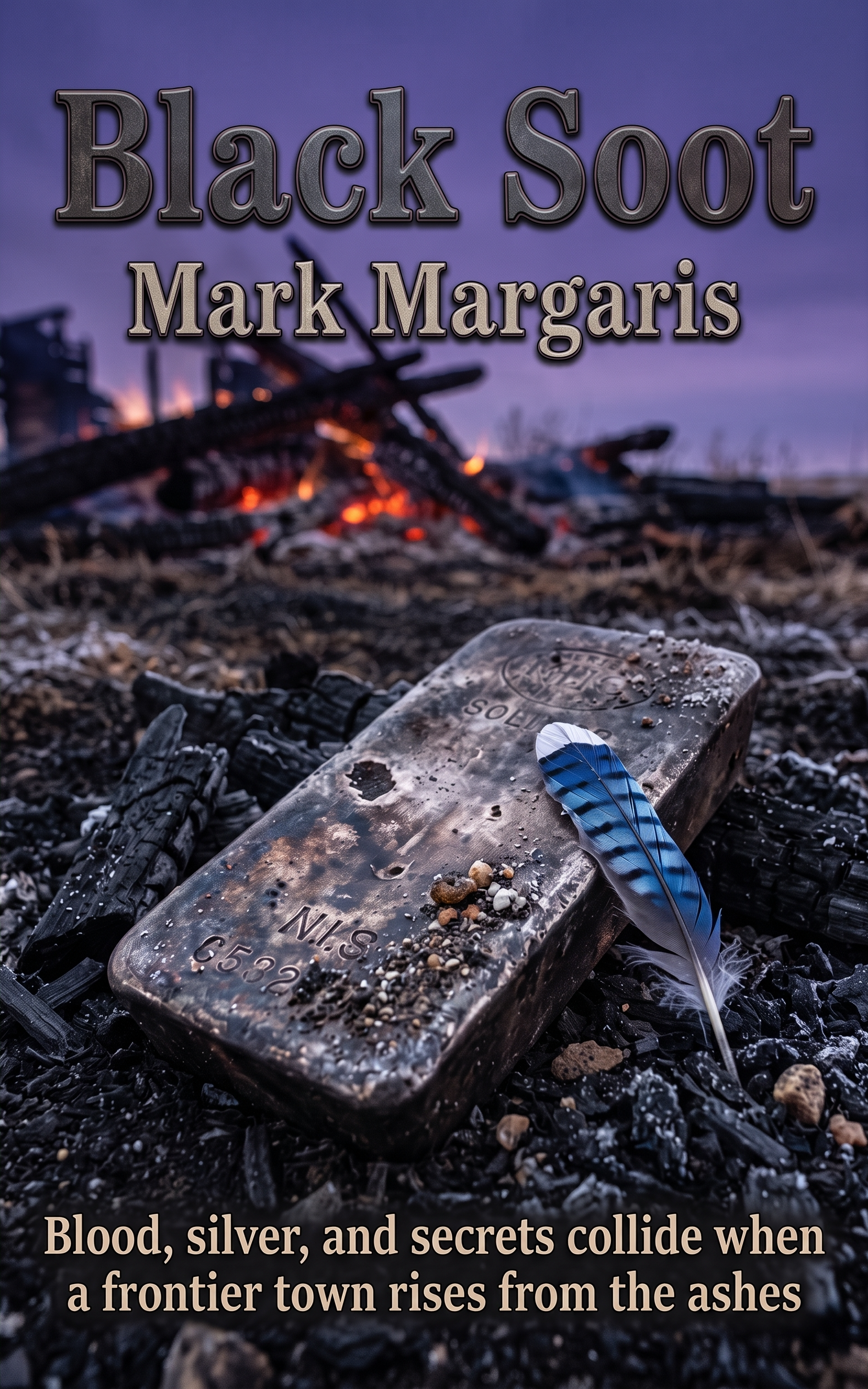
Black Soot
Blood, silver, and secrets collide when a frontier town rises from the ashes
by Mark Margaris
The Montana frontier doesn't forgive, and it certainly never forgets. When a mysterious fire levels the Lonetree Stage Stop, the settlers of the valley are left stranded and vulnerable. For George K, rebuilding isn't just about survival—it's about protecting the secrets buried beneath the soil. But as the smoke clears, a new threat arrives in the form of Marshal Sterling Vance, a rigid lawman whose arrest warrant threatens to tear the community apart. The discovery of a hidden cache of stolen silver marks a deadly turning point. With the notorious McCoy gang closing in and the influential Arnold family playing a double game for control of the valley, George must navigate a web of fragile alliances. From the hidden moonshine caverns to the frost-covered homesteads, every neighbor is a potential ally or a deadly traitor. As the first winter storm looms, George realizes the silver is linked to a past he tried to bury. In a land where the law is often a mask for greed, he must decide what he’s willing to sacrifice to keep Lonetree standing. The frontier is changing, and only those with the grit to face the truth will survive the coming thaw. Mark Margaris delivers a masterful blend of Western grit and suspenseful mystery.
- Western
- Mystery
- Historical Fiction
- Adventure
- Cozy Mystery
- Small Town Mystery
Sifting Through the Embers
George K stood in the center of what had once been the main lobby of the Lonetree Stage Stop, his boots sinking into a thick, gray carpet of wet ash. The air was heavy and sour, smelling of charred pine, scorched wool, and the bitter residue of water poured over dying coals. He took a slow breath, but the acrid draft only burned the back of his throat. He raised a heavy iron rake, its long wooden handle smooth and familiar against his calloused palms, and dragged the metal teeth through a pile of blackened timber. Sparks, long dead, rose as fine black dust, settling onto the knees of his denim trousers.
To his left, Phyllis Stannin was working with a quiet, fierce determination. She was a tall, sturdy woman, and today her silver-streaked hair was pulled back so tightly into a bun that it seemed to pull the skin of her forehead taut. She wore a pair of faded men’s work trousers and a heavy wool shirt, both stained with soot. With a short-handled shovel, she scooped up a load of ruined glass bottles and melted tin cups, throwing them into the bed of a wooden handcart with a loud, metallic clatter. Her expression was hard, her jaw set against the ruin of her livelihood.
Lori Stannin was a few feet away, working to clear the stubborn remains of the front porch railing. Her face was streaked with black soot, a dark smudge cutting across her nose and cheekbone, but her eyes were bright and focused. She wore a practical split riding skirt and a work shirt with the sleeves rolled up to her elbows, revealing forearms that had grown strong from years of frontier labor. When she looked up and caught George watching her, she offered a small, tired smile that did not quite reach her eyes.
“We need to clear this corner before the ground freezes solid,” Lori said, her voice slightly raspy from the dust. She wiped her forehead with the back of her sleeve, leaving another gray streak on her skin. “If we can get the foundation cleared, we can start hauling the new timber from the mill. We can build it back better than it was, but we won’t get a chance if we let the winter catch us with our hands in our pockets.”
George leaned on his rake, looking at the charred perimeter. “The stone foundation looks like it held,” he said, his voice polite and measured. “The heat didn’t crack the main joist supports. That will save us two weeks of digging and hauling stone from the coulee.”
Phyllis stopped her shoveling, leaning her weight against the wooden handle. She looked toward the northern horizon, where the gray clouds were beginning to gather over the distant breaks. “We will need more than just stone, George,” she said, her tone commanding and practical. “We need three thousand feet of finished pine boards, two dozen kegs of square-cut nails, and enough dry shingles to cover the roof before the first heavy snow. And we have to find a way to pay for it all without selling ourselves to the bank in Fort Benton.”
“One step at a time, Phyllis,” Lori said softly, walking over to place a hand on her sister’s shoulder. “We still have our lives. The horses survived in the lower corral, and the well is clean. We aren’t beaten yet.”
George nodded, appreciating the young woman’s resilience. He did not say much; he was a man who preferred to let his labor speak for him. He turned back to the pile of debris, using the heavy rake to pull a half-burned oak table out from the ruins of the wall. The wood was deeply charred, its fine varnish bubbled into black blisters, but the iron hinges were still intact. He lifted the heavy frame, his muscles straining against the weight, and carried it toward the edge of the clearing.
“I will take this load down to the creek bed,” George said, gesturing to the piled debris. “We can dump the iron and the heavy ash in the wash. The spring floods will bury the rest of it.”
“Take the handcart,” Phyllis said, not looking up as she resumed her steady, rhythmic digging. “And don’t be gone too long. We have the southern sill to clear before sundown.”
George loaded the ruined furniture onto the wooden cart, the iron-rimmed wheels creaking loudly as he pushed it down the sloping trail that led toward the creek. The path was narrow, winding through dry brush and wild rose bushes that had already turned brown with the coming autumn. The sound of the rushing water grew louder as he descended, a cold, clean sound that offered a brief relief from the dry heat of the burn site.
He reached the gravel bank where the creek pooled before disappearing into the limestone canyon. He tipped the cart, letting the charred wood tumble onto the rocky shore. As he reached down to sort the salvageable iron pieces from the ash, a movement near the willow thicket caught his eye.
Silas Pendergast was kneeling in the shallow water, his trousers soaked to the thighs. The nervous assayer was frantically scrubbing a heavy, rectangular object against the smooth river stones. His spectacles were sliding down his nose, held in place only by a thin layer of cold sweat and river silt. He was trembling so violently that the water splashed around his knees in erratic ripples.
“Silas?” George called out, his voice calm but cautious.
The assayer let out a sharp, high-pitched squeak and dropped the object into the water. He scrambled backward, his hands clawing at the wet gravel as if he expected to be struck. When he recognized George, he let out a long, ragged breath, though his chest continued to heave beneath his wet flannel shirt.
“G-George!” Silas stammered, his teeth chattering from the cold water and sheer terror. “You... you startled me. I thought you were one of them. I thought they had tracked me down.”
George stepped closer, his boots crunching on the wet gravel. He looked down into the clear pool where the object had fallen. Even beneath the shimmering water, it caught the pale autumn sunlight. George reached down, his fingers closing around the cold, heavy metal, and lifted it. It was a solid bar of refined silver, roughly the size of a brick, but far heavier. The mud had been partially cleared from its face, revealing a deeply stamped mark: a distinct diamond shape with a capital letter B nestled in the center.
“What is this, Silas?” George asked, his flint-colored eyes narrowing as he turned the heavy bar over in his hands.
“It-it-it’s not just ore, George!” Silas whispered, his voice rising in pitch as he scrambled to his feet. He grabbed George’s sleeve with wet, shaking fingers. “This is refined plate, marked with the stamp of the Comstock! It’s blood money! That mark... that’s the Belmont robbery stamp from three years ago. The shipment that vanished near the border. People died for this, George. A lot of people.”
George looked from the silver bar to the trembling man. “Where did you get this?”
“I found it,” Silas hissed, looking wildly over his shoulder toward the thick brush. “Near the entrance to the cavern ruins. Just past the old limestone ledge on your property. There’s a whole cache of them, George. Hidden under some brush and flat stones. I went looking for mineral samples, and I... I stumbled right into it. But someone else knows it’s there. I saw horse tracks. Fresh ones. The fire at the stage stop... it wasn’t just a dispute over land or trade. It was a distraction! They wanted everyone looking at the smoke while they moved the silver!”
George felt a cold weight settle in his stomach. The secret moonshine operation beneath his homestead was already a dangerous burden, and now this stolen treasure was linked to the very ground he claimed. If the outlaws or the marshal found Silas with this silver near his land, his quiet life would be over before the winter even arrived.
“You need to calm down, Silas,” George said, his voice low and steady. “If anyone sees you like this, they’ll start asking questions.”
“I can’t calm down!” Silas cried, his spectacles finally falling from his nose. He caught them clumsily before they hit the rocks. “They’ll kill me, George. If Colter McCoy’s men find out I have this, they’ll string me up from the nearest cottonwood. You have to help me. Just for tonight. Let me hide at your cabin. Please.”
George looked at the silver bar in his hand, then back up toward the ruins where Lori and Phyllis were rebuilding their lives. The frontier was proving to be a highly unpredictable place, and the web of secrets was pulling tighter around them all. He wrapped his fingers tightly around the silver bar and slipped it into the bottom of his empty handcart, covering it with a piece of charred canvas.
“Alright,” George said quietly. “You can stay in my canvas tent tonight. But you keep your mouth shut, Silas. Not a word to the Stannin sisters, and not a word to anyone else in the valley. We walk back up there, we finish the clearing, and then you follow me home.”
Silas nodded rapidly, his face pale but filled with a desperate relief. “Not a word, George. I swear it. Not a single word.”
The Marshal's Shadow
The morning sun was just cresting the breaks when a lone rider appeared on the main trail, his silhouette tall and imposing against the pale sky. The light was thin and cold, casting long, dramatic shadows across the dry bunchgrass and the gravelly earth of the homestead. George K stood near the front of his canvas wall tent, a flat sharpening ston…