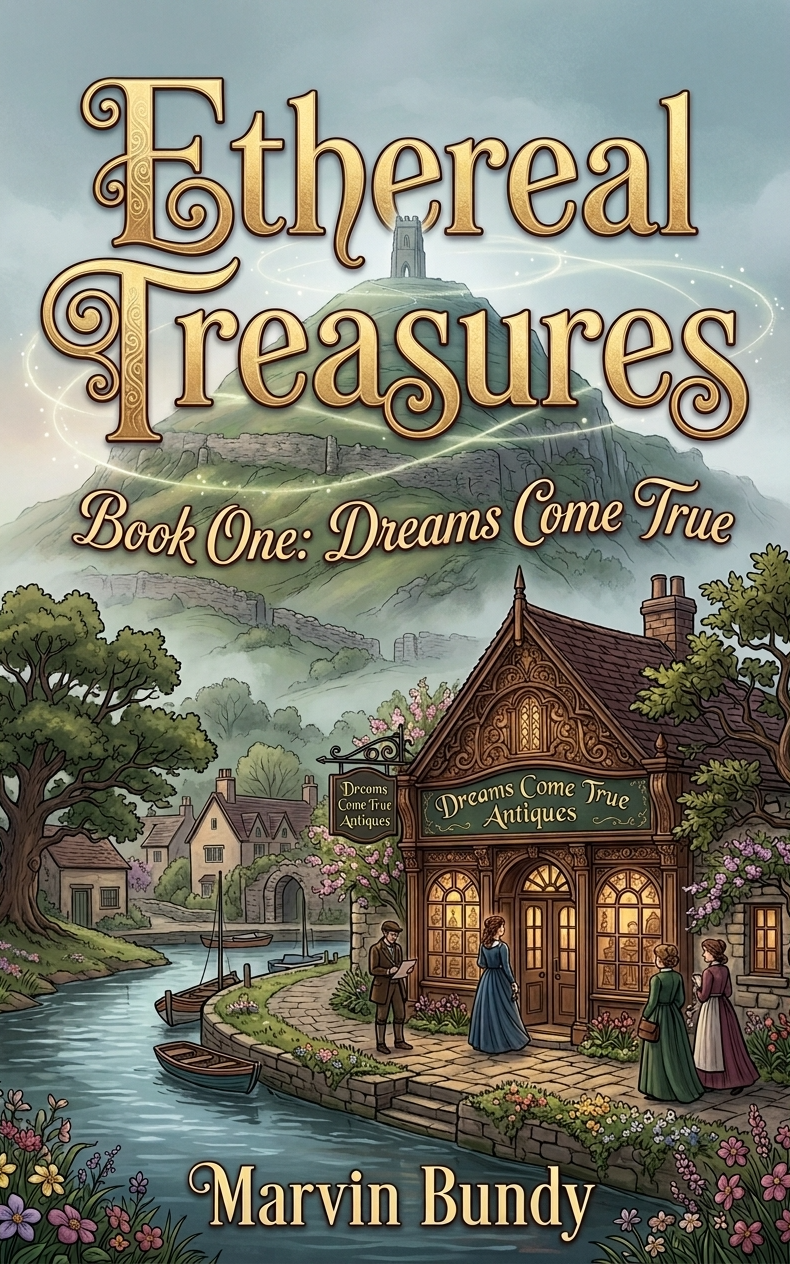
Ethereal Treasures
Book One: Dreams come True
by Marvin Bundy
In the quiet village of Glastonbury, Elizabeth Everly lives a life of service as a diligent maid. While her days are filled with chores for Mistress Allison, her heart constantly wanders toward the emerald slopes of the Tor and the whispers of a destiny she cannot name. Everything changes the moment she steps into 'Dreams Come True,' a vanishing antique shop that shouldn't exist. Gifted a mysterious sapphire ring by an enigmatic proprietor, Elizabeth suddenly sees the world in vibrant color. Shimmering ley lines trace the earth, and ancient visions of the past begin to bleed into her reality. But this newfound power is a beacon for more than just wonder. A dark secret society is stirring in the shadows, intent on exploiting the Tor's magic for their own gain. To protect her home, Elizabeth must unite with a kind artist named Thomas and her loyal friends to confront an ancient evil. When the ring is stolen, she faces her greatest challenge: realizing that the true magic never resided in the jewel, but deep within herself. From the cozy hearths of village life to a high-stakes magical battle atop the Tor, witness the transformation of a maid into a guardian in this spellbinding tale of courage and heritage.
- Fantasy
- Adventure
- Mystery
- Paranormal
- Historical Mystery
- Quest
A Maid's Routine
Elizabeth Everly paused on the front step, her hand resting on the chipped wood of the doorframe. The world just beyond Mistress Allison’s house was painted in pearly hues: a faint fog clung to the cobblestones, and rooftops glistened with dew like a thousand tiny mirrors. Elizabeth drew her shawl tighter over her shoulders, the thick knit scratchy but comforting, and took a steadying breath. The air carried a hint of woodsmoke and river mist, a blend she had come to think of as uniquely Glastonbury.
The door gave a soft click behind her. For a heartbeat, Elizabeth stood poised, letting her senses adjust to the gentle hush of morning. The lane before her was still but not silent—above the distant clatter of a milk cart, she could pick out the gossamer voices of early risers, a peal of laughter from somewhere down by the green, and the metallic song of a lark staked out on a rooftop. She squared her shoulders, feeling the familiar weight of Mistress Allison’s list of errands pressing from the pocket of her dress, and set off toward the market. As she walked, her mind buzzed with a quiet anticipation. Could Glastonbury hold secrets beyond its surface? The idea both thrilled and unnerved her, yet she welcomed the familiar pull of the day's tasks.
Her footsteps echoed on the wet stones, crisp and even. As she walked, Elizabeth made a point of noticing the little things: how the butter-yellow curtains in the baker’s window had been drawn back just so; the way someone had chalked a lopsided hopscotch grid on the edge of the square; and the fresh delivery of milk bottles lined up like glass soldiers along the stoop of the apothecary.
On the corner by the greengrocer’s, Mr. Jenks was already sweeping his front step. He straightened as she approached, his cheeks ruddy from the cold, and gave her a brisk nod. “Morning, Miss Everly,” he called, voice softened by the hour.
Elizabeth offered a gentle smile. “Good morning, Mr. Jenks. Lovely weather for ducks, isn’t it?”
He grunted in amusement. “Suppose it is. Off to the market?”
“Yes, Mistress Allison has a list as long as my arm today. If you see me weighed down with produce, I’ll owe you a favor for not telling tales.”
Mr. Jenks’ grin widened, and he tipped his cap. “Mum’s the word.”
Elizabeth walked on, her heart lighter for the brief exchange. That was the way of things in Glastonbury—people noticed, remembered, and passed the time with a kindness that made the routines of each day feel less like drudgery and more like a sense of belonging. The familiar rhythm of the morning eased the restless tug in her chest, if only for a few moments. Elizabeth's footsteps were light as she made her way back through the village. The cobblestone streets seemed to glow in the golden morning light, and even the air felt different—charged with possibility. It was as if the very stones were whispering of the changes to come.
Ahead, the street climbed gently upward. From its crown, Elizabeth could see the silhouette of Glastonbury Tor, rising above the town like a solitary sentinel. Even shrouded in morning mist, it was impossible to ignore: the ancient tower at its summit stood stark and skeletal, a finger pointing to mysteries just out of reach.
Elizabeth slowed her pace and regarded the Tor for a long moment. She had lived all her life within sight of that hill, and it never failed to draw her eye. Mistress Allison insisted it was nothing more than “a relic and a tourist’s curiosity,” but Elizabeth suspected the truth was far more interesting. She liked to imagine that the Tor watched over the village—not as a monument to the past, but as a promise that the world was much wider, stranger, and more magical than anyone dared admit.
A cold gust whipped down the lane, snapping her back to the present. Elizabeth clutched her shawl and hurried on, the sight of the Tor lingering at the edge of her thoughts. She’d visit it someday, she promised herself—not just to look, but to climb all the way to the top and see what lay beyond the horizon.
Another block brought her to the heart of the village. The market square was beginning to wake: stalls were being erected, crates unpacked, and the air thickening with the scent of damp earth and fresh-cut greens. Elizabeth caught sight of the baker’s wife, Margaret Wills, bustling through her shop door with a tray of steaming rolls. Their eyes met, and Margaret waved a flour-dusted hand, beaming a smile as warm as the bread she carried.
Elizabeth waved back, her cheeks tingling with anticipation of the bakery’s sweet air. But that treat would have to wait until she’d finished the first item on Mistress Allison’s list. She made her way around the square’s edge, slipping past a knot of chattering schoolboys and a pair of gossiping grandmothers, each politely acknowledged with a nod or a murmured good morning.
As she circled the market’s perimeter, Elizabeth found herself glancing skyward again. The Tor’s silhouette was softer now, blue and pale against the morning sun. It looked less imposing, almost inviting, as if it too were waking from a long night and stretching toward the day ahead.
She smiled at the thought. “We’re not so different,” she whispered, her voice lost in the rustle of leaves and the distant bell of the abbey. “We’re both waiting to see what happens next.”
With that, Elizabeth turned her attention to the business at hand, the promise of adventure folded safely into her heart, and made for the bakery. Elizabeth's eyes sparkled as she continued, her voice soft but filled with passion as she muttered to herself, "I've always dreamed of seeing the great cities of Europe. Paris, Rome, Vienna... to walk their streets, breathe in their history, and see the art I've only read about in books." For now, the smell of fresh yeast would have to be her Paris, and the cobblestones of Glastonbury her Roman road.
Elizabeth barely had time to open the bakery door before the heat and scent of yeast and sugar enveloped her. It was like stepping into a different world—one filled with golden light and the promise of sweetness. The wooden floors creaked beneath her sensible shoes, and she blinked against the sudden rush of warmth on her cheeks.
“Lizzie! You’re up with the lark, aren’t you?”
The cry came from behind the counter, where Margaret Wills, queen of the bakery and the village’s unofficial source of good cheer, was pulling a rack of rolls from the oven. Margaret’s cheeks were as rosy as her reputation, and her blue eyes sparkled with a kind of persistent mischief. Her arms, bare to the elbows, were dusted in flour; her apron, embroidered with small daisies, told the story of a busy morning.
Elizabeth smiled. “Mistress Allison believes the early bird catches the best fruit. Or perhaps just the first batch of buns.”
Margaret snorted, waving Elizabeth closer. “Come here and let me see you. You’re too thin; I can tell from the door. Grab a seat, love.” She gestured toward a little wooden stool by the window—a throne reserved for regulars and strays alike.
Elizabeth perched obediently, letting her shawl slip to her lap. “It’s lovely in here, Margaret. Warmer than out there.”
“It’d be a scandal if it weren’t, with the oven running since four.” Margaret set the new batch of rolls on a cooling rack with a practiced flick, then wiped her hands on her apron. “Now, tell me. What’s Mistress Allison got you running after today?”
Elizabeth reached for the folded slip of paper. “The usual: bread, eggs, and a half-pound of cheese. And—oh, she did mention that if you have any of your honey scones left, she’d be forever grateful.”
“Hah!” Margaret’s laughter filled the room like music. “Forever,” she says? I’ll believe that when I see her smile. But for you, Lizzie, I’ll set aside the best scone in the basket.” She turned and rummaged in a bin, emerging with a still-warm scone wrapped in parchment. “There’s an extra one for your walk home, too. You burn more calories than a team of horses, I swear.”
Elizabeth laughed, and the sound felt good in her throat. “If only my appetite matched.”
“It will, love, it will. You’re young yet.” Margaret leaned in, lowering her voice. “How’s she treating you, then? Not too hard on you, I hope?”
Elizabeth hesitated, but the concern in Margaret’s eyes made her honest. “She’s… fair. I can’t say more. Some days are easier than others. But I have my routines. And I get to see you, which helps.”
Margaret’s smile softened. “You’re a good soul, Lizzie. Don’t let anyone grind that out of you.” She slid a warm bun across the counter. “On the house. Consider it a bribe to come back tomorrow.”
Elizabeth broke off a piece of the bun, savoring the hint of cinnamon and the perfect, airy crumb. "I wouldn’t dream of missing it," she admitted, her voice soft. "The bakery is the one place where the day always feels like it's starting on my own terms."
They exchanged a few more pleasantries—Margaret inquired about the new vicar’s sermon, and Elizabeth asked after Margaret’s son, recently apprenticed at the smithy. For a moment, it was as if the rest of the world, with all its demands and expectations, had shrunk to the warm, fragrant space between the counter and the stool.
As the first customers trickled in—two boys still dusted with pillow lint and a housemaid with coins clutched in her mittened hand—Elizabeth gathered her bundle of bread and scones, standing to leave. Margaret saw her to the door, still fussing over whether she needed another scarf for the wind.
“Thank you, Margaret,” Elizabeth said, truly meaning it. “You always make my day a bit easier.”
“That’s what we’re here for, love. Go on, then. I’ll expect a full report tomorrow.”
Elizabeth stepped back into the street, clutching the warm bun in one hand and the scone for Mistress Allison in the other. The fog had begun to thin, revealing a patchwork of shops and homes lit by the low winter sun. She felt, for the first time that morning, not just a sense of duty, but a flicker of happiness.
She nibbled the edge of the bun as she walked, its sweetness lingering on her tongue. And as she made her way toward the market square, Elizabeth thought to herself that if the world could hold small kindnesses like Margaret’s, perhaps it wouldn’t be so ordinary after all.
The market was in full swing by the time Elizabeth arrived, and it was impossible not to be swept up in the current of morning activity. Stalls lined both sides of the square, the canvas awnings pulled taut and dripping with the night’s dew. Even in winter, Glastonbury’s market was a patchwork of color: piles of root vegetables earthy and bright, strings of dried herbs suspended like garlands, and baskets of crimson apples and speckled eggs arranged with almost artistic care. The vendors themselves added to the spectacle—scarves and shawls, ruddy faces, and hands in constant motion as they weighed, measured, and gestured.
Elizabeth wove her way between the stalls, balancing her purchases in one arm and the bread basket in the other. She paused first at Mrs. Linton’s cheese stand, where wheels of cheddar and wedges of crumbly blue were displayed beneath glass domes.
“Morning, Elizabeth! You’re looking bright as a button.” Mrs. Linton’s voice was as sharp as her wares, but the smile behind it was genuine.
“Good morning, Mrs. Linton. Mistress Allison sent me for a half-pound of your sharpest.” Elizabeth placed her order with care, watching as the cheese was wrapped in waxed paper and tied with twine.
“Tell your mistress she’s a woman of taste.” Mrs. Linton’s eyes sparkled with good humor. “And tell her, too, that if she ever wishes to barter for those currant scones, I can be persuaded.”
Elizabeth grinned. “I’ll be sure to deliver the message.”
She moved on to the produce stall, where Mr. Patel—who, despite living in Glastonbury for over twenty years, was still referred to as “the new grocer”—was rearranging his carrots into neat, uniform rows. His stall was immaculate, every vegetable scrubbed and lined up with precision.
“Miss Everly!” he greeted, offering her a carrot as though it were a prize. “You must try these. Sweetest in the county, I promise.”
Elizabeth accepted the carrot with thanks. “You say that every week, Mr. Patel.”
He wagged his finger at her, mock-serious. “And I am never wrong, am I?”
She bit into the carrot and found it was indeed perfectly crisp. “You never are.”
As she waited for Mr. Patel to tally her selection—parsnips, potatoes, a small cabbage, and a bundle of spring onions—Elizabeth let her gaze drift over the square. The world here was so contained, so neatly ordered: the boundaries of the market were both physical and invisible, and everyone within them seemed to know their part. Sometimes she wondered what it would be like to step beyond them, to lose herself in the chaos of a city or the wild expanse of open fields.
She imagined herself in a distant land, bargaining for silks in a sun-baked bazaar or picking oranges from a tree heavy with fruit. The air would be thick with spice, the people strangers to her name and face. Maybe she would speak another language, dress in colors forbidden by the modesty of Glastonbury, and live a life as strange and bright as a dream.
“Miss Everly?” Mr. Patel’s voice snapped her back. He was holding out her bag, eyes kind.
“Sorry, Mr. Patel. I was… thinking.”
He handed her the parcel with a conspiratorial wink. “I hope it was a good thought.”
Elizabeth laughed, embarrassed. “It was. Thank you.”
She made her way down the row of stalls, ticking off items from Mistress Allison’s list as she went. At every stop, she exchanged a word or a smile: the fishmonger, who wrapped her haddock in thick paper and gave her an extra fillet “just because”; the flower girl, only eight years old, who insisted Elizabeth take a sprig of rosemary for her hair; and the candlemaker, who set aside the pale beeswax tapers preferred by the household and asked, in a low voice, if Elizabeth had any news of the world beyond the village.
Elizabeth hadn't any news to share, but the question made her chest ache with a sudden, sharp longing. It was a reminder of how small her world truly was, confined to the familiar streets and the domestic walls of Mistress Allison's house, while the rest of the world spun on in places she could only name in her prayers.
The business of the market was as much about conversation as commerce, and Elizabeth found herself caught in more than one friendly tug-of-war over the latest news, the best recipe for pottage, or the merits of one vicar’s sermon over another. The villagers treated her with a kind of gentle respect, equal parts affection and curiosity; she was, after all, Mistress Allison’s “girl,” and there was always speculation about what that might mean.
Elizabeth accepted their company gladly, but beneath it all was a current of restlessness she couldn’t quite suppress. Each friendly face was a reminder of her place, and each exchange a small confirmation of the boundaries that hemmed her in.
It was only when her arms were full—basket brimming with bread, sack of vegetables slung over her shoulder, and a paper-wrapped parcel of cheese nestled beneath her chin—that she realized she had nearly completed her errand. She paused at the edge of the square to catch her breath, letting the clamor of the market swirl around her.
As she stood, a gaggle of children darted past, chasing each other in circles and shrieking with delight. One girl, her curls wild and eyes bright, nearly collided with Elizabeth and stopped just in time.
“Sorry, miss!” the child said, bobbing a quick curtsey.
Elizabeth smiled. “No harm done. You’re very fast.”
The girl beamed. “My mum says I run like a hare. She’s right.” And with that, the child was off again, swallowed by the crowd.
Elizabeth watched her go, a small smile lingering on her lips. There was something about the child’s energy—the complete lack of self-consciousness, the unguarded joy—that made her wish she could recapture her own younger self, just for a moment. Before the world had become so full of lists and obligations.
She shifted her parcels and prepared to head home but found herself glancing once more toward the Tor. In the clearing light, its outline was sharper, the old tower at its crest dark against the sky. It seemed to beckon her, just as it always had.
Someday, she told herself again.
For now, there was comfort in routine, in the familiar faces and rhythms of the market. But the dream of something more—of adventures and mysteries, of a world beyond the square—was never far away.
Elizabeth drew her shawl tighter, tucked the rosemary sprig into her braid, and started the walk back through the village. Each step echoed the one before it, but she carried with her the taste of sweet bread, the laughter of children, and the distant, persistent call of the unknown.
The lane that led back to Mistress Allison’s house skirted the edge of the green, where the grass was still slick with dew and the bare trees cast long, spidery shadows across the ground. Elizabeth moved slower now, careful not to jostle her careful balance of parcels and bread, and let herself enjoy the quiet hum that followed the bustle of the market.
It was near the old stone fountain, just past the churchyard, that she spotted them: a pack of children, all knees and elbows, tumbling over each other in a frantic game of tag. Their laughter rang out, high and unrestrained, and every so often one would topple to the grass, clutching their side in helpless giggles before leaping up to rejoin the chase.
Elizabeth found herself stopping to watch, instinctively shrinking back into the shelter of an overhanging branch so as not to disturb their game. She could pick out some of their faces—two belonged to the baker’s brood, their red hair unmistakable; one was the apothecary’s youngest, who often trailed after his mother on errands. They darted in and out of the winter sunlight, their coats flapping, boots muddied, and voices carrying like songbirds through the still air.
She caught a snatch of their conversation as they paused for breath.
“You’re it, Nelly!” shouted the tallest, brandishing a stick as a scepter.
“I’m not! You didn’t touch me!”
“Did so!”
“Did not!”
It went on in this fashion, the arguments as fierce and fleeting as the game itself. Eventually, the dispute resolved, and the chase resumed, wilder than before.
Elizabeth hugged her parcels a bit tighter. For a moment, she was seven years old again, a wild-haired child running barefoot through the back alleys, her only worries whether her skirt would survive the climb over the neighbor’s wall and whether she could sneak home before the supper bell. There had been no Mistress Allison then, no lists of chores, no careful lines to color inside. Just the world, big and mysterious, and the feeling that anything—anything—was possible.
A strange, sweet ache settled in her chest. She wondered where that child had gone. Perhaps she was still there, hidden beneath the sensible dress and the daily routines, waiting for a chance to break free.
One of the children noticed her then, slowing to a stop with a sheepish grin. “Hello, Miss Everly!” he called, his face flushed and bright.
Elizabeth smiled back, warmth blossoming in her cheeks. “You’re all very quick,” she said. “I’d be afraid to race you.”
The others skidded to a halt, sizing her up with the wary curiosity children reserved for adults who did not scold or command. “You could try, if you want,” the red-haired girl offered, twirling her stick. “But we play rough.”
Elizabeth laughed, shaking her head. “I’ll leave it to the experts today. Maybe next time.”
With that, the pack whooped and dashed off, the game morphing into something new before they’d even reached the edge of the green. Elizabeth watched them until they disappeared behind the churchyard wall, the sound of their voices lingering long after.
She stood for a moment more, allowing the memory to settle over her like a favorite old blanket. Then, parcels secure, she turned for home, her step a little lighter and her smile slow to fade.
By the time Elizabeth reached the gate, the sun had climbed high enough to burn off most of the morning mist, leaving the world crisp and clear. The house looked much as it always did: imposing and well-kept, its brickwork scrubbed and its brass knocker polished to a shine. There was a certain pride in the way Mistress Allison ran her household—a pride that extended to every last shined bannister and swept stoop.
Elizabeth shifted her parcels, nudged the gate open with her foot, and marched up the path. She hesitated only a moment before knocking, out of long habit—despite years in service here, it never quite felt like her own threshold. The door opened almost instantly, as if the house itself had been expecting her.
“Miss Everly,” intoned Mistress Allison, standing just inside the foyer. She was tall, not by nature but by bearing, and her eyes were a sharp, measuring blue. Today she wore her gray hair swept back in a bun so tight it might have held up the very roof, and her dress was a severe navy that managed to look both expensive and practical.
“Good morning, ma’am,” Elizabeth replied, dipping a small, practiced curtsy. “I’ve brought everything from the list. The bread is still warm from Margaret’s oven, and Mrs. Linton was kind enough to include a sample of her new sharp cheddar for you to try.”
Mistress Allison inspected the packages with a practiced eye, then ushered Elizabeth inside. The air in the house was noticeably cooler than the bakery or the market, scented faintly with lemon polish and the green bite of laundered linens.
“In the kitchen, if you please,” Mistress Allison said, leading the way down the hall.
Elizabeth followed, careful not to let the bag of vegetables bump the walls. She set the parcels on the big oak table and began to unpack, arranging each item just so.
Mistress Allison hovered, arms folded, but her gaze lingered on the bread. “Did Margaret send her regards?”
“She did, ma’am. And she says you have a standing invitation for coffee whenever you wish it.”
Mistress Allison’s mouth twitched at the corner—a smile, or the ghost of one. “Margaret always did have a generous streak. I suppose I’ll have to reciprocate. What was the market like today?”
“Busy, ma’am, despite the cold. Mr. Patel’s carrots are especially fine, and Mrs. Linton says she’ll trade you for currant scones if you’re willing.”
Mistress Allison let out a short, surprised laugh, quickly stifled. “She’s relentless, that one. Did you see anyone else of note?”
Elizabeth paused, considering. “The candlemaker asked after the news, but there’s nothing much to report. The flower girl insisted I take a bit of rosemary.” She patted her braid, where the sprig still rested.
Mistress Allison eyed it but only said, “Very well. That will be all for now, Miss Everly.”
Elizabeth bobbed another curtsey, ready to retreat to her chores, but Mistress Allison’s voice stopped her at the door.
“You manage well, Elizabeth,” she said, softer than before. “Better than most in your position.”
Elizabeth looked back, her fingers twisting slightly in the fabric of her apron, uncertain whether she was meant to reply. “Thank you, ma’am,” she finally whispered, the rare validation warming her more than the kitchen hearth ever could. Elizabeth's fingers traced the intricate patterns of the tapestry in the hallway as she passed, marveling at the interplay of colors and textures. The wooden table in Mistress Allison's kitchen creaked softly as she leaned forward later to set down the tea, her eyes wide with surprise and delight at the sudden softness in her employer's demeanor.
Mistress Allison turned away, but not before Elizabeth caught the briefest flash of pride—or was it affection? —in her eyes. “Be sure to take your tea before the next task. You’ve earned it.”
Elizabeth nodded and slipped out, heart beating a little faster. Praise from Mistress Allison was as rare as diamonds and twice as precious. It wasn’t love, perhaps, not in the way stories described, but it was something real and lasting, something Elizabeth had long ago learned to treasure.
She allowed herself a small, secret smile as she prepared the kitchen for the afternoon’s work. The day’s errands had left her tired, but the simple acknowledgment—the softening in Mistress Allison’s voice—had given her a second wind. As she measured out the tea and set it to steep, Elizabeth realized she was humming, almost without knowing it.
For the first time in ages, the house did not feel quite so cold. Elizabeth felt something shift within her. The world suddenly seemed wider, full of possibilities she'd never dared to imagine before. She thought of the stories she'd heard of far-off lands and people with spirits yearning to capture beauty. Returning to her work, Elizabeth let out a contented sigh. "Perhaps this is the beginning of something greater," she mused, her voice tinged with both excitement and trepidation. "A chance to weave my own story, beyond the walls of this house."
Elizabeth fell into the rhythm of the afternoon, moving through the house as if guided by a silent metronome. Each room demanded its own attention—the polish of silver, the dusting of shelves, the careful inspection of linens for stray stains or wear. She worked with methodical precision, never rushing, never dawdling, each task a small act of devotion to the order Mistress Allison held so dear.
Yet with every flick of the duster, every measured spoon of tea, her mind wandered. It was easier, in the hush that followed the morning’s bustle, to let her thoughts drift. Occasionally they landed on practical things: a new recipe she wanted to try or the memory of a story Margaret Wills had told over a shared cup of coffee. But more often they strayed further, to the edges of the map, to places Elizabeth had only ever seen in the illustrated pages of discarded travel books.
She imagined herself at sea, hair whipped wild by salt wind, standing on the deck of a ship bound for foreign shores. Or perhaps atop the Tor, looking down not at the safe boundaries of the village but at a world spread out vast and untamed below. She pictured cities so enormous the streets never emptied, deserts where the stars burned brighter than any lantern, and forests that whispered secrets to those brave enough to walk beneath their tangled boughs.
Once, she’d tried to explain this yearning to Margaret, late in the bakery’s kitchen after a particularly long day.
“It’s like there’s something pulling at me,” Elizabeth had said, kneading dough until her hands ached. “Not just curiosity, but a hunger. As if I was meant to see more than what’s outside my window.”
Margaret had laughed, low and understanding. “That’s how you know you’re alive, love. Don’t let them tell you otherwise.”
The memory made Elizabeth smile, even now. She wondered if Margaret had ever felt the same or if she’d found contentment in flour-dusted mornings and the reliable sweetness of fresh bread.
The hours passed with deceptive quickness. There were vegetables to peel for supper, a loaf of bread to slice just so, and letters to set out for Mistress Allison’s correspondence. Elizabeth took pride in the small perfections: a neatly folded napkin, a vase of rosemary on the mantel, and the subtle gleam on the silver platter. These details mattered, she thought. They were the difference between a house and a home, between servitude and stewardship.
Near evening, as the sun slid lower in the sky, Elizabeth found herself drawn to the window in the upstairs hallway. The view from here was modest—just the weathered rooftops, a patch of the sleeping garden, and beyond that the Tor, dark and brooding in the last light of day. The sunset gilded the world in a heavy, liquid gold, turning the bare branches outside to delicate filigree and painting the clouds in streaks of fiery pink and deep violet.
She leaned against the glass, breath fogging the pane, and allowed herself to dream a little. For a moment, she pictured herself not inside looking out, but out there—walking the fields, climbing the hill, perhaps with a friend at her side or a journal in her pocket, recording the wonders she would one day see.
A door creaked open at the far end of the hall, and Elizabeth straightened, heartbeat quickening. But it was only the cat, slipping out of Mistress Allison’s room in pursuit of a sunbeam.
Elizabeth watched the animal slink down the stairs, tail aloft, and envied its easy freedom.
She lingered a few minutes more before returning to her duties. Supper would need to be set out soon, and there was always the evening tea to prepare. As she worked, she hummed a tune—something she’d heard as a child and only half-remembered, but comforting all the same.
The night settled slowly over Glastonbury, the village lights winking on one by one. Elizabeth closed the shutters, checked the locks, and completed the final sweep of the main floor. When everything was in order, she allowed herself a moment at the hearth, holding her hands to the embers and savoring the warmth.
Tomorrow would bring another list, another circuit of the market, and another day like this one. But for now, Elizabeth was content. Not satisfied—no, never quite that—but content, in the way of someone who knows they are part of a story still unfolding.
She carried the feeling with her up the stairs, into the narrow bed beneath the eaves, where she lay awake for a while, watching the moon rise through the crack in the curtains. The world outside was silent, mysterious, and full of possibility.
With a final, lingering glance at the Tor in the distance, Elizabeth closed her eyes and let herself drift, certain that someday, the unknown would not only call to her but also welcome her in.
The Curious Errand
The kitchen bustled with activity, pots clanging and voices mingling in a familiar morning cacophony. Elizabeth wiped her hands on her apron, watching as Mistress Allison strode purposefully towards her, a folded note clutched in her elegant fingers. "Elizabeth," Mistress Allison's voice cut through the din, firm but not unkind. "I need you to coll…
Want to read the rest?
Get the full book here: