

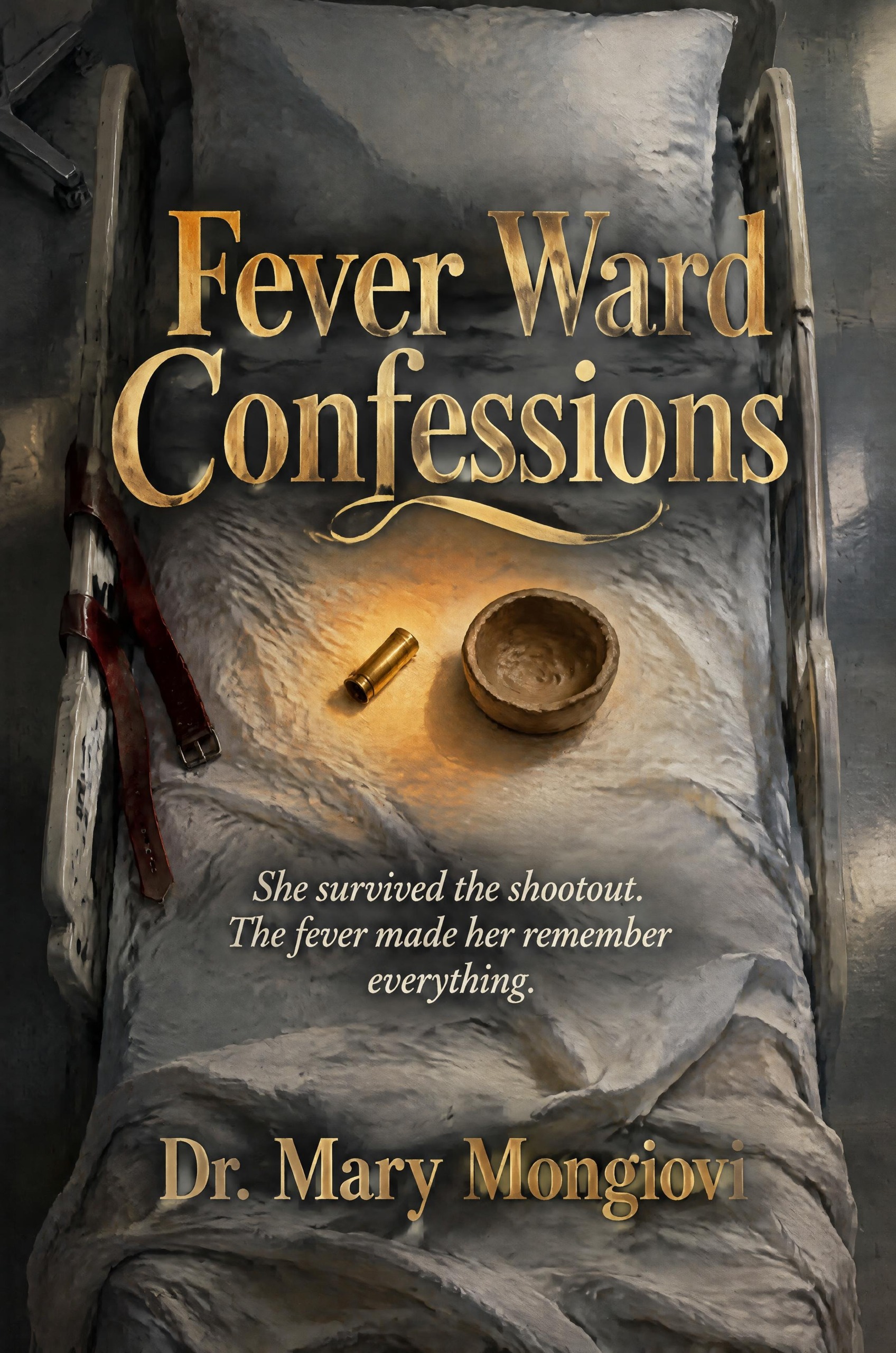
Fever Ward Confessions
She survived the shootout. The fever made her remember everything.
Deanna Williams was a cop until a shootout killed her partner and destroyed her shoulder. Eighteen months later, she is still not okay. A routine surgery to remove scar tissue goes wrong when a post-op fever spikes to 104 and Deanna's grip on reality shatters. She attacks the nurses trying to help her, convinced she is back in that alley with her partner bleeding out. By the time the restraints go on, no one on the floor wants to enter her room. Cassie Evans hears the commotion from the nurses' station and walks in anyway. She speaks to Deanna the way she speaks to her pottery clay: steady, patient, without flinching. And something in that quiet voice cuts through the fever dream long enough for Deanna to let go. What starts as crisis intervention becomes something neither woman expected. Deanna does not know how to need anyone. Cassie has spent years learning that caring for wounded people can become a way of disappearing into them. As the fever breaks and the truth about the shootout surfaces—along with a deputy chief who wants it buried—they have to figure out whether what is growing between them is real or just the aftershock of proximity, trauma, and grief. Fever Ward Confessions is a slow-burn contemporary romance about the terrifying, tender work of letting someone see you whole.
- Romance
- Literary Fiction
- Contemporary Romance
- Slow Burn Romance
- Grief & Loss
- Relationship Drama
The Woman in Room 412
Cassie Evans had been off the clock for exactly eleven minutes when she heard the crash. She had her bag over one shoulder and her car keys already out, the particular bone-tired feeling of a double shift settling into her lower back, when the sound came from down the hall, metal against tile, loud enough to stop three people at the nurses' station mid-sentence.
"Security to 412," Laura Thomas said into the phone, and her voice had none of the flatness Cassie usually heard from her. "Now. I need somebody now."
Three nurses stood outside the door of Room 412 in a loose, useless cluster, the kind of huddle people formed when none of them wanted to be the one closest to the door. One of them, a young nurse's aide Cassie recognized from orientation, had a red mark blooming along her forearm and was holding it against her chest like it might fall off.
"What happened?" Cassie asked, setting her bag down on the counter without thinking about it.
"Post-op fever, spiked overnight," Laura said. "Shoulder patient, former cop. She was fine at midnight. By two she was hallucinating, pulled her own IV, flipped the bedside table. Jen went in to check on her and got a bedpan across the arm for her trouble."
"Is she hurt?"
"Bruised. Scared more than hurt." Laura rubbed at her eyes under the drugstore readers that always slid down her nose. "I cleared the room. We're waiting on the doc for an order, but with her vitals the way they are, sedation's going to mean restraints too. I don't love it, but I don't have a better option."
Cassie looked through the narrow window in the door. The room had the particular wreckage of a struggle, the bedside table on its side, a plastic water pitcher rolling in slow half-circles against the baseboard. The patient was pressed into the far corner between the wall and the window, knees drawn up, hospital gown twisted around one shoulder, and her close-cropped black hair was dark with sweat at the temples. She wasn't lunging at anyone. She wasn't even looking at the door. Her eyes were fixed on something low and to her left, something only she could see, and her mouth was moving.
"Get down," the woman was saying, low and urgent, the words half swallowed by her own breath. "Louis, get down, get down, stay down."
Cassie went still.
"Laura," she said. "She's not fighting you. She's fighting whatever happened to her."
"I know what it looks like, Cassie. Knowing doesn't make it safer to walk in there."
"Has anyone tried talking to her instead of restraining her?"
"We tried talking. She came off the bed at Jen before Jen got three words out." Laura glanced at the aide, at the mark on her arm, then back at Cassie, and something in her face shifted, tired past the point of pride. "You want to try?"
"I want to try."
"If this goes wrong, it's on me either way. Might as well be for a reason I believe in." Laura stepped aside from the door. "No restraints, no touching her first. You call out if it turns, and I mean the second it turns, not after."
Cassie nodded, and before she could think too hard about what she was agreeing to, she opened the door and stepped inside.
The room smelled like antiseptic and sweat and something underneath that, fear with nowhere to go. She did not look at the overturned table or the broken IV line still looped on the floor. She kept her eyes on the woman in the corner and let her shoulders drop, the way she dropped them over the wheel when a piece of clay had gone off-center and needed coaxing back rather than force.
"Hi," Cassie said, quiet, no urgency in it at all. "My name is Cassie. I'm a nurse here."
The woman's eyes didn't move to her. "Louis, get down. Shots coming from the window, get down."
"You're safe," Cassie said, keeping her voice level and unhurried. "The shooting's over. It's over. Louis is safe."
She did not know if that was true. She said it anyway, because a hallway full of frightened people was no place to decide whether the truth was kind.
The woman's breath hitched, and for a moment her eyes flicked toward Cassie's voice without finding her face, the way someone surfacing from deep water looks for light before they look for a person. Cassie didn't move closer. She stayed where she was, hands open and visible at her sides, and let the silence sit between them instead of filling it.
"You're in a hospital," Cassie said. "You had surgery on your shoulder. You've got a fever, and it's playing tricks on you. None of this is real right now, but I am. I'm real, and I'm not going to hurt you."
"Louis," the woman said again, but softer now, less certain, like a word losing its grip on the thing it was holding onto.
"I need you to look at me," Cassie said. "Just at me. Nothing else in the room matters right now."
It took a long moment, long enough that Cassie heard someone shift their weight in the hallway behind her, long enough that she wondered if she'd been wrong. Then the woman's eyes found her face and stayed there, confused, searching, the deep brown of them finally catching on something steady instead of sliding past it.
"There you are," Cassie said, and smiled, small and unhurried. "Hi."
The woman's shoulders came down an inch. Then another. Her breathing, which had been fast and shallow, began to slow, each breath a little longer than the one before, the way a kiln cooled if you let it cool right instead of cracking the door too soon.
"That's it," Cassie said. "You're doing fine. Let's get you back to bed, okay? No one's going to touch you unless you want them to."
She held out one hand, palm up, and waited. For a moment nothing happened, and then the woman unfolded from the corner, slow and shaking, and let Cassie walk her the few steps back to the bed without once taking that hand.
She sat on the edge of the mattress, breathing hard, blinking like the room had only just come into focus around her. Then her hand shot out and closed around Cassie's wrist, hard enough to bruise, her eyes suddenly sharp and present in a way they hadn't been seconds before.
"Did he make it?" she said.
Cassie did not know who Louis was. She did not know what had happened to him, or whether the answer would undo everything she'd just built in this room with nothing but her voice.
"You're in the hospital," she said instead, gently. "You're safe."
The grip on her wrist loosened. The woman's eyes closed, and her head tipped back against the pillow, and for the first time since Cassie had walked through the door, the room went quiet.
Fever Logic
Deanna woke to afternoon light the color of weak tea and a weight on both wrists that took her a moment to understand. Soft restraints, padded cuffs looped through the bed rail, loose enough that she could turn her hands but not lift them. She lay still and catalogued the room the way she used to catalogue a scene: window to her left, door straight…