

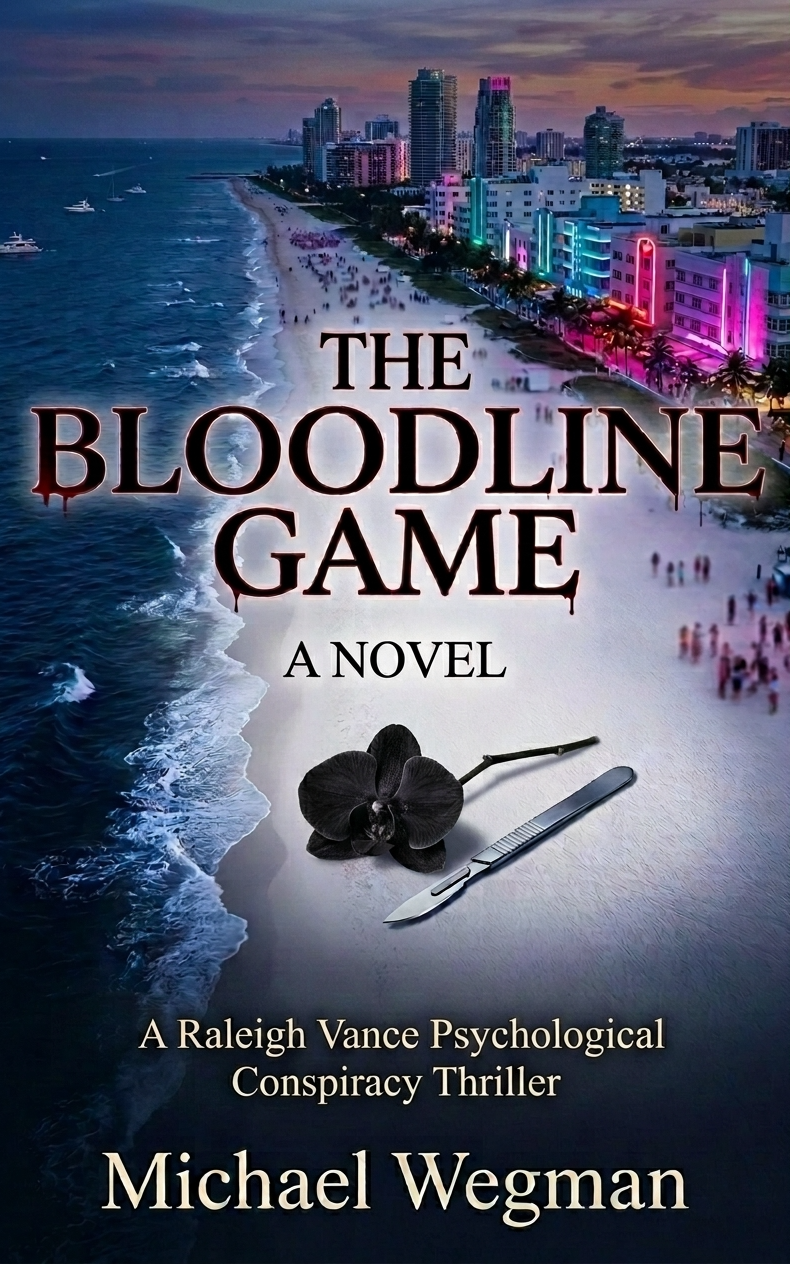
The Bloodline Game
A Psychological Thriller
by Michael Wegman
Miami’s neon lights are blinding, but the shadows in South Beach have never been darker. As thousands of college students descend upon the coast for Spring Break, a predator is hunting among the palms. The victims: daughters of the nation’s most powerful men. Each crime scene is a masterpiece of surgical precision, a grisly message left for an elite class that thinks it’s untouchable. Detective Raleigh Vance is a woman haunted by a failed past, now tasked with stopping a killer who defies every profile. When she crosses paths with Killian Saint-James, the enigmatic 'Dark Prince of South Beach,' she finds an ally who is as dangerous as the monster she’s chasing. Their attraction is a volatile fusion of desire and suspicion, ignited in the heart of a city that thrives on decadence. As Raleigh digs deeper, she uncovers the 'Blue Bloods,' a secret society where the victims' fathers are more than just grieving parents—they are architects of a terrifying legacy. With the Governor’s daughter next on the list, Raleigh must decide if she can trust a man like Killian, or if she will become the final sacrifice in a game of genetic dominance. In a world of wealth and ritual, the truth isn't just buried—it's lethal.
- Thriller
- Crime Fiction
- Romance
- Dark Romance
- Psychological Thriller
- Crime Thriller
Neon and Bone
The call comes at 3:47 AM, and Miami doesn't even have the decency to be quiet about it.
I pull onto Ocean Drive with the windows down because the AC in my department-issue sedan gave up somewhere around February. The night air is thick and salt-heavy, threaded through with bass from clubs that haven't closed yet, perfume and sweat and the particular sweetness of spilled rum that coats South Beach like a second skin during Spring Break. Neon bleeds across the pavement in long, wet streaks. Somewhere behind me, a group of college kids shout at each other across the street, oblivious to the fact that a girl their age is lying dead half a mile north.
I park behind the cordon of black-and-whites and duck under the tape without breaking stride.
The lifeguard tower stands at the edge of the light. Someone has rigged two portable floods to illuminate the scene, and the result is almost theatrical — harsh white beams cutting through the pre-dawn dark, throwing the whole structure into sharp relief against a sky that is just beginning to bleed purple at the horizon. The Atlantic mutters behind it all, indifferent.
I stop ten feet out and look before I move any closer. That's the discipline. You look first, long and unhurried, before you let your feet contaminate anything. The victim is positioned on the tower's narrow platform with her back against the railing, legs extended, face tipped toward the ocean. She could be sleeping. She could be waiting for the sunrise. Someone wanted her to look exactly like that — a girl on vacation, catching the first light.
The blood is the problem. Or rather, the absence of it.
I climb the access ladder in nitrile gloves, camera already in hand, and crouch at the victim's left side. Twenty-one years old, according to the ID recovered from the designer bag staged neatly beside her. Chloe Montgomery. The name rings a distant bell — tech money, old money dressed up in new-tech clothing. Her father's face has appeared on more magazine covers than most politicians. I file that away and focus on what's in front of me.
The incisions are the first thing I catalog. Four of them, symmetrical, following the natural architecture of the clavicle and the iliac crest. Whoever made these cuts knew exactly where to place a blade. No hesitation marks. No ragged edges. The surrounding tissue shows the kind of clean separation that takes either years of surgical training or a pathological patience that amounts to the same thing. This isn't rage. Rage is loud and sloppy and leaves evidence everywhere. This is something practiced and quiet and far more disturbing than rage has ever been.
The exsanguination is near-total. In the ambient light, her skin has a porcelain quality that would read as beautiful if you didn't understand what it meant. It means every drop of blood was removed deliberately, methodically, somewhere that wasn't here. This beach is a secondary scene. Chloe Montgomery died somewhere else entirely, and someone carried her here and dressed her up like a centerpiece.
I photograph everything twice.
By 6 AM, the body is in transport and I am standing in the Miami-Dade Forensics Lab watching Dr. Aris Thorneville work. The lab is his natural habitat — cool and fluorescent and blessedly quiet after the chaos of the beach. He moves around the table with the unhurried precision of someone who has never once confused speed with competence. A Debussy piece plays softly from a small speaker on the counter. He refuses to work in silence, claims the dead deserve better than that.
"The incisions are surgical grade," he says, without looking up. His voice is measured, the consonants clipped in a way that speaks of a different era's education. "We are looking at someone with significant anatomical knowledge. The approach to the subclavian is particularly telling. A layperson does not know to go there."
"What's the cause of death?"
"Exsanguination, almost certainly, though I'll need the full panel to confirm." He sets down his instrument and looks at me over the rim of his gold spectacles. "But that is not the most interesting detail, Raleigh."
He gestures for me to come closer, and I do, pressing my gloved hands to the edge of the table. He gently repositions the victim's head, extending the neck at a careful angle, and points to the anterior throat with the tip of a steel probe.
"The hyoid bone," he says quietly.
I look. The structure is visible on the imaging he's pulled up beside the table, and something is immediately, viscerally wrong with what I'm seeing. The characteristic horseshoe shape is there, but the density reads differently. The color under the portable scope is wrong — too bright, too uniform.
"That's not bone," I say.
"Silver." He says the word with the careful neutrality of a man who has learned to quarantine his own reactions. "Cast with remarkable fidelity to the original structure. Whoever removed the hyoid and placed this replica did so with enough skill that the surrounding soft tissue shows minimal additional trauma."
I straighten up. The fluorescent hum fills the space between us.
"He's rebuilding them," I say, and the words taste strange on my tongue. "He's not just killing them. He's replacing parts of them with something he considers better."
Thorneville watches me with an expression that is equal parts sorrow and intellectual admiration. "The body as a statement," he says softly. "I've seen violence in every form this city produces, and I have never seen anything quite like this."
My phone buzzes before I can respond. Then buzzes again. Then a third time in rapid succession, which means someone in a position of authority is having a bad morning and has decided to share it. The deputy commissioner's office. The Mayor's communications director. A number I don't recognize but whose area code is City Hall.
The message is the same in every variation: drug overdose, tragic accident, high-profile family, Spring Break tourism, discretion expected, ruling pending.
I put the phone face-down on the counter and look back at the silver bone gleaming under the scope.
"They're going to push for an overdose classification," I tell Thorneville.
"They are welcome to push," he says, returning to his work. "I sign the death certificates in this county."
I leave the lab as the sun clears the horizon and turns the Miami skyline into something that looks, from the right angle, like it was built to be admired. I stand on the sidewalk outside the building for a moment, letting the heat settle across my shoulders, and replay the beach in my mind.
The crowd of onlookers. The tape. The flicker of phone screens held up like offerings.
And the man who wasn't holding a phone.
He had been standing at the outer edge of the cordon, far enough back to suggest he understood perimeters, close enough that the flood lights caught the pale fabric of his linen suit. Tall. Dark-haired. Completely still in a crowd that was incapable of stillness. His eyes had found mine across forty feet of crime scene tape, and he hadn't looked away. He hadn't had the decency to pretend he was just another curious bystander.
He had looked at me the way predators look at things they've already decided to pursue — patient, certain, unhurried.
The hair on the back of my neck had stood up then, the same way it does when I walk into a room and know, before I see anything specific, that something inside it is wrong.
I pull my blazer straight and walk to my car.
The hunt has started. I can feel it in the particular silence the city leaves behind when something terrible has already begun moving through it, and no one on the neon-soaked streets below has figured that out yet.
I have. And somewhere in this city, so has he.
The Fixer’s Gambit
The Obsidian Club doesn't advertise. It doesn't need to. You either know the address or you don't, and if you have to ask, the door isn't opening for you. I found it the same way I find most things: I followed the money. The man in the linen suit had been captured on three separate traffic cameras between South Beach and this address on Brickell, a…