

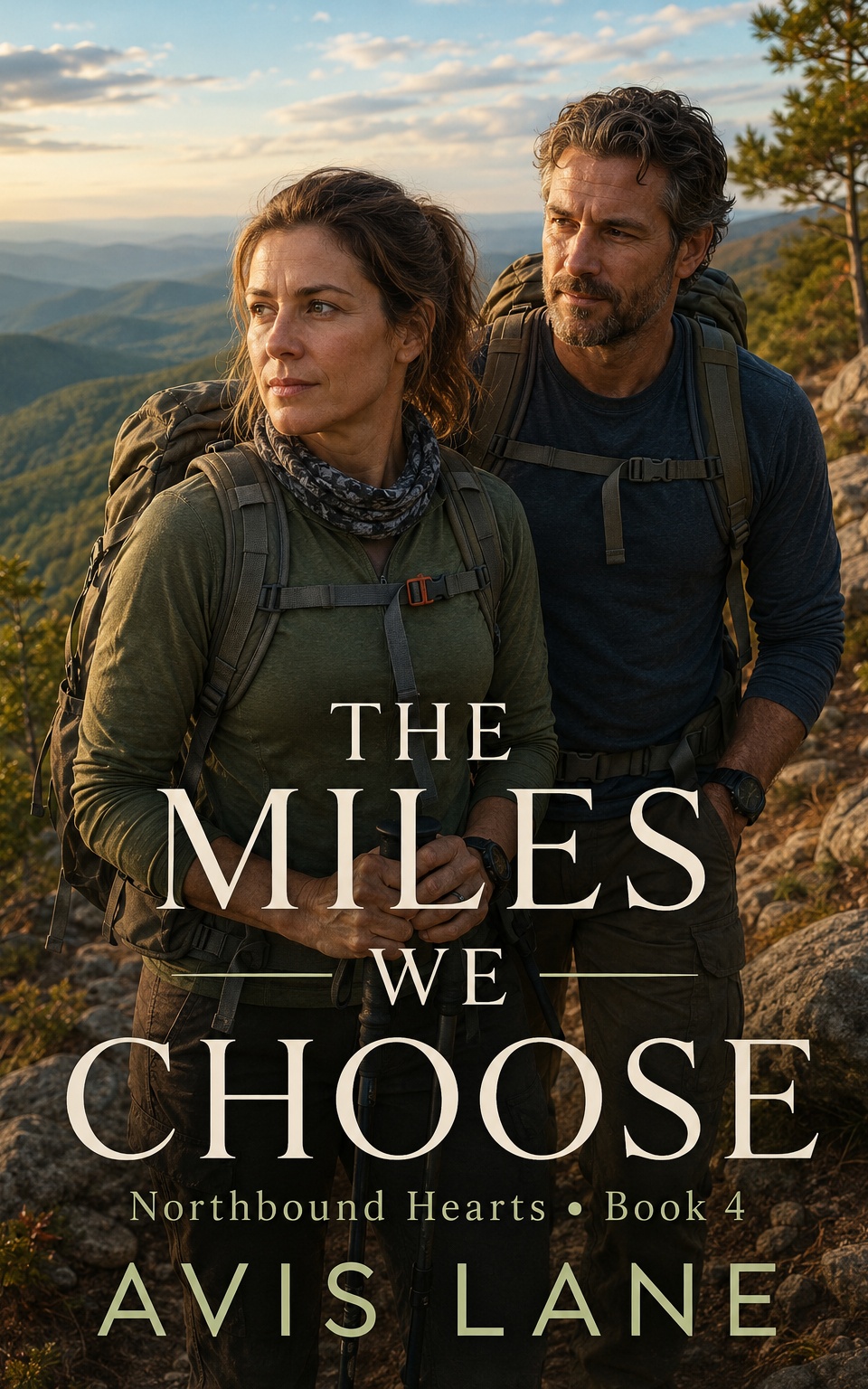
The Miles We Choose
Finding the courage to walk together when you have spent a lifetime walking alone
by Michael Wegman
Julia Merrick is a woman who treats life like an operations manual. At forty-one, she has survived a hollow divorce by mastering the art of the controlled variable. When she reaches the Mason-Dixon line on her northbound Appalachian Trail journey, her goal is simple: maintain the system, manage the miles, and prove that her independence is a shield, not a scar. But the trail from Pennsylvania to Massachusetts is a brutal teacher. Between the jagged rocks of the Keystone State and the sweltering heat of the mid-Atlantic, Julia’s polished gear and rigid schedules begin to fail her. Then there is Reed Calder. A forty-four-year-old former conservation worker, Reed possesses a quiet competence that Julia cannot categorize or ignore. He isn’t looking to rescue her; he is simply there, offering a steady presence that challenges her belief that self-sufficiency is the only form of freedom. As the miles unfold through river crossings and ridgelines, Julia must confront a terrifying question: Is she hiking toward a destination, or is she just running away from the possibility of being known? In this emotionally mature slow-burn romance, two people who have spent years being the solution for others must finally learn how to be the answer for each other. Before the mountains of the north begin, Julia has to decide if she is brave enough to choose a partner for the path ahead.
- Romance
- Adventure
- Literary Fiction
- Women's Fiction
- Contemporary Romance
- Slow-Burn Contemporary Romance
The Mason-Dixon Line
The Mason-Dixon line was smaller than the life Julia Merrick had left behind.
No fanfare. No ceremony. No brass plaque announcing consequence. Just a weather-worn stone marker near the edge of Pen Mar Park, set low to the ground as if it had no interest in being admired. A few families had gathered near the picnic tables behind her, the ordinary sounds of a late morning park carrying through the trees—children asking for snacks, a cooler lid snapping shut, someone laughing too loudly at something that had nothing to do with state lines or endings or beginnings.
Julia stood in front of the marker longer than was strictly necessary.
Pennsylvania started on the other side.
That was the relevant information.
She had read the carved letters for fact first. Feeling, if it came, could come later. That had always been her order of operations. Identify the boundary. Confirm the terms. Adjust the plan accordingly.
Her pack was already settled on her shoulders. Hip belt snug. Sternum strap clipped. Trekking poles loose in her hands. The weight rode cleanly above her hips, exactly where it was supposed to ride, because she had spent three evenings in Philadelphia measuring, adjusting, repacking, and adjusting again before she ever stepped onto this section of trail. She had not come here to improvise incompetence and call it freedom.
A man in a clean ball cap paused near the marker with his phone raised.
“Want me to get one of you?” he asked.
Julia glanced at him, then at the stone.
“No, thank you.”
“You sure? Big moment.”
“Not yet.”
He gave a polite laugh, uncertain whether she had made a joke, then took a picture of the marker by itself and walked back toward his family.
Julia waited until he was gone before she adjusted the load lifters on her pack. The small movement grounded her. Webbing, buckle, tension, release. Simple mechanisms doing what they were designed to do.
The divorce was a closed file.
She did not open closed files on the trail.
She took one photograph of the marker for the record, not for sentiment. Then she put the phone away, turned north, and stepped across the line.
Pennsylvania accepted her without comment.
She had been awake since five.
The room in Waynesboro had smelled faintly of detergent and old air-conditioning, the kind of functional motel room that knew hikers would forgive almost anything if the shower ran hot. Julia had not forgiven it, exactly, but she had used it efficiently. Shower. Repack. Check weather. Eat. Fill bottles. Check weather again. Ignore the part of herself that wanted the forecast to offer certainty it did not possess.
Now, under the green canopy north of Pen Mar, the forecast seemed irrelevant in the way forecasts always became irrelevant once the sky had its own opinion.
The first mile climbed through mixed hardwoods still holding last night’s rain. Water clung to the leaves and dropped at irregular intervals, cold against the back of her neck when the wind found the branches. The trail was soft in places, slick in others, and the early Pennsylvania rocks began almost politely, as if introducing themselves before becoming rude.
Mountain laurel crowded the trail in waxy green corridors, the last few pale blooms clinging in sheltered places. Pretty, if one wanted to stop and admire that sort of thing. Containing, if one was paying attention. The branches pressed close enough that her poles brushed leaves on either side, and her pack scraped once against a trunk where the tread narrowed around a shallow washout.
Her lungs made their initial complaint and then settled. Her calves objected to the first sustained grade, filed the objection, and withdrew it somewhere near the second switchback. Her pack shifted twice before finding its balance. By the time the trail leveled briefly under a stand of tulip poplar and oak, the familiar negotiation was over.
Walking became what walking always became when she let it: body, trail, breath, and the next white blaze on the next tree.
She had chosen good gear. She knew that. She also knew other hikers would notice it the way people noticed a new car in a parking lot, with judgment already forming before anyone asked a question. Her pack was expensive. Her rain shell was too clean. Her titanium cook pot was still unscarred enough to look aspirational. She had chosen every item after weeks of research, cross-referencing reviews against field reports and calculating her base weight to the ounce.
This was not vanity.
This was operations.
She had spent twenty years making other people’s systems work. She saw no reason to stop being thorough because the project was personal.
A pair of southbound day hikers appeared around a bend, moving lightly with small packs and the cheerful exhaustion of people who would end their day near a parking lot.
“First day out?” the woman asked, smiling.
Julia could hear the assumption in it. Polished gear. Clean pack. New section. Woman alone.
“Not exactly.”
The man glanced at her pack. “Nice setup.”
“Thank you.”
“You heading far?”
“North.”
He waited, perhaps expecting more. Julia did not supply it.
“Well,” the woman said, still friendly, “rocks get meaner.”
“So I’ve been told.”
They moved on, and Julia kept walking.
At the next rise, she stopped long enough to drink. South of her, Maryland folded away in green ridges and lingering haze. The view was wide enough to invite meaning, and Julia resisted the invitation. She took one breath, then another. She drank exactly six swallows and put the bottle back in the side pocket where her hand could find it without looking.
Behind her, somewhere lower in the trees, a wood thrush offered a clear, fluted phrase that seemed too beautiful for the practical hour. The song rose, curved, and vanished.
Julia listened until the silence returned.
Then she started north again.
The spring was where the app said it would be, which Julia appreciated.
A narrow metal pipe emerged from a mossy bank below the trail, water running in a thin, steady thread into a shallow stone basin dark with leaves and silt. Ferns grew in the damp seam below it, their fronds bright against the mud. She heard the water before she saw the man crouched beside it.
He was filling a bottle with the patience of someone who had learned not to argue with gravity.
Julia stopped at the edge of the little clearing. Not abruptly. Not enough to suggest surprise. Just long enough to assess the space, the approach, the available rocks, the distance required for privacy without rudeness.
He looked up.
He was not what she would have assembled from the idea of a trail man. No dramatic beard. No performative wildness. Tall and spare, with brown hair lightened by sun and a short beard that looked maintained when town allowed and ignored when it did not. His shirt had faded unevenly at the shoulders. His pack was worn in a way that suggested use rather than neglect, one seam patched with careful stitching, the webbing at the hip belt softened by miles.
He had calm gray-blue eyes and no visible interest in making her arrival into an event.
“Running clear,” he said.
“Good.”
She set her pack down on a flat rock far enough away to make the distance plain.
He did not appear to register this as a statement. He simply turned back to the bottle and watched the level rise.
Julia pulled her filter from the top pouch and unclipped her reservoir. The motions were precise because the system was precise. Dirty bag. Filter. Clean bottle. Cap on rock, not dirt. Gloves were unnecessary. Water treatment tablets remained in reserve.
“You headed for Rocky Mountain tonight?” he asked.
The question was practical enough not to offend.
“That was the plan.”
“Water’s a haul there.”
Julia looked at him then.
He did not look smug. Did not look instructive. He had merely offered information, the way a sign offered mileage or a blaze offered direction.
“I saw the note.”
“Half mile blue blaze down toward the road, then right to the spring.”
“I can read.”
“I figured.”
That was worse, somehow. Not being underestimated gave her nothing to push against.
She returned her attention to her filter. “You know the section?”
“Some.”
“Recent information?”
“Trail crew south of here. They were clearing a blowdown yesterday morning.”
That explained the patch on his pack. The economy of movement. The way he looked at the spring as a function, not a novelty.
“You’re with them?”
“Not officially anymore.”
She waited. He did not elaborate.
The water did the talking for them. It fell steadily into his bottle, then hers. A drop struck a leaf below the basin in a rhythm too irregular to become useful. The air smelled of wet stone, fern, and the mineral cold of the hillside.
He finished first. He capped his bottle with one hand, shouldered his pack in a single easy motion, and did not ask where she was going beyond what he had already asked. Did not offer to walk with her. Did not offer to show her anything. Did not offer anything, which she noticed only because she had been braced for it.
“Enjoy Pennsylvania,” he said.
“That sounds like a warning.”
“Observation.”
His mouth almost moved at one corner. Not enough to count as a smile unless she decided to count it, which she did not.
He stepped onto the trail.
“Reed,” he said, as if adding a missing label to a map.
Julia considered withholding her own name on principle, then decided that was theatrical.
“Julia.”
He nodded once. “Walk well, Julia.”
Then he headed north, and that was all.
She waited until his footfalls faded before she stood. She told herself this was because she needed to finish her water and check the updated note about the next shelter. That was true. She also preferred choosing her own distance.
Both things could be true.
She had learned the difference between solitude and avoidance a long time ago.
She was still deciding which one she was practicing.
The first real climb did not ask permission.
The map had presented it as moderate. The map had been optimistic. The trail kicked up through exposed limestone shelves and root-crossed switchbacks that sent her poles skidding twice before she adjusted her weight. Her calves burned. Sweat gathered beneath the shoulder straps and along the line of her sports bra. Her breath turned ragged, then steadied, then turned ragged again when the grade sharpened for no apparent reason other than Pennsylvania feeling underappreciated.
At the top of the first pitch, she stopped with one hand against a rough-barked tree and looked south.
The view opened unexpectedly—Maryland rolling away in long green folds, haze caught in the hollows, the line she had crossed now invisible behind her. No marker from up here. No boundary. Just land continuing in both directions as if human beings had not spent centuries naming and dividing it.
Julia took another six swallows.
Her phone had service enough to be unhelpful. The app loaded slowly, then pulled up the next stretch again.
Deer Lick. Too close.
Antietam. Still too close.
Tumbling Run. Possible if she wanted to make a ceremonial first day out of barely leaving the starting line.
Rocky Mountain Shelters sat far enough north to count as a real beginning. That had been the plan. A clean first section day, respectable but not reckless, with a shelter close enough to make the mileage feel disciplined.
But the water note kept bothering her.
The shelter itself was not the problem. The water was. A blue-blazed side trail. A road. A turn. A spring somewhere beyond the convenience of simple arrival. Not impossible. Not even unusual. Just inefficient at the exact point in the day when inefficiency would cost most.
Quarry Gap sat beyond it, another five and a half miles north, with water near the shelter.
She stared at that number longer than necessary.
Five and a half additional miles were not nothing. They were also not impossible.
The trail did not care about the itinerary. It had not attended the planning meeting.
She put the phone away.
For the next hour, the ridge made her work for every small view it gave her. Rocks rose through the tread in angled teeth. Some were stable. Some shifted just enough to punish trust. The white blazes appeared at practical intervals, patient and blunt, while the mountain laurel closed and opened around the path like a green curtain.
She saw Reed once, far ahead where the trail straightened along a broken spine of rock. Same unhurried stride. Same steady line through the uneven ground. He had not slowed to let her catch up, and he had not pushed hard enough to disappear.
He simply moved at whatever pace was his, as if her location had nothing to do with him.
That should have made him easier to ignore.
It did not.
A group of three hikers came up behind her near midday, moving faster and louder than the terrain justified. Two men and a woman, all in sun hoodies, all carrying nearly identical ultralight packs that seemed less worn than hers despite being dirtier. Their conversation arrived before they did.
“Twenty-two by dinner if we don’t waste time.”
“Water’s the issue.”
“Water is always the issue.”
Julia stepped aside at a wide place in the trail.
“Thanks,” the woman said, breathing hard. “You going to Rocky?”
“Possibly.”
“Spring’s annoying, according to FarOut.”
“I saw.”
One of the men gave her pack a quick assessment. “You can probably haul enough. Lot of capacity there.”
Julia looked at him until he looked away.
“Capacity is useful,” she said.
The woman laughed once, not unkindly, and they moved on.
Julia waited until their voices thinned into the trees before she resumed walking.
By the next water source, she had made the decision. Not because Reed had mentioned it. Not because the passing hikers had confirmed what she already knew. Because the available information supported a revised plan.
She filled everything.
Both bottles. The reservoir. The collapsible bag she usually kept rolled and clipped inside her pack. The added weight was immediate and unpleasant, six extra pounds settling into the structure of the day with the blunt authority of fact.
She tightened the hip belt and started north.
The next miles were slower.
Not dramatically. Not enough for anyone else to notice. But Julia noticed. Her shoulders noticed. Her hips noticed. The carefully balanced system she had built around a specific water carry had been altered, and the alteration traveled through her body with every step.
The afternoon grew close and humid. Clouds thickened without fully gathering. The air under the trees lost movement, and the smell of wet leaves deepened into something almost sour where water sat trapped in low places. Her shirt clung to her back. Grit collected beneath the edges of her socks. A small ache began behind her left knee and stayed there, not escalating, not resolving.
She did not resent the trail.
Resentment required a belief that something owed you better treatment.
The trail owed her nothing.
That was part of its appeal.
Rocky Mountain Shelters appeared later than she wanted and exactly where the map said they would.
The side trail angled away from the AT, dropping through trees into a small shelter area that looked both welcome and already claimed. Packs leaned against the wall. Someone’s socks hung from a line. A stove hissed on the edge of the platform. The air held the warm, tired smell of damp nylon, crushed leaves, and hikers deciding whether they had enough energy to be friendly.
Julia stopped just outside the clearing.
The group that had passed her earlier had beaten her there. The woman in the sun hoodie sat on the platform with her shoes off, examining one heel. One of the men had sprawled across more space than any one body required. The other was already asking someone about the water run.
“Down blue blaze, then road,” a voice answered from the shelter. “It’s not bad. Just not what you want after you take your pack off.”
That was the problem exactly.
Julia stood with the weight of the day still on her shoulders and understood that taking the pack off would decide for her.
She could stop here. She had made the plan. She had carried the water. She had done enough for a first day north from the Mason-Dixon line. No rational person would call Rocky Mountain a failure.
But the shelter was crowded enough to require negotiation. The water was enough of a nuisance to punish stopping. And Quarry Gap, another five and a half miles north, had moved from ambitious to appealing in the strange arithmetic of trail life.
A raindrop struck the brim of her cap.
Then another.
Of course.
Julia looked back toward the AT.
Reed was standing at the junction, one hand on the strap of his pack, rain darkening the shoulders of his shirt. He was not in the shelter. He had not taken his pack off.
He looked at the clearing, then at her.
“Full?” he asked.
“Not technically.”
“Different thing.”
“Yes.”
A roll of thunder moved somewhere beyond the ridge, distant but present.
Julia could hear the shelter behind her, voices lifting as the rain began to commit. Someone laughed. Someone cursed softly about wet socks. Someone else said the water run could wait until morning, which was the kind of sentence people said before making tomorrow worse.
Reed glanced north, not dramatically, just enough to mark the direction.
“Quarry Gap has water close,” he said.
“I know.”
“Five and a half.”
“I know that too.”
He nodded, as if both facts had now been placed on the table and required no further handling.
He did not say they should go. Did not say she could make it. Did not say anything that would turn her decision into a reaction to him.
That was what made it difficult.
Julia had spent all morning choosing distance. From the marker. From the first spring. From Reed. From assumptions. From the life behind her that still knew exactly how to reach her if she let it.
Now Pennsylvania had revised her plan again. The shelter was behind her, crowded and close. Quarry Gap was ahead, wet and farther than she had intended. Reed stood in the rain at the edge of both options, neither waiting nor leaving.
Julia tightened the strap across her sternum.
“Well,” she said, “if Pennsylvania wanted to be charming, it had several opportunities.”
This time, Reed did smile.
Not much.
Enough.
He stepped back onto the trail. “Then we should probably walk.”
We.
The word landed before either of them could retrieve it.
Reed seemed to notice it at the same time she did. He did not correct himself. He also did not press.
Julia looked once at the shelter, at the platform and the socks and the hikers settling into the evening she had planned for herself. Then she looked north, where the white blaze waited on a wet tree trunk, indifferent and patient.
“Then we should probably walk,” she said.
Reed started north without offering a hand, without checking whether she could manage her own load, without turning the decision into a favor.
Julia followed him into the rain.
Her pack was heavier than planned. The day was longer than planned. The next shelter was farther than planned.
And somewhere between the Mason-Dixon marker and the crowded shelter she had just refused, the trail had introduced a variable she could not calculate away.
Worse, she wanted to see what it would do next.
The Inventory of Bone
They reached Quarry Gap Shelters in the last gray light of the afternoon, wet, hungry, and five and a half miles past the version of the day Julia Merrick had planned.That was the first inventory.Feet: hot, but not blistered.Left knee: registering a formal complaint.Shoulders: grooved.Mood: controlled, pending review.Pack: too heavy, though technic…