

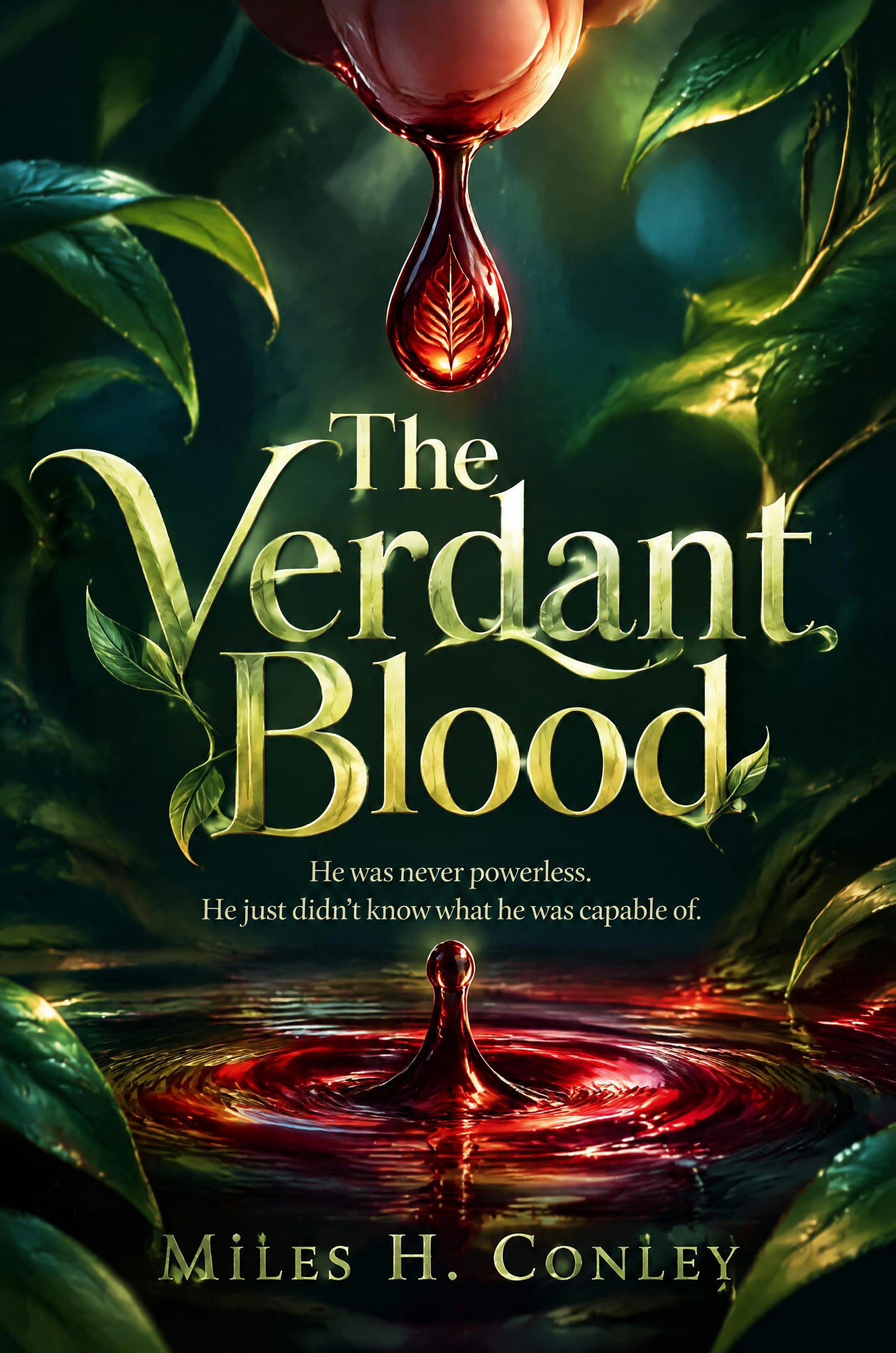
The Verdant Blood
He was never powerless. He just didn’t know what he was capable of.
by Mick Mounsey
By twenty, Rowan no longer expects answers. In a world where werewolves, fae, and banshees are ordinary, humans are rare, and everyone is supposed to know what they are, Rowan has nothing. No ability to shift. No magic to speak of. He doesn't even have a genetic species match. Others believe he is an Allo, born without a species category or any magic, in a society that ranks people by power. He just wants to finish Human Studies at Asthgard University and become a doctor, but that all changes when new friends enter his life. Puck, a shameless werewolf. Murella, a nature fairy who becomes the first friend not to flinch. Mason, a shapeshifter whose flirting is impossible to ignore. Life almost feels normal until plants grow where they should not. Leaves follow him. On the night he turns twenty-one, a brutal attack leaves him broken, and the earth answers. Rowan is not powerless, but what he can do should not be possible
- Fantasy
- Romance
- Magic Academy
- Urban Fantasy
- Paranormal Romance
- Slow Burn Romance
Prologue — Inconclusive
The waiting room smelled like lemon cleaner and old paper. I sat with my hands locked between my knees and counted the tiles on the floor until I lost track and started over. Sixteen was supposed to be old enough that this kind of appointment felt unnecessary. Nearly everyone I knew had already shifted, sparked, sung, or otherwise proven what they were years ago. I still had nothing to show except a file that kept getting thicker and no more useful.
Dad sat on my left with a journal article open on his lap, though I had watched him read the same paragraph twice. Mom sat on my right, her fingers worrying the strap of her purse. She had that look she got when she was trying not to feel too much in public. I appreciated the effort. I just wished it worked on me too.
“You don’t have to pretend this is a dentist visit,” I said.
Dad glanced up. “I wasn’t pretending. I was catastrophizing quietly, which is the medically responsible version.”
“Alaric,” Mom said, but she smiled anyway.
The door to the hall opened. Dr. Voss stepped out in a white coat that looked like it had never met a wrinkle. His hair was already going gray at the temples, neat as always, and his smile landed in that practiced place between professional and familiar. He had known our family long enough that I didn’t flinch when he used my first name.
“Rowan. Thank you for coming in.” He nodded to my parents. “Alaric. Raven. We’ll start with a conversation, then the draw. Nothing invasive beyond that today.”
I stood. My chair scraped louder than it needed to. “Lead the way.”
His office was the same as I remembered from previous visits. Books lined one wall. A framed print of some old botanical chart hung behind the desk, pale greens and careful labels. There was a window that looked out on a courtyard that was trying very hard to be peaceful. I sat in the chair across from him. Mom and Dad took the ones beside me.
“How have you been feeling?” Dr. Voss asked, folding his hands. “Any changes since last year? Dreams, temperature swings, unexplained growth, auditory phenomena. The usual checklist.”
“I still sleep like a person and not a wolf. I still can’t make plants do anything except die if I forget to water them. No screaming. No glowing. I’m extremely boring.”
Mom made a small sound. “You are not boring.”
“I’m statistically boring,” I said. “That’s different.”
Dr. Voss’s mouth twitched. “We’ll let the blood argue with your self-assessment. Before we do, I want to review the history so the lab has full context. You were found at approximately two years old.”
I nodded. I had heard this story so many times it felt like it belonged to someone else, except it didn’t. Firefighters containing a wildfire had found a toddler walking along the edge of the burn, unhurt, no adults in sight. Water abilities and ordinary hoses. Smoke. Heat. Me, somehow still standing.
“They said the flames never marked you,” Dr. Voss continued, gentle. “No blistering. No inhalation damage consistent with the scene. That is unusual even for heat-resistant species, and you were far too young for a controlled manifestation.”
“I know.” I picked at a loose thread on my jeans. “They also never found anyone who claimed me. So. Adoption. Happy ending, pending plot twist.”
Dad’s hand settled on the back of my chair. “It was a happy ending,” he said quietly.
Dr. Voss turned a page in the file. “There is also the matter of magical intervention. When you were eight, a compound fracture.”
I remembered that better than the fire. I remembered the sound more than the pain. I remembered a healer from the clinic laying her palm over my arm and frowning like the world had personally insulted her training.
“She tried to mend it,” I said. “The magic wouldn’t go in. It sat on the surface and did nothing. They had to set it the human way. Cast. Six weeks. It sucked.”
“It couldn’t penetrate the skin,” Dr. Voss said, as if he needed the wording exact. “That remains one of the more consistent findings. Resistance is not unheard of in humans, but the degree we observed is not typical, and you are not otherwise presenting as human.”
“I’m presenting as an unanswered question,” I said. “I get it.”
He looked at me for a moment longer than a polite doctor should. Then he smiled again, softer. “Questions are why we do this work. A great many people know their species well before they ever sit in this chair. Sixteen is late by any ordinary timeline. That does not make you a failure. It makes you a puzzle. I like puzzles.”
“I like answers,” I said.
“Then let’s go find some.”
The lab was colder. A technician named Harris walked me through the consent form even though my parents had already signed everything twice. I sat on the paper-covered table and rolled up my sleeve. The tourniquet bit. Harris’s hands were steady. The needle still made my stomach dip, which felt unfair given how many times I had done this.
“You’ll feel a pinch,” Harris said.
“I always do.”
The vial filled dark. Then another. They labeled them with a code instead of my name, which I assumed was supposed to feel scientific and not like I was already being filed away. Harris pressed gauze to the inside of my elbow. The magic-assisted clotting charm he tried next fizzled against my skin the same way every other charm did. He didn’t comment. He taped ordinary gauze instead.
“We’ll run a full species panel,” Dr. Voss said from the doorway. “Markers for lycanthropy, fae lineages, banshee vocal signatures, elemental affinities, kitsune traces, and the broader rare-species indexes. If there is a match, we will see it.”
“And if there isn’t?” I asked.
“Then we talk about what that means. Honestly.”
Mom hovered until I told her I was fine. Dad asked Harris three questions about sample handling that Harris answered like he had been waiting for a professor to appear. I swung my legs once, then stopped because it made me feel younger than I wanted to be.
They sent us back to the waiting room while the first-pass sequencing ran. Time in medical buildings did not behave like time anywhere else. I read a magazine about campus housing I was not old enough to need. Mom bought terrible coffee from a machine. Dad gave up on his article and stared at the courtyard like it might volunteer information.
“Whatever it says,” Mom said, not looking at me, “you are still you.”
“I know.”
“I mean it.”
“I know you mean it.” I meant that too. It just didn’t fill the hole I had been carrying around since I was old enough to notice other kids turning into something specific while I stayed exactly this.
When Dr. Voss called us back in, his expression had not collapsed into disaster. That was something. He closed the door. He set a tablet on the desk, screen facing him first, then turned it so we could see a cluster of graphs that meant nothing to me and probably too much to Dad.
“The panel did not return a species match,” Dr. Voss said.
I had prepared for those words. They still landed like a missed step on stairs.
“Nothing?” Dad asked. “Even partial?”
“No clustering within known ranges. No lycan markers. No fae affinity sequences we recognize. No human-typical baseline either, which I want to be clear about. This is not a simple Allo profile.”
Mom’s hands tightened in her lap. “Could the sample be contaminated?”
“We ran it twice. Harris is very good at his job.” Dr. Voss tapped the tablet, bringing up a second screen of color that refused to settle into any labeled category. “An Allo is born without species abilities. They are uncommon, but they exist, and they are not, as a rule, magic resistant to this degree. Allos can still be affected by healing spells, binding charms, diagnostic magic. Rowan cannot. Combined with the circumstances of his discovery, the data is internally inconsistent with that explanation.”
“So I’m not an Allo,” I said.
“I cannot tell you that you are. I also cannot tell you what else you are. The honest answer is that your genetics do not currently correspond to any species in our reference libraries.”
The office was very quiet. Somewhere down the hall a printer started and then stopped. I stared at the botanical print because looking at my parents felt like it would make this worse.
“Could the libraries be incomplete?” Dad asked. He sounded like himself again, the professor, stacking hypotheses so nobody had to sit in the empty space.
“They are always incomplete,” Dr. Voss said. “Rare lineages fall off the map. Extinct classifications linger as rumor. I will keep the file open. I will compare against additional archives as they become available. I will not pretend I have a name for you today.”
I nodded. My throat felt tight, which I hated. I had told myself for months that I would be fine with whatever they found, including nothing. Fine was apparently a theory, not a practice.
“Rowan,” Dr. Voss said. “Look at me, please.”
I did.
“This result is not a judgment. It is a limitation of our tools. You are healthy. Your labs otherwise are unremarkable. You can go to school, sleep, eat badly like every other teenager, and live your life. If something changes, if anything at all begins to present, you call me. Day or night.”
“Okay.”
He hesitated, then added, “I know you wanted a sentence you could put on a form. I am sorry I do not have one.”
Sorry was decent of him. It did not change the graphs.
Mom asked about follow-up. Dad asked about data storage and privacy, which Dr. Voss answered with the kind of calm that made people trust him. I listened and did not really listen. I thought about the fire I could not remember and the bone that magic could not touch. I thought about classmates who had already chosen majors based on what their bodies could do. I thought about the word Allo sitting on the table like a shirt that almost fit and then didn’t.
Dr. Voss walked us to the door. In the hallway, while Mom was thanking Harris, I saw him look back at the tablet. Just a glance. His face did not do disappointment. It did interest, quick and sharp, before he put the professional smile back on like a coat.
I pretended I had not seen it. I was good at pretending not to notice things that would only make the day longer.
In the car, nobody spoke until we left the parking lot. Rain had started, thin and cold on the windshield. Dad turned the wipers on. Mom reached into the back seat without looking and squeezed my knee once, then let go.
“We can get pizza,” Dad said. “Or we can go home and I can attempt cooking, which is a threat.”
“Pizza,” I said.
We ate in the kitchen because the dining room felt too ceremonial for bad news that was not actually news. I managed two slices. Mom talked about a patient who had asked for yellow flowers and then changed her mind. Dad told a joke about anatomical nomenclature that deserved to be illegal. I laughed because they needed me to, and because some part of me still wanted the evening to look like any other evening.
Later I sat on my bed with the light off and the hallway light leaking under the door. My arm ached a little where the needle had gone in. Ordinary ache. Human-looking. Useless as evidence.
I had wanted a name. Werewolf. Fae. Something with rules. Something I could study and then stop thinking about. Instead I had a doctor who liked puzzles, parents who loved me anyway, and a body that refused to file itself.
I rolled onto my side and stared at the dark shape of the bookshelf. I could keep waiting for an answer that might never arrive. I could keep treating every year like a delayed test result. Or I could decide that not knowing was simply going to be part of the deal, the same way some people lived with allergies or a bad knee or a story about a fire they were too young to remember.
It was not the ending I had wanted. It was an ending I could carry.
I closed my eyes. Tomorrow I would go to school. I would sit through classes. I would tell anyone who asked that the tests were inconclusive, and I would say it like it did not matter, until maybe it didn’t.
Maybe not knowing was just something I would have to live with.
Chapter 1
Five years later, I still packed the same way: textbooks first, then clothes, then the extra charger I always forgot until I was already in the car. The difference was that I no longer expected the world to hand me a species label if I folded my shirts neatly enough. Asthgard University still expected me to show up on time, pay housing, and pretend…