

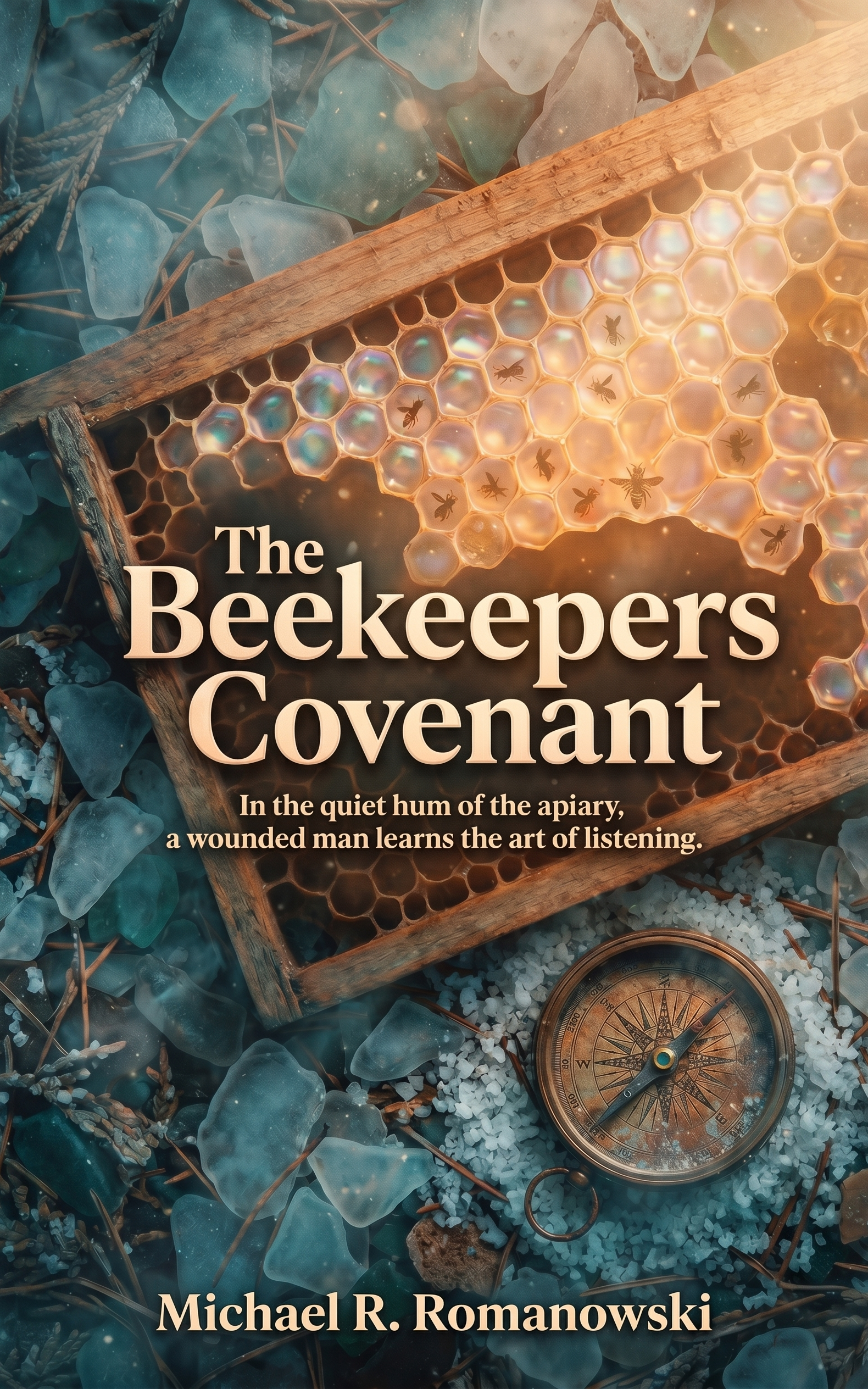
The Beekeeper's Covenant
In the quiet hum of the apiary, a wounded man learns the art of listening
by Mike Romanowski
Emmett Reeves knows how to fix things. As a former Army combat engineer, he built his life around structure, strength, and solutions. But when relapsing-remitting multiple sclerosis ends his career and his grandmother Mae dies, Emmett returns to Saltmere Island with a body he can’t trust, a grief he can’t measure, and an inheritance he never asked for: a stone cottage, twenty beehives, and a legacy far stranger than he expected. The bees are not merely bees. They are a community with voices, histories, loyalties, and secrets. Their ancient queen, Heartwood, is fading. Her heir, Pulse, is not ready. And Isla, the quiet woman who has been tending the hives, understands a language Emmett has only just begun to hear. To the islanders, the bees are a covenant—a sacred bond that requires a witness, not a master. But Emmett has spent his life surviving by staying in control. As his illness flares and Mae’s journals reveal the hidden wisdom of the hive, he must learn that some cracks are not meant to be filled. Some are meant to let the light in. The Beekeeper’s Covenant is a literary cozy fantasy about grief, illness, belonging, and the quiet magic of learning to stay.
- Cozy Fantasy
- Literary Leanness
The Weight of Salt
The ferry engine had a three-beat hitch that Emmett felt in the screw of his left knee. It wasn't the knee he’d been born with; that one had stayed in the dirt outside of Lashkar Gah, along with three inches of his tibia and the better part of his twenties. This one was titanium and carbon fiber, bolted into a socket that had begun to itch three miles out from the mainland. He kept his weight on his right heel, his hand closed over the rubber grip of his cane, and watched the grey water swell against the hull. The Atlantic looked like a sheet of lead that someone had tried to fold and then given up on.
The light was the color of a wet slate. October on the coast didn't do gold; it did grease-grey and salt-scab. Up in the wheelhouse, the captain had his face pressed near the glass, his eyes small and watery behind the wipers. He’d given Emmett that look when they boarded—the slow, heavy slide of the eyes down to the cane, the slight hitch in the chin that was supposed to mean something like tough break, son, but only ever smelled of relief that it was someone else’s leg. Emmett had ignored him. He was good at ignoring people. He’d had twelve years of practice in the engineers, then another three in the hospitals where the doctors spoke about his spine like it was an old bridge they were trying to keep from dropping into the creek.
The vibration from the diesel deck was different today. It wasn't just the metal singing through his boot; it was a thin, high wire of static that seemed to run from his lower back straight up to the corner of his left eye. A blur. He blinked, but the grey line of Saltmere Island didn't clear. It stayed double—two low, dark humps of cedar and granite rising out of the foam, one stacked slightly above the other like a bad print. He reached into his coat pocket, his fingers finding the flat, square side of the flask of Maker’s Mark. He didn't take it out. Not yet. The lawyer would be waiting at the slip, and he didn't need her smelling the corn on his breath before they’d even signed the disclosure forms.
He turned his face into the wind. It was cold enough to make his eyes water, which was better than the other thing. The air was thick with the rot of bladderwrack and the sour grease of the engine, but underneath it, right at the back of his tongue, there was something else. A heavy, greasy sweetness. It didn't belong in the middle of a salt-channel three miles off the coast of Maine. It smelled like the floorboards of Mae’s pantry when he’d been nine years old, before his father had stopped driving him up here for the two weeks in August that always ended in a row about money or church or the way Mae kept her grass long enough to hide the snakes.
The ferry bumped the pilings with a sound like a wet sack of flour hitting a cellar floor. The green timber groaned, the creosote bleeding out into the foam in black, greasy rainbows. Emmett waited until the deckhands had dropped the chain and the three cars ahead of him had rattled over the iron apron. His truck—a rusty four-by-four Ford with a dented tailgate he’d bought off a kid in Bangor for fifteen hundred dollars—was parked near the stern. It started with a wet cough that took three turns of the key to clear. His left hand, the one on the steering wheel, was shaking. Not the big, loose shake of a man who’d had one too many the night before, but the small, fast twitch of a wire under too much tension. He clamped his fingers down until the knuckles turned the color of lard.
“Come on,” he muttered to the dashboard. “Just the keys. Then the lawyer. Then the sign in the dirt.”
He drove off the ramp, the tires thudding on the wet planks of the slip. Saltmere didn't look like much from the water, and it looked like less from the dock. A row of low, shingled sheds that had gone the color of old driftwood, a gravel turnaround where three rusted lobster pots were piled like giant teeth, and a single telephone pole leaning toward the bay at a thirty-degree angle. The gravel was wet, the puddles holding the yellow reflection of the low clouds.
Gale Sterling-Holloway was sitting in a silver Volvo with her engine running. He knew it was her because the car was clean, which was an offense on Saltmere, and because she was the only person on the dock who wasn't wearing orange vinyl bibs. When Emmett cut his engine, she got out, her boots hitting the gravel with a clean, dry snap that didn't belong here either. She was wearing a charcoal wool coat that looked like it had been brushed with a small brush before she’d left the house. Her hair was dark, cut short and straight around her jaw like a carpenter’s square.
“Emmett,” she said. She didn't offer her hand. She looked at his cane, then up at his face, her eyes doing that quick, professional calculation that lawyers do when they’re trying to figure out if you’re going to die before the check clears. “You look like your father.”
“He was taller,” Emmett said. His voice sounded like gravel being kicked down a well. He hadn't used it since the gas station in Ellsworth six hours ago.
“He was,” she agreed. She reached into her coat pocket and pulled out a leather folder, the brass zipper dull against the grey wool. “The road to the cottage is washed out near the creek. You’ll have to take the high track. The Ford should make it if you don't mind the paint getting stripped by the bayberry.”
“The paint’s already gone,” Emmett said. He leaned his weight onto his cane, his eyes tracking a white gull that was trying to land on a piling and failing because of the swell. The bird kept its wings spread, hovering three inches above the wet wood, its yellow legs twitching. He knew how it felt. “Let’s do the papers.”
“Not here,” Gale said. She looked around the gravel lot, where a man in a yellow oilskin was watching them from the deck of a dragger called the Sally G. The man was scraping something off a block with a short knife, his movements slow and rhythmic. “My office is three miles up the road. Or we can do them at the house. I have the keys.”
“The house,” Emmett said. “I’m not staying any longer than I have to. I want to see what we’re selling.”
Gale paused, her thumb resting on the zipper of her folder. “Your grandmother didn't want you to sell it, Emmett.”
“My grandmother’s in the ground behind the Methodist church,” he said. “And she didn't leave enough in the bank to pay the back taxes on forty acres of swamp. Unless you’re planning on paying them for her.”
She didn't flinch. She’d handled Mae’s business for twenty years, which meant she was probably used to people who didn't have any money and didn't want any advice. “She left the hives,” Gale said. “And she left the covenant.”
Emmett let out a dry sound that might have been a laugh if his throat hadn't been so full of salt. “A covenant isn't a legal term, Gale. It’s a Sunday school word. I’m an engineer. I deal in deeds and surveys. Is there a lien on the property?”
“No,” she said, her voice dropping into that quiet, flat tone that made Emmett think of the JAG officers who’d read him his retirement papers in the hospital at Walter Reed. “No liens. Just the land. And the bees. But the will has some... provisions. Mae was very specific about the transition of the apiary. She didn't want the hives split, and she didn't want them moved before the frost.”
“It’s October,” Emmett said. “The frost is next week.”
“Exactly,” Gale said. She reached into her pocket again, this time pulling out a heavy iron key on a loop of greasy string. It looked like the kind of key they used for granaries in the nineteenth century. She held it out, but she didn't let go of it immediately when his fingers touched the iron. “She also specified that you had to spend seven consecutive nights on the property before any transfer of title could be filed with the county. I tried to argue her out of it. She told me I was welcome to try, but she’d already paid my retainer and she’d leave the land to the Audubon Society if I didn't write it in.”
Emmett looked at the key. His hand was doing the thing again—the little jump in the thumb that made it look like he was trying to catch a fly. He wrapped his fingers around the cold iron, his palm swallowing the shape of it. “Seven nights.”
“Seven,” Gale said. “Starting tonight. I’ll need to see you in my office on the eighth day to sign the deed over to the buyer.”
“You have a buyer?”
“We have inquiries,” she said, her eyes shifting toward the bay. The silver Volvo was still ticking, its exhaust white in the cold air. “The Holloway group has been buying up the frontage near the spit. They want the dock rights. They’ll give you a fair price for the cottage, but they don't want the hives. They’ll knock the sheds down before the ink is dry.”
“Good,” Emmett said. “Saves me the trouble of hiring a backhoe.”
Gale looked at him for a long moment, her mouth a straight line that had no pity in it, only a kind of dry disappointment that was much worse. “You haven't been here since you were ten, have you?”
“Twelve,” Emmett said. “And the plumbing didn't work then either.”
“It still doesn't,” she said, and then she turned back toward her car. “I’ll follow you up to the gate. Just to make sure you don't end up in the ditch. The high road has a wash-out near the old quarry, so keep your wheels on the high side of the gravel.”
He didn't answer. He got back into the Ford, the vinyl seat cold against his thigh through his trousers. He laid his cane across the passenger seat, next to his small duffel bag and the cardboard box that held his pills—the interferon that didn't seem to do anything but make him feel like he had the flu every Thursday, and the little white ones for the spasms that made his bladder feel like a fist. He reached into his pocket, took a short pull from the flask, and let the warmth of the whiskey settle into his throat. It didn't steady his hand—not really—but it took the edge off the high-frequency hum in his ears. It made the grey line of the trees look like one line again, instead of two.
The road up from the dock was narrow, the spruce branches scraping against the Ford’s mirrors with a sound like fingernails on a screen. The gravel was dark, greasy with wet pine needles and the black mold that grew on the rocks where the sun never hit. Through the rear-view mirror, he could see the silver Volvo following him at a distance, its headlights two small yellow eyes in the fog. He had to keep his foot hard on the gas to keep the truck from slipping into the ruts where the water had cut through the roadbed, his prosthetic leg feeling clumsy and heavy on the pedal. There was no feel in it—no way to know how hard he was pushing except by the roar of the engine and the way the chassis shuddered when the tires caught a rock.
He’d spent twelve years calculating load-bearing capacities for tactical bridges, figuring out exactly how many tons of iron could cross a dry wash before the timber gave way. He knew about stress. He knew about the point where a structure stopped bending and began to tear. Looking down at his own left leg, he felt like an old timber that had been left in the dirt too long. The VA had given him the leg and a pension and told him to find a hobby, but they hadn't told him what to do with the hours between three in the morning and dawn, when his toes—the ones that had been buried in some military cemetery three thousand miles away—started to burn like they were being held to a stove.
The turn-off for Mae’s cottage was marked by a cedar post that had rotted off at the ground and was now leaning against an old blackberry thicket. Emmett swung the Ford wide, the rear end sliding on the wet grass before the tires bit. The cottage sat at the end of a long, narrow spit of land that ran out into the marsh like a tongue. It was a small, one-story thing made of cedar shingles that had turned the color of a wet horse, with a low stone chimney that looked like it had been built by someone who didn't have a plumb line. The roof was green with moss, the small windowpanes dark and greasy with salt-crust.
Behind the house, the land opened out into a salt-marsh that went on for half a mile before it hit the bay. In the grey light, Emmett could see the hives. They were arranged in three long rows along the edge of the woods, twenty of them, looking like small grey tombstones in the high grass. They weren't the white, neat boxes he’d seen in pictures; they were dark, weather-beaten cedar, built with pitched roofs like tiny houses. Some of them had small stones on top to keep the wind from lifting the lids. Even from thirty yards away, through the closed window of the truck, Emmett thought he could hear them. A low, heavy thrum that wasn't the wind and wasn't the sea. It was the sound of a big machine idling in an empty room.
He cut the engine and sat there, his hands on the wheel, waiting for his heart to slow down. His left leg was aching—a deep, wet ache that felt like water in a boot. He reached over, took his cane, and pushed the door open. The air hit him like a cold hand. It was wet, smelling of spruce needles and muddy salt-flats, but that other smell was stronger now. Honey. Not the sweet, clear stuff you bought in plastic bears at the grocery store, but something dark and heavy, like brown sugar that had been burned in a pan.
Gale’s Volvo stopped behind him. She got out, her leather folder tucked under her arm, and walked up to where he stood by the truck’s fender. She didn't look at the hives. She kept her eyes on the house, her mouth set in that hard, legal line.
“The pump is in the kitchen,” she said. “You’ll have to prime it. There’s a bucket of water by the sink, but if it’s gone dry you’ll have to fetch some from the rain barrel. Don't drink the well water without boiling it. It’s got too much iron in it. It’ll turn your teeth yellow.”
“I don't mind the color,” Emmett said. He looked at the hives again. A single bee, large and dark, was crawling along the rusted latch of his truck’s hood. It didn't seem to mind the cold. It moved slowly, its wings flat against its back, its antennae twitching toward the salt-crust on the metal. “You said someone was looking after them.”
“Isla,” Gale said. She turned her head toward the marsh, where a small wooden skiff was tied to a stake in the creek. “Isla Fenwick. She’s been here since April. Mae took her in after her father died, and she stayed on to help with the honey. She’s the one who’s been keeping the hives from rotting into the grass.”
“Where is she?”
“Around,” Gale said. “She doesn't spend much time in the house. She lives in the old net-shed down by the creek. She’s... quiet. But she knows the bees. If she tells you to leave a hive alone, Emmett, you leave it alone. She’s got a temper like her father’s, and he once threw a lobster pot through the window of the bank because they wouldn't give him a loan on a boat that didn't have a keel.”
“I don't need a caretaker,” Emmett said. “I’m here to inventory the estate and sign the papers. The hives go with the land.”
“The hives are the land,” Gale said. She stepped closer to him, her voice dropping so low he could barely hear it over the sound of the surf. “Mae left a specific instruction about Isla. She’s to have first refusal on the bees if you decide to sell them separately. But she doesn't have any money, Emmett. Her father left her nothing but three miles of nylon gillnet and a bad name. If you sell to the Holloway group, she’ll have to leave.”
“That’s her business,” Emmett said. He looked down at his boot, where the dark bee had crawled off the hood and was now sitting on his leather laces. It was vibrating, its body moving with a fast, rhythmic twitch that felt like the wire in his own leg. He resisted the urge to shake it off. “I have my own problems.”
“We all have those,” Gale said. She reached into her folder and pulled out a single sheet of blue paper, the edges slightly curled from the damp. “This is the covenant. Mae made me draft it three days before she died. It’s not a standard deed, and the county clerk laughed when I brought it in, but it’s legal enough to keep the title from transferring if you don't follow the terms.”
She handed it to him. Emmett took it, his fingers dry against the paper. The typing was old-fashioned, done on Mae’s manual Underwood with the sticking 'e'.
“To my grandson, Emmett Reeves, I leave the stone cottage and the twenty hives of Saltmere Apiary,” he read, his eyes squinting against the blur that kept trying to slide over his left field of vision. “On the condition that he shall perform the weekly maintenance of the boxes, that he shall not sell the land to any party that intends to divide the frontage, and that he shall remain on the property for seven consecutive nights to witness the transition of the crown. If he fails to do so, the property shall fall to the care of Isla Fenwick, with the understanding that she shall maintain the covenant as I have maintained it.”
Emmett looked up. “The transition of the crown? What is this, some kind of joke?”
“Mae didn't joke about the bees,” Gale said. “She believed they had their own law. She spent forty years out here, Emmett. After your grandfather died, she didn't go into town for six months. When I came out to check on her, she was sitting on the back porch with three hives set up on the boards, talking to them like they were her sisters. I thought she’d gone soft in the head, but she gave me a jar of honey that tasted like thyme and salt, and she told me that if you don't tell the bees when someone dies, they’ll leave. She said they don't like surprises.”
“They’re insects,” Emmett said. He folded the blue paper and shoved it into his pocket. “They have six legs and a brain the size of a pinhead. They don't have a law. They have a biological program.”
“Maybe,” Gale said. She looked at him with that dry, cold look again. “But your grandmother’s will is legally binding, and if you don't spend those seven nights here, the Holloway group won't buy this land because they won't have a clear title. I suggest you get your stove going. It’s going to freeze tonight, and the wind comes right through those shingles.”
She turned and walked back to her Volvo, her boots snap-snapping on the gravel. She didn't look back when she got in, and she didn't wave when she turned the car around in the high grass, her tires leaving black, wet tracks in the clover. Emmett watched her go until the red tail-lights disappeared behind the spruce trees, and then he stood there in the quiet.
The silence of the island was different from the silence of his apartment in Bangor. There, the silence was just the absence of the bus on the street or the neighbors’ television through the wall. Here, the silence felt like something heavy that had been dropped into the grass and was now waiting for him to step on it. It had a weight. It pressed against his ears like water, and underneath it, that low, three-beat vibration of the hives kept time with the pulse in his temple.
He turned back to the Ford. His left leg was numb now—not the cold numbness of a winter wind, but the white, dead numbness that meant his nerves were misfiring again, the signals from his brain getting lost somewhere in his lower spine like mail in a dead-letter office. He had to lift his leg with his hand to get it out of the truck, his fingers hooking under his thigh to swing the boot onto the gravel.
“One week,” he said to the empty yard. “Seven days. Then I sell the wood.”
The bee on his boot hadn't moved. It sat on the wet leather, its wings vibrating in the grey light, its small, dark body holding the center of his shoe like a knot in a pine board. He reached down with his cane and tapped the leather next to it. The bee didn't fly. It only shifted its legs, its head turning toward the sound, and then it crawled slowly into the seam of the tongue, disappearing into the dark fold of the leather where the salt had dried white.
Emmett watched it go, then he took his duffel bag and his cane and walked toward the cottage, his boots thudding heavily on the grass as the first cold drops of the October rain began to fall.
Amber and Iron
The key turned in the lock with a dry, iron scrape that Emmett felt in the teeth of his lower jaw. He had to shoulder the door to get it to clear the jamb, the cedar swollen from forty years of salt-fog and wet Octobers. When it gave, it didn't bounce; it simply stayed where it was, dragging a semicircular groove into the dark floorboards. The air …