

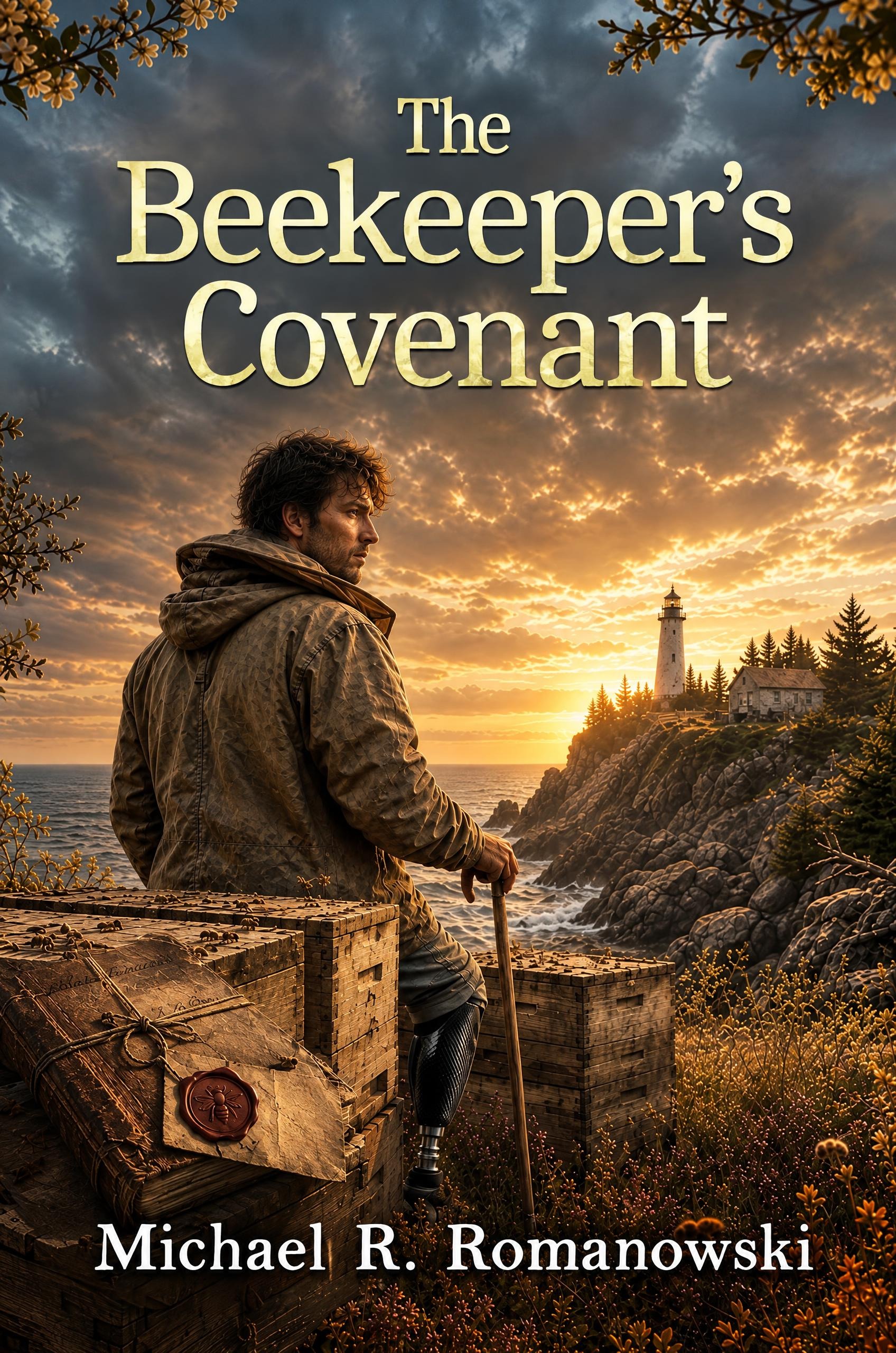
The Beekeeper’s Covenant
Emmett Reeves, a wounded combat engineer living with limb loss and multiple sclerosis, returns to the Maine island of Saltmere following the death of his estranged grandmother, Mae Reeves. To satisfy the terms of her inheritance and preserve the land from developers, Emmett must spend thirty days residing in her home and fulfilling the obligations of the Beekeeper's Covenant: protecting the island apiary and an essential freshwater spring. Struggling with physical limitations, past guilt over the battlefield death of his friend Danny, and a legacy of familial emotional distance, Emmett forms a fragile alliance with Mae's former apprentice, Tess Galt, and a network of tight-knit islanders. Together, they confront a predatory developer seeking to exploit missing historical survey sheets and challenge Emmett's fitness to serve as keeper.
- Literary Fiction
- Small Town Drama
- Grief & Loss
- Character Study
- Family Drama
The Door Was Not Locked
T
he ferry Millicent H. came in crooked.
She always did, the deckhand had explained somewhere in the gray
middle of the crossing, raising his voice over the engine without being asked. The channel bent around a shoal invisible from the surface. Take the turn too tight and you put your bottom on the rocks.
Emmett had nodded once and gone back to watching the island assemble itself out of the fog.
A smear first.
Then a line.
Then spruce rising dark above the water, a white church needling through it, and roofs descending toward the harbor as though someone had dropped them from the hill and decided where they landed was good enough.
Beneath the ferry engine was another sound.
Low. Broad. Easy to mistake for the boat.
Emmett left it alone and studied the Millicent H.
That was the older habit.
Older than the war. Older than the years when his body had begun answering ordinary instructions with negotiations of its own.
The ferry was forty feet long, top-heavy, and carrying a list to port he could feel through the bench beneath him. The welds along the gunwale looked sound. Two cleats did not. Their backing plates had worked loose, the steel softened by salt and repetition.
Nobody had repaired them because they had not yet demanded blood.
Emmett catalogued the defect without deciding to.
Mae had crossed on this boat for forty years.
The thought arrived without emotion, a fact placed flat on a table.
Behind it came the fact he had spent the entire drive north keeping facedown.
Four years since he had spoken to her.
He had not chosen four years.
That was the lie he usually told himself.
He had chosen one missed call. Then another. A holiday passed. A birthday.
A month became a season. Silence repeated until repetition became structure.
Mae had called the spring before last.
He had listened to the message twice.
Her voice had sounded smaller than he remembered, but no less certain. She had not asked him to come home. Mae rarely asked directly for anything she considered obvious.
She had said the bees had something they wanted him to know and that she would tell him when he was ready.
Then, as she had ended every message since he was old enough to leave home, she said the door was not locked.
It never was.
He had told himself she was being dramatic.
Mae Reeves had never been dramatic a day in her life.
The island continued toward him, indifferent to the distinction.
The engine note dropped.
Pilings rose from the murk, black and furred with weed. The hull touched them, shuddered once, and settled alongside.
The deckhand threw a line he did not need to throw.
A boy on the float caught it mostly for the pleasure of having been needed.
The other passengers went first: an old woman pulling a wheeled cart and two men in oilskins who had not spoken during the crossing and showed no sign of beginning now.
Emmett stayed seated until the deck cleared.
He had learned not to enter a press of bodies on uncertain footing with a prosthetic leg and a left hand that kept its own schedule.
When the last passenger reached the dock, he stood.
The duffel went over his right shoulder, where the strap could carry what his left hand could not always be trusted to hold. He took the cane in his right hand and planted its rubber tip against the deck before committing his weight. The ramp was the problem.
It always was.
It dropped from the fixed dock toward the floating platform at whatever angle the tide demanded. That morning the tide had chosen steep.
Wet aluminum. Narrow ribs. The float rising and settling beneath it.
Emmett stepped onto the ramp with the prosthetic first.
The right foot found the ribbing.
The ramp moved.
For half a second, it was not a ramp.
It was the inside of an RG-31 outside Kandahar, the vehicle rising and turning at once. The blast reached him first through his teeth and sternum, before sound had time to become sound.
Then the white absence where the next seconds of his life should have been. Emmett stopped midway down.
His left palm pressed against the rail, though he did not trust it to hold. His right hand locked around the cane.
He waited.
The dock returned by pieces.
Diesel.
Rockweed.
Cold air.
Somewhere above the fog, a gull cried.
The ramp became aluminum again.
The moment passed because it always passed.
That did not make it harmless.
He kept breathing until his jaw unclenched. Until the cane was a cane. Until the rail beneath his left palm belonged to Maine instead of Afghanistan. Only then did he move.
There was no one behind him.
Good.
At the bottom of the ramp, he paused and let the float settle beneath him.
The ferry's engine had shut down.
The second sound remained.
A hum.
Low and continuous, coming from somewhere above the village. It seemed less like something entering his ears than pressure gathering inside his ribs. He turned toward the hill.
There was always a cause.
Finding it was the closest thing to prayer he still practiced.
A transformer, perhaps. An island substation carrying too much morning load. Surf working inside a sea cave. The ferry's blower winding down behind him.
But the sound rose and fell at the edges. It gathered.
It spread.
There was no machinery in it.
Emmett stood at the head of the dock listening until recognition arrived with the clean discomfort of a measurement that refused to agree with the drawing.
Bees.
A great many bees.
More volume than twenty colonies had any business making in October.
By now the hives should have been folding inward around their queens, shedding drones, preserving stores and heat, settling themselves against winter.
Mae's twenty hives.
He had read the inventory in the lawyer's packet during the drive north. Cottage.
Three acres.
Harbor right-of-way.
Twenty colonies.
He had read each item as though it belonged to somebody else.
He had not expected to hear those colonies from the water.
He had certainly not expected them to sound as though they had noticed him.
“That's the bees,” a voice said. “In case you were going to ask.”
An old Ford idled at the foot of the dock with the passenger door standing open. Its paint was the color of a healing bruise.
The man behind the wheel had not gotten out.
He was somewhere past seventy and built like a piling, with a gray watch cap pushed back from a forehead that had taken sixty winters without complaint. He studied Emmett with the frank patience of a man assessing a boat he had no intention of buying.
His eyes moved to the cane.
The prosthetic.
The single duffel.
He did not pretend they had gone anywhere else.
“I wasn't going to ask,” Emmett said.
“No.” The man let the word sit between them. “You'd be Mae's grandson.” Not a question.
Emmett came down the dock at his own pace.
The cane found each board. The prosthetic rolled through its arc.
He made the old man wait and did not apologize.
Up close, the truck smelled of bait, pipe tobacco, and the cold metallic scent of salt worked so deeply into a thing it could no longer be cleaned away. A wire trap sat in the bed beside a coil of rope and a crate covered by a tarp.
“Donal Ferris,” the man said. “Hauled your grandmother's gear thirty years.
Such as she'd let me.”
He looked toward the hill.
For a moment something moved beneath the flatness of his expression. Then it was gone.
“You'll want a ride up,” Donal said. “Road's bad.”
“I'm all right walking.” Donal looked at the cane again.
Not unkindly.
That was almost worse.
“It's more than a mile,” he said. “Most of it up.”
“I'll walk.”
Donal considered him.
“The door's not locked.”
“No.”
The old man's eyes narrowed by a fraction.
Not surprise.
Recalculation.
Emmett stood with the duffel cutting into his shoulder, the bees pushing their impossible October sound through the village, and every sensible reason to climb into the truck laid out before him.
The leg would manage the hill.
Then it would charge him.
The residual limb would swell against the socket. Balance would worsen. By evening the left hand might fade from clumsy to useless.
Tomorrow would be smaller because of what he spent today.
He knew that before taking the first step.
He wanted to walk anyway.
He wanted to arrive at Mae's cottage under his own power.
The phrase irritated him the moment it formed.
As though accepting a ride meant arriving under somebody else's. He ignored that part.
He wanted to owe nothing to the island. Nothing to Donal. Nothing to anyone who might later decide his presence required accommodation, supervision, carrying.
Thirty days.
Sign whatever needed signing.
Leave clean.
“I'll take it as a kindness,” Emmett said, “if you run the duffel up. Leave it on the step.”
Donal's mouth shifted.
Not quite a smile.
“Kindness.”
“That's the word.”
Donal reached across the seat.
Emmett pulled the duffel from his shoulder. His left hand opened a fraction too early, and the bag dropped the last few inches into Donal's grip instead of being handed over.
Neither man remarked on it.
Donal placed the bag carefully on the bench between them. “The bees are loud,” he said.
“I heard.”
“Folks here mostly don't try to explain it.”
“I didn't ask.”
“No.” Donal put the truck in gear. “You didn't.”
He paused with his foot on the clutch.
“Thirty days, I hear.”
“That's right.”
“That'd be Gail's number.” Emmett said nothing.
Donal accepted silence as an answer. “You'll do what you'll do.” He released the clutch.
The Ford climbed away and disappeared into the spruce. Its engine faded.
The hum closed over the space it left behind.
The road began at the harbor without mercy.
Donal had been right about that.
It climbed through a series of grades a younger man with two natural legs might have called pleasant. Emmett took them in stages, choosing each rest before he absolutely needed it so the stopping might still resemble a decision.
The first grade cost little.
The second collected interest.
By the third, the socket had begun announcing itself along the outside of the residual limb.
He kept going.
He passed a boarded ice cream stand, a white chapel with a hand-painted sign, and a dry-stone wall that followed the road for fifty yards before turning inland.
The wall stopped him.
Granite blocks had been fitted without mortar or fasteners, each stone chosen and placed by somebody who understood what the next winter would try to do.
Two hundred years, perhaps.
Frost beneath it every season. Water entering seams. Ground lifting and settling.
Still it stood.
Not because it defeated every force.
Because somebody had arranged it to survive them.
Emmett rested his right hand on the cold top course.
The grief he had kept flat all morning acquired an edge.
Mae's unanswered message.
The door she had insisted remained open.
Four years spent refusing to test whether she meant it.
He had treated silence as though silence were neutral.
Standing on the hill with the island's stone cold beneath his palm, he knew better.
Silence was an action repeated until it became a fact.
He removed his hand and continued upward.
The hum stayed with him.
It strengthened as he climbed until he could feel something faint through the cane each time its tip met the road.
On the second long grade, his left hand slipped from unreliable toward absent.
There was no dramatic moment.
No pain.
The fingers simply began reporting too late, as though the signal had farther to travel than it had an hour before.
He adjusted without looking down.
The shoulder took what the hand would not.
The arm hung loose.
He kept walking.
He had spent years making failure look intentional.
Anyone watching would have seen a tired man climbing a hill.
Nothing more.
The sound from the hives was not threatening.
Emmett tried the word against it several times. It did not fit.
Attention came closer.
The sound of something turned toward him and waiting.
Bees did not turn toward people, he reminded himself.
A colony was heat, instinct, chemistry, numbers.
What he heard was twenty stressed hives in late October. Some short on stores, perhaps. Some already tight around brood. Maybe a failing queen somewhere in the line. All of them unsettled by cold and by the absence of the woman who had worked among them for forty years.
That explained plenty.
It did not explain the feeling.
Emmett left the distinction alone.
The cottage appeared around a bend.
It was smaller than memory had made it.
Gray-shingled and low, it sat in the lee of the hill with its back against the weather and its windows turned toward the sea.
Three acres, the packet had said.
He could see most of them from the road.
A kitchen garden gone to seed.
A woodshed with its door hooked open.
Mae's veil hanging from a nail inside, pale and empty in the shadows.
A slope of unmown grass falling toward spruce.
And along the southern edge of the property, twenty white boxes beneath stones gathered from the beach.
The hives.
The air above them was dark with movement.
Bees crossed and recrossed in numbers no October morning should have held.
Emmett took three steps off the road before realizing he had turned toward them.
The need was immediate.
Get close.
Look.
Find the failure.
It was the same impulse that had once carried him toward damaged bridges and ruptured structures while other people were still deciding whether the ground was safe.
He stopped at the edge of the grass.
Donal had warned him without actually warning him.
Thirty years hauling Mae's gear had earned the man more authority than Emmett's curiosity.
Emmett turned away.
The decision cost him more than it should have.
He faced the cottage.
His duffel waited on the step exactly where he had asked Donal to leave it, squared against the wall instead of dropped.
A thread of smoke rose from the chimney into the still morning.
Emmett stopped at the gate.
Someone had kept a fire burning in Mae's stove.
The pipes would not freeze.
The cottage was warm.
He had not warmed it.
The smoke rose straight into the gray sky as though the house had continued living without requiring anyone's permission.
He entered the yard.
The ridgeline sagged slightly at the center. A rafter had failed years earlier and been reinforced. The southeast corner of the foundation had settled toward the hill, leaving the cottage an inch or two out of plumb.
It should have looked unstable.
Instead, it looked as though it had leaned into the weather and stayed there. Wrong to a level.
Right to the island.
The thought came uninvited.
Emmett let it.
The ridge could be repaired. The corner would require lifting part of the house, a larger job than he intended to inherit.
He would not be here for a season.
Thirty days.
Long enough to satisfy whatever clause Mae and her lawyer had built around the estate.
Long enough to inspect the roof, understand the water, decide what could be sold, transferred, or refused.
Then the cottage, the bees, and the fire somebody else had kept alive would become another person's responsibility.
That was the plan.
Clear.
Finite.
He trusted finite things.
Behind him, the colonies rose and fell in the cold air.
The sound touched the back of his neck.
He did not turn.
He walked to the step.
The latch was the old kind, a wrought-iron thumb lift polished bright by generations of hands.
Emmett placed his thumb against it.
The metal was cold.
Inside, the stove ticked.
Warm air pressed gently through the narrow seam around the door, carrying beeswax, old paper, and woodsmoke.
Beneath those scents was another.
Faint.
Dry.
Known before he could prevent himself from knowing it.
Lanolin and lavender.
Mae's hands.
For one instant he was four years old again and certain nothing in the world could reach him while those hands were near.
His right hand remained steady on the latch.
He made certain of that.
He stood on the step of his grandmother's cottage with his left hand useless at his side and twenty colonies roaring behind him.
For one second, the island seemed to wait on the small piece of iron beneath his thumb.
Emmett lifted the latch.
The door opened inward.
Warmth came out and took the shape of him.
Behind him, the bees kept speaking.
Emmett stepped inside.
Twenty Hives in October
B slept one night under Mae’s roof and mistaken exhaustion for y the time Emmett learned the thirty days had already begun, he had neutrality. He slept badly in the spare room. The narrow bed smelled of cedar and old linen. Each time he drifted off, the cottage found another way to announce itself: a pipe knocking behind the wall, a floorboard easi…