

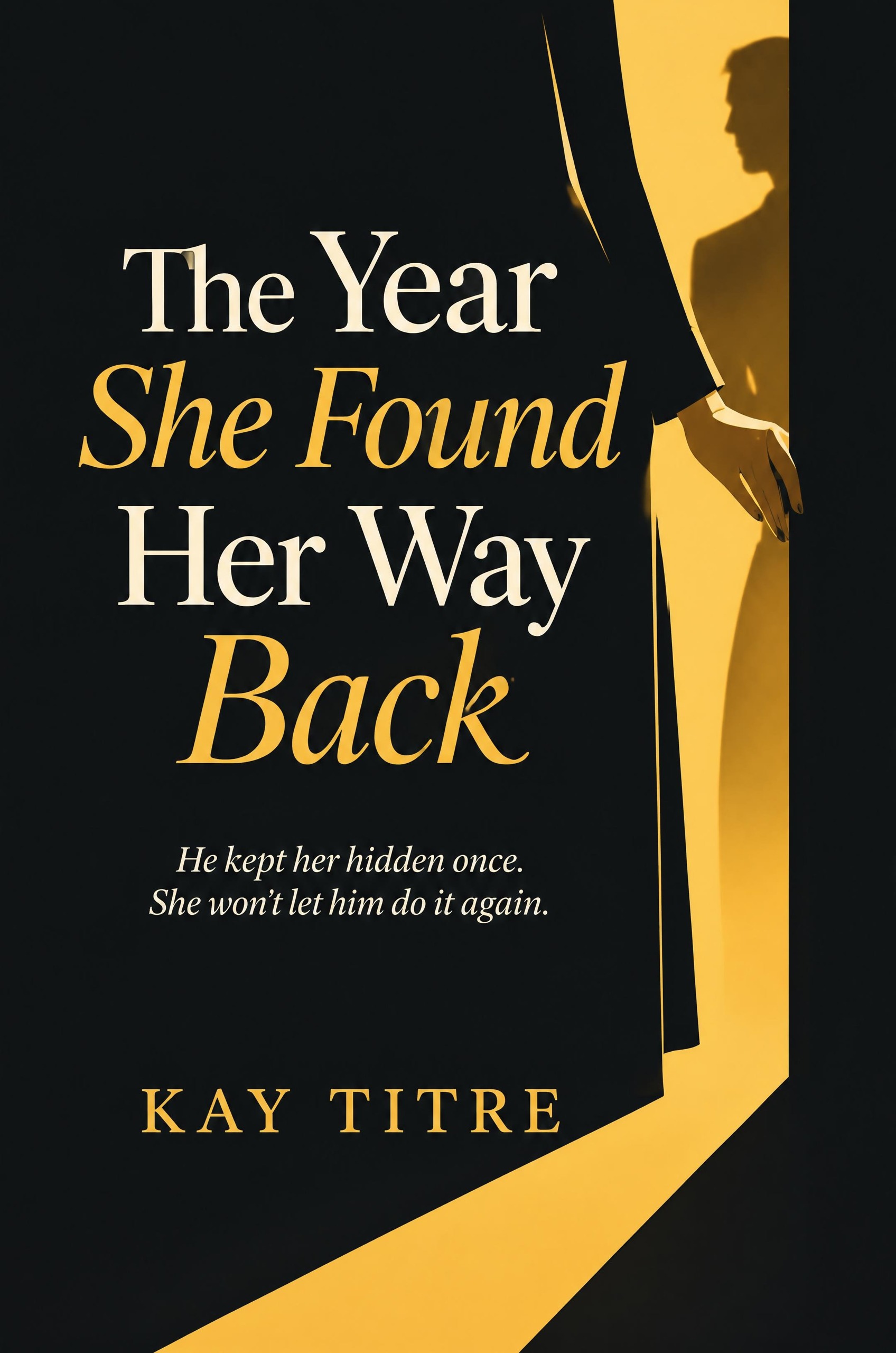
The Year She Found Her Way Back
He kept her hidden once. She won't let him do it again.
by Motivation Titre
Three years ago, Delma buried her heart and built a life of discipline: executive assistant by day, mother of four by every other waking hour. Her three-year-old daughter Emily has her father's eyes, but nobody knows it—because Emily's father is Marco Rossi, star striker for the Reds, and Delma walked away from him the night his world publicly disavowed her. Marco has spent those three years trapped. His father, his coach, controls everything—including the hollow public romance he parades with an ex-girlfriend he does not love. A single misleading photograph has convinced him Delma moved on, back to her former husband, back to a life without him. Then a charity gala in a foreign city puts them in the same garden, in the same dim light, and every carefully constructed wall begins to crack. He pursues. She resists with the armor of old wounds. But the truth about Emily will surface, and when it does, Marco demands what he was denied: a family. A secret marriage follows. A hidden home. A year of fragile happiness. Until paparazzi photos surface of Marco with his ex in a compromising pose. Until his parents push for a public engagement to protect the family name. Until Delma must face the same question that broke her once before: can she stand beside a man who keeps her in the shadows? The year she found her way back is a sweeping second-chance romance about the cost of love in the public eye, the weight of family expectations, and a woman who refuses to be anyone's secret ever again.
- Romance
- Billionaire Romance
- Second Chance Romance
- Contemporary Romance
- Forbidden Love
Chapter 1
The weekday machine ran before the sun fully committed itself to the kitchen windows. Delma chose her path through it with the same precision she used on a closing calendar: she set each plate without a wasted reach, kept her voice to what the morning required, and left no room for the kind of thought that could snag and pull. Liam was already at the counter with a protein shake and a quiet scan of his phone, seventeen and folding himself into the morning like a young man who understood that noise cost time. Noah ate toast over a notebook, fourteen and already writing something he would not show her until it was finished. Caleb, twelve, argued with a banana as if the fruit had personally offended him, then surrendered when she set a second one beside his plate without comment.
Chole sat in her booster seat at the end of the table, three years old and solemn in the way small children could be when they were watching older brothers pretend they were not watching her. Delma cut the waffle into squares small enough to manage, wiped syrup from a tiny wrist, and did not let herself linger on the shape of the child's face. She had learned, over three years, that lingering was a luxury that turned into a trap.
"Shoes by the door," she said. "Backpacks. Liam, if you take the late bus again, text me before practice, not after."
"I know, Mom." His voice was affectionate and slightly cheeky, the almost-adult version of a boy who used to need her to tie his cleats. "I'm not eight."
She almost smiled. Almost was as far as she allowed herself on a Tuesday.
The drive was a sequence of drop-offs she could have done in her sleep. Boys at their schools. Chole at preschool with a kiss on the forehead and the same practiced brightness Delma used in conference rooms when a client was watching. Then the Harrison firm, glass and quiet carpets and a calendar that belonged to a man who measured loyalty in on-time memos. Mr. Harrison did not ask about her weekends. He asked about the Singapore packet, the courier window, and whether the board packet had been paginated to his preference. She answered. She did not linger on the sports pages someone had left folded on the reception table. She walked past them as if they were weather.
Maria met her at the coffee station with two cups and an expression that had never learned to be subtle. "You look like you slept. That's new. Or you finally started lying better."
"I slept," Delma said. "Four hours counts if you don't count them."
Maria's earrings caught the overhead light. She waited, as she always waited, for a name that never came. The old steel cage tightened around the secret she had cemented into something that passed for truth. She would not say it. Not here, not in a hallway that still remembered the months after the public disavowal, when Maria had pulled her out of a silence that had looked too much like drowning.
"You never say his name," Maria said, not unkindly. "Even when the whole office is talking about the Reds like they pay our rent."
"That is not a deliverable I can put on the calendar." Delma took the cup. "Not again."
Maria's mouth tightened. She looked past Delma toward the copier, then back, as if she might still ask. A second passed, and she let it go, because the morning had already started and Delma's desk was already a fortress of color-coded files. "Fine. But if you keep running on spite, babe, it's going to give you a migraine that looks like a personality."
Delma went back to work. She did not admit, even to the quiet part of herself that still checked things she had no right to check, that the injury reports existed. She filed the impulse under control and opened the overseas project folder as if it could occupy every remaining corner of her mind.
Maria had joined the firm two years ago, after everything. She had decided it was better to be close during the hard months, when Delma's silence had seemed too much like drowning, and the proximity had worked. It had given Delma back a version of herself that could function in hallways and conference rooms. Even so, she still did not like it when Maria brought him up. Something inside her still stung at the mention, a cold, clean ache she refused to name.
Pickup was a long curve of cars and impatient engines. Chole's preschool let out in a rush of small backpacks and louder parents. Delma stood at the usual spot, Chole's hand already in hers, scanning for Liam's after-school ride that would meet them two blocks over. Mark arrived early. He always did when the Sunday schedule needed adjusting. He stood close, neat in weekend-dad khakis even on a weekday, and they talked about pickup times and a dentist appointment that had to move around soccer.
"I need the facts before Sunday," Mark said, measured, direct. "Not a narrative. The facts."
"Sunday at four. I'll have their bags. Caleb's inhaler is in the side pocket. Don't let him convince you he doesn't need it because he feels fine."
Mark nodded. Their shoulders nearly touched in the crowded line. At the edge of her sight a figure with a phone shifted, another body in the pickup crush, a blur of motion she did not turn toward. From that angle the two of them would have looked, at a distance, like something they were not. Delma did not see the camera. She was watching Chole's shoelace, which had come undone again, and Mark was watching the clock on his phone as if time itself were a co-parent he could schedule.
"You look tired," he said, not unkindly.
"I look employed." She tied the lace.
He hesitated, then said nothing. They were, in their own broken way, still a team for Liam, Noah, and Caleb. She would not let a school driveway become a courtroom. Chole tugged her hand, ready to go, and Delma walked away from Mark without looking back, the day still filed under control.
Evening settled the house into the lull that followed organized exhaustion. Homework, baths, a brief war over whose turn it was to choose the show, then the quieter rooms where teenagers pretended they did not still need a mother within shouting distance. Delma put Chole to bed last, because Chole always lasted longest and because the questions came then, when the lights were low and the armor of the office had no place to sit.
Chole's dark hair fanned on the pillow. She looked like a secret Delma had carried through three winters of tight calendars. "Mama. At school they have daddies at the gate. Why don't I have a daddy at school?"
Delma sat on the edge of the bed. The answer was on her tongue, but she held it a beat too long, shaping her voice into something even and ordinary. She would not name him. She had promised herself that much, and she kept her promises the way she kept Mr. Harrison's clock: without romance, without leakage.
"Families come in different shapes," she said, the practiced line smooth from use. "Some have two people at pickup. Some have one. Some have extra uncles and loud brothers. You have me, and you have Liam and Noah and Caleb, and that is a whole house."
Chole considered this with the seriousness of three. "Is it a good house?"
"It's ours." Delma kissed her temple. "Sleep. Tomorrow is another early morning."
She left the door ajar, the way Chole liked it. In the kitchen she stood with both hands on the counter and let the day close like a ledger. Breakfast. Preschool. Calendar. Maria's almost-question. Mark in the pickup line. A child's question answered without the truth that would explode the walls she had rebuilt. She filed it all under control.
Later, after the house went fully quiet, she opened her phone and did not admit why. She scrolled past headlines, past scores, past a photograph she refused to look at long enough to name. Those reports lived in a corner of the internet she visited the way some people checked the weather: briefly, as if the information were only practical. She closed the screen before the names could settle. She had been insulted once, in public, and she intended to protect herself with cold, unflinching precision. Wanting was not on the calendar. It had not been for three years. Her thumb found the switch. The plastic was warm from the lamp, a small, ordinary click against the pad of her finger, and then the room went dark around that last point of contact.
Chapter 2
The morning at the Reds training facility smelled of cut grass and cold liniment, and the light came down hard across the empty stands. Marco Rossi arrived before the rest of the squad because his father demanded it, and because routine was the only place where his body still obeyed him without argument. At thirty-three, he knew every ache in his k…